

We always like to differentiate between prediction markets, the commercial hype, and prediction markets, the consensus forecasting tool for event outcomes. Certainly, the news, media, and money revolve around the wagering aspects of sports and cultural event prediction markets, but the social utility remains rooted in the underlying science of probability.
Prediction markets can expand beyond major popular culture events to become tools that strengthen community planning. By creating contracts on neighborhood-level outcomes, these markets would surface dispersed resident knowledge that traditional planning processes and democratic voting models routinely miss. Public safety trends, housing supply effects, and school performance dynamics become clearer when people with direct experience place positions based on what they observe daily.
City planners and quantitative modelers have long relied on citywide averages and historical datasets. Those approaches deliver useful baselines, yet often overlook the fine-grained realities that shape whether a street feels secure, whether new housing materializes, or whether a local school district is meeting standards. Prediction markets reverse that pattern by rewarding accurate local information and converting it into continuous price signals.
When markets price the probability of concrete neighborhood results, overlooked insights move from informal or local political conversation into structured civic forecasts that planning teams can consult directly to maximize social utility.
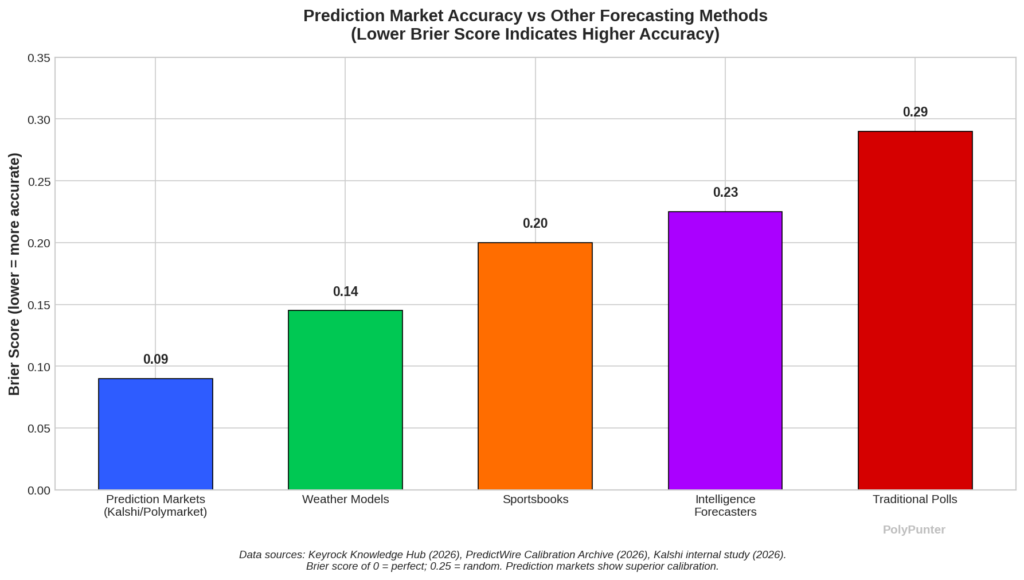
Why Traditional Planning Leaves Local Knowledge Untapped
Conventional forecasting tools perform well at major metropolitan scales. They struggle when conditions vary sharply between neighborhoods. Employment shifts, income changes, and real estate demand can vary dramatically over rather short distances, especially in highly dense urban areas. Advanced quantitative spatial models attempt to address this by dividing areas into thousands of small cells and projecting outcomes decades ahead.
But even detailed models still depend on past data and assumed relationships. Residents, however, notice real-time conditions—construction delays, changing foot traffic, informal safety networks, or shifts in family enrollment choices. Visit any neighborhood’s NextDoor app if you’d like to see this hyper-local issues discovery happening in real time. Prediction markets create a direct channel for turning that lived experience into priced probabilities.
As a result, planning teams could receive complementary signals rather than competing ones. Prediction markets enrich rigorous modeling with incentives that draw out information that would otherwise remain silent or be overlooked. Continuous price updates allow forecasts to evolve as local conditions change, providing a living, dynamic reference instead of static reports. Imagine a natural disaster or other fast-changing circumstance arises; waiting six to eight weeks for an official response report may be incredibly costly to many.
Surfacing Public Safety Trends
Public safety remains one of the most consequential yet opaque areas of community life. Official statistics arrive with a lag and frequently fail to capture the full texture of residents’ concerns or provide actionable data at the neighborhood level. For example, even within a relatively smaller area, certain subsets, say, homes or stores near freeway access, may be affected by crime far differently than similar venues just eight blocks away. Markets focused on specific safety outcomes can reveal emerging patterns earlier and more precisely.
Contracts can ask whether reported incidents in a defined area will decline by a set percentage, or whether community-led networks will achieve measurable reductions. People with direct knowledge, such as shop owners, parents walking children to school, or neighborhood watch or block association members, can take positions grounded in daily observation. In many major cities, nuisance crimes and other lower-level crimes often go unreported so they never form part of any official record. But local residents are well aware of these issues and surface them when given the proper forum and incentive.
Platforms already list contracts tied to safety metrics and related policy effects. The resulting prices reflect aggregated judgment that official tallies alone cannot match. Planning teams reviewing these signals can identify hotspots or successful interventions sooner and direct accurately assigned resources more effectively.
The transparency of market prices also encourages constructive conversation. A noticeable shift prompts an examination of underlying factors, fostering informed dialogue across the community. When local voices are heard, neighbors are more motivated to build informed arguments rather than rant. Again, review the ratio of rant to sensible discussion on your local NextDoor. When people feel their opinions are not actually being heard or affecting outcomes, they tend to prioritize noise over substance.
Revealing Housing Supply Effects
Housing dynamics further demonstrate the value of aggregating local knowledge. Citywide indices covering millions of people across large territory often mask stark differences between neighborhoods in construction timelines, zoning impacts, and absorption rates. Prediction markets can support direct forecasting of supply outcomes at finer scales.
Recent partnerships have created contracts that settle against frequent housing price indices. Traders can take positions on whether indices will rise or fall over monthly, quarterly, or annual horizons. These markets deliver more frequent updates than traditional monthly releases, allowing continuous incorporation of on-the-ground information.
Residents and local professionals notice permit activity, construction delays, or sudden shifts in rental demand long before official statistics appear. By placing positions, they inject that information into the price signal. Developers and housing agencies could monitor these markets to receive earlier indications of constraints or opportunities.
Conditional markets can also forecast outcomes under specific policy scenarios, helping isolate the expected effects of zoning or development choices.
Improving School Performance Forecasts
School quality ranks among the strongest drivers of neighborhood trajectories. Traditional ratings and test-score releases provide important benchmarks, yet they often lag real changes in teaching effectiveness, enrollment patterns, and family decisions by months, if not years. They are often affected by local politics, union involvement, and various other external factors.
Prediction markets can forecast measurable school outcomes such as improvements in standardized test results or shifts in enrollment. by drawing on observations from parents, teachers, and nearby residents. Those closest to the schools and their services often detect early indicators of progress or challenges that official metrics miss.
Research on the rollout of school rating systems has shown how greater information availability accelerates divergence in housing values and community composition. Markets extend that dynamic by generating forward-looking probabilities rather than solely backward-looking scores.
Planning bodies responsible for teacher hiring, facility investments, or attendance retention can consult these forecasts to allocate resources and support more timely, targeted decisions.
Design Principles That Make Prediction Aggregation Effective
The core strength of prediction markets lies in their incentive structure. People with superior information have a stake to act on it thoughtfully, while those without such knowledge tend to observe or learn from prices. This filtering process prioritizes accurate local insights over arguments, disputes, or social-circle differences that often plague many local councils and public meetings.
Clear, verifiable outcome definitions remain essential. Markets focused on percentage changes in reported incidents, completed housing units, or specific performance thresholds minimize ambiguity at the resolution stage. Subjective questions, such as “Do you feel safer?” are less helpful in this process. Transparent data sources for settlement further strengthen credibility.
Conditional structures add practical value by forecasting outcomes under different possible policy paths, allowing planning teams to test expected impacts before committing resources. Everyday knowledge of local conditions becomes a usable asset without requiring specialized training. Merely the collective wisdom of the local area in question.
Over repeated cycles, accurate forecasting builds a track record that planning teams can trust more than surveys or historical data alone, creating a reinforcing cycle of better information and better choices. It democratizes opinions by encouraging informed decisions about specific events, rather than merely voting for political candidates or broad issue platforms.
Integrating Markets With Existing Models and Managing Risks
Sophisticated models already generate granular forecasts across thousands of small geographic cells. Prediction markets do not compete with these tools; they complement them. Model outputs can serve as starting points, while market prices reveal where residents’ knowledge diverges from baseline assumptions.
When probabilities differ substantially from model projections, planning teams receive a clear prompt to investigate factors the model may have underweighted. Combining both approaches produces a more rounded impression: models provide structure and long-horizon consistency, while markets provide real-time correction and local texture.
Scaling neighborhood-level markets requires attention to liquidity and resolution integrity. Thinly traded contracts risk noisy prices, so high-relevance questions that attract sufficient interest should take priority. Concerns about manipulation deserve careful attention. Markets on sensitive topics should incorporate robust monitoring and clear rules against actions that could artificially influence underlying events.
Wider Benefits and the Path Forward
Accurate neighborhood-level signals strengthen civic engagement by providing residents with a structured way to contribute knowledge, observe its impact, and see it reflected in prices and percentages, versus the typical binary of elections. Prices become a shared reference point for public conversation. Resource allocation should grow more efficient as capital and public funds flow toward areas showing higher probabilities of positive outcomes.
Markets can highlight disparities that averages conceal, prompting earlier attention to underserved neighborhoods. Over time, a culture of continuous forecasting encourages probabilistic thinking, helping residents evaluate evidence and update beliefs more effectively.
(Analogous work on climate and local risk markets has shown how skin-in-the-game forecasting can increase knowledge and concern among those who engage. A detailed academic discussion of climate prediction markets illustrates these incentive and learning effects.)
- Oxford Economics ANIMA quantitative spatial equilibrium model for neighborhood-scale forecasting
- WIRED examination of prediction markets applied to local risk and wildfire outcomes
- Polymarket partnership creating housing price index prediction markets
- Kalshi listing of urban planning-related prediction markets
- Kalshi public safety prediction markets category
- Bond Buyer analysis of prediction markets opportunities for municipal planning and finance
- Discussion of prediction markets for assessing government and community goal delivery
- Research on prediction markets and related tools for smart city knowledge generation
- Spatial agent-based modeling of prediction markets and the role of local information
- Coverage of expansion of prediction markets into residential housing indices
- Study of school performance information effects on community housing and composition
- Analysis of prediction markets’ potential to improve institutional decision-making
- Video exploring climate prediction markets and effects on knowledge and concern
- Concept for integrating prediction markets into urban infrastructure coordination
- Overview of city and local outcome prediction markets
- Research on sources of accuracy in prediction market forecasts
- Kalshi study of prediction market calibration and precision