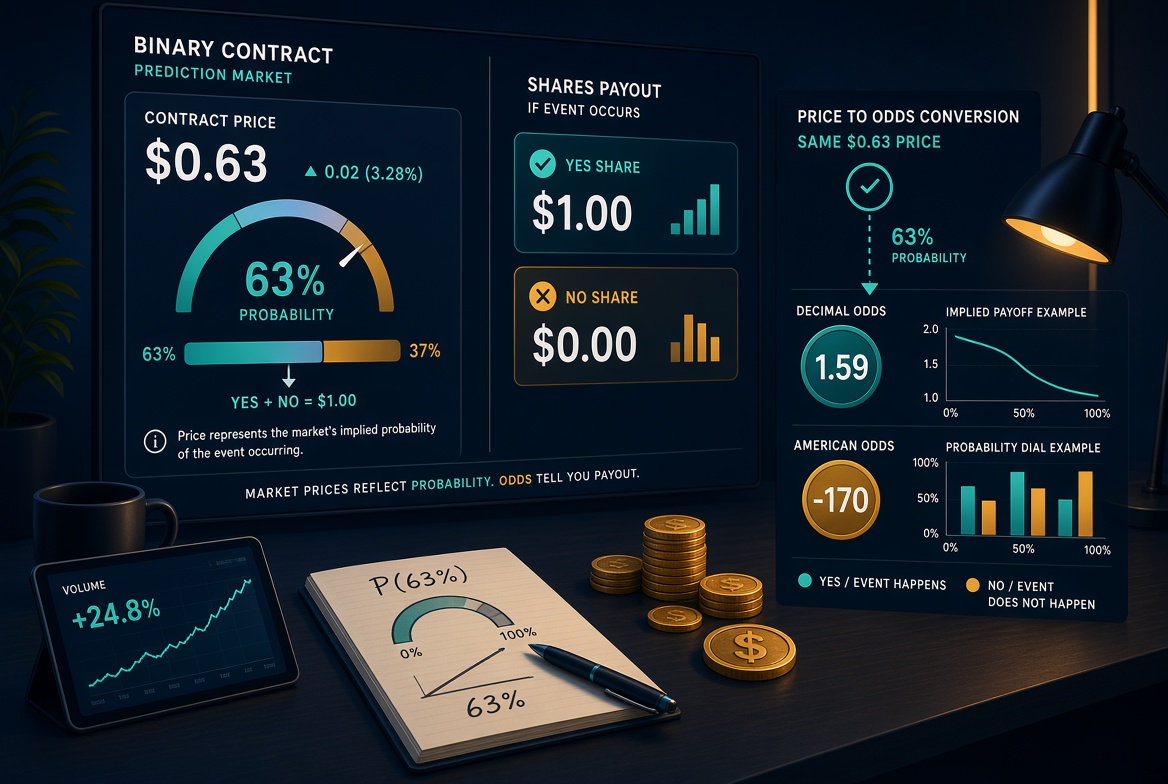
Prediction markets utilize perhaps the simplest numerical system ever invented, 1 to 100. The same scale we use for dollars and cents, percentages, school grades, and top rankings lists.
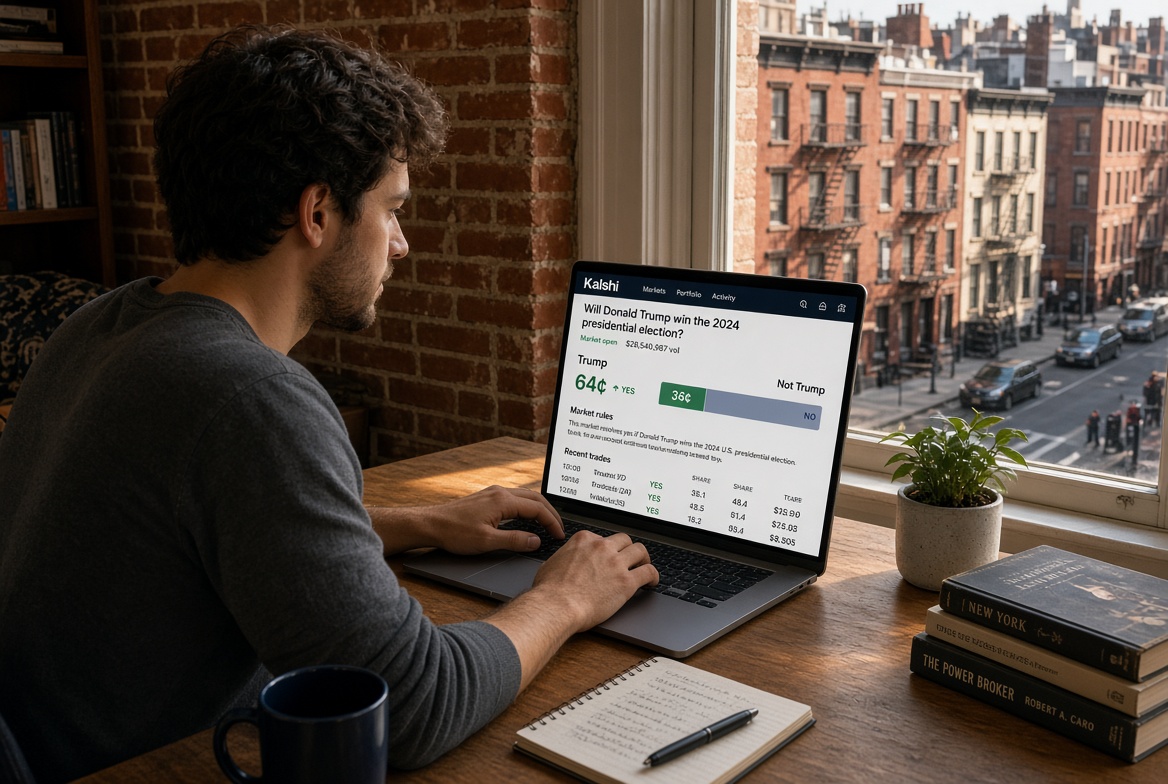
Every prediction market contract is priced between $0.01 (1 cent) and $0.99 (99 cents), which corresponds to how the market views the probability of the prediction coming true (YES) or not coming true (NO). A contract trading at $0.63 YES on a prediction market question or event implies a 63% market probability that YES is correct. The mechanics are intentionally simple so that anyone can trade.
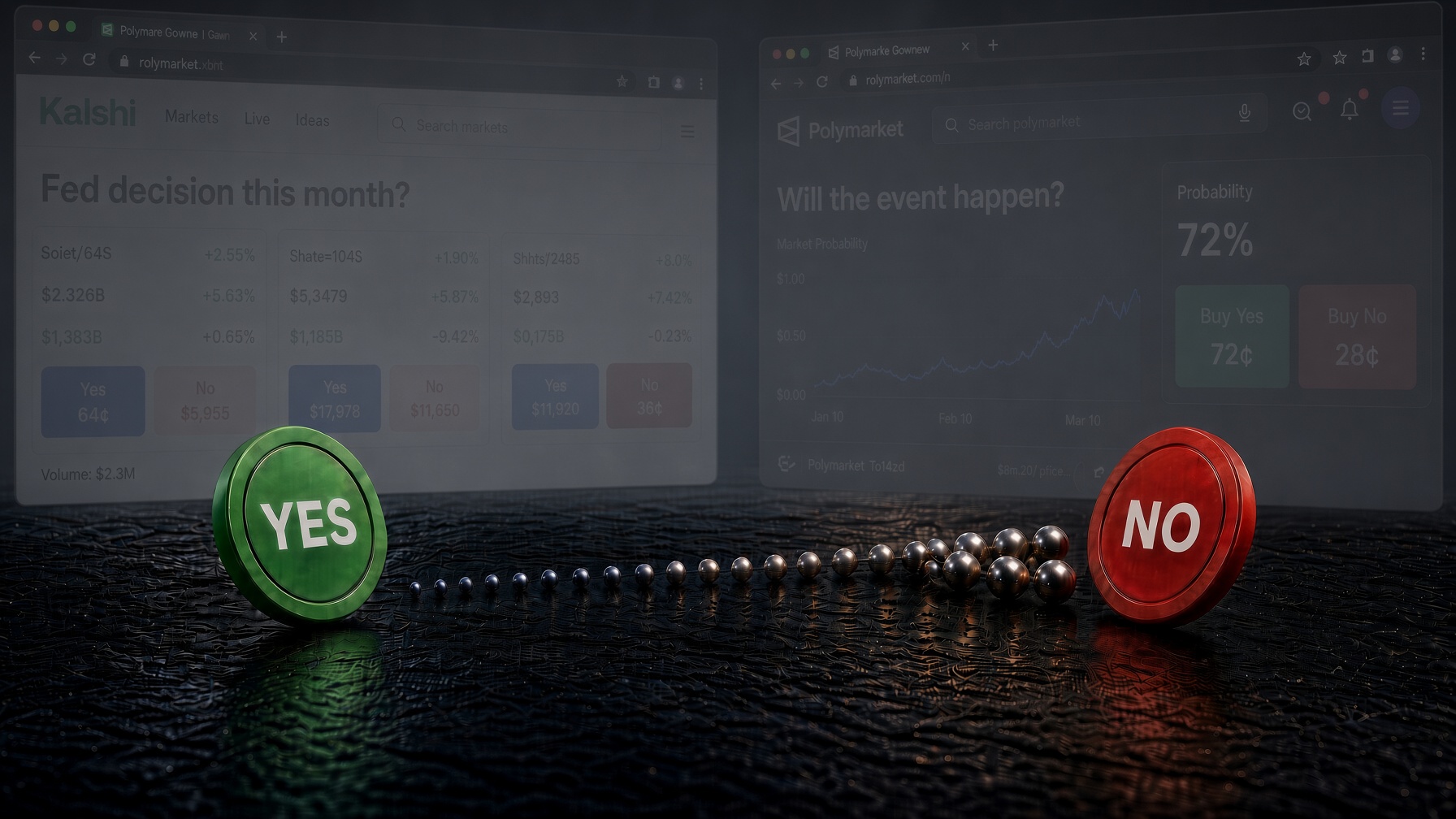
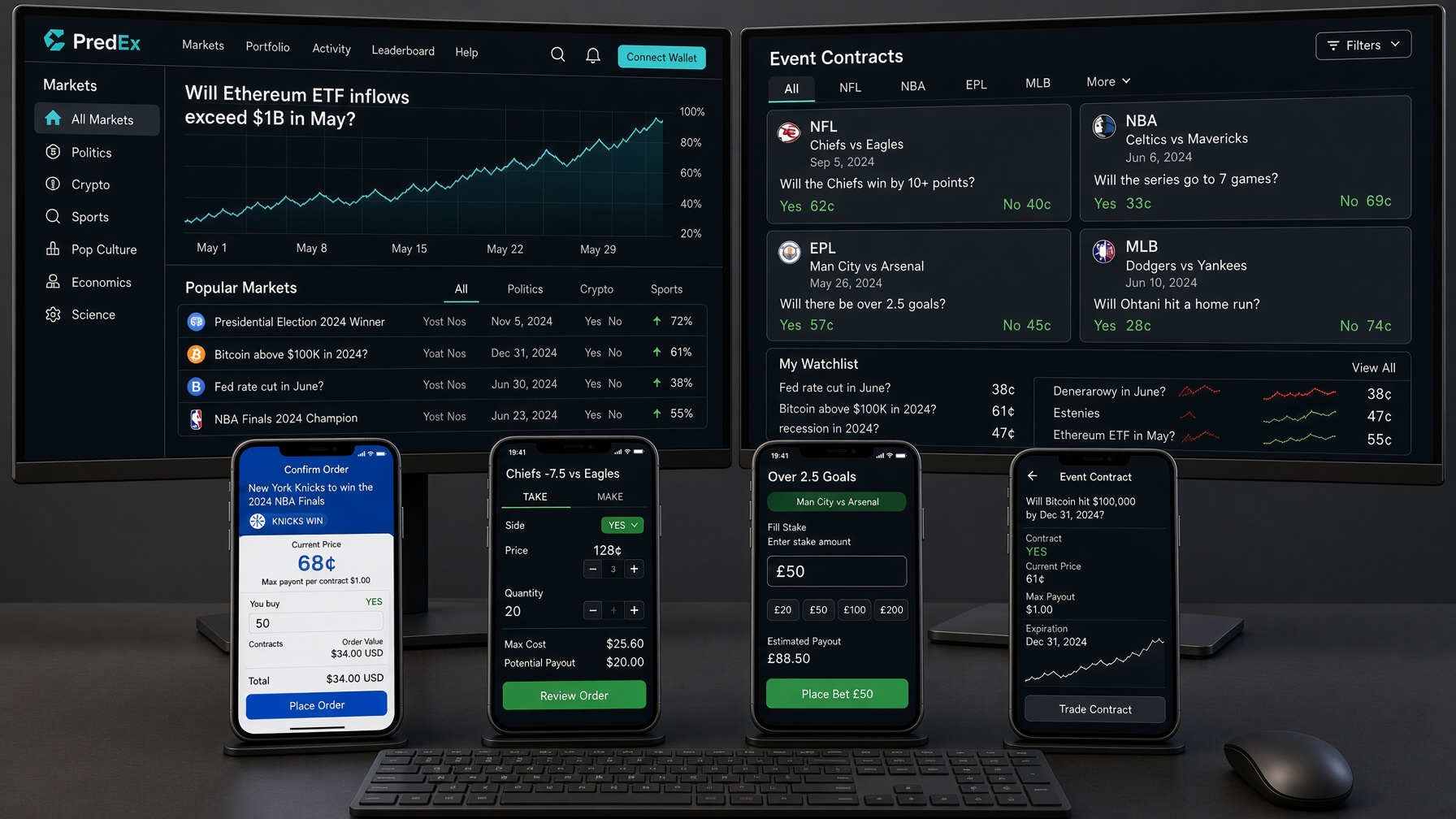
On Kalshi, Polymarket, and similar venues, binary contracts trade between $0.01 and $0.99 and settle at $1 for correct predictions or $0 for incorrect ones. The live market price is the crowd’s combined estimate of the current probability, forever moving as people buy or sell on new information. It is still an estimate: an 80% YES market can resolve no, and a 15% NO market can resolve yes. Just as a large sports favorite can lose and a massive underdog can win. These are only probabilities of the future; nobody can see the future.
Why the Contract Price Already Equals Implied Probability
A YES contract pays $1 if the event happens and $0 if it does not. You pay $0.40 for a contract, and you win $0.60 when you are right or lose $0.40 when you are wrong. The market price reflects the balance of all traders’ current probability estimates. Traders therefore read the quote as the probability itself. A $0.40 price should be correct 4 out of 10 times. But it often won’t.
Kalshi states the rule directly: a YES price of p cents implies about a p% chance the event occurs. Buying at 25¢ risks 25¢ to win 75¢, and buying at 75¢ risks 75¢ to win 25¢.
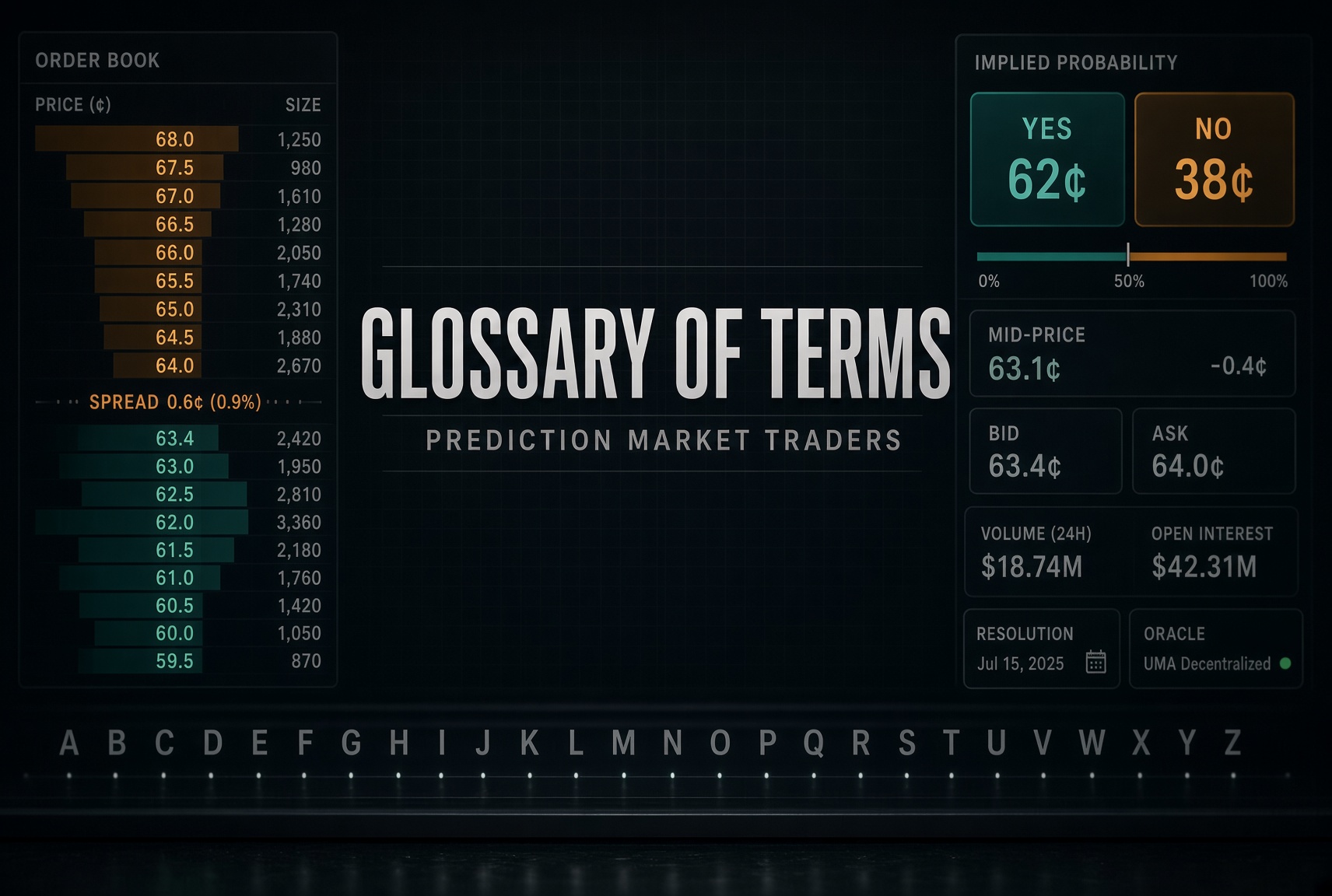
Polymarket uses the same math, but displays it differently. The on-screen figure is usually the midpoint of the best bid (buy) price and best ask (sell) price. A 34¢ bid and a 40¢ ask show as 37%. If the spread widens past $0.10, the screen falls back to the last traded price. (Those rules are spelled out for Polymarket in How Are Prices Calculated?)
YES and NO prices combined should sit near $1 because the winning side settles at $1. But this won’t always be the case because of market friction or small differences between buying and selling contracts. But it should be near $1.
Converting Prices into Odds Traders Can Compare
Decimal odds equal 1 divided by the price. A $0.50 contract is 2.00, even money. A $0.25 contract is 4.00. A $0.80 contract is 1.25. The formula does not change from one platform to another.
American odds split at even money. Under $0.50, use (100 / price) − 100, so $0.25 becomes +300. Over $0.50, use −(price / (1 − price)) × 100, so $0.75 becomes −300 and $0.63 lands near −170.
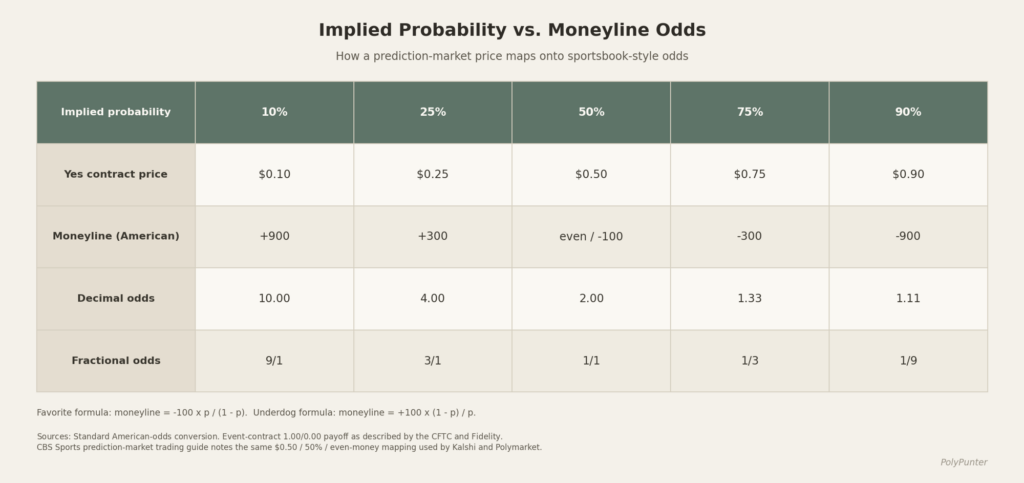
Fractional odds are just the win-to-risk ratio: $0.25 is 3/1, and $0.75 is 1/3. Sportsbook lines often hide a vig, so both sides of a −110 / −110 market add to more than 100%. Prediction-market prices stay closer to a pure probability because opposing traders push the two sides toward $1. You still pay the spread and, on some venues, a fee on winnings.
Read the cents as the percent first, then compute the payout as $1 minus the price, and only then switch formats. That order keeps a flashy payout from hiding a thin edge.
Spreads, Fees, and the Gap Between Price and Real Chance
The market price is what the market collectively assumes the probability is. Your probability estimate, your forecast, should be entirely independent of the market price. We highly recommend developing your own estimate before looking at the market price so it doesn’t influence your personal prediction model. The difference between your forecast and the market price is the edge.
A $0.55 contract against a 68% personal estimate is a 13-point raw edge. The same contract against a 52% view is already too rich. You’re not trading the market price; you’re trading the edge. Expected profit per contract is your probability minus the price you pay. Buy when your YES estimate is several points above the YES market price; several points above to cover fees. When your estimate is at or below the market price, stay out, sell any YES contracts you’re already holding, or buy NO contracts.
Fees do raise the hurdle. Trading transactions have fees, and many venues take a fee on winning contracts. They are typically small, but you need to factor them into your profit calculations or else you may find what you thought was a win actually cost you money.
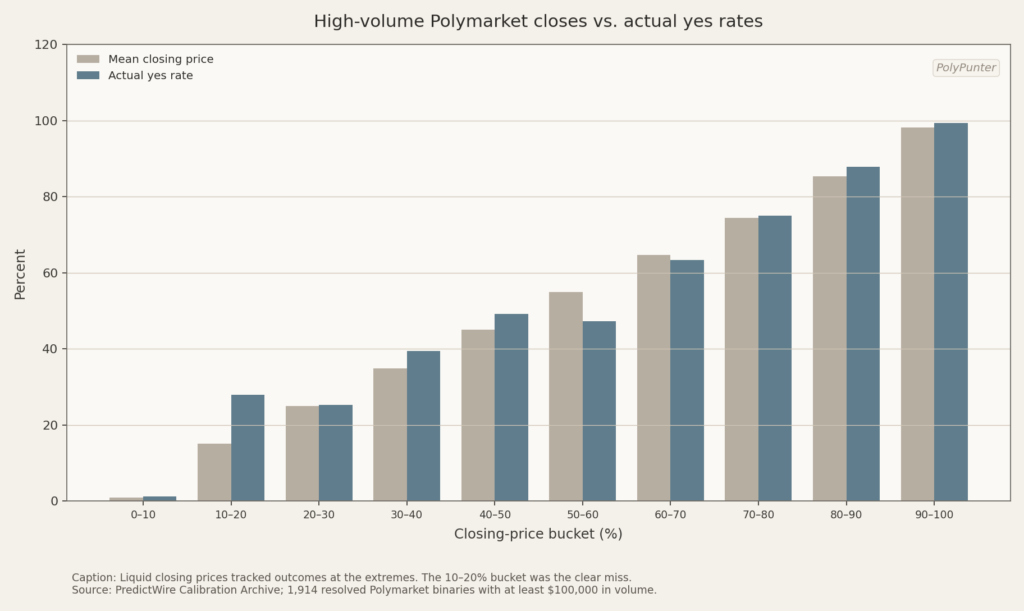
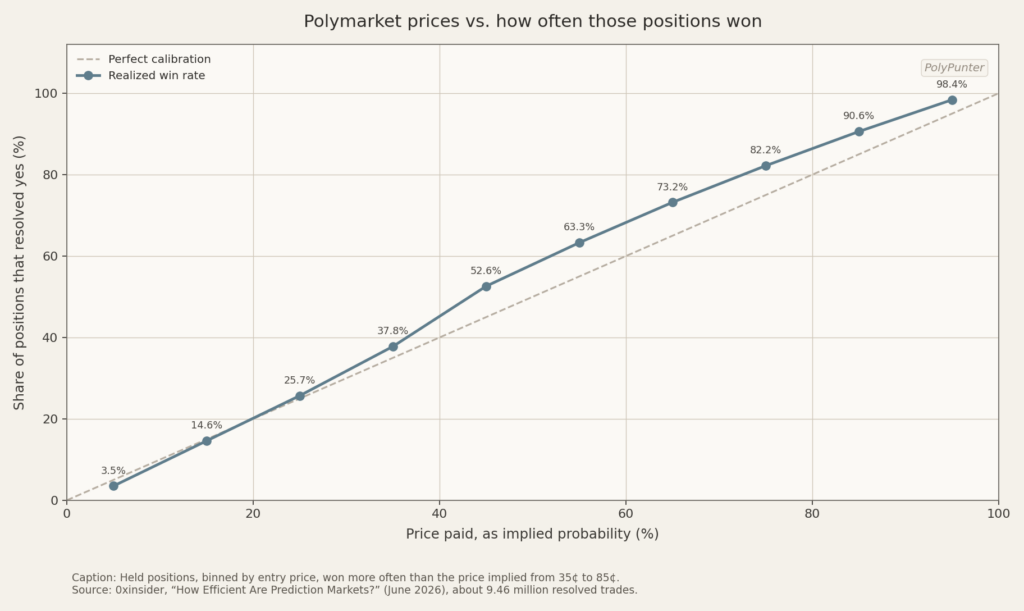
Liquidity matters too. Liquidity is basically how active a market is and how easy it is to make trades. In active markets, the final price you pay on a contract will be close to the listed price, since there are many sellers. The fewer sellers, the wider the “spread” between the listed price and your final cost. Watch for this in your calculations because if a $0.35 listed YES contract actually costs you $0.37 to purchase, you need to use the latter for potential profit calculations.
It’s very important to assess the accuracy of your forecast estimates honestly. To do that, you must look across more trades. A 40% probability should come true 40% of the time; one or two trades won’t give you much useful feedback. Across ten trades, it becomes more relevant. Were you correct 4 out of 10 times? Track your estimates and recalibrate: am I usually too optimistic or too pessimistic? Where did my estimates go wrong? Is it the same issue most of the time? These are forecasts. Update your internal models based on actual results.
Multi-Outcome Markets and Cleaning the Overround
Binary markets with only two options, YES or NO, need no extra step. Fields with three or more outcomes often do, because separate prices can sum to more than $1. Those raw quotes then overstate each option’s probability.
Add the prices and divide each one by the total. Quotes of $0.40, $0.35, and $0.30 sum to $1.05, which normalizes to about 38%, 33%, and 29%. You are ranking a pie larger than 100% and need to account for that in your calculations, since the winning trade is still based on $1 and 100%. This is almost like a built-in vig, since you’re essentially paying a markup on your trade.
Putting the Conversion to Work on a Live Quote
Build your own probability from public reports, filings, schedules, polling averages, weather models, or company guidance, then subtract the price you would pay. A gap of a couple of points rarely survives fees. A gap of 8% or more, on a liquid contract with clear rules, is where many traders start looking.
This is expected value: your estimate minus purchase price and all fees. Only act when you have positive expected value. Otherwise, you’re relying on luck to win, and luck has a lousy track record in all markets.
Frequently Asked Questions
How do you convert a prediction market price to a real probability?
Multiply the market price by 100 and read it as a percent. A YES share at $0.63 is a 63% implied probability of YES occurring.
What is the difference between probability and odds?
Probability is the chance, from 0% to 100%. Odds are the payout ratio. A $0.25 price is a 25% probability and 3-to-1 odds, since you risk $0.25 to win $0.75. Use probability to judge likelihood and odds to judge the payoff.
Do YES and NO prices always add to $1?
They should land near $1, because only one side settles at $1. Spreads, fees, and uneven liquidity can push the sum slightly off. On multi-outcome markets, divide each price by the sum of all prices to find the real probability for value calculations.
How do you turn a contract price into American or decimal odds?
Decimal odds equal 1 divided by the price, so $0.40 becomes 2.50. Under $0.50, American odds equal (100 / price) − 100. Over $0.50, they equal −(price / (1 − price)) × 100, so $0.75 is about −300.
When is a market price not a reliable probability?
Wide spreads, thin market volume, and vague resolution rules weaken the signal. A quiet contract can jump on one order, and fees push break-even above the raw quote. Tight, liquid books with clear rules are the quotes worth treating as a usable probability and almost always the most advisable for new traders.