Table of Contents
- An Introduction to Prediction Markets
- How Prediction Markets Work
- Why Prediction Markets Captivate New Traders
- Choosing the Right Prediction Market Platform for Beginners
- Step 1: Creating Your Trading Account and Learning the Platform Features
- Step 2: Review the TOS and Use Demo Mode for Practice
- Step 3: Funding Your Trading Account Safely
- Step 4: Understanding Fees and Funds
- Step 5: Mastering Yes/No Contracts and Pricing Mechanics
- Step 6: Understanding Market Resolution
- Step 7: Learn Your Bids, Asks, and Spreads
- Step 8: Placing Your Very First Trade With Confidence
- Step 9 (Final): Use Active Monitoring for Tracking
- Common Pitfalls That Trip Up New Traders
- Smart Strategies to Build an Edge From Day One
- Tracking Positions and Managing Risk Effectively
- Understanding Resolution, Settlement, and Withdrawals
- Your First Trade Awaits
- Frequently Asked Questions
An Introduction to Prediction Markets
Prediction markets transform personal insights and predictions into tangible financial opportunities; they allow traders from beginners to experts to buy and sell contracts tied to the probabilities of future real-world events.
These platforms create dynamic marketplaces where participants wager against one another on outcomes ranging from election results and economic indicators to sports scores and cryptocurrency movements. Prediction markets attract traders ranging from passionate fans and sports bettors to deeply serious financial traders and automated AI trading bots.
It’s important to understand from the get-go that everybody has equal access to prediction markets, but not everybody has the same level of technical resources, skills, and experience. These markets, like any, decisively favor the more savvy players. Imagine stepping onto an ice rink where some skaters are brand-new, and others are NHL stars.
How Prediction Markets Work
Prediction markets operate on the concept of crowd wisdom, where scores of people with different perspectives buy and sell contracts on the probabilities of future events. Collectively, this crowd of traders, bidding in real time, reaches a market consensus on the probability of an event occurring. That consensus changes throughout the event timeline as new information arises.
Prediction markets operate via Yes-or-No contracts priced between $0.01 and $0.99, where the price reflects the market’s implied probability of an event occurring. Therefore, buying a Yes contract at $0.42 signals that you believe the chance of the event occurring is at least 42%, and possibly higher. If the market price was $0.42 and you thought the odds of it occurring were only 20%, you would buy a No contract.
Upon event resolution, each share pays out $1 to the Yes or No contract, depending on which matches the actual result.
Example: If you buy 100 Yes contracts on the Oklahoma Thunder to win the NBA title at $0.42 for a total purchase of $42 and the Thunder do win the NBA title, you will settle at 100 shares x$1.00 = $100, or a $58 profit on your purchase. Of course, if the Thunder don’t win the NBA title, you lose your $42. This is wagering.
Why Prediction Markets Captivate New Traders
With conventional sportsbooks, fixed odds are set by the bookmaker or the “house”. This is typically a sportsbook or casino (or sometimes a guy named Lou who hangs out down the block). Bets are placed at the listed odds and locked. You’re betting on a specific outcome, with a specific dollar amount and a specific payout if you win. You can place additional bets on the same event, but you can’t trade or modify any of your bets once placed.
In contrast, prediction markets operate on peer-to-peer trading in which supply and demand between buyers and sellers continuously set prices. Traders can buy and sell event contracts with one another at any time once the market opens and until it resolves (closes), attempting to capture value as new market information shifts probabilities during that period. Prediction market traders who want to get out of their contracts can sell their positions to another trader and exit the market entirely before it settles. Don’t try that at Caesars (or with Lou).
Prediction markets are far more active and fluid throughout the process, while sportsbooks are bet-it-and-wait-to-see. Many participants enjoy the more active, hands-on, dynamic nature of active trading over static betting.
Nevertheless, this dynamic nature requires attention to details like trading fees, market liquidity, and event resolution criteria. This tutorial explains those elements so that your start feels smooth and informed rather than confused and shocked by anything. The leading prediction market platforms continue to improve their interfaces and educational resources for users, making this an ideal time to try trading in prediction markets, at least in the markets.
Choosing the Right Prediction Market Platform for Beginners
Platform selection influences your entire experience, from onboarding speed to available markets and fee structures. Kalshi stands out for U.S.-focused traders seeking full regulatory protection and the convenience of trading with U.S. dollars. Polymarket delivers unmatched global liquidity and crypto-native trading.
Kalshi and Polymarket are the big two. Between them, they accounted for 97.5% of all prediction market trading volume in 2025. But there are other lower-volume markets some traders may enjoy. PredictIt specializes in political depth with straightforward rules that some beginners appreciate. Crypto.com offers a prediction market portal. DraftKings and FanDuel have both expanded beyond their sports-betting cores to launch prediction-market apps. Robinhood, the retail stock trading giant, has also entered the prediction markets. But no doubt: Kalshi and Polymarket are the big two.
Top Prediction Market Platforms Compared for Beginners
| Platform | Best For | Currency | Fees | Deposit Methods | Key Beginner Advantage |
|---|---|---|---|---|---|
| Kalshi | US traders, the biggest sports markets | USD | Maker/taker fees; no settlement fee on most | ACH, debit card, wire, crypto | Simple fiat onboarding and CFTC oversight |
| Polymarket | Crypto-native users, currency speculators, geopolitics | USDC on Polygon | Low taker fees (0-0.75% on select); makers pay 0% | Crypto wallet, on-ramps like MoonPay | Global volume and transparent blockchain trading |
| PredictIt | Political event enthusiasts | USD | 10% profit fee on winnings | Bank transfer, credit/debit | Focused political contracts with clear rules |
Kalshi requires personal identity verification and offers straightforward U.S. banking integration. Kalshi also operates under full regulation by the U.S. Commodity Futures Trading Commission (CFTC), including a CFTC-supervised dispute resolution process. It’s as safe and regulated as the stock market. New users enjoy this level of trust.
Polymarket minimizes trading barriers through easy-to-use crypto wallet integrations, enabling quick starts for crypto holders while offering deep order books for popular events. Polymarket has stood out for its geopolitical, climate, and economic markets, as well as its cryptocurrency derivative markets.
PredictIt maintains position limits that naturally encourage smaller, educational trades, perfect for learning, and are less likely to attract the more serious, high-volume, high-dollar traders.
Evaluate your comfort with crypto wallets versus traditional banking before committing. Many beginners open accounts on both platforms to directly compare experiences. There’s no cost to get set up, so checking out both major prediction markets makes sense.
Step 1: Creating Your Trading Account and Learning the Platform Features
On Kalshi, navigate to the homepage (you can use your web browser, but you will ultimately need to sign up on the app itself) and select the sign-up option. Provide your email address along with basic personal details required for regulatory compliance. Upload a government-issued ID during verification. This will share your full name, birthday, and address. You will also be asked for the last four digits of your Social Security number to verify your identity.
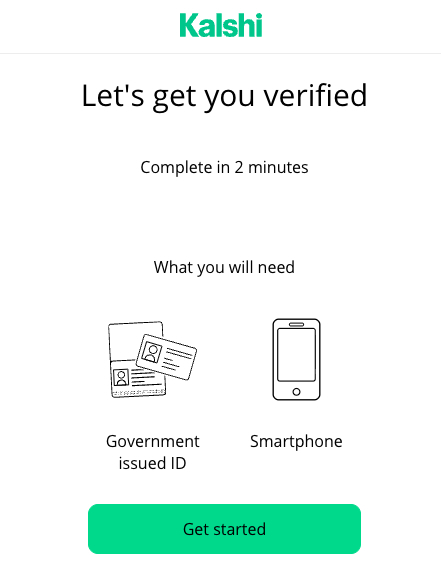
For those highly concerned with personal privacy, unfortunately, you can’t bypass this verification step if you want to trade on legitimate, regulated prediction markets.
Polymarket streamlines the process. Visit the site or app and connect a Web3 wallet such as MetaMask or use email-based magic links for instant access, following guidance from resources like the MetaMask Polymarket overview. This wallet connection grants self-custody of funds while bypassing lengthy traditional forms.
For those familiar with using crypto wallets, this will be a breeze. For newcomers, follow the step-by-step Polymarket instructions.
PredictIt follows verification similar to Kalshi, requesting personal information and linking a bank account for smooth transactions, as explained in their support documentation.
Security Note: Enable two-factor authentication across every platform immediately after creation.
Step 2: Review the TOS and Use Demo Mode for Practice
During signup, dedicate some time to reviewing the terms of service and resolution guidelines. Understanding these policies prevents later confusion when events settle. New users may find discrepancies in how markets are resolved, especially in non-traditional markets where deciding Yes or No may be more complicated than “Who won the game?”
Platforms will offer welcome resources or demo modes that simulate trading without risking real money. Most definitely try the demo mode trading. It’s a great way to practice. Track your results, make your mistakes, learn your lessons, and build up your trading game all without risk. Consider it a free education.
Polymarket Demo Trading Via Chrome Extension.
Successful account creation will unlock the full dashboard, where market lists, portfolio trackers, and order interfaces become available. Take a moment to thoroughly explore the navigation menus before proceeding to funding. Familiarity with the dashboard reduces stress during your first real trade, especially if timing is an issue. Think of it like a new car. Learn where all the buttons and controls are before you hit the road.
Step 3: Funding Your Trading Account Safely
Before trading, you’ll need to fund your trading account. Kalshi supports multiple convenient methods, including ACH (electronic bank transfer), which usually clears in one to three business days. Debit card deposits provide instant access, although they carry small fees. Crypto transfers offer another flexible route for hybrid users.
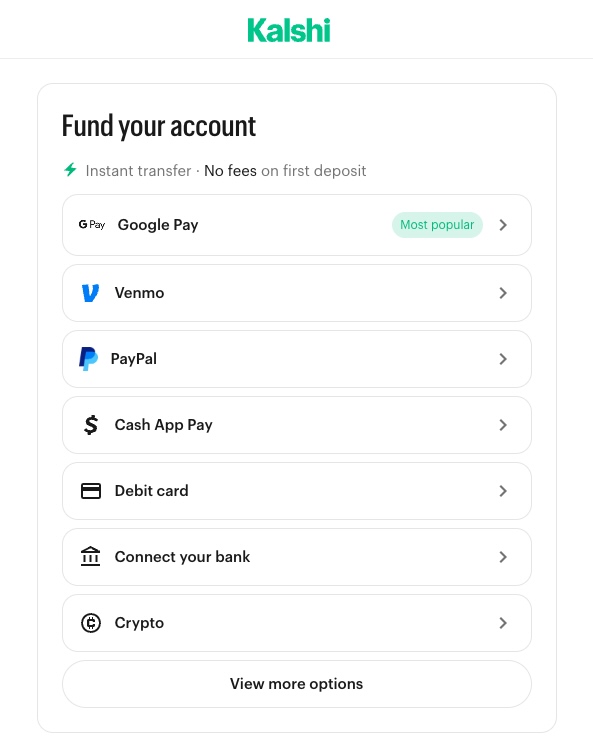
Polymarket operates exclusively on USDC stablecoin via the Polygon network for low-cost, fast transactions. Connect your wallet, then utilize the built-in on-ramp services or transfer from external exchanges, following the detailed Polymarket documentation.
Hint: Always start with a small crypto wallet test transfer to verify addresses and network settings are correct.
Common Deposit Methods Across Platforms
| Method | Kalshi | Polymarket | PredictIt | Typical Speed |
|---|---|---|---|---|
| Bank ACH | Free, 1-3 days | Not direct | Supported | 1-3 business days |
| Debit Card | 2% fee | Via on-ramp | Supported | Instant |
| Crypto (USDC) | Supported | Primary (Polygon) | Not primary | Minutes |
Beginners commonly deposit modest amounts, say, between $25 and $100. This conservative approach allows meaningful practice while limiting exposure during the learning phase. You can (and should) also use the demo modes, where you’re trading simply to learn. You will have to fund the account first to gain access.
Step 4: Understanding Fees and Funds
Track any associated market fees carefully, as they affect breakeven calculations for small trades.
Unlike in traditional betting, where you’re playing against the house, with prediction platforms, you’re trading with and against other traders. The platforms earn their money through activity fees. While fees are not relatively large, they will be deducted from any market gains and may change your calculations on which markets to enter and which trades to make. Count your winnings net of any fees to know how you’re really doing financially.
Once funds appear in your balance, confirm that the display matches the amount you transferred. Remember that there may be a small fee applied to your deposit, depending on the funding source. Many interfaces show available trading funds separately from pending deposits.
Security remains paramount throughout funding. Double-check all wallet addresses and never share private keys. Platforms employ industry-standard protections, yet user vigilance prevents avoidable losses.
Step 5: Mastering Yes/No Contracts and Pricing Mechanics
Core trading revolves around straightforward Yes-or-No binary contracts. Purchasing “Yes” shares expresses confidence that the defined event will occur by the deadline. Conversely, “No” shares bet against occurrence. Contract prices always sum to $1.00 across both sides, reflecting collective market probability.
In some cases, the markets will have single Yes-or-No contracts, such as “Will the Patriots win the 2027 Super Bowl?” In some cases, they will offer multiple options, such as “Who will win the 2027 Super Bowl?” and multiple teams will have Yes or No options at separate probabilities.
In this example below, we see the market on Kalshi for predicting who will win the 2028 Democratic Presidential nomination:
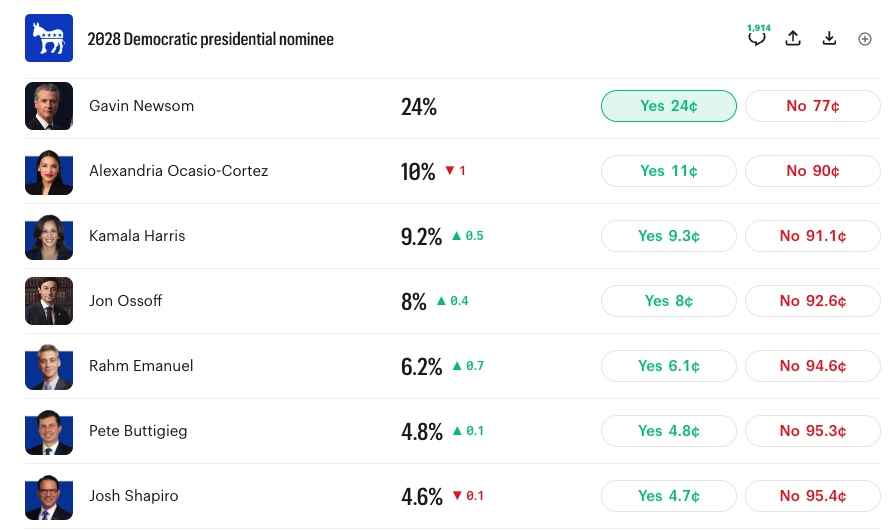
This market page shows you the Yes and No contract prices, as well as your options. There were more candidates than shown here, but this is everyone with a chance of winning above 4% as of May 18, 2026.
You could purchase 100 contracts for Gavin Newsom, Yes to be the nominee; he’s the current favorite. The price before fees would be $24. If he wins the nomination, you will be paid out $100. Now, say you’re quite certain he’s not going to win, but not sure who will, you could be No on Gavin Newsom for 100 shares for $77. If he fails to secure the nomination, your $77 will turn into $100. You can buy as many Yes and No contracts for as many candidates as you like, and when you’re done, you can sell any, some, or all of them back into the market as prices change.
A $0.24 price on Yes implies traders collectively assess 24% likelihood. If your research suggests higher odds, buying creates positive expected value (your expectation of Yes above the market’s expectation). You may sell partial or full holdings at any time before resolution, realizing profits or limiting losses based on price movements. This flexibility distinguishes prediction markets from one-time bets.
Example: You believe there’s a 75% chance of an event occurring. The Yes price is at 60 cents. That would suggest you have a stronger positive view of it than the market at this time. You would buy Yes contrats. Now, say, a week later, the Yes price is at 85 cents, but your personal belief is that the probability is still at 75%. You would then have a less positive view than the market and might choose to sell your contracts, earning 25 cents per share net of fees. Unlike the final outcome, which is speculative, that transaction is guaranteed profit.
Step 6: Understanding Market Resolution
Resolution is the term for when a market closes with an official outcome. Rules for how markets are resolved are outlined in each market’s rules. Kalshi emphasizes transparent CFTC-compliant processes. Polymarket leverages blockchain data and community-vetted sources. PredictIt uses clear definitions of political outcomes that minimize ambiguity. Always read the full contract language before committing capital.
In all cases: know your resolution rules. Read them! There is often confusion and frustration about how Yes-or-No is determined when topic resolutions are open to interpretation. This typically is the most bothersome when wagering on geopolitical events, where the definition of, say, “the Strait of Hormuz being open” is not as simple as whether the Fed raises interest rates before March 31. “Open” can be open to interpretation.
Each resolution rule beneath each contract will also tell you which organization will determine the official outcome of this contract. In our example above of the 2028 Democratic Party Presidential Nominee, Kalshi lists the Democratic Party as that official body. So, not CNN, AP, or Fox News declaring the winner, but only when the Democratic Party declares the winner. The event contract will only pay out based on the Democratic Party’s determination.
Watch this step-by-step Polymarket tutorial to see contract mechanics in action.
Step 7: Learn Your Bids, Asks, and Spreads
Order books on the platform reveal current bid and ask prices along with available depth. High-volume markets feature narrow spreads, facilitating easier entries and exits.
What is Bid/Ask/Spread: imagine you’re in a marketplace with buyers and sellers for the same product. Everybody there is trying to buy or sell a quart of Dreyer’s Vanilla ice cream. To you, that’s worth $3.98. You start screaming out, “I’ll pay $3.98!” That’s your “bid”. Somebody with a quart of Vanilla says back to you, “I’ll sell, but I want $4.09.” That’s the seller’s “ask”. The “spread”, or the difference between the bid and the ask, is 11 cents.
Now, if the market is crowded with sellers, you can go around asking for your $3.98 and likely find a seller with a closer ask, a smaller spread. The more volume in the market, the more buyers and sellers trading quarts of Dreyer’s Vanilla ice cream, the more likely compatible buyers and sellers will find an exchange that is closer to their initial wish.
Understand that the more popular, high trading volume contracts will be easier to find the prices you want, as a buyer or seller, and easier to get in or out of your positions in the market. If you start getting into less popular, lower volume event markers, the trading process becomes ever less efficient.
New traders benefit from concentrating their initial activity in these liquid environments, with lots of active traders, where information flows rapidly, and prices adjust efficiently because so many traders are constantly moving positions. Start out in these popular markets.
Step 8: Placing Your Very First Trade With Confidence
Selecting your inaugural market marks an exciting milestone. You’ve arrived.
Browse categories that match your knowledge areas, such as upcoming economic releases, familiar sports matches, markets related to your favorite music artists, or world events you know more than most. Again, read every detail in the market description, including exact resolution criteria and timing.
Decide your position after weighing available evidence. Enter the desired contract quantity and review the total cost and potential payout, both displayed prominently. Kalshi and PredictIt interfaces calculate maximum returns instantly. Polymarket shows real-time matching details, including slippage estimates, for larger orders.
Slippage is the difference in price between when you place your order and when it’s executed. The more contracts you’re trying to purchase, the more slippage may occur, as the market may be sourcing contracts for you from multiple sellers.
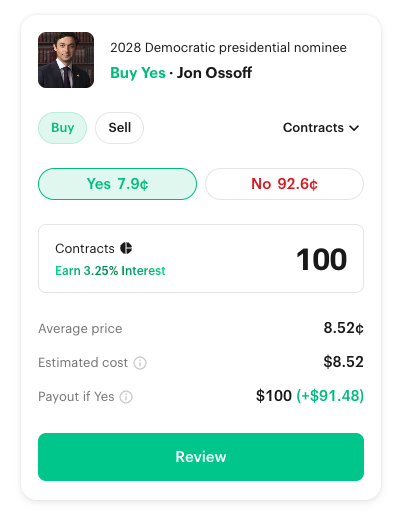
As an example, on the Kalshi market for the 2028 Democratic Presidential Nominee, I’ve chosen Jon Ossoff as my winner. Currently, he’s a long shot, so the Yes price is listed at 7.9 cents, implying a 7.9% probability. My actual estimated purchase price, including slippage and fees, will be $8.52 for the 100 contracts I’m buying. If I hold these contracts until resolution, when the Democratic Party officially declares its winner, and it’s Jon Ossoff, I’ll be paid out $100 on my initial $8.52 investment. Pray for me!
Review and confirm the trade only after verifying all elements meet your liking. Your portfolio updates within seconds, displaying the new position with current unrealized value. Celebrate this moment. You’re now a trader. We recommend you limit first trades to 1-2% of total deposited funds. This early phase is for learning. The more markets and trades you can make, the faster you will learn. Spread it out.
Once you’ve purchased your first event contracts, the business of trading has only begun. Like a sports bet, you could sit on this about 12-1 longshot position for the next 2+ years and wait to see if you win. Or you can horse trade. Once, twice, ten thousand times over that same time period.
This is the excitement and strategic decision-making that draws many users into prediction markets.
Step 9 (Final): Use Active Monitoring for Tracking
You can set platform alerts for significant price movements or enable notifications for related news. (Off platform, set news and social media alerts for breaking stories in your market.) Observing how markets digest and respond to information accelerates your intuition faster than passive study alone. Many beginners journal their first few trades, noting research sources, entry rationale, and subsequent price action. This practice compounds learning and reveals personal strengths or biases over time.
Third-party apps like IFTTT integrate fully with your Kalshi trading and provide a series of automated tools for monitoring markets and your positions.
The probability pricing on Jon Ossoff to win will change all the time from now until the resolution. If it rises above my own forecasts, I can start selling my contracts for a profit. I can even hedge my portfolio by betting against Ossoff if his Yes position rises, guaranteeing myself a profit when the resolution occurs, even if only a small one.
Common Pitfalls That Trip Up New Traders
1. Rushing into illiquid markets (lower volume markets with fewer traders) without checking volume makes it difficult to exit positions at reasonable prices. As in our Dreyer’s Vanilla ice cream example, fewer traders, thin order books, and spreads that widen dramatically erode potential profits, even on correct forecasts. Therefore, prioritize popular events during the initial months. Save the smaller, niche markets for when you feel more comfortable trading among fewer people.
2. Not reviewing market rules in their entirety leads to unexpected resolutions when edge cases arise. Don’t be disappointed when a win you had in your mind turns into a loss in your account because of a resolution rule you missed. In our 2028 Democratic Presidential Nominee market example above, you may see CNN declare a winner and think you’ve nailed it, because you failed to note it’s only the Democratic Party announcement that matters, and maybe they post a different name.
3. Emotional decisions after early losses often compound into larger drawdowns. If you’re newer to wagering, you may not be familiar with this natural habit, though it’s true in most things in life. When you lose at any game or opportunity, many people’s instinct to get it back immediately kicks in. This sentiment has led many a person into a quick series of inferior decision-making. Just be aware of it. Look at each market anew and use the same process in each, regardless of what happened on your previous trade.
4. Neglecting the fee impacts turns marginal edges negative over repeated trades. As in my Jon Ossoff example above, my $8.00 purchase of contracts became $8.52 with fees. So while I will see these contracts as $8 in my portfolio, and think that selling them for $9 may earn me a small profit, after fees are accounted for, it could even be a small loss.
5. Avoid chasing hype without independent analysis. Markets can overreact temporarily to headlines, creating both opportunities and traps. Patience in waiting for alignment between your assessment and pricing pays dividends consistently.
For each of these potential mistakes, deliberate preparation mitigates these risks. Start conservatively, verify every detail, and treat early experiences, even losses, as tuition for an education rather than failures. Most successful traders recount initial mistakes that ultimately strengthened their approaches.
Smart Strategies to Build an Edge From Day One
DO YOUR RESEARCH. Thorough research differentiates profitable traders from casual market participants. Cross-reference platform prices and implied probabilities with independent data sources, including polls, statistical models, and expert analyses. Identify situations where your researched and informed view diverges meaningfully from consensus pricing. If the reason you’re making a trade is that your gut tells you to, you may be a casual. It can be fun and entertaining for sure, but it likely won’t prove profitable.
DIVERSIFICATION across unrelated event categories smooths results and builds broader knowledge. For example, combine political contracts with economic indicators and occasional sports positions. This balanced exposure prevents over-reliance on single news cycles. The opposite of this would be to buy Yes positions on every positive market possibility for your favorite sports team because you want them to win. Please don’t do this.
EMPLOY LIMIT ORDERS to specify exact entry prices you’re willing to pay rather than accepting current market rates. This discipline substantially improves the average cost basis as volume allows. Maintain detailed records of each trade rationale, outcome, and key lessons extracted afterward. Reviewing journals monthly highlights patterns worth reinforcing or eliminating.
Check this beginner-friendly video breaking down both Kalshi and Polymarket mechanics side by side.
FOCUS INITIALLY ON SHORTER DURATION MARKETS to experience full cycles quickly and reinforce your education on the complete process. As your confidence grows, explore longer-term contracts that offer higher potential rewards for accurate forecasts and more opportunities to adjust your positions over time in the ongoing market.
In all cases, combine fundamental analysis with awareness of market sentiment shifts driven by breaking news developments. Probability calibration exercises in demo mode or just tracking on paper will enhance your skills. Estimate chances for various events, then compare against eventual outcomes and platform settlements. This mental training will have a positive impact on your trading. Build your prediction market muscles!
Tracking Positions and Managing Risk Effectively
Modern prediction market platforms like Kalshi and Polymarket provide sophisticated portfolio dashboards that display real-time profit-and-loss calculations. You should use these tools to monitor exposure (what percentage of your total funds are in existing contracts and currently at risk) across all open positions simultaneously.
Establish personal risk parameters before trading begins. Many experienced traders never allocate more than 5% of their total funds available to any individual contract. This guideline preserves capital through inevitable periods of losses. Withdraw portions of profits periodically to lock in success and maintain the psychological advantage and wonderful feeling of being ahead.
This is more of a personality-type thing: avoid over-monitoring your contract markets if it leads to impulsive adjustments. Daily reviews suffice for most positions. There are some traders for whom maintaining a high anxiety level works for them. But for most, it’s detrimental. Patience emerges as a powerful advantage when combined with disciplined position sizing and continuous education.
Some advanced risk techniques include hedging against correlated events or gradually scaling into positions as conviction strengthens with new information. These methods become natural extensions once you’ve become practiced in the basics.
Understanding Resolution, Settlement, and Withdrawals
The event conclusion (date and time are always listed on the market) will trigger a prompt-resolution announcement via each platform’s standard channels. Correct contracts credit $1.00 per share automatically to balances. Kalshi distributes money directly to linked banking accounts if you’ve set that up. Polymarket remits USDC to connected wallets almost instantly after processing.
Withdrawal procedures mirror the simplicity of deposits on reputable platforms. Kalshi processes requests via ACH or other banking rails with minimal delays. PredictIt follows similar timelines, while Polymarket handles only blockchain transfers and is subject to network conditions. Always retain transaction records for tax preparation purposes.
The settlement process typically occurs within hours or days after the event concludes.
There are fairly rare cases where resolutions are disputed. As mentioned, these typically occur in geopolitical or similar markets where determining Yes or No on an event is less mathematical or overt, and is somewhat subjective or complicated by rule language. We won’t discuss that here, but there are numerous articles on PolyPunter about such instances.
Your First Trade Awaits
This detailed tutorial has equipped you with practical steps, platform comparisons, risk awareness, and the basic strategies needed for success. Refer back to it as needed. The prediction market landscape is evolving rapidly, yet the core principles of research, discipline in trading, and probability assessment remain constant.
People enjoy prediction markets for various reasons, but they are all putting money at risk. Please approach this pursuit with that understanding. Approach each contract and position thoughtfully, starting small and scaling responsibly as experience accumulates.
Markets reward consistent effort, strong research, and honest self-assessment over time. Your initial trades mark the beginning of a fascinating journey in which information, timing, and the courage of conviction intersect with financial incentives. Success stories emerge daily from individuals who embraced these markets thoughtfully.
Gradually expanding your involvement while documenting progress offers strong advantages, as with any new pursuit. Over months, patterns in market behavior become clearer, allowing sharper entries and more confident position management. The blend of analytical skill and real-time feedback makes prediction markets uniquely engaging compared to passive investment vehicles. Your journey begins with that single informed first trade.
Frequently Asked Questions
What is the minimum amount needed to start trading on prediction markets?
Most platforms have no strict minimum deposit, but beginners typically start with $50-$100. This range lets you place meaningful trades while learning platform mechanics without excessive risk. Kalshi and PredictIt allow small fiat deposits, while Polymarket works well with modest USDC transfers via on-ramps.
Are prediction markets legal for traders in the United States?
Yes, regulated platforms like Kalshi operate under CFTC oversight, making them legal for eligible U.S. users. Polymarket offers access through crypto wallets in many states, though some jurisdictions maintain restrictions. Always verify your personal eligibility and comply with local regulations before depositing funds.
Do I need cryptocurrency to trade on all prediction market platforms?
No. Kalshi and PredictIt support direct USD deposits through bank transfers and cards. Polymarket requires USDC on Polygon, but built-in on-ramp services let you buy crypto directly with fiat. Choose the platform that best matches your preferred funding method.
How do prediction markets differ from traditional sports betting?
Prediction markets use continuous peer-to-peer pricing that updates in real time, allowing you to buy or sell contracts anytime before resolution. Traditional sportsbooks set fixed odds. Prediction markets also focus on diverse events beyond sports and emphasize probability-based trading rather than one-time wagers.
What happens if the market resolves against my position?
Your contracts settle at $0 and you lose the amount invested in that position. This outcome highlights why starting small and diversifying matters. Treat losses as learning opportunities and review what information you may have missed to improve future decisions.
How are profits taxed on prediction market platforms?
Profits generally count as ordinary income or investment income depending on your jurisdiction. Platforms like Kalshi and PredictIt provide transaction reports that simplify record-keeping. Consult a tax professional for personalized advice and maintain your own detailed trade journal.
Can beginners realistically make money trading prediction markets?
Yes, many beginners achieve consistent results by focusing on research, starting small, and managing risk. Success comes from finding edges where your analysis differs from market prices rather than chasing every event. Treat it as a skill-building process that improves over time with experience and discipline.
*****
Reminder: Engaging in prediction markets can be highly addictive, similar to gambling, potentially leading to financial loss, emotional distress, and compulsive behavior. Bet responsibly, set limits, and seek professional help by calling 1-800-MY-RESET if you experience signs of addiction, such as chasing losses or neglecting responsibilities.