
You might think prediction markets are about accurately predicting future events. But really, they are about predicting the future better than your competitors. Think of them like guessing how many jelly beans are in a giant jar. Nobody knows how many jelly beans are in the jar. Like nobody can predict the future. The winner is the one who guesses best.
A trader finds markets where they think other traders are too high or too low on their guesses, and enters that market to exploit their superior estimate. Everybody puts money in the pot to ensure everybody takes their estimates seriously.
Instead of owning a share of a company as in the stock market, in a prediction market you own a contract on a future result: a Fed rate decision, a sports championship, a political vote, the price of bitcoin by next month, a weather threshold. At any given time, across dozens of prediction market platforms, thousands of open event markets will be live, on topics ranging from the incredibly popular to more niche. For everybody’s professional or personal expertise and passion, there is a market.
This primer explains the basic mechanics of prediction markets in a 10-minute read. You will see how prices form, how a trade settles, how these books differ from sportsbooks, and what beginners should check before funding an account. This should give the introductory knowledge you need to get started. We’ll provide links to more content and more detailed prediction market tutorials to help you become even more informed.
What a Prediction Market Contract Actually Is
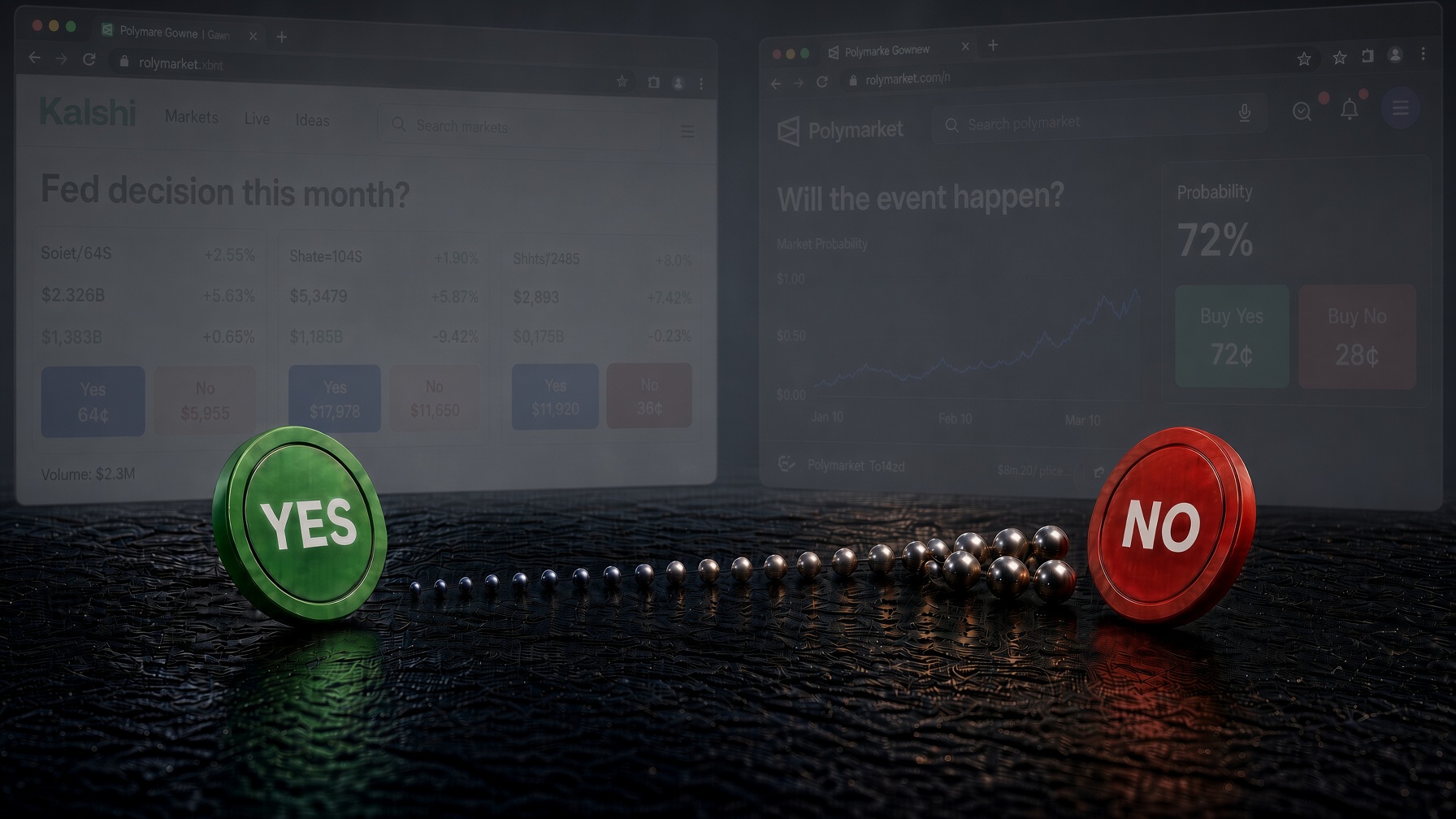
A prediction market will list four primary elements: a concise question about a future outcome, a price that reflects current market probabilities, an end date or event for that market, and the rules that determine winners and losers when it ends. For the general public, prediction platform apps and websites provide a simple, intuitive design that makes the basic mechanics of trading in these markets quite easy. See Polymarket and Kalshi as the two largest platforms.
Most market questions are framed as binary. The only answers can be Yes or No. You will buy Yes contracts if you believe the answer will be Yes, and No if you believe the opposite. Everything else you do flows from this initial, binary prediction.
A market contract is a constantly tradable asset that you own. You can sell it at any time before the market’s close time and date. Or you can hold until the end, until settlement. Your account will show all the contracts you currently own and list all your past transactions. When a market settles, any contracts you hold that are deemed winners will pay out. Losing contracts will simply expire, and you will receive nothing. Your account will show all the settlement transactions.
There is no limit to how many contracts you can own, how many you can trade, how many markets you can trade in, or how you choose to manage your holdings. To get started, you’ll need a funding source attached to your account to add money to your trading balance, if you choose.
How Traders Read Prices and Implied Probability
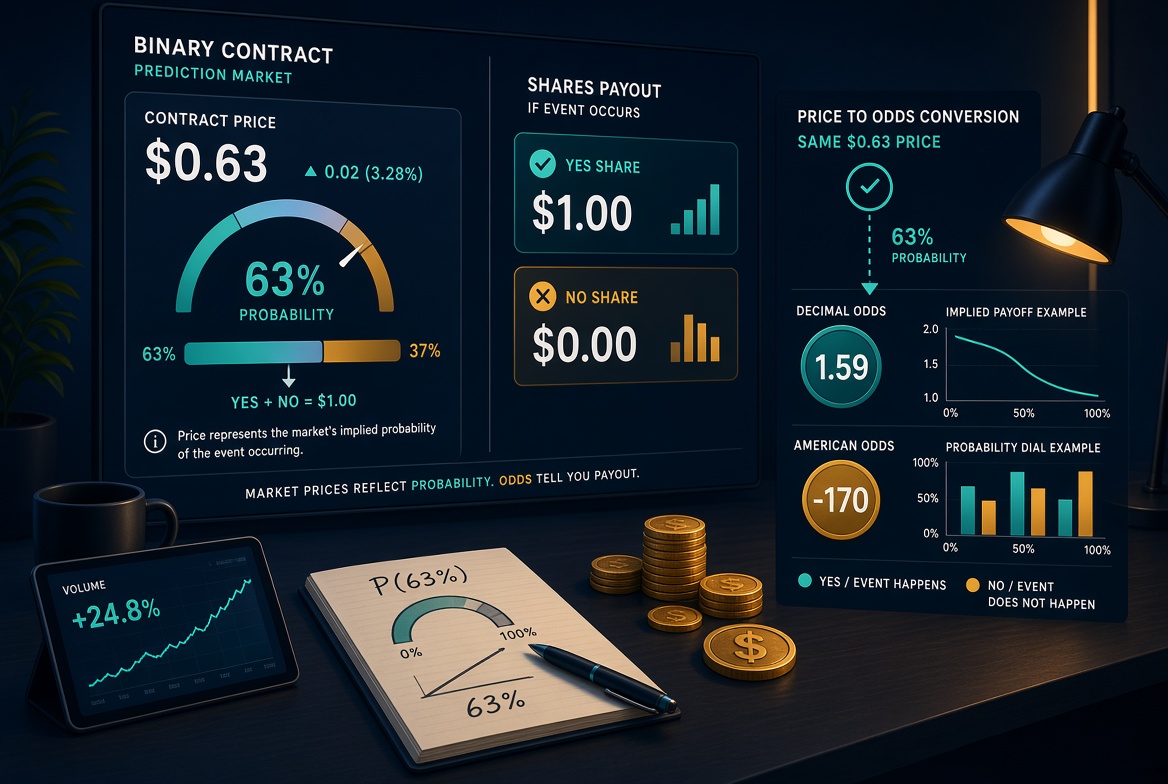
All prediction markets trade in prices on a scale of 100. To keep it simple, platforms price in cents. You can buy or sell Yes-or-No contract prices from 1 to 99 cents, often written as $0.01 to $0.99. These prices correlate to implied probabilities of the event outcome prediction, from 1% to 99%.
Implied probability is the contract price restated as a chance. $0.72 Yes implies a probability of 72% that Yes will occur. It is not a poll or an official projection. It reflects traders buying and selling these contracts until they reach a consensus price. Like a stock price, it changes often based on whether the next trader sees it as underpriced or overpriced.
No matter the price you pay for your contract, a winning contract pays $1.00 and a losing contract pays $0. So our $0.72 Yes contract pays $1.00 if the outcome is Yes, or a profit of $0.28 per contract. Traders can buy (and sell) as many contracts as they like. If you bought 100 $0.72 contracts for $72 and were correct, you would be paid $100.
In these binary markets, a price above 50 implies a favorite, and a number below 50 implies an underdog, to use sports terms. So a contract on a favorite pays less than even money, and a contract on an underdog pays more than even money.
When a Cheap Contract Isn’t a Cheap Contract
A cheap-looking contract price isn’t automatically a good trade. $0.10 is a bargain only if you believe the true chance is higher than 10%. Meanwhile, a $0.90 contract can be a poor buy, like betting on a heavy favorite, because you’re still taking on risk and your payout if you win will be relatively small.
This is why you enter a prediction market with a number already in mind. Just as when you go to any marketplace to bid on an item, you already have an idea of what it’s worth to you. You can’t haggle with a car salesman over a good price if you don’t know what a good price is. In your mind, you have a number. In a prediction market, that number is your forecast probability.
If the market question is, “Will it rain tomorrow — Yes or No?” you need more than a Yes or No; you need a Yes, and I’m 60% certain. If the Yes price in the market is $0.70, you wouldn’t buy that contract because it’s too high compared to your prediction. For you, it has negative expected value. If it’s $0.50, then you’re buying it below your implied probability, and it’s a good price with positive expected value.
Buy contracts priced below your estimate of their worth, and sell contracts you already own when the price is above your estimate. Just like any other product.
From Order Ticket to Payout
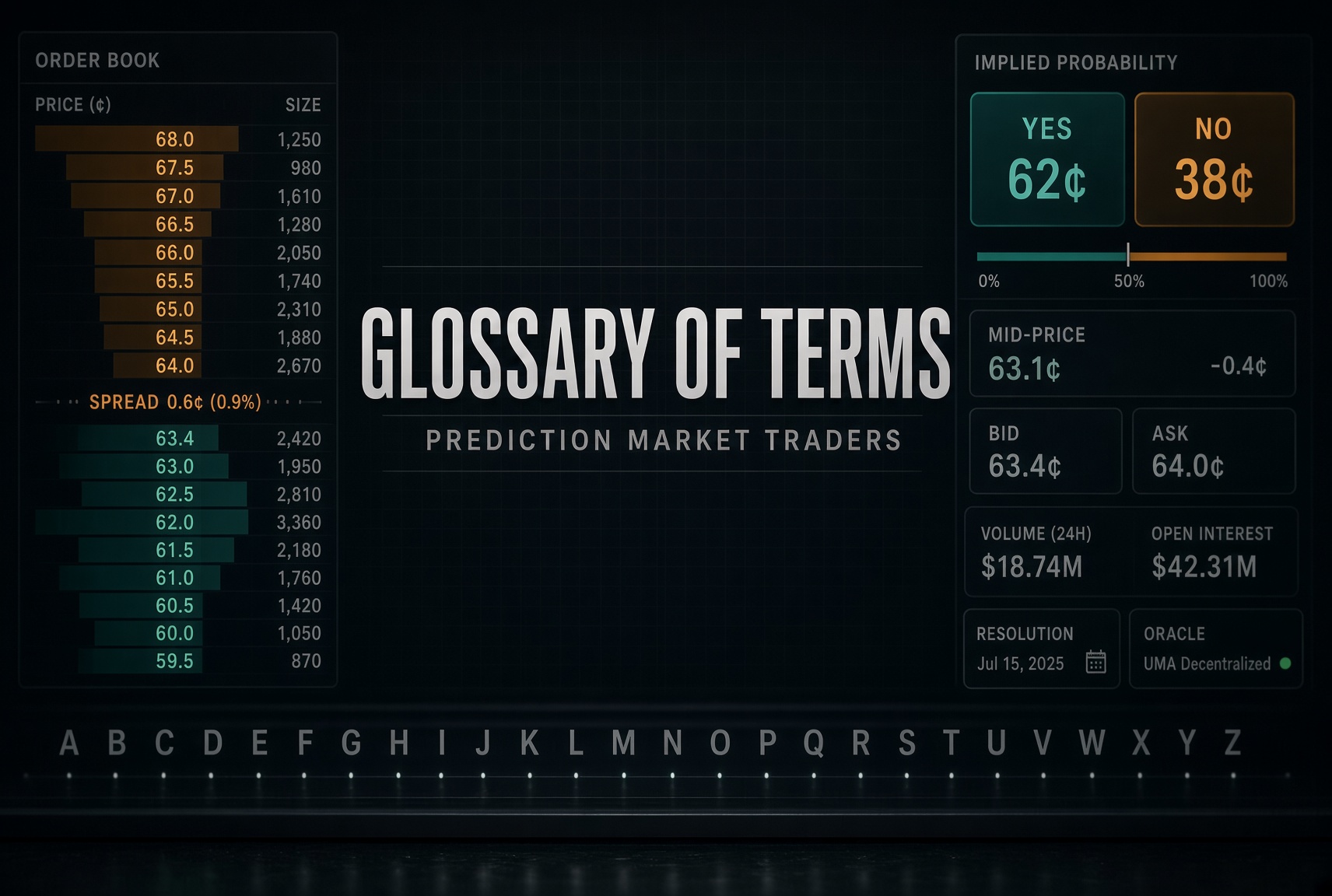
Most large prediction market venues use an order book, literally as it sounds, a register of all placed orders to buy or sell. You can take the current posted market offer with a market order, or post a limit order and wait to see whether other traders fulfill it.
After you’ve purchased a contract, you have three choices.
- Hold the contract to settlement and take $1.00 per contract you own if you’re right, or $0.00 if you’re wrong.
- Sell
- Or buy the opposite Yes-No side of your existing holds to reduce your risk
If you got into the market at a good price, selling early when the price rises is often the cleaner move. A contract you purchased for $0.40 that has already jumped to $0.80 has paid most of the potential gain. Holding it for the last twenty cents can turn a good trade into a coin flip. Conversely, if you think the market is headed down, you may want to sell to cut your losses. Studies show that the best prediction-market traders aren’t those who hold until settlement, but those who profit from trading prior to close.
End-of-market settlement always follows the prewritten rules. The rules text is always on the same page as the market. Read them. Regulated exchanges usually point to an official source, such as a government release or a league result. On-chain venues often use an oracle to bring that real-world answer onto a blockchain so payouts can run automatically.
Read what counts as Yes or No, which source is binding, and what happens if the event is postponed. Then read the fee page. A few cents per contract, a cut of profits, or a withdrawal charge can erase a thin profit margin. Don’t think you won, only to find out you lost money when you do the final count. Know the numbers.

How Sports Prediction Markets Differ from Sportsbooks
A sportsbook sets a betting line and takes the other side from the bettor. A prediction market lists a contract and lets traders trade with one another. That difference changes the incentive. The sportsbook earns when customers lose. The prediction venue earns when people transact.
The quote looks different too. Sportsbooks often show moneyline odds such as -150 (bet $150 to profit $100 on a win) or +130 (bet $100 to profit $130 on a win). Prediction markets may show a number like $0.60, which some apps also label as 60%, to represent the price to purchase($0.60) a $1-win payout contract. You can convert between the two. A $0.60 contract that pays $1.00 on a win is a $0.40 profit on a $0.60 “bet,” or the same as a -150 moneyline on a $60 bet.
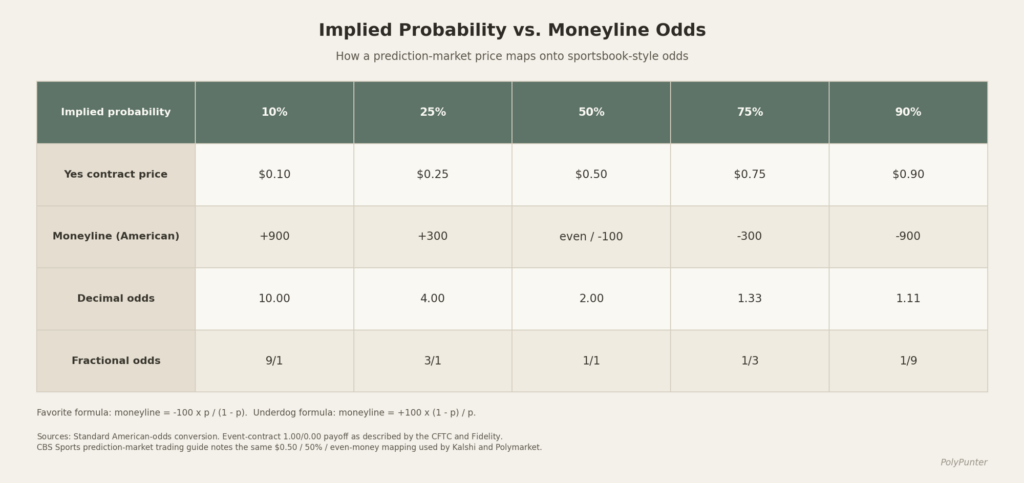
Intra-term trading and early exit are the other practical differences. With a sportsbook bet, you place your bet and wait until settlement to see if you win or lose. Once you bet, it’s a passive process. In prediction markets, you can buy or sell contracts for a specific event as often as you like before settlement. As we mentioned, much of the money made in prediction markets is from trading, buying low and selling high, not from being accurate about the final outcome. A savvy prediction market trader could turn a profit and exit a market before the game even takes place.
Which Venues Beginners Usually Meet
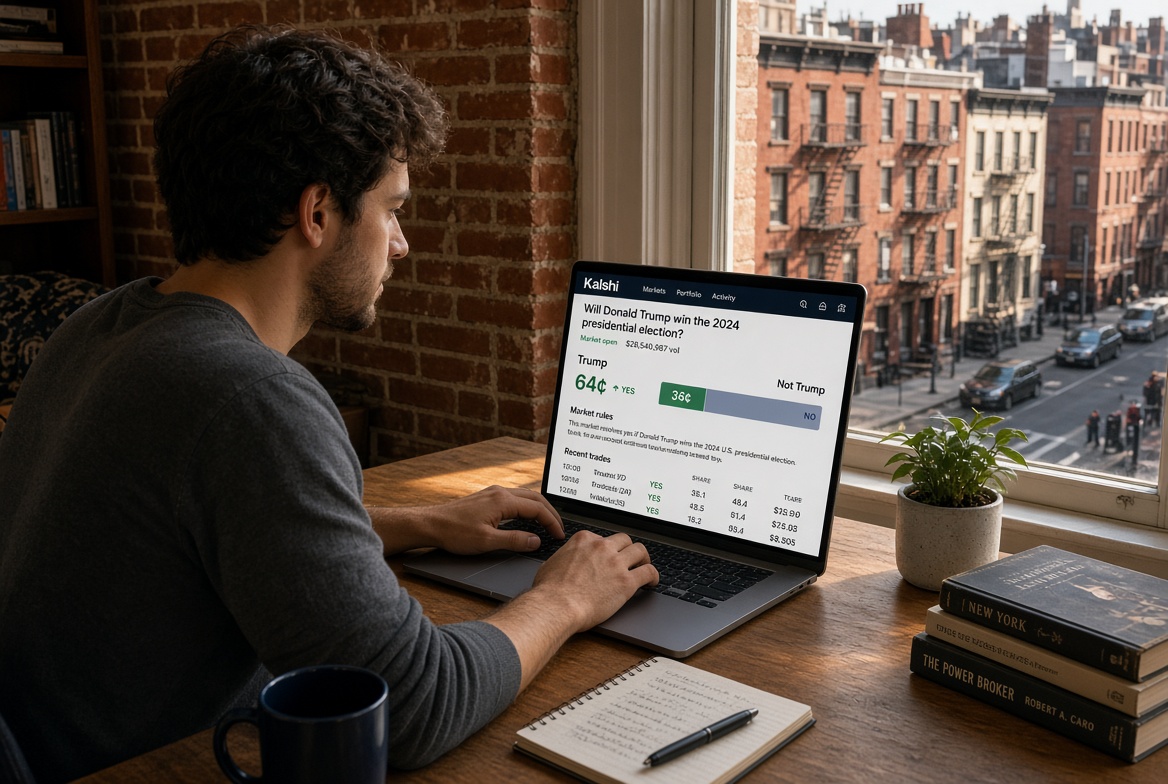
Kalshi is the largest prediction market, by a good margin. It’s one of the original, federally regulated exchanges that operates in U.S. dollars and uses a central order book, making it simple for new traders to use. The catalog covers sports, elections, economic releases, weather, and culture. Identity checks and bank transfers make the account feel more like opening a brokerage account than a crypto wallet.
Polymarket built its name on a crypto-settled book, with prices in USDC and settlement that can run through an oracle. Polymarket operates on-chain globally. A separate U.S.-only traders venue has opened this year under federal designation. The platform will identify your location and direct you accordingly. The mechanics for new traders will look similar to Kalshi.

Other major prediction market apps include those launched by sportsbook giants FanDuel (FanDuel Predicts) and DraftKings (DraftKings Predictions), as well as Underdog (UnderdogPredicts). Novig is a newcomer that focuses only on sports prediction markets. Additionally, major brokerage and financial services firms like Robinhood have also added prediction markets to their existing services. The market is growing incredibly fast, with dozens of other venues launching recently and more coming soon.
For many, the choice will be between dollar-based venues and crypto-based venues. The wallet-based on-chain platforms add self-custody and faster global access. They also add irreversible transactions and uneven contract quality when anyone can list a question. If you want fewer operational surprises, start on a regulated book. Pay close attention to fees, withdrawal speed, dispute rules, and the questions you actually want to trade.
Risks Trading on Prediction Markets
1. Losing the full amount you pay is the primary risk. These contracts are not a basket of big-cap stocks. One outcome can wipe out a position overnight. Risking a small slice of a trading bankroll on any single idea is how beginners stay solvent long enough to learn.
2. Liquidity, meaning how many contracts are trading back and forth in a market, is the next trap. A quote of $0.50 means little if only a handful of contracts sit at that price and you can’t get in. Similarly, in a tight market, trying to sell off a large position can move the price against you. Check recent volume and order book depth before treating market prices as available prices.
3. Legal access is shifting in many states. Federally designated exchanges argue they can operate as derivatives markets nationwide. Some state gambling regulators disagree, especially on sports contracts, and court cases have limited access in certain places while appeals move. Always read the venue’s own eligibility page.
4. Taxes sneak up. Gains may be reported as ordinary trading income depending on the product and the account. Save entry price, exit price, fees, and settlement dates. Guessing at year-end is more expensive than a short conversation with a tax professional who has seen derivatives forms.
Prediction Markets FAQ
What is a prediction market?
A prediction market is an exchange where traders freely buy and sell event contracts tied to a future outcome. The contract price is the market’s live estimate of the probability that the outcome occurs. It favors well-informed forecasters and savvy traders. It’s like a stock market, but instead of companies, you’re buying contracts based on a prediction of a future outcome.
How does a prediction market event contract pay out?
A winning contract settles at $1.00. A losing contract settles at $0.00. If you buy Yes at $0.40 and the event happens, you profit $0.60 per contract, before fees. If it does not happen, you lose the $0.40 you paid. Many traders sell their contract before the event outcome is known. Trading skills are as important as, if not more than, predicting the future.
How is implied probability different from a poll?
A poll samples opinions and provides a fixed snapshot of sentiment at a moment in time. It can vary dramatically based on how questions are framed. A prediction market price represents the implied probability that a prediction will come true. That price changes constantly as new information becomes available to traders. Those traders are financially staked in their trades, so sentiment and emotion are far less likely to affect the results than in a poll.
How is a prediction market different from a sportsbook?
A sportsbook sets a betting line and takes the other side of all bets. You’re betting against the sportsbook. A prediction market lists an event contract, matches interested traders with one another, and collects a service fee. You’re playing against other traders like yourself. Also, unlike sportsbook bets, which are set and you await the outcome, a prediction market contract is fully tradable any time before the event outcome is known.
Can I exit a trade before the event ends?
You can sell contracts anytime before the market closes, as long as you find an interested trader. With any live prediction market contract, you have three basic options: sell and take a profit if the price rises or avoid a bigger loss if it starts dropping, hold until settlement, or buy contracts on the opposing side to shrink risk. Many prediction market traders buy and sell contracts and don’t stay in the market until the market question is even decided.
What should I always read before I place a first trade?
Always read each market’s rules before entering. Confirm what counts as a Yes or No result, which official source settles the market, and how the timing works to resolve and settle the market for payment. Second, check the bid-ask spread and recent volume in the market you’re interested in to see how active it is and how likely list prices are to be the final prices on your orders. The more active the market and the higher the volume, the closer list prices will be to the final prices you’re charged.
What are the main risks for beginners?
First, you can lose the full amount you pay for a contract if you hold it until the end and your Yes or No prediction was incorrect. Second, quiet markets with less active buying and selling may make it harder or more expensive to sell and exit later. Third, fees and wide spreads can erase a thin edge. Finally, Legal access can also vary by venue and product, so check the platform’s eligibility page for your account before you deposit funds.
How should a beginner start?
Track one busy market for a week and write down what new public information moves the price. Place a small first trade with a limit order. Keep a short journal of why you bought, what would make you sell, and what you missed after settlement. If you cannot explain why the crowd price/probability is wrong in one sentence, skip the trade.