
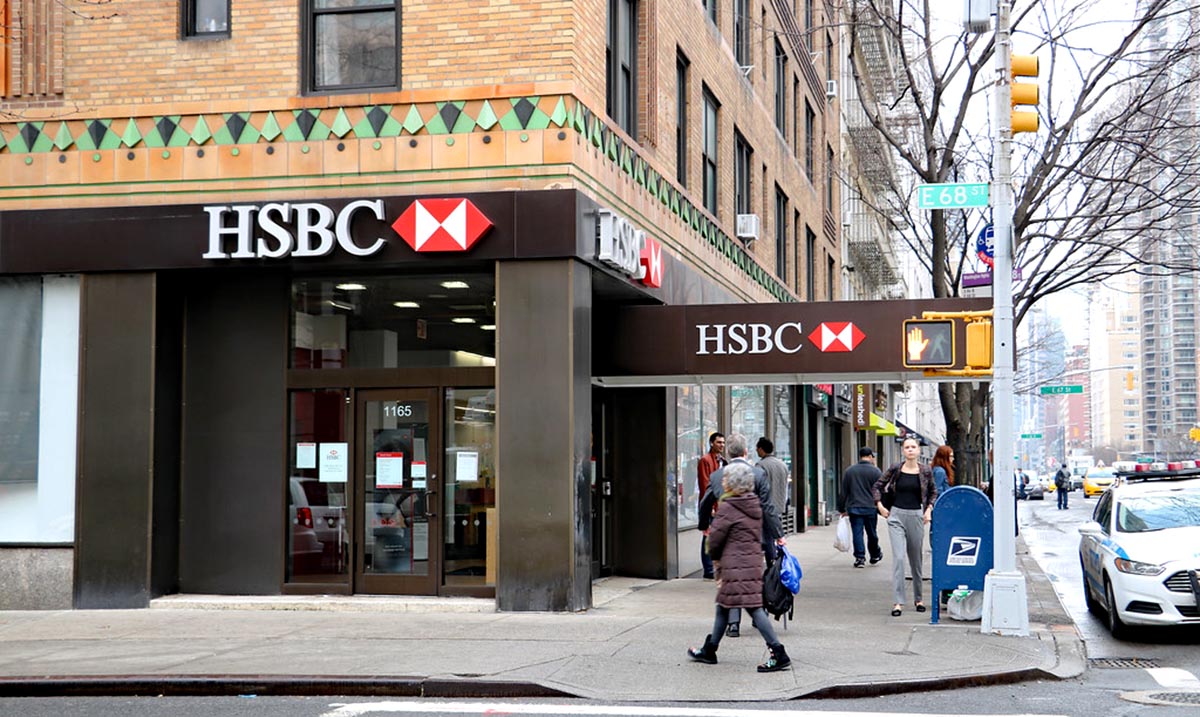
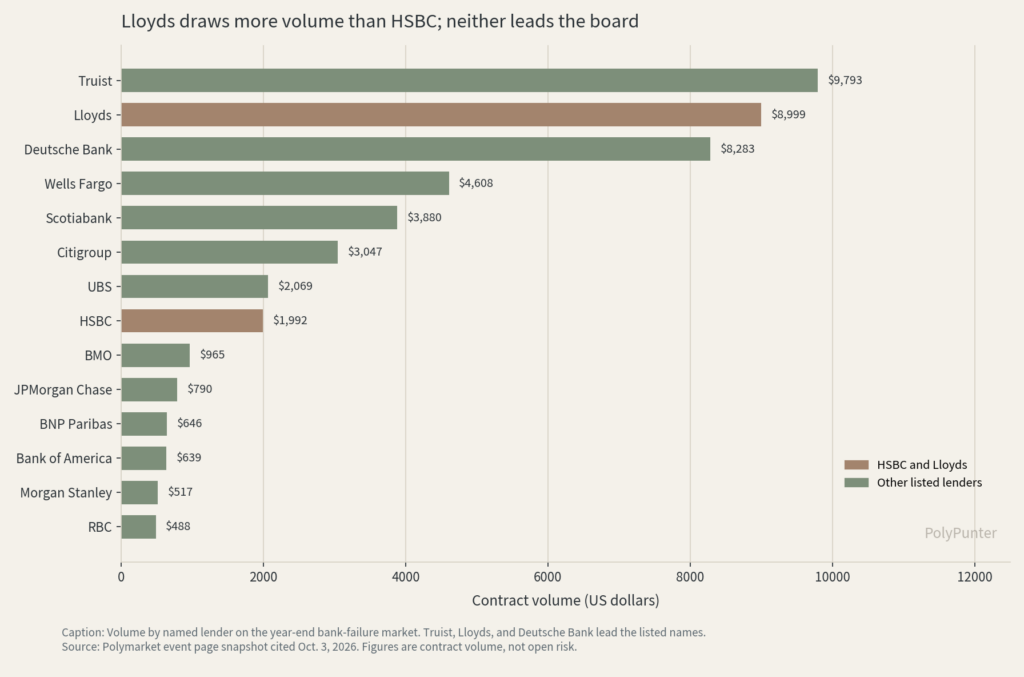
A thin stack of bank failure contracts is causing a loud argument. On October 3, 2026, Polymarket took $77,507 (£58,530) in positions on whether some of the world’s largest lenders will fail by year-end. HSBC and Lloyds Banking Group sit on that list beside JPMorgan and BNP Paribas. The volume is not particularly significant, but the market topic surely is.
Liberal Democrat MP Bobby Dean, who sits on the Treasury committee, wants regulators to call their US counterparts. He warns that a market priced as a novelty today could worsen if sentiment shifts as it scales. The Financial Conduct Authority announced it is already speaking with international regulators about market integrity. HSBC and Lloyds declined to comment, and the Treasury did not respond.
Residents of the UK, the US, Canada, and the EU are blocked from the offshore venue under Polymarket’s own rules. Traders in roughly 150 other countries are not. Some people in blocked countries also use virtual private networks to work around their geofencing.
What the Bank Failure Contracts Actually Price
The contracts ask a narrow legal question: a listed bank counts as failed only if its primary regulator declares it insolvent or non-viable, or pulls its license, and that step starts a resolution, liquidation, wind-down, or transfer. Official actions are the main resolution source, with credible reporting consensus as a backup. The deadline is December 31, 2026, at 11:59 p.m. ET.
Prices on the live board aren’t screaming distress, except for the Goldman Sachs number, which has been plummeting on this thin book.
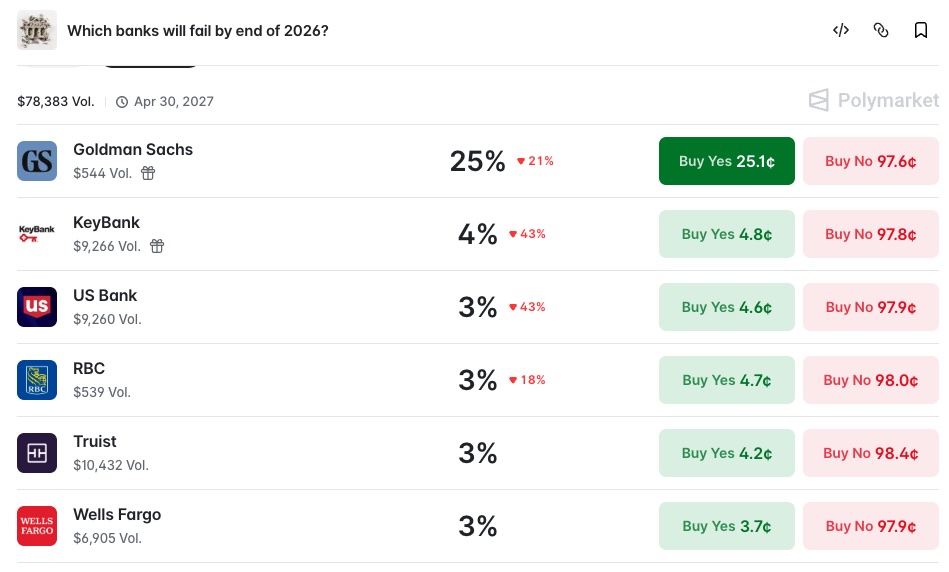
Those are not institutional block sizes. These are retail traders in something of a silly market, for now. They are large enough to screenshot, quote, and push into a feed. A trader who buys yes at 2 cents is paid only if the failure test is met. But the thin book means you’ll pay a spread just to get into this novelty space.
Why Bobby Dean Wants a Call to US Counterparts
Bobby Dean did not argue that HSBC or Lloyds is about to fail. He argued that the venue has a poor record of stopping insider trading and bad actors, so a contract tied to a lender could aggravate sentiment. “If the bank-related activity grows on the platform and then a particular market were to escalate rapidly, it could even trigger bank runs,” he said. He acknowledged that the risks look small today, but that this sector has already shown how fast size can change. It’s a bit of an alarmist take, though not unexpected from a politician, in any country.
Dean’s ask is specific: raise the concern with US counterparts. The Bank of England said its supervisors already engage with companies on market developments and emerging risks. Neither body announced a new rule on October 3. Offshore Polymarket contracts do not need a domestic listing to reach depositors; a chart can move through group chats faster than a supervisory note.
Banks have heard a version of this warning before. In August 2024, the Bank of England pressed lenders to prepare for social-media-fuelled bank runs, pointing to the 2023 failures of Silicon Valley Bank and Credit Suisse, when speculation on X and WhatsApp helped accelerate withdrawals. Dean highlighted his concerns here again: rumor, speed, and deposits leaving together.
How Neal Kumar Defended the Contracts
Polymarket’s chief legal officer, Neal Kumar, answered by pointing at an older market. “The information in these markets is already public,” he said. “Banks, hedge funds and credit professionals have had access to credit default swap markets for years,” Kumar said, adding that a person should not need an institutional seat to see a price on bank failure. He said the venue simplifies the question, puts it in front of a larger audience, and can work against disinformation and speculation because the price signals from these markets are fully transparent to the public.
The argument is not entirely without some shortcomings. Credit default swaps sit inside margin rules, reporting duties, and named counterparties. Traders’ identities in these markets are known. These Polymarket contracts sit on crypto wallets that are publicly traceable but hard to tie to a person. The wallet lets anyone audit a position after the fact. But it also makes it harder for a supervisor to know, in real time, whether a surge is a hedge, a joke, or a push.
Related friction with banks is not new. In August 2026, Bloomberg reported that JPMorgan had ended its banking relationship with Polymarket over regulatory concerns. That episode was a different dispute. But it shows large lenders were already uneasy about Polymarket before these contracts drew a Treasury committee MP member into the story.
Insider Trading Incidents European Supervisors Already Flagged
The European Securities and Markets Authority used its twice-yearly risk report last month to say a growing number of incidents shows these markets are rife with insider trading. The ESMA Trends, Risks and Vulnerabilities Risk Monitor singled out distributed-ledger venues with limited identity checks. Pseudonymous accounts, wash activity, and fights over how a contract settles were all on the list.
Newly created wallets reportedly made $1.2 million shortly before the US-Israel strike on Iran became public in February. In January, a US soldier was criminally charged over alleged use of classified information to trade the capture of Venezuela’s leader, Nicolás Maduro. In April, French police were notified over suspected tampering with weather sensors at Charles de Gaulle airport used to settle weather contracts.
None of those cases is a bank failure. Dean is using them as a pattern: if a wallet can front-run a strike, a raid, or a temperature reading, a wallet can also front-run, or fake, stress at a lending institution.
What a Jump in the Odds Would Test
A Polymarket contract can reprice in minutes if a rumor lands, even before the legal test for failure is met, if that ever even comes to pass. Depositors don’t have to trade the contract to react to a chart or a breaking news report that says the odds of a bank failure before the end of the year just doubled. Silicon Valley Bank and Credit Suisse were not brought down by a contract. They were forced into failure or rescue while online messages condensed fear into withdrawals. You may be shocked to learn that the Internet will spread information around the world in seconds without any verification requirements.
Kumar’s defense leaves a practical test. If the signal is already in the credit default swap market, a public contract should mostly echo it for a broader audience. If the contract starts leading the swap spread, or leading deposit outflows, that defense gets harder to hold. Supervisors watching both series could see which one moved first. The FCA has not said it is running that comparison. The fact that it is talking to foreign regulators suggests a bona fide concern.
References
- The Guardian, “UK urged to act as Polymarket takes bets on whether HSBC and Lloyds will fail,” October 3, 2026
- Polymarket, “Which banks will fail by end of 2026?”
- The Guardian, Bank of England warning on social-media bank runs, August 6, 2024
- Bloomberg Money Minute, JPMorgan and Polymarket, YouTube
- ESMA, Trends, Risks and Vulnerabilities Risk Monitor No. 2, 2026
- The Guardian, US soldier charged over Maduro-raid trading, April 23, 2026
- The Guardian, French police and weather-sensor claim, April 23, 2026
- The Guardian, trading linked to Iran and Ukraine strikes, April 11, 2026
- Macey and Enriques, Oxford Business Law Blog, August 2026