
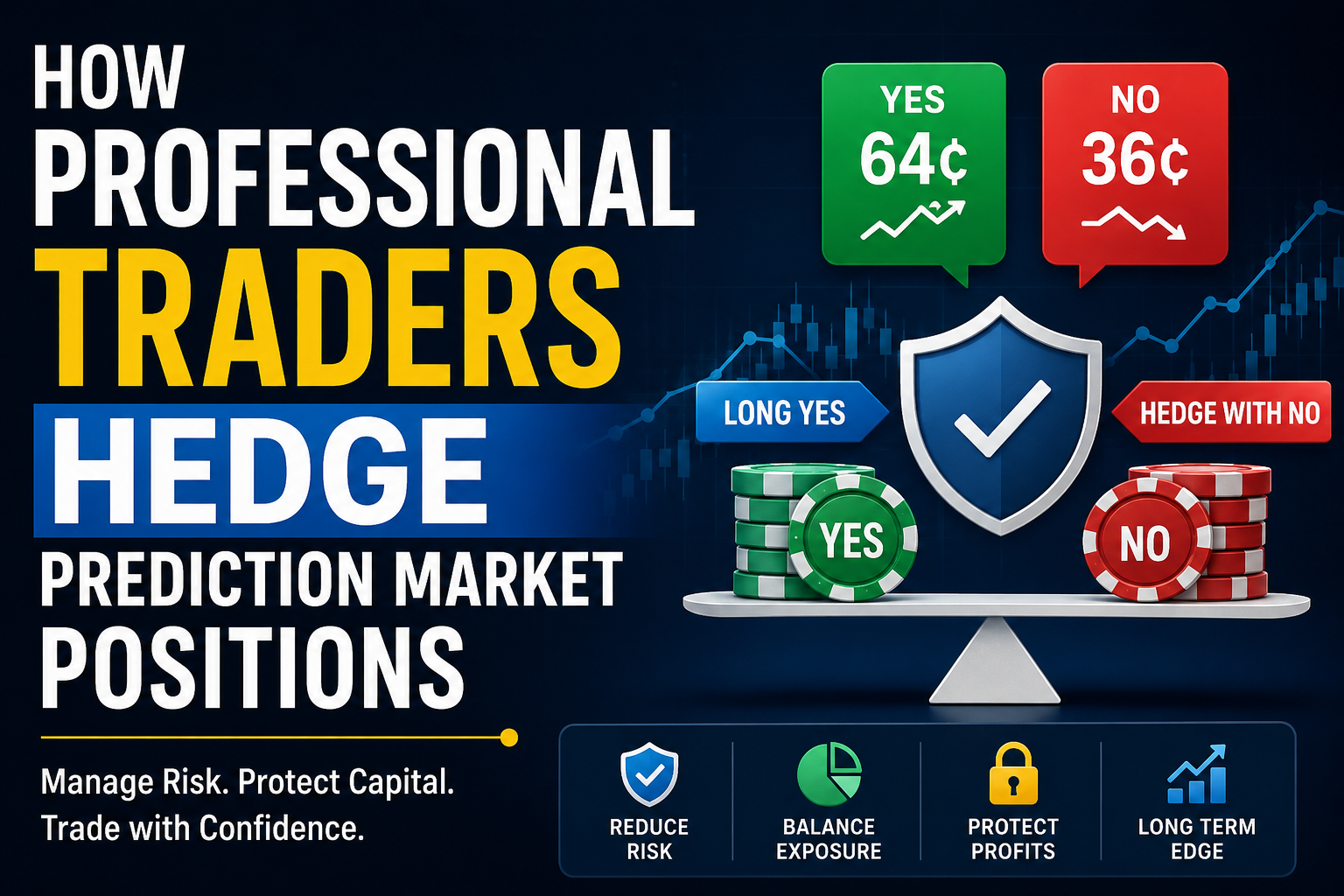
Prediction markets have moved from niche curiosity to serious trading venues and with real money on the line, risk management matters just as much as picking winners. When professional traders hedge prediction markets positions, they are not trying to guarantee a profit on every trade – they’re trying to control how much they can lose while keeping their upside intact.
In this guide, we will break down exactly how that’s done, from basic offsetting trades to cross market arbitrage, so you can apply the same principles whether you’re trading Polymarket, Kalshi or a sportsbook style platform.
Why Traders Hedge Prediction Market Positions in the First Place
Prediction markets are binary or near-binary by nature. A contract resolves YES or NO, and the price sits somewhere between $0.01 and $0.99 reflecting the market’s implied probability. That structure creates a specific kind of risk: a single event can move a position from fully in-the-money to worthless almost instantly. Unlike a stock that might dip 5% on bad news, a prediction market contract can collapse to near zero the moment an outcome becomes clear.
Because of this, professional traders hedge prediction market positions for a few concrete reasons:
- To lock in a gain before resolution. If a contract you bought at $0.30 is now trading at $0.75, you can take an offsetting position to bank profit without waiting for the final outcome.
- To reduce exposure to a single event. Large positions concentrated in one market create outsized risk if new information shifts the odds overnight.
- To manage liquidity risk. Some prediction markets have thin order books. Traders hedge to avoid being stuck holding a position they can’t exit at a fair price.
- To arbitrage pricing gaps. When the same event is priced differently across platforms, hedging becomes a way to capture near risk-free spread.
The common thread is that hedging isn’t about avoiding risk entirely — it’s about shaping it into something manageable.
Core Hedging Strategies Traders Actually Use
1. Opposite-Side Offsetting
The simplest hedge is buying the opposite outcome on the same contract. If you’re long YES on “Candidate X wins” at $0.40, and the price rises to $0.65, buying a NO position at $0.35 locks in a guaranteed profit regardless of the outcome, because $0.65 + $0.35 exceeds $1.00 minus your original cost basis. This only works cleanly once the combined cost of both sides is less than $1.00, which usually only happens after a meaningful price move in your favor.
2. Cross-Platform Arbitrage
Because prediction markets aren’t perfectly efficient, the same event can be priced differently on two platforms. A trader might see “Team A wins the championship” priced at $0.55 YES on one exchange and $0.50 NO on another. Buying both sides across platforms locks in a small, near-guaranteed edge. This is one of the purest ways professional traders hedge prediction market positions, since it doesn’t depend on predicting the outcome at all — just on spotting temporary pricing inefficiencies.
3. Partial Position Sizing and Scaling Out
Rather than hedging with a single opposing trade, many traders scale out gradually. If a position moves favorably, they’ll sell a portion of it at each price milestone — say 25% of the position every time the contract gains ten cents. This reduces exposure progressively without fully exiting, letting traders keep some upside if the trend continues while banking real profit along the way.
4. Correlated Market Hedging
Some events are correlated even if they aren’t identical. A trader holding a position on “Party X wins the election” might hedge using a related market like “Party X controls the legislature,” since both outcomes tend to move together. This isn’t a perfect hedge, but it reduces correlated risk when a direct offsetting contract isn’t available or is too illiquid to trade in size.
5. Basket Hedging Across Multiple Events
Traders who hold several related positions — for example, multiple state-level election markets — sometimes hedge at the portfolio level rather than trade-by-trade. Instead of offsetting each position individually, they calculate their net exposure across the whole basket and place a smaller number of hedges to bring that aggregate risk down to an acceptable level. This is a more advanced technique but is standard practice among traders running larger books.
How Professional Traders Hedge Prediction Market Positions Using External Instruments
Not every hedge happens inside the prediction market itself. Experienced traders sometimes hedge with instruments outside the platform entirely:
- Options and futures on related assets. A trader with a large position on an economic-policy prediction market might hedge using interest rate futures or equity index options that react to the same news.
- Sports betting lines. For sports-related prediction markets, traders sometimes hedge against traditional sportsbook odds when the two markets diverge.
- Stablecoin or fiat reserves. On crypto-based prediction markets, traders keep a portion of capital in stable assets specifically to hedge against platform-level risk, such as smart contract failure or exchange insolvency, which is a real and separate risk from the bet itself.
This layered approach — hedging the outcome risk and the platform risk separately — is one of the clearer signs of a professional approach versus a casual one.
Practical Example: Hedging a Political Prediction Market Trade
If a trader purchases 1,000 contracts of the YES at $0.35 when “Candidate wins primary” occurs, that will cost the trader $350. After two more weeks, the price rises to $0.70 again.Then, after 2 more weeks, the price increases to $0.70. The trader has to choose between 2 options:
- Full exit: When they sell for a total of $350 at $0.70, they will have no exposure and they will have made a profit of $350.
- Partial hedge: Sell 600 contracts at $0.70 and keep the rest 400 contracts risk-free ($420 already recovered – more than the cost) If the candidate prevails, the additional $400 is paid for those 400 contracts. If they lose even then the trader keeps the $70 in profit he made in part sale and pocketed.
This partial-hedge approach is extremely common among professional traders because it removes the “all downside” scenario while preserving some upside. It’s a small example, but it’s the same logic scaled up in institutional trading desks handling six- and seven-figure books.
Common Mistakes When Hedging Prediction Markets
- Hedging too late. Waiting until a market has nearly resolved often means the opposite side is too expensive to make the hedge worthwhile.
- Ignoring fees and spreads. Prediction market platforms charge trading fees or have wide bid-ask spreads, which can eat into what looks like a risk-free arbitrage on paper.
- Over-hedging. Some traders neutralize their entire position and end up with negligible profit after fees, defeating the purpose of taking the trade in the first place.
- Assuming correlated markets move identically. Correlated hedges reduce risk but rarely eliminate it — treating them as a perfect offset is a common and costly error.
Key Takeaways
Professional traders hedge prediction market positions using a mix of direct offsetting trades, cross-platform arbitrage, scaled exits, correlated market positions, and external financial instruments. The goal is never to eliminate risk completely — it’s to convert an all-or-nothing bet into a controlled, asymmetric position where losses are capped and some upside remains. Beginners can start with simple offsetting trades and scaling out, while more experienced traders can layer in cross-platform arbitrage and portfolio-level hedging as their position sizes grow.
FAQs
Can you hedge prediction markets?
Yes. Traders hedge prediction market positions mainly by taking the opposite side of the same contract, entering a correlated market, or offsetting on another platform.
How did one trader make $2.4 million in 28 minutes?
In 2015, a trader turned $110,000 into $2.4 million on Altera call options in the minutes before Intel’s takeover news broke, when the stock jumped 28% right after trading resumed. The timing was so precise that Reuters later found the trades happened seconds before the news went public.
What is the 84% rule in trading?
It’s a retail trading heuristic claiming that if a trade setup fails once, it works about 84% of the time on the second retest. It’s popular among day traders but isn’t backed by peer-reviewed data.
How do traders predict the market?
They read the current price as an implied probability, watch for new information, and compare that price to their own estimate of the real odds.
How did Warren Buffett predict the market?
He didn’t — Buffett avoids short-term forecasting and instead buys undervalued businesses to hold for years.
How accurate is Jim Cramer?
Not very, by most independent studies. A Wharton analysis found his Action Alerts PLUS portfolio returned 4.08% annually from 2000-2017, versus 7.07% for the S&P 500.

Colin is a long-time digital media channel operator and content creator with an intense interest in sports gaming, prediction markets, and artificial intelligence, and how they are shaping the social, entertainment, and economic landscapes.


