Instead of endless lawsuits, a high-court ruling could separate genuine hedging and forecasting from pure gaming and force Congress or the CFTC to write durable rules, rather than improvising around today’s politics.
Prediction-market platforms now list cash-settled event contracts on elections, sports, weather, and economic releases. State gaming agencies treat many of those products, most notably sports, as wagers dressed up in derivatives clothing. The result is a tangle of injunctions, emergency orders, and rival readings of the same federal statute by different state and circuit courts.
Waiting for Congress to craft and pass specific legislation clearing up this dispute seems dubious and likely to take years, at the least. I’d buy the No contract on that happening before 2030.
The Supreme Court has no overt political entanglements or mechanics and therefore can bring Article III order to this disarray. A national ruling would decide whether event contracts on designated contract markets are “swaps” under the Commodity Exchange Act, whether federal exclusive jurisdiction trumps state gaming codes, and what Congress meant when it told the Commodity Futures Trading Commission to block contracts “contrary to the public interest.” Once again, Congress was little help. But it can be overcome.
The Statute Already Has a Test That Has Never Been Settled.
In 2010, Congress added a special review power in CEA section 5c(c)(5)(C). The CFTC may find that contracts based on occurrences or contingencies are contrary to the public interest if they involve unlawful activity, terrorism, assassination, war, gaming, or similar activity designated by rule. The agency implemented that authority in Regulation 40.11.
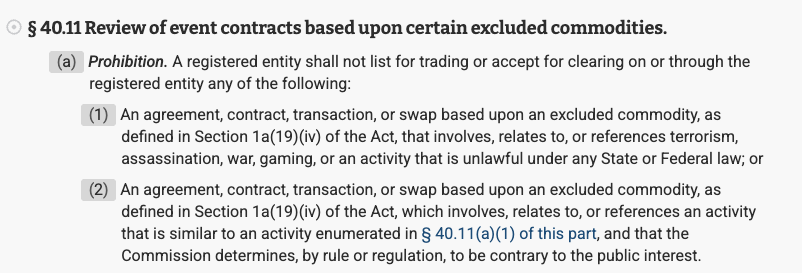
For years, the clause sat mostly unused. It was simply not practically relevant. Then prediction market trading volumes surged, with sports contracts driving much of the activity. Self-certification let new listings arrive faster than the 90-day review required by this very same 40.11 Federal regulation.
The hinge word is “involve.” One reading looks at the underlying market event. Another treats the mere act of staking money as a form of gaming. In 2024, Judge Jia Cobb vacated the CFTC’s ban on Kalshi’s congressional-control contracts and adopted the first reading. The agency later dropped its appeal, as a Congressional Research Service legal sidebar recounts.
Because Congress never defined “gaming” with any precision, every later fight inherited the same hole. Sports leagues and state attorneys general say a yes-or-no contract on a final score is sports betting in every way but name. Exchanges say it is a fully collateralized swap on a commodity. Both answers cannot stand at once. Though somehow they currently are.
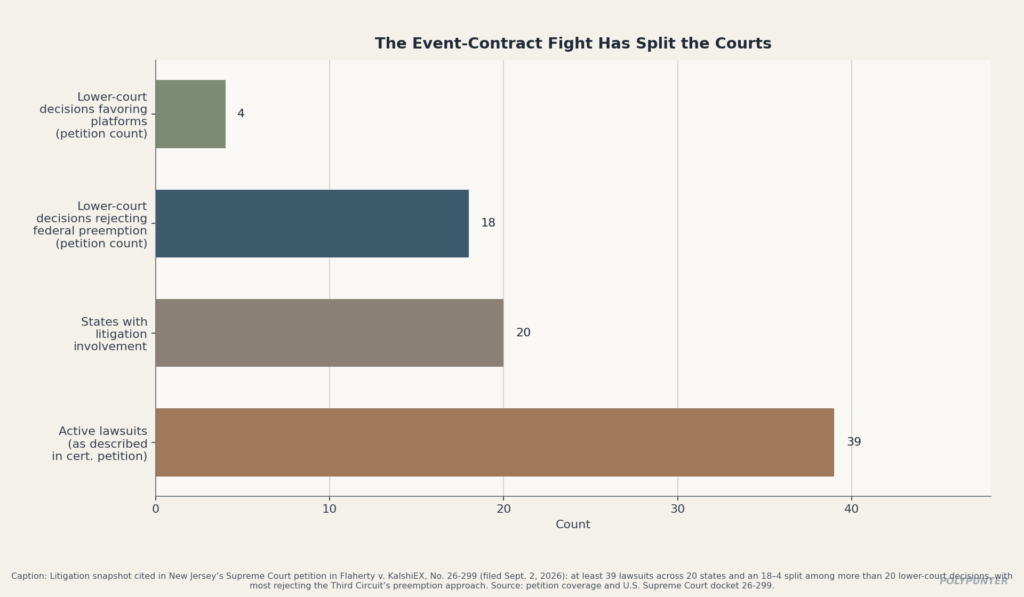
Lower Courts Are Writing Two Different Federal Laws
In April 2026, a divided Third Circuit affirmed a preliminary injunction for Kalshi in KalshiEX LLC v. Flaherty, 172 F.4th 220. The majority said sports event contracts on a CFTC-registered market likely qualify as swaps and that federal preemption applies.
The Ninth Circuit has gone the other way, treating sports event contracts as outside the swap definition and leaving state gaming rules intact. Related appeals are pending elsewhere. And more recently, the Sixth Circuit joined the Ninth in its strong lean toward the overarching rights of state gaming regulators to oversee wagering in their own states.
Meanwhile, New Jersey officials petitioned the Supreme Court to reverse the Third Circuit’s ruling that prevails in their state. On September 2, 2026, Attorney General Jennifer Davenport and Division of Gaming Enforcement Interim Director Mary Jo Flaherty filed No. 26-299. They ask whether Dodd-Frank preempted states from regulating sports bets offered on CFTC-registered markets. Kalshi’s response is due November 9, 2026.
Murphy Does Not Answer This Case by Itself
State officials lean on Murphy v. National Collegiate Athletic Association. In 2018, the Court struck down the Professional and Amateur Sports Protection Act (PASPA), opening the door for states to choose whether to allow legal sports betting in their jurisdictions. Justice Alito wrote that Congress may regulate sports gambling directly, but if it elects not to, each state remains free to act on its own.
Prediction market contract exchanges answer that Congress already acted. Dodd-Frank broadened the swap definition, gave the CFTC exclusive jurisdiction over swaps on designated contract markets, and added the special rule. The contract market platforms will argue that Murphy’s reservation of state power applies only where federal law is silent. On this point, they will claim Congress has already spoken.

Textual interpretation can support both arguments. A swap includes an agreement that pays based on an event associated with a potential financial, economic, or commercial consequence. Sports results move sponsorships and media rights. Elections move taxes and regulation. Weather moves insurance. Still, if every contingent payout is a swap, federal regulation covering this entire sector risks becoming meaningless in practice.
That is why a Supreme Court opinion would help even if it is narrow in focus. The justices don’t need to design an approved prediction market product catalog. They may need to decide only whether the swap definition reaches retail sports event contracts, how exclusive “exclusive jurisdiction” really is, and how the special rule interacts with state police power.
The CFTC Has Rewritten Its Own Playbook Twice
Agency policy has lurched. The Commission blocked Nadex political contracts in 2012 and Kalshi’s congressional-control contracts in 2023, treating election staking as a distinct form of gaming. A district court later vacated the Kalshi order. After a leadership change, the agency dropped its appeal, withdrew a 2024 proposal that would have treated many political and sports contracts as categorically contrary to the public interest, and announced a more permissive stance: New White House administration, new stance.
On June 10, 2026, the CFTC issued a new proposal, “Prediction Markets; Public Interest Determinations,” published at 91 Fed. Reg. 35,806. The draft would rewrite Rule 40.11, define “gaming,” explain when a contract “involves” an enumerated prohibited activity, and add a multifactor public-interest appendix.
The proposed inquiry has three interrogative steps. Is the instrument an event contract? Does settlement turn on an enumerated activity? After a contract-specific review, is the listing contrary to the public interest? Involvement would no longer be an automatic ban. The Commission would have to make an affirmative finding. It has already struck down certification of contracts involving national leader assassinations and some similarly openly distasteful, deadly activities and fatality counts.
While that is marginally clearer than the old practice, a proposed CFTC rule is still not a statute. A later Commission can rewrite it. Durable law still has to come from Congress, or from a Supreme Court reading that agencies, regulators, and operators cannot practically work around.
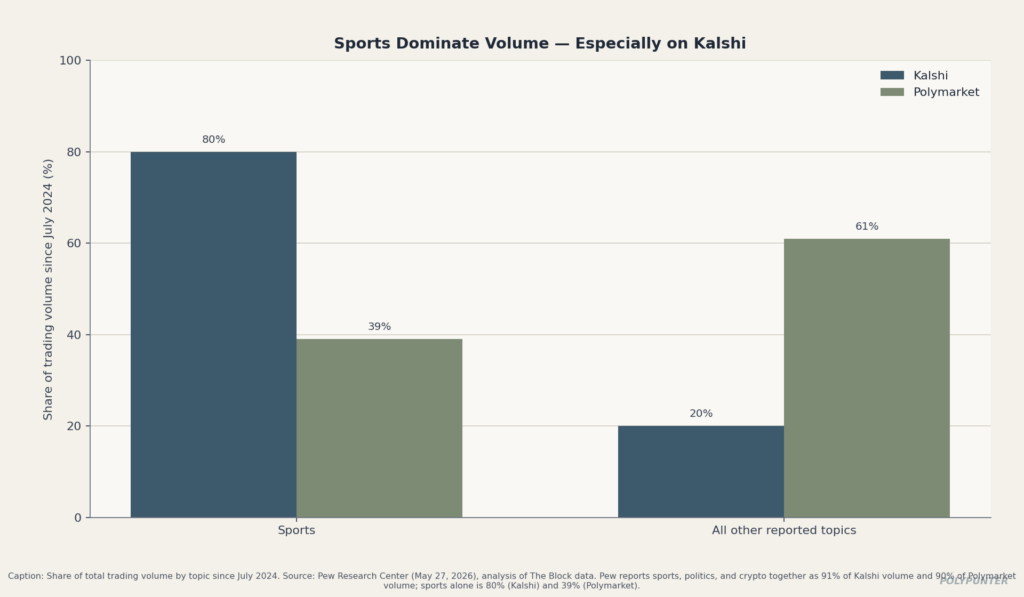
Economic Value Versus Gambling
A strong test for prediction market contracts is economic utility, such as risk-hedging functions or the accuracy of public information. A winter freeze contract mitigates weather risk. An election contract aggregates scattered civic information. A CPI contract hedges rate exposure for 401(k) investors. Those uses match the price-discovery mission that futures law has served for over a century.
A contract that pays if a roulette wheel stopped on red does not. Neither does a contract built around a referee’s subjective call, a player’s injury, or a school game. The June proposal draws a similar line. It treats sports as gaming in the underlying-activity sense. Yet, it preliminarily finds that aggregate professional and collegiate outcomes with objective settlement data are unlikely to fail the public-interest test. Pure-chance games and high-risk adjacent markets would face the opposite presumption.
CFTC Chairman Michael Selig has made the same case publicly. In remarks to the agency’s Innovation Advisory Committee, he argued that prediction markets are not a novelty Congress forgot and previewed Rule 40.11 amendments plus later core-principle updates.
Congressional oversight is probing the same fault line. A House hearing on customer protection and market integrity in sports event contracts put manipulation risk on the record. But as noted, looking to Congress for legislative solutions in this era is one level below even wishful thinking.
A Federal Label Does Not Erase Misconduct
The CFTC’s Division of Enforcement issued an advisory after Kalshi disciplined traders for misusing nonpublic information, including a political candidate trading a contract tied to his own race. Release No. 9185-26 reminds the market that fraud, manipulation, and misappropriation statutes still readily apply in certified CFTC markets.
Insider trading and market manipulation cases cut two ways. They show that a federal derivatives regulator can police event contracts with tools states often lack, including exchange surveillance duties and CEA anti-fraud provisions. They also show why “public interest” shouldn’t mean “list everything and hope surveillance catches the rest.” A regulated market needs regulation. Offshore venues are largely unregulated and exist for traders who prefer that option.
Settlement design is part of that test. A contract that resolves on a published box score or a government-certified canvass is auditable and, while not impossible to manipulate, considerably harder to do. A contract that resolves on a rumor, a social-media “mention,” or an officiating judgment invites noise, mistrust, and diminished public benefits. Courts can force that distinction by refusing to treat every contingent payout as either automatically lawful or automatically a crime.

Fifty Rulebooks Cannot Govern One Screen
New Jersey’s SCOTUS petition recites a now-often cut-and-paste state gaming officials’ grievance: sports event prediction markets are nothing more than nationwide sports wagering without the licensing, tax, age-verification, and consumer-protection regimes built after the Murphy decision. Multiple states have sued prediction market platforms or sought restraining orders. The CFTC has answered with amicus briefs, interventions, and even emergency authority to keep a registered market open. Chairman Selig often repeats that Congress did not intend for derivatives exchanges to live under a patchwork of gaming codes. Platform operators echo this view, saying the patchwork stifles national market efficiencies and product innovation.
Patchwork regulation is economically incoherent. A fully collateralized contract cannot be a lawful swap on Monday and an illegal wager on Tuesday because a user crossed a state border while on their phone. Clearing and surveillance systems do not respect lines on maps, and forcing them to do so is costly, inefficient, and antithetical to open access to markets.
If federal law controls the field, states should not nullify a registered contract listing simply by relabeling it as gambling. If federal law does not preempt the field, exchanges should not be able to nullify state gaming power with a self-certification. The Supreme Court should solve this core conflict, if only for sports event contracts which dominate the practical landscape under discussion.
What a Useful SCOTUS Opinion Would Do
First, decide the swap question with a limiting principle. Event contracts can fit the statutory definition when settlement depends on an occurrence tied to economic consequence and when trading occurs on a registered market. That honors the original text without pretending a binary sports event market is identical to a federal interest rate forecast.
Second, reject the preemption debate. Exclusive jurisdiction over swaps on registered markets can coexist with residual state power over unregistered wagering and products that never enter the CEA framework. If the claim is that Dodd-Frank silently nationalized retail sportsbooks, the major-questions doctrine will demand a clearer statement than a generic swap definition drafted after a financial crisis.
Third, treat the special rule as operative. Congress listed gaming for a reason. Ignoring that list would invite contracts on violence and assasinations under a similarly thin hedging story. Treating the list as a blanket ban would erase the public-interest step Congress wrote. The middle path is a real review with published reasons.
Congress Still Has the Pen
A Court ruling could temporarily settle sports-event market conflicts in the circuit courts, but it won’t finish the job. Current bills already float bans on sports and casino-style event contracts, tighter limits on war and terrorism contracts, and hybrids with state opt-outs. That specific legislation would be a more comprehensive conclusion.
Congress could confirm that event contracts on registered markets are federal instruments. It could clarify “gaming” as the underlying sports or entertainment contest, not the mere act of taking risk. It could bar contracts that pay on violence, official corruption, or events a trader can personally cause. It could require coordination with sports governing bodies and real surveillance. It could leave unregistered products with the states.
Alternatively, Congress could decide that retail sports event contracts belong with state gaming commissions and amend the CEA accordingly. Either choice would beat another decade of staff advisories and withdrawn proposals. The current rule draft already contains much of the raw material: a settlement-based definition of “involve,” a recreation-and-rules definition of gaming, and factors that weigh price discovery, hedging utility, and manipulation risk. Those ideas should be enacted into law, with specific, not vague definitions, to bring long-term stability to prediction markets.
Markets That Price the Future Need Law That Lasts
Prediction markets provide a valuable public benefit: they compress scattered knowledge into a single public price. They provide superior forecasts of future events, guiding more rational resource allocation, greater economic efficiency, and decreased risk. Many of their potential benefits have yet to be implemented in practice, but the possibilities are immense.
In turn, they work in the opposite direction when they create a payoff for harm, launder insider information, or exist only to evade a licensing and government supervision regime the public already chose. The public-interest standard is supposed to separate those cases. It has not, because no institution with final authority has defined what the words mean.
Granting review in Flaherty or a companion petition seems like necessary judicial housekeeping after lower courts split and an agency reversed itself twice. After that reading, the political branches should stop improvising and hype-seeking. If hedging and information aggregation are the justification, write rules that codify those uses. If some designs are gaming with a federal logo, keep them off registered exchanges. We are discussing the nation’s legal principles, not the commercial interests of prediction market operators. The latter is a valid concern for owners who can and already do fully represent their legal arguments.
Markets that claim to price the future should not live on emergency orders. They should rest on durable law, which, if it never comes, SCOTUS clarification can best mitigate. It’s time.
References
- CFTC, Prediction Markets; Public Interest Determinations, 91 Fed. Reg. 35,806 (June 12, 2026)
- CRS, CFTC Issues Proposed Rule Regarding Prediction Markets, LSB11441
- CRS, Prediction Markets: Policy Issues for Congress, IF13187
- 17 C.F.R. § 40.11
- Supreme Court Docket No. 26-299, Flaherty v. KalshiEX, LLC
- Murphy v. National Collegiate Athletic Association, 584 U.S. 453 (2018)
- New Jersey Attorney General, petition announcement (Sept. 2, 2026)
- Arnold & Porter, Prediction Markets at a Crossroads
- Pillsbury, Indian Gaming and Prediction Markets
- Cleary Gottlieb, CFTC Special Rule proposal analysis
- Lawfare, The CFTC Is Tying Its Own Hands on Prediction Markets
- Steven Ruddock, The Coming Supreme Court Showdown Over Prediction Markets
- CFTC Release No. 9185-26, Prediction Markets Advisory
- Reuters, CFTC maps rules for prediction markets
- Sports Business Journal, Selig on sports prediction-market standards
- Chairman Selig, Innovation Advisory Committee opening remarks
- House hearing on customer protections and market integrity in sports event prediction markets