Traders have already put more than $750 million to work on 2026 midterm election contracts. That large pool of money is a live civic dashboard, updating constantly while surveys are still being fielded, weighted, argued over for their accuracy and methodologies, published, and disputed once more. Polls aren’t useless, but they are becoming glaringly outdated as standalone forecasting methods for electoral outcomes.
Calling this 2026 general election cycle the first prediction-market election describes how information now moves. Campaigns watch the prediction markets. Newsrooms quote implied probabilities. Donors demand to know why a Senate race contract just repriced after a debate clip. Too many institutions still treat those prices as a novelty or media stunt instead of a powerful public signal.
Election prediction markets will not replace rigorous polling just yet. They will, however, aggregate dispersed knowledge about likely outcomes faster than a tracking survey can. A healthy democracy should use that signal openly. Ignore the circus aspects; focus on the accuracy improvement. Reap the improved forecasting.
Expectation Is Not the Same Thing as Support
A poll asks whom you would back if the election were held today. A prediction market asks what you think will actually happen on Election Day. It’s the difference between “Who do you want to win?” and “Who do you think will win?” Personal preferences given on surveys are emotionally based. Market contract purchases with real money are far more objective.
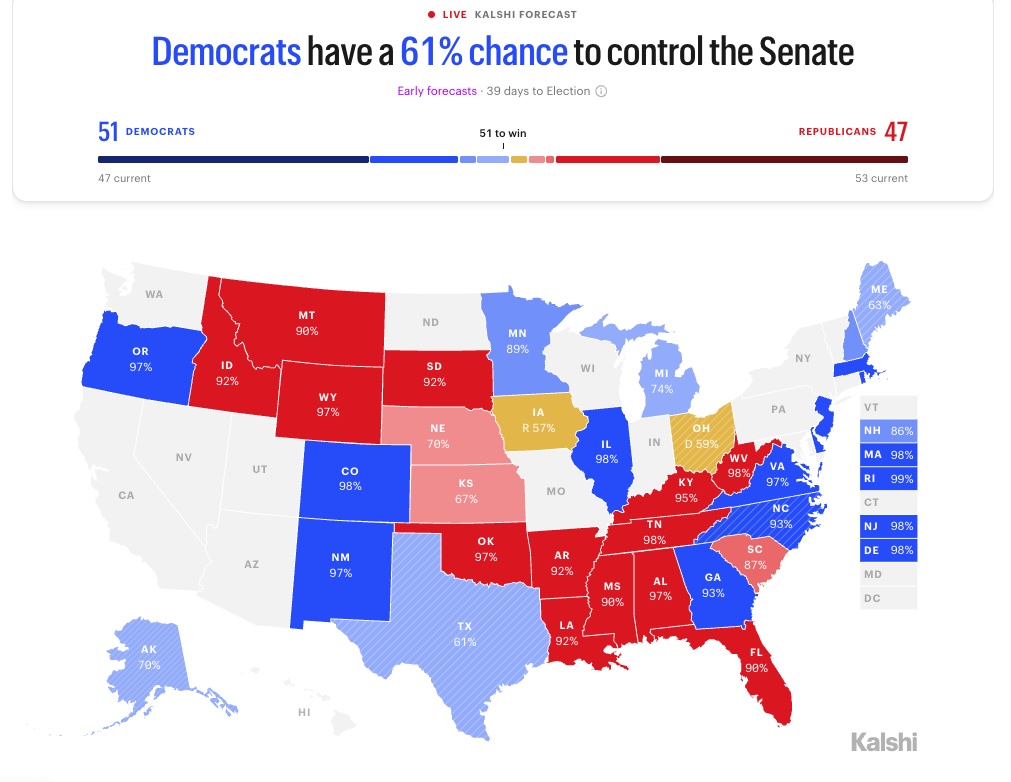
Kalshi’s midterms hub combined multiple data points, including survey results. It places live odds beside polling averages, fundraising reports, and historical results, creating one screen for congressional control and individual races. The value is not the easy layout. The value is that sentiment, money, and probability finally sit in public view together. It’s a murder board for elections. Not all evidence is weighted equally, but it all plays a part in finding your killer.
Tarek Mansour, Kalshi’s co-founder and chief executive, said markets “cut through polarization and show you what the wisdom of the crowds actually believes, backed by real money, not rhetoric.”. The line is heavily promotional. But the mechanism behind it is older than the company: prices move when facts move. And real money speaks the most honest language.
A candidate suspends. A filing drops. A court ruling redraws a map. The contract reprices before the next survey is even conceived. That speed is the civic feature most commentary underplays when it argues that election contracts feel unseemly. We live in a digital age where information travels at the speed of fiber optics. Waiting a week for a survey to see a debate’s impact on a political race is last century’s solution. Prediction markets are faster and more accurate.
The Record Favors Faster Forecasts, Not a Single Oracle
Asking whether markets are always superior to polls is the wrong fight. Polls remain the best tool for the nuances and “emotions” that factor into elections, which are, by nature, human and emotional events. Experienced surveyors and data collectors can find insights in the polling process itself that may provide key data points for more accurate forecasts. They have their ear to the ground. They’ve been through this process many times and can spot differences, even subtle ones. We’re now talking about skilled pollsters and advanced firms, not BuzzFeed online surveys.
Yet prediction markets are stronger as living probability machines, especially far from Election Day. Thousands of highly attuned, highly informed traders look at data points and build their own algorithms to predict likely outcomes. Much like an advanced sports bettor might build an outcome algorithm with hundreds of weighted inputs, iterated from decades of historical game and league data, to create a far more accurate prediction model than the general public. And hence, why sportsbooks ban or radically limit such advanced players.
Joyce Berg, Forrest Nelson, and Thomas Rietz compared Iowa Electronic Markets vote-share prices with 964 national polls across five presidential elections from 1988 through 2004. The market forecast matched the eventual two-party vote split 74 percent of the time, and the edge widened more than 100 days out, according to the International Journal of Forecasting.
Kalshi reports a similar pattern in recent U.S. races: candidates its markets favored, even three months out, later won about nine times out of ten, and events priced near 70 percent occurred near 70 percent of the time. A Washington Post review of 2026 primary markets, cited in the hub launch note, found candidates in the 70–80 percent band winning about 75 percent of the time. That’s a very high probability accuracy rate.
Calibration is the boring virtue public debate usually lacks. A $0.60 price is a probability, not a promise. If you purchase a $0.60 Yes contract five times, it should be correct three times and incorrect twice. To paraphrase Mansour, when a $0.60 contract fails, that doesn’t mean it was inaccurate. A coin toss has a 50% probability of heads on each toss. If you flip it twice and it’s tails both times, that doesn’t indicate it’s time to update to a more precise probability forecast for the next toss.
How Scattered Clues Become One Number
A prediction market is a clearinghouse, not a casino. A reporter notices weak canvassing. A finance staffer sees an odd ad buy. A volunteer watches early-vote lines. None of them has to publish a memo. The election prediction market price absorbs the information in real time, from outside in.
Benjamin Freeman, Kalshi’s head of politics growth, told CNN that polls are backward-looking and slow, while markets stay live and can “price-in new information quicker than polls.” In the same report, Polymarket called its feeds “an antidote to the disinformation poisoning public dialogue.” Granted, both companies have a commercial stake in promoting the value of election prediction markets. But objectively, the claim still holds: the more accurate election information available to the public, the less disinformation can occur. These markets have no political agenda, and the high-volume markets are very hard for agenda-driven outsiders to manipulate.
Large institutions are already acting on that claim. French financial services firm Société Générale published a midterm forecast that folds Kalshi and Polymarket pricing into U.S. House and Senate projections. When a global bank treats event-contract odds as model inputs, the “just gambling” line starts to look dated. 160-year-old French banks are not trend hoppers.
The Tape Is Already Changing the Race
The $750 million midterm election markets tally is highly significant. This is midterm, not even a Presidential election. Congressional chamber-control contracts alone have drawn about $32 million and are still growing six weeks out at the time of this posting. Hundreds of other markets now cover seats, endorsements, and even whether the midterms occur on time. (As always at PolyPunter, we advise you to stay away from thin, niche markets on any topic.)
Depth is uneven, and you must note that limitation. Quoting all markets as equally valid data points is foolhardy, if not intentionally misleading. Headliner control markets are liquid. Many district books are thin. Quoting a $40,000 market as if it were a national referendum misuses the tool. The Anti-Corruption Data Collective counted thousands of 2026 congressional markets and warned that lightly traded prices are fragile. That’s an understatement. They are unreliable data.
Campaigns are watching anyway. Operatives told CNN the markets, even these thin and unreliable markets, have become “background noise” they must manage. Elisabeth Diana, Kalshi’s head of communications, said the forecasts should be read as a complement that “surfaces wisdom-of-the-crowd data.” Complement is the right word. One data set. A powerful one in liquid markets, but still only one.
The Better Indicator Is Still Imperfect
A serious case for election prediction markets as a superior forecaster has to include the misses. The recent Wisconsin Democratic Gubernatorial primary miss was a high-probability failure, and that can look jarring to the public. It will be the subject now of many questioning news articles. High probability requires many instances to properly assess accuracy. Any one-off provides no actionable intelligence. That’s why it’s called speculation.
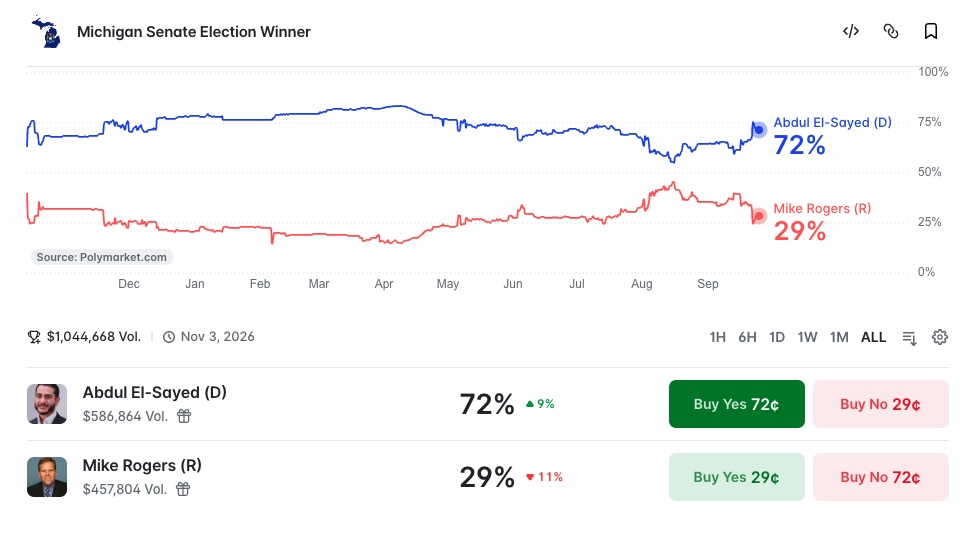
Primary markets have produced sharp calls and sloppy blowout prices. Michigan Senate Democratic primary contract sitting above 98 percent the day before a narrow finish. Calibration across hundreds of races can still be good, even when a single book looks reckless.
Brian Schaffner, Newhouse Professor of Civic Studies at Tufts, is right that markets will not “supplant” voter surveys, as he argued in Tufts Now. A market price cannot tell you whether an independent voter cares about housing or crime. A questionnaire can. Prediction markets lack the nuance and associated volume to handle such specifics. In contrast, a questionnaire cannot instantly digest an emergency court order or a breaking TMZ story on a campaign official’s arrest. A prediction market can, will, and has.
The Iowa Electronic Markets experiment began from that same humility. Robert Forsythe, George Neumann, and Forrest Nelson wanted to know whether a small real-money market could extract a cleaner forecast than surveys that had just failed. It worked often enough to become research infrastructure.
Visibility Beats a Two-Tier Information System
Some government officials wish the markets would vanish because a live probability can be twisted into a propaganda story. Those abuses are real. They are also not unique to event contracts. Polls and cable chyrons have been drafted into the same bad-faith scripts for years. And then there is perception of the purveyor. Half the country will look at a CNN or Fox News poll and discount it immediately, regardless of methodology, polling firm, or past accuracy.
Hiding prediction market numbers from the public, beyond being practically impossible right now, would not restore trust. It would create a split system in which professional desks and campaign war rooms keep watching prices while everyone else is told the numbers are unreliable and “just gambling”. For a country already suspicious of private election information, it’s a poor idea.
The better model is full visibility with detailed explanations. Publish the control-market price, the 24-hour move, and the open interest. Remind the audience that a 70 percent contract still fails three times in ten and that it means nothing more than being the favorite in a sporting event who still loses routinely. Then share each platform’s actual track record in predicting past elections, with details. That same level of transparency is hard to find from polling agencies.
The pretense that this is a niche pastime is already collapsing. Combined monthly trading on the two largest platforms jumped tenfold from last August to this past month. Politics is obviously not the whole market or even close to sports. It is no longer a hidden corner either. $750 million and counting on the midterms so far, and we’re not even in October. It’s going well past a billion.
Keep the Faster Signal
By November, some of today’s confident election market prices will look sharp, and some will look foolish. That is forecasting. The test of a civic tool is not whether it never misses. It’s the ability to provide valuable information, complement other data sources, and be freely available and easy for the general public to digest.
On their best days, election prediction markets meet all of these marks. They force a number onto a claim. They update when reality updates. They give journalists a reason to dig and hunt for the fact that moved the number. They give voters a view of expectation with any personal agenda stripped out.
Prediction market books are offering a rare public estimate of political reality that nobody can fully own. Treating them as an informational threat or “just gambling” is an ignorant dismissal. Treating election prediction markets as a public dashboard is the more honest choice.
References
- CNN, “The ‘first prediction-market election’ scrambles the midterms”
- Kalshi, Midterms Hub launch
- Fox News, Kalshi Midterms Hub coverage
- Berg, Nelson, and Rietz, “Prediction market accuracy in the long run”
- Prediction News, Société Générale forecast using market pricing
- Covers, Kalshi midterm odds tracker
- NOTUS, campaigns and market-accuracy claims
- Tufts Now, Brian Schaffner on markets and polling
- NBC News, Iowa Electronic Markets origins
- Pew Research Center, prediction-market trading volume