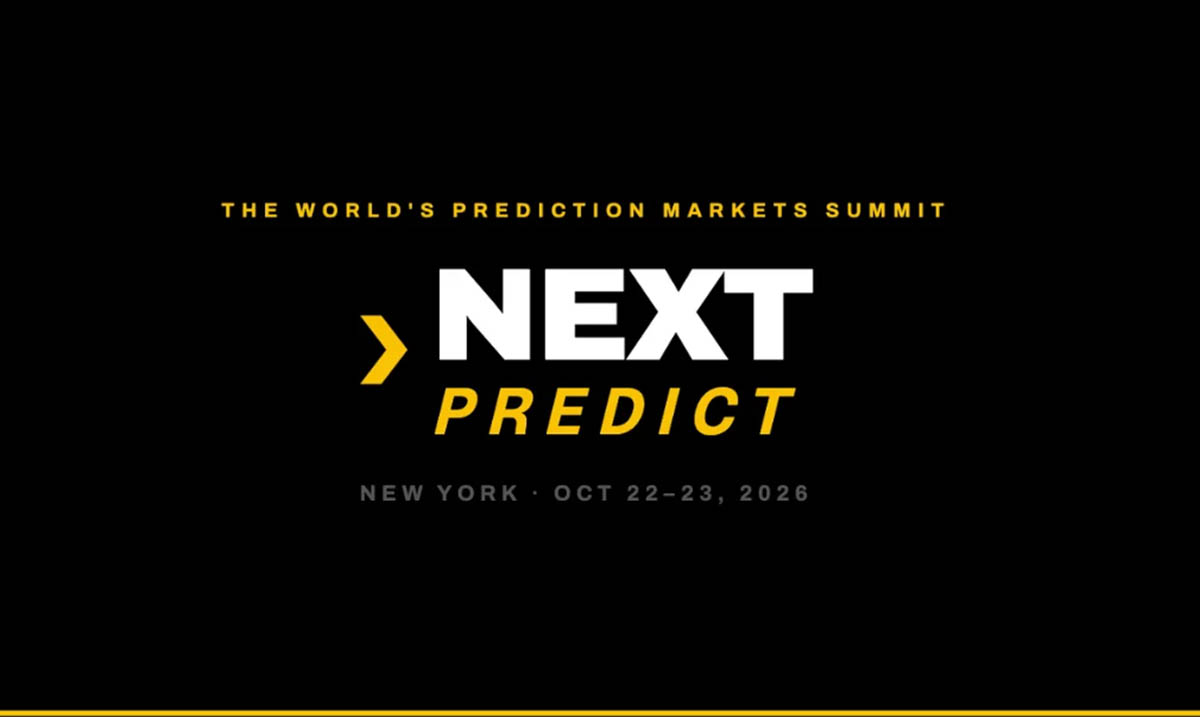
Wall Street has talked about event contracts for months. Now one of the largest banks is diving in rather publicly. Morgan Stanley has signed on as a strategic partner for NEXTPredict, the October 22–23 industry summit, and it will lead the day-two session on institutional capital. This is not an insignificant development in how institutional banks and brokers now view prediction markets.
Pierre Lindh, co-founder and managing director of NEXT.io, said the bank is the first to attach its brand to a public-facing initiative like this. Private meetings and research notes have not yet produced a clear path for large desks to trade these contracts at scale, but many now see this as inevitable.
Stephen Grambling, Morgan Stanley’s head of U.S. gaming, lodging and leisure research, will run the panel. He already covers sportsbooks, an analogous reference that still shapes how many research teams map the prediction market category. Grambling said prediction markets are drawing more attention across the financial system, yet institutional use will depend on a clear view of opportunity, market structure, and risk. That’s shorthand for the even shorter hand: we’ll dip our toes and see how it goes.
NEXTPredict expects about 2,500 attendees and 91 confirmed speakers across five stages. The session is meant to ask what would move real balance-sheet money, not just curiosity and experimentation.
Valuations assume the product mix will change. Kalshi has been discussed at a reported $40 billion, Polymarket closed a round near $20 billion, and DraftKings, the closest listed comparison, trades around $13 billion. 90% of liquidity and turnover still sits in sports contracts, and many traders treat the venues almost solely as an alternative sportsbook. As we’ve seen in recent valuation discussions from PitchBook, valuation forecasts for firms like Kalshi still depend heavily on their currently at-risk sports event contracts.
Why Banks Have Waited While Valuations Ran Ahead
Talk from other firms has been mostly just that, talk. In April, JPMorgan Chase chief executive Jamie Dimon said the bank might one day offer something in the category, while ruling out sports and politics and stressing insider-information rules. Goldman Sachs chief executive David Solomon said on the firm’s January earnings call that he had met both large operators and that an internal team was studying the space. Concrete client programs for both those Wall Street blue chips have lagged those remarks.
Morgan Stanley already joined Kalshi’s $1 billion Series F in May, valuing the exchange at $22 billion. Its wealth-management group published an April note arguing growth had outrun regulation. In August, Morgan Stanley released The Wisdom of Crowds in Markets, reviewing more than 72 million Kalshi trades and finding contract prices tracked outcomes closely, with traders slightly underrating favorites and overrating long shots.
Lindh said large banks are still waiting for regulatory clarity as state-level cases proceed. As you might imagine, banks tend to be hands-off in involvement in industries under heavy legal entanglements. Their core businesses are heavily regulated and constantly reviewed for propriety.
Lindh described Morgan Stanley’s involvement as a pure relationship story. NEXT.io has worked with Morgan Stanley for five years and partners with the bank on a sports-betting show each March. Grambling, Lindh said, championed the summit internally and cleared it across departments. A GlobeNewswire release said the conference panel will cover where institutions see opportunity, what still blocks broader use, and which questions on capital and risk remain open. Just asking some questions, as they say.
What Institutional Desks Want From Event Contracts
Research teams want a sharper read than polling. Risk groups want hedges for events ordinary futures do not price well. Lindh offered a commercial example: a conference organizer can run a flawless production and still lose a quarter’s revenue to a hurricane. NEXT.io is already testing the idea internally, using staff markets to forecast whether the company will hit its own commercial targets. Banks, he said, are looking at similar internal forecasting and at whether clients could hedge operating risk on a broader scale.
Sports volume still dominates daily activity. If 90% of turnover stays in these contracts, the $40 billion and $20 billion valuation marks become harder to defend. And that’s not even considering how major court rulings could radically affect those sports prediction markets. If weather, rates, earnings, and logistics contracts gain depth, the product starts to look like a risk-transfer venue. Grambling’s panel is being sold as putting some intelligent discussion behind that diversification.
NEXTpredict previewed the session on X, telling followers to find the Institutional & Capital panel on day two and promising a look at “opportunities, roadblocks + real questions institutions have.” The announcement framed the bank as assembling the conversation, not merely sponsoring a booth. That’s the real headline here.
How the Summit Turns a Research Desk Into a Public Test
NEXTPredict bills itself as a business meeting first. Confirmed names have included Kalshi co-founder and chief executive Tarek Mansour and DraftKings chief executive Jason Robins, plus voices from Blackstone, Bloomberg Intelligence, Bank of America, Robinhood, and CNBC. The event will be publicly available via livestream.
For a bank that has so far preferred research notes and private rounds, a livestreamed capital panel is a big shift. These participation choices aren’t made willy-nilly; they move up and down several layers of authority at Morgan Stanley.
Lindh’s core claim is simple: the industry’s pitch to investors is that tomorrow’s product is not today’s sports-heavy order book. He argues that valuations work only if hedging, research, and corporate forecasting grow. Morgan Stanley’s presence at this summer does not settle that argument. It does put a named research lead in front of it. If Grambling can connect a gaming coverage franchise, a $1 billion Kalshi check, and a 72-million-trade accuracy study to a client-ready market, other banks will find it harder to stay on the sidelines. These banks do compete for clients.
References
- Decrypt: Morgan Stanley Joins NEXTPredict
- NEXTPredict: Morgan Stanley strategic partner announcement
- Markets Insider / GlobeNewswire partnership release
- NEXTpredict on X: Day 2 Institutional & Capital panel
- Decrypt: Kalshi $40 billion valuation talks
- Bloomberg: Polymarket funding-round valuation
- Fortune: DraftKings valuation context
- Business Wire: Kalshi $1 billion Series F
- Morgan Stanley Counterpoint Global: Wisdom of Crowds
- CoinDesk: Jamie Dimon on prediction markets
- CNBC: David Solomon meetings with operators
- NEXT.io: NEXTPredict tickets and speaker wave
- Gate News: Decrypt media partnership for the summit