
At PolyPunter, we caution ourselves to always separate the mechanics and science of prediction markets from the commercial reality of present-day prediction market platforms. The potential utility of prediction market forecasting remains immense. Sports and entertainment event markets currently lead all prediction markets in trading activity and media coverage, but this doesn’t diminish the underlying potential for far broader utility.
In an age filled with confident predictions from television panel pundits and op-ed pages, prediction markets stand apart by demanding a real cost for being wrong. These platforms require people to stake real money on future outcomes, thereby turning opinions into calibrated, reasoned probabilities. As a result, the consensus forecasts hold media voices and credentialed predictors to a higher standard while opening reliable predictions of future events to anyone willing to risk capital.
This approach aggregates dispersed knowledge under continuous pressure and reduces the influence of unaccountable storytelling on public understanding and policy. A cable commentator can declare a recession or a candidate’s outcome with little to no consequences if completely wrong. A trader buying contracts on Polymarket or Kalshi, however, absorbs immediate losses when their forecast fails. This skin-in-the-game dynamic filters out wishful thinking and rewards precision.
Why Financial Stakes Improve Forecasting
Accountability arrives through profit and loss, a real-world, practical model for accuracy. Disagreeing requires buying or selling with personal funds. Over time, inaccurate voices literally lose market influence as their resources dwindle.
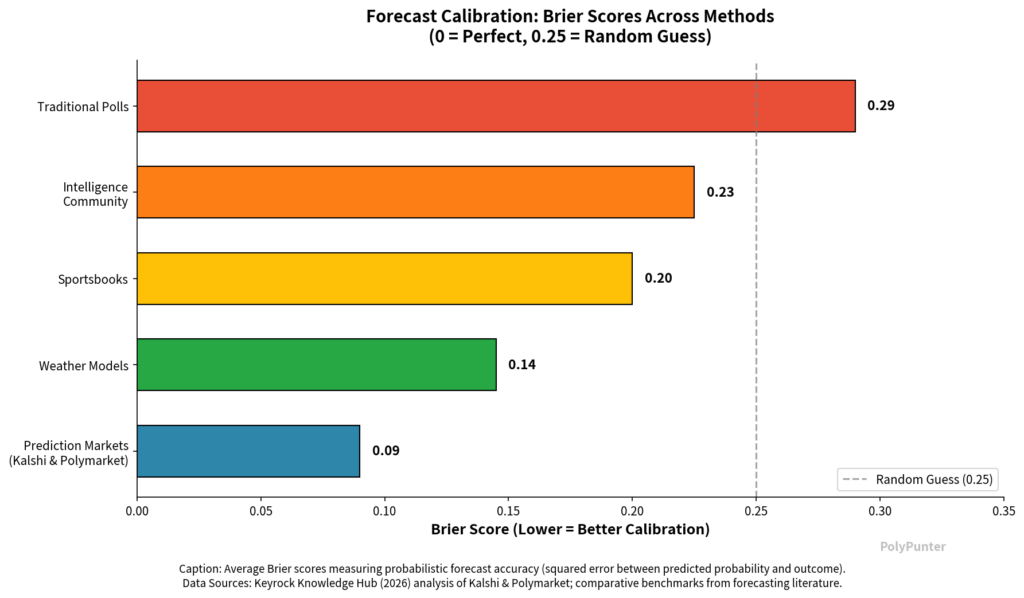
Data from the Iowa Electronic Markets, which has operated since 1988, clearly show the edge. These exchanges outperformed contemporaneous polls by about 74 percent across presidential cycles when measured against final vote shares. The advantage grew further from Election Day, when snapshot surveys are weakest. Markets already priced in expected shifts that raw poll numbers ignored, due to inherent flaws of opinion polling.
Recent contests follow the same pattern. On the eve of the 2024 presidential election, Polymarket priced Donald Trump at nearly 60 cents, while many polling averages were near a coin flip. The prediction market forecasts proved stronger across key states. Media narratives dismissing certain paths for a Trump win faced no comparable scorekeeping. Platforms simply settled the contracts.
Anonymity on many platforms further strips reputational pressure. Traders need not fear audience backlash for assigning meaningful odds to unfashionable outcomes. Only the final resolution matters. This freedom encourages honesty that media and political career incentives, or even social pressures, often suppress. Specifically, regarding Trump, traditional pollsters admitted a real concern about the honesty of polling responses given his controversial public persona, causing polls to repeatedly underestimate voter support for Trump.
Consistent Advantages Over Traditional Predictions
The record extends beyond elections. Markets have shown higher accuracy than surveyed economists on Fed rate decisions, legal scholars on Supreme Court outcomes, and critic consensus on awards. Philip Tetlock’s long-running study of thousands of predictions from credentialed political scientists and economists found average performance to be near random chance on many questions. Markets impose continuous selection: capital flows to better calibration measured by repeated results rather than self-selected highlights.
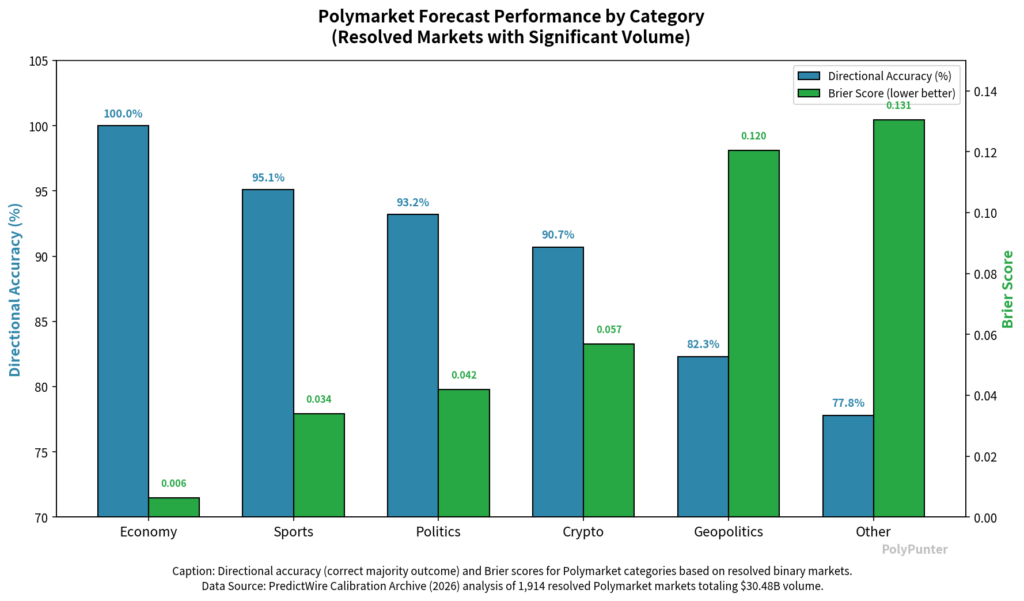
Real-time updating widens the gap. An op-ed on TV or in the newspaper can sit unchanged for weeks (if not forever) after new data arrives. Markets reprice within minutes (if not seconds) of a jobs report or policy announcement. In fast-moving situations, platforms that incorporate frequent releases track developments more responsively than those with lagged commentary. They also allow for endless iteration and updating, with the ability to track “versions” or prior crowd thinking that drove prior probabilities.
Aggregation supplies another strength. No single commentator, even if well-researched, holds every signal. Front-line observations often reach markets before formal reports. Corporate internal markets, including those from a real-life experiment at Hewlett-Packard, beat official planning forecasts on sales most of the time by synthesizing dispersed employee knowledge that never reached headquarters.
Opening Reliable Signals to Broader Use
Prediction markets lower barriers once reserved only for institutions. Domain knowledge from varied sources is weighted by accuracy rather than credentials. This counters concentration of narrative power in traditional media. When high-profile voices shape coverage, errors spread with limited correction. Markets create a parallel channel in which capital-backed disagreement moves the price, giving the public a continuously updated probability estimate.
In policy settings, the value sharpens even further. Debates over rates, regulations, or legislation often feature confident claims supported mostly by conjecture from individual sources, often partisan or biased. Related contracts force those claims into a quantitative form. Divergences between media consensus and market prices serve as visible signals that prompt deeper investigation into the underlying evidence. Even modest stakes have produced useful forecasts; larger volumes increase liquidity and sharpen high-attention questions even more.
Thin markets can be noisy and extreme probabilities sometimes show bias. Yet pure commentary suffers from parallel flaws without a built-in means for self-correction; with no capital at risk, there is little incentive for iteration and correction.
Professor Robin Hanson has long noted that speculative markets excel at information aggregation because incentives align with accuracy. Empirical comparisons show consistent superiority or parity against polls and committees. The process invites those with knowledge to trade and others to stand aside.
Everyday Uses and Remaining Limits
Individuals and organizations can consult prediction market prices for practical guidance. Firms actively monitoring related contracts can adjust even earlier. Investors receive real-time checks on consensus views. Citizens compare rhetoric against implied odds of delivery. Continuous pricing encourages attention to developments that move probabilities even without heavy media coverage.
Well-defined binary contracts with clear resolution help to strengthen historical evaluation. In contrast, ambiguous questions weaken the signal. Successful approaches attract capital and greater price impact while weaker ones fade, creating performance-ranked aggregation rather than equal airtime based on extraneous factors like playing to a niche audience or clickbait.
Challenges remain, such as thin contracts, potential bias at extremes, and integrity concerns. Regulatory attention continues to address many of these. And these issues do not erase the core incentive advantage. Combining markets with polls and models yields the strongest results, each correcting the others’ blind spots. Markets uniquely supply the skin-in-the-game filter.
Conclusion: Toward Clearer Collective Judgment
Prediction markets will not end disagreement. They do raise the cost of confident error and lower barriers to informed input. In doing so, they restore discipline to public forecasting while distributing the ability to challenge dominant narratives.
The practical result is better distinction between signal and story. Debates grounded in capital-weighted probabilities align more closely with reality than those driven by untested claims. Media and political voices now face an independent scorecard that rhetoric cannot erase. Expanding reach to high-societal-value questions allows this mechanism to guide collective decisions more effectively.
In a complex world that needs better information, that combination of accountability and openness offers measurable progress.
References
- Prediction Markets vs. Polls: Which Is More Accurate? | TickerTracker
- 9 Reasons Prediction Markets Beat Experts | Zogby
- CryptoRUs’ George Tung Breaks Down Why Prediction Markets Are Beating Polls
- Are Prediction Markets Better Than Polls? | Prediction Circle
- Opinion | Trump talks prediction markets vs. ‘fake polls’ – The Washington Post
- Why Betting Markets Are Better at Predicting the Future than Pundits and Polls
- Wisdom of Crowds Explained: Why Prediction Markets Aggregate Better Than Experts
- Prediction Markets vs Polls: 12 Times Markets Won | Zogby
- Prediction Market Accuracy: Brier Scores, Data & Comparisons (2026)
- Did Prediction Markets Predict the 2024 Election? A State-by-State Accuracy Audit
- Kalshi banks on its predictions’ accuracy | Semafor
- How is Polymarket more accurate than Wall Street analysts?
- Betting on Prediction Markets Is Their Job. They Make Millions. – The New York Times
- Skin in the Game and Prediction Markets
- Skin in the Game – Kalshi News
- Introduction to Prediction Markets, Robin Hanson
- America Is Betting On EVERYTHING?
- Betting on Reality: The Promises and Perils of Prediction Markets
- Prediction Markets vs Polls | PredictorHQ
- Prediction Markets: How you can (almost) certainly see the future by having skin in the game