

Prediction markets have surged into prominence by turning uncertainty into tradable contracts that price the odds of elections, corporate milestones, and policy outcomes. Rapid growth has also produced clear excesses: sports-style volume that mirrors traditional wagering, contracts on war and leadership changes that create moral hazard, and insider trading cases that undermine market integrity. Carefully designed reforms, such as banning war and death contracts, enforcing stronger identity verification and insider prohibitions, and providing targeted liquidity support for high-value topics, can still realize the original economists’ vision of superior collective intelligence while curbing downside elements.
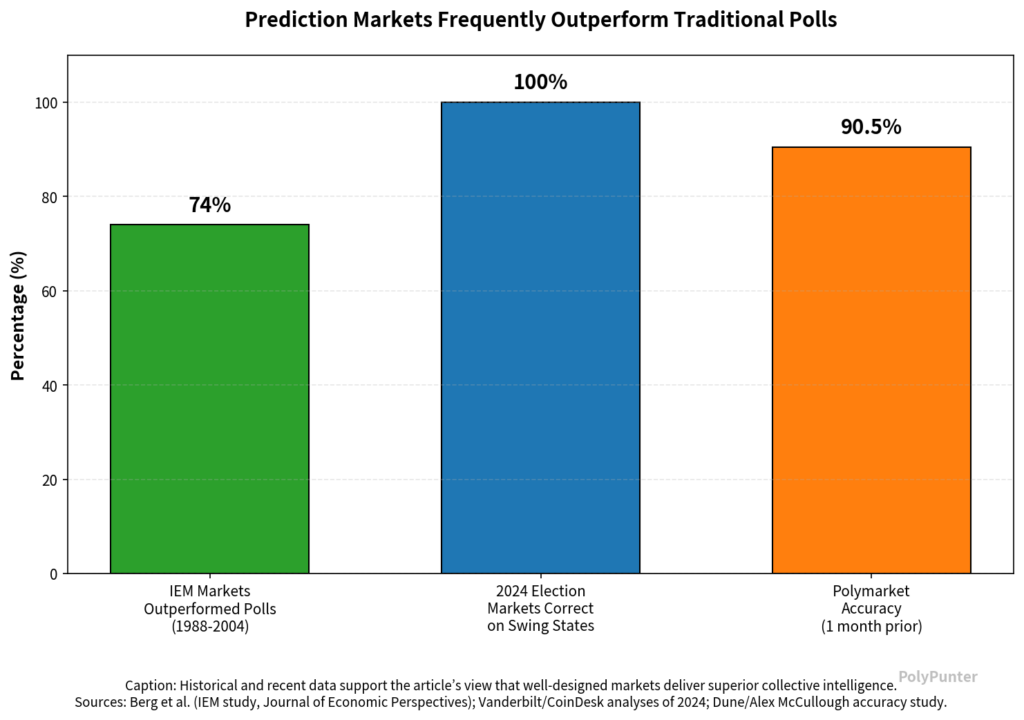
In 2008, economists including Kenneth Arrow, Robin Hanson, and Justin Wolfers published “The Promise of Prediction Markets” in Science. They argued that prediction market tools aggregate dispersed knowledge more accurately than polls or conventional forecasts and should face fewer unnecessary restrictions. Event markets have a history of lower prediction errors for elections and similar events, with clear applications for business and public policy. That core insight remains powerful today. Realizing this potential, however, requires deliberate market design that prioritizes information value over pure speculation.
Robin Hanson has described decision markets and policy markets that could evaluate the likely effects of choices before leaders commit to any path. Justin Wolfers has emphasized that prediction markets efficiently aggregate information even when other methods fall short. Empirical work has confirmed outperformance in elections and the provision of useful signals on economic indicators. Corporate internal markets have improved forecasts of product timelines and sales. The vision is centered on economically meaningful events with public value, such as policy outcomes, scientific milestones, and risk assessments, rather than entertainment-driven volume.
Current Excesses That Undermine the Promise
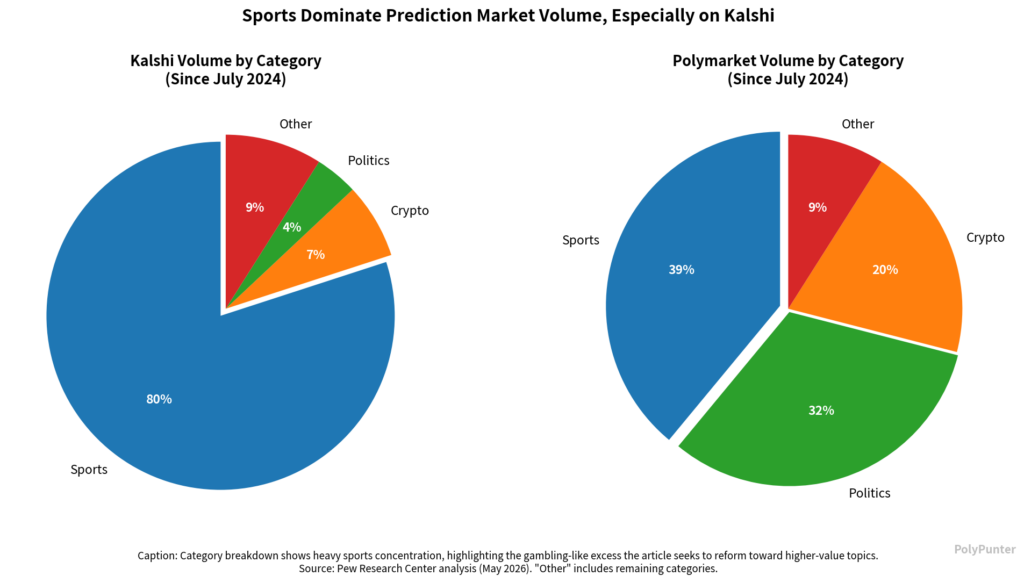
Sports-related contracts now drive substantial trading volume, especially on Kalshi, where they account for by far the largest share. Aggregate outcomes of professional contests can produce some price discovery, yet many peripheral markets closely resemble, if not intentionally mimic, traditional sports wagering. Addiction concerns and consumer-protection issues only intensify when platforms present pure speculation such as “total catches in a game by a wide receiver” as sophisticated forecasting.
The mere fact that something speculative is difficult to predict does not stamp it as a utility-bearing forecast. The utility test is whether this forecast provides value to others beyond the mechanics of pure wagering.
CFTC regulators have begun distinguishing objective, verifiable sports results that maintain the integrity of the infrastructure from higher-risk designs involving injuries or officiating calls that are random and invite manipulation by a single person. Similar to how individual athletes have been caught up in sports-betting scandals by modifying their individual performances in games. Though the CFTC has stopped well short of markets for traditional sports betting outcomes such as game outcomes and futures on season-long play and standings.
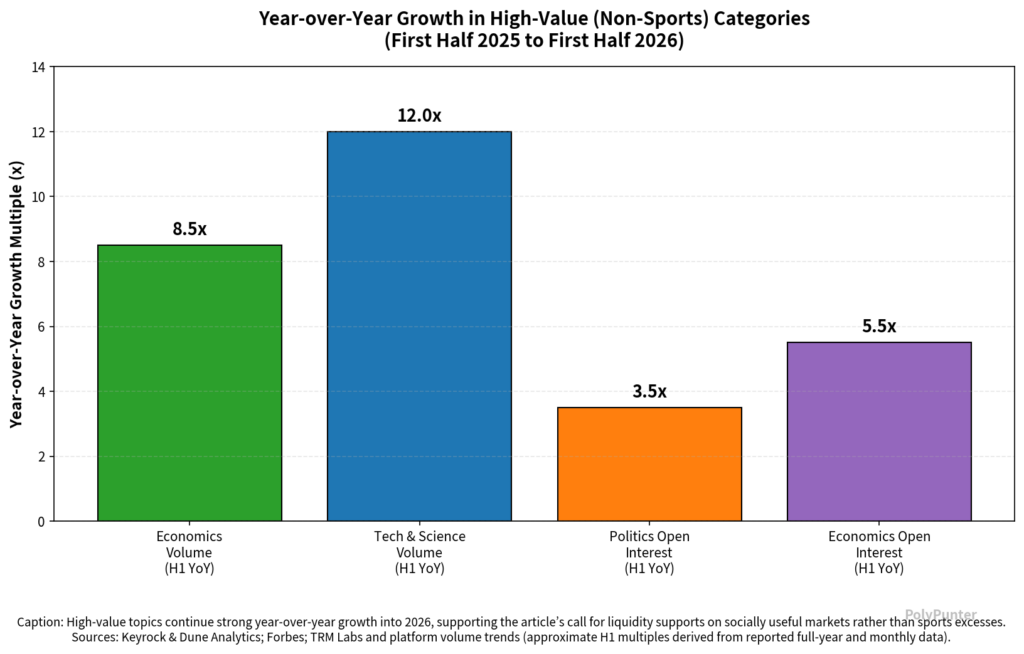
Contracts involving war, military operations, leadership changes, and assassinations create a different type of problem. Large volumes have traded on the timing of strikes or the removal of foreign leaders such as Venezuela and Iran. These markets attach financial incentives to outcomes involving human suffering and operational secrecy. Legislation such as the DEATH BETS Act seeks to prohibit registered entities from listing contracts relating to terrorism, assassination, war, or an individual’s death. Such proposals recognize that certain topics generate moral hazard that outweighs any forecasting benefit. But Congressional bills are inherently mired in politics and always a blunt instrument; they could be better addressed through internal platform prohibitions.
Insider trading cases have moved from theory to enforcement. The Commodity Futures Trading Commission has pursued actions against individuals who allegedly used nonpublic information to manipulate gains for themselves in public prediction markets. Platforms have responded with voluntary rules that bar those who can influence outcomes and require greater disclosure. Anonymous or lightly verified accounts, especially those funded by cryptocurrency, continue to pose challenges. Public trust erodes when markets appear to reward privileged knowledge rather than broad information aggregation. Thinly traded contracts can be moved by relatively small sums, amplifying any informational edge and essentially allowing one to ‘own’ the outcomes of smaller markets.
These three factors notably distract from genuine forecasting value and invite regulatory backlash that could harm prediction market applications with greater social utility. That is not a moral judgment on issues such as sports wagering, but rather a recognition that including, if not highlighting, that element could undermine prediction markets’ overall ability to flourish.
Core Reforms: Clear Boundaries and Fairness Rules
Drawing a firm line against contracts involving war, assassination, terrorism, or individual death protects market integrity and societal values. The Commodity Exchange Act already flags these categories for heightened scrutiny. Proposed rules from the Commodity Futures Trading Commission outline a public-interest test weighing price discovery, hedging utility, manipulation risk, and settlement integrity. Contracts whose settlement turns on military actions or mortality can fail that test because they introduce operational risks and ethical conflicts. Lawmakers have introduced multiple bills reinforcing this boundary. Formal prohibitions create consistency, reduce incentives for offshore venues with weaker oversight, and free regulatory attention for constructive design on remaining topics. Though internally, industry prohibitions will work better than politically conceived legislative solutions to this issue.
Identity verification and robust insider prohibitions form the foundation of credible markets. Requiring know-your-customer procedures reduces the anonymity that currently shields potential misuse of nonpublic information and dissuades traders from breaking the rules. Platforms that collect employment details for sensitive markets and block politicians, athletes, or officials from trading related contracts take useful steps. Extending these practices industry-wide, with regulatory backing, raises the cost of misconduct.
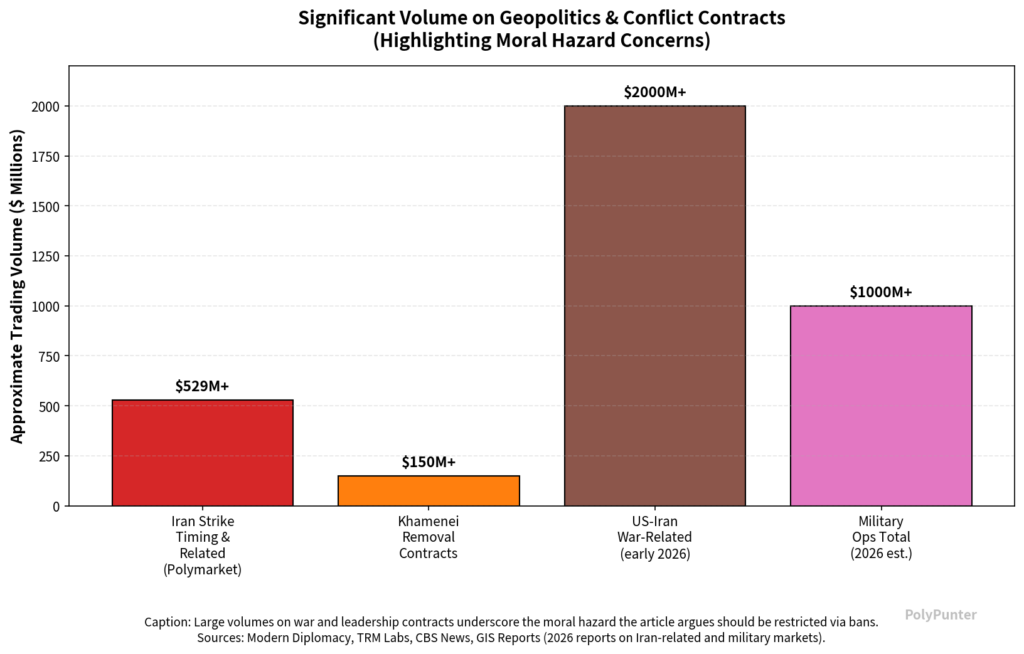
The Commodity Futures Trading Commission has clarified that trading on material nonpublic information in breach of a duty of trust constitutes fraud. Enforcement actions demonstrate willingness to apply these standards. Stronger rules should prohibit trading by anyone in a position to influence an outcome and require disclosure of relevant affiliations. When traders know privileged information carries legal risk, prices more reliably reflect widely available knowledge. This is no different than SEC regulations that prevail in equities markets to mitigate insider trading. None of these prevention systems are perfect, but mitigation is vital.
With guardrails, especially those aimed at prevention, markets become fairer venues for collective intelligence. Liquidity providers and informed traders without insider access engage more readily when they trust the playing field rewards real forecasting merit. Accuracy improves because prices incorporate dispersed public information instead of being skewed by a few privileged accounts. Clear bans and fairness rules together restore confidence without eliminating incentives to research and trade on open data.
Liquidity Supports for High-Value Topics
High-value topics such as policy outcomes, scientific milestones, climate indicators, and economic risks often suffer from thin trading relative to sports or entertainment contracts, which draw much broader casual trading interest. Subsidized liquidity or market-maker incentives can correct this imbalance. Platforms already spend on liquidity rewards to attract volume. Directing those resources, or adding public and philanthropic support, toward questions with clear societal importance produces better public goods. This need not be a highly specific re-routing. Rather, a shift in liquidity from sports-and-entertainment contracts to other categories.
Robin Hanson has long argued that those who value the information should subsidize market makers so prices reliably inform decisions. And most major platforms offer financial incentives to market makers. Governments or nonprofits could fund liquidity in markets that forecast the effects of proposed policies, the timing of technological breakthroughs, or the likelihood of specific risks. Though this would immediately introduce a political component to these decisions, making it less ideal than internal platform decisions.
Liquidity programs can incorporate design features that discourage manipulation, such as time-weighted pricing or transparent market-maker rules. Combined with stronger user identity and insider controls, subsidized high-value markets become robust tools rather than fragile experiments. This approach fulfills the original economist vision more effectively than relying solely on organic trading interest.
Delivering Better Collective Intelligence Through Reform
With war-and-death contracts removed, identity verification strengthened, insider trading deterred, and liquidity directed toward meaningful, longer-range forecasts (rather than daily events), prediction markets can focus on their comparative advantage. Prices will more consistently reflect the aggregation of available knowledge rather than privileged tips or purely recreational and fast-turn wagering motives. Decision-makers in government, business, and society at large can consult these signals with greater confidence.
Conditional markets that forecast outcomes under alternative rules can help evaluate policy choices. Scientific and technological timelines become clearer when traders stake money on milestones. Risk monitoring for economic or environmental events improves when continuous price updates occur faster than traditional reports. These applications match the 2008 Science paper’s call for tools that enhance private and public decision-making. Reforms also reduce the risk of backlash that could shut down potentially useful markets entirely, very much including sports and entertainment, which can lend liquidity to other categories. By addressing legitimate concerns about moral hazard, addiction, and fairness, carefully designed systems maintain political support.
Implementation can begin with existing tools. The Commodity Futures Trading Commission’s proposed public-interest determinations already provide a process for evaluating contracts on a case-by-case basis. Though this process needs refinement, and will ultimately be pushed by political interests, it does remain the bones of a working evaluation system.
Strengthening know-your-customer requirements and insider prohibitions fits within current enforcement authority. Liquidity supports can scale through self-certified incentive programs that meet regulatory transparency standards. International coordination will matter because offshore venues can (and currently do) undercut domestic standards. Clear domestic rules, paired with access restrictions (though these are admittedly fairly weak in modern digital-world practice) on non-compliant platforms, reduce leakage. Research institutions and corporations should pilot internal micro-markets to build evidence of value to support broader adoption of prediction markets.
The theoretical choice is not between prohibition and laissez-faire, but the practical choice may very well be.
It is between designs that amplify excesses and designs that channel market power toward broader-use benefit. Choosing the latter delivers more accurate forecasts, better-informed choices, and greater public trust. Societies face complex uncertainties in technology, climate, economics, and governance. Tools that help harness collective knowledge more effectively than current methods deserve careful cultivation and, hopefully, a sustainable level of commercial interest. Prediction markets, properly reformed, offer one such tool.
References
- Arrow, K. J., et al. (2008). The Promise of Prediction Markets. Science.
- PDF of The Promise of Prediction Markets.
- Economists have long pushed for prediction markets. The reality is not what they’d hoped for. CNN Business.
- Hanson, R. (2026). On Prediction Market Regulation.
- S.4035 – DEATH BETS Act.
- Trump administration proposes new rules on prediction markets. CNN Business.
- CFTC Proposed Rule: Prediction Markets; Public Interest Determinations.
- CFTC Charges Google Employee with Insider Trading in Event Contracts.
- CFTC Staff Issues Prediction Markets Advisory.
- Rep. Levin & Sen. Schiff Introduce DEATH BETS Act.
- Hanson, R. Futarchy Liquidity Details.
- There’s Still Time to Make Prediction Markets Useful.
- Prediction Markets Under Fire.
- Polymarket and Kalshi Grapple With a New Era of Insider Traders. Bloomberg.
- CFTC Advisory on Incentive Programs for Prediction Markets.
- Why Prediction Markets Beat Experts (YouTube).
- Prediction markets: can betting be good for the world? (YouTube).
- Robin Hanson on Prediction Markets, Gambling, and the Future of Forecasting.
- CFTC Issues Proposed Rule Regarding Prediction Markets. Congressional Research Service.
- Hanson, R. Policy Markets.