
Two Commodity Futures Trading Commission rulemakings sit with the White House, and neither is law yet. The Office of Information and Regulatory Affairs received both on September 28, 2026. One would further define “swap” to include event contracts. The other, listed as an interim final rule, would further define “swap” to exclude casino-style gambling products. As of October 1, the OIRA review log still marked both as pending, and the full text had not appeared in the Federal Register.
Three days before the filings landed, a federal appeals court said Kalshi had not shown that the sports event contracts before it were swaps under the Commodity Exchange Act. The agency is now trying to write a favorable definition while judges are still testing the old one.
The pairing is the real story. Pulling event contracts into the swap definition would support the CFTC’s claim of exclusive jurisdiction over contracts traded on designated contract markets. Carving casino-style products out of that definition would leave a second category on the other side of the line and show that the agency built distinctions into the definition. Until the text is public, nobody outside the agency can say where sports, election, or weather contracts are supposed to land.
What the two event contract rule filings actually say so far
The public record is thin. RIN 3038-AF82 is titled “Further Definition of ‘Swap’ to Include Event Contracts,” and OIRA lists it as a proposed rule. RIN 3038-AF81 is titled “Further Definition of ‘Swap’ to Exclude Casino-Style Gambling Products,” and OIRA lists it as an interim final rule. Both arrived the same day; neither carries a legal deadline, and the CFTC marked both “not economically significant,” meaning it did not claim an annual economic effect of $100 million or more.
This has to be based on the current-state case, as courts disallowing some or all event contracts from the swap definition would have a massive financial impact on prediction market operators.
The procedural split still matters. A proposed rule ordinarily goes out for public comment before a final rule can take effect. An interim final rule can take effect when it is published, with comments collected afterward, if the agency supplies the reasons the law requires. Receiving a package at OIRA starts neither clock. Review can change wording, delay publication, or stop a measure from being issued.
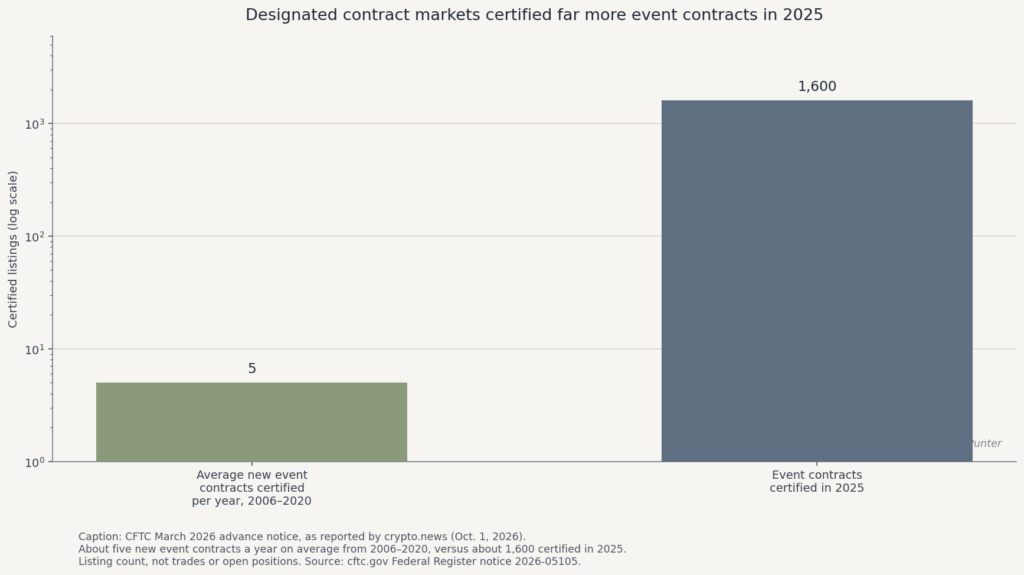
These filings also come after earlier CFTC papers, and they should not be collapsed into one. In March 2026, the agency’s advance notice asked about core principles, public-interest review, inside information, and contracts that may be prohibited. It said the Commodity Exchange Act does not define “event contract” as a stand-alone term. A June proposal separately took a broad view of “gaming,” citing roulette, poker, and chess, but not sports. The September filings do not say whether the new exclusion adopts that view, narrows it, or ignores it. Many questions left to be answered.
How the swap label is colliding with appeals already on the books
The court fight turns on the same word the CFTC is trying to define: swaps. On September 25, the Sixth Circuit rejected Kalshi’s claim that sports event contracts necessarily qualified as swaps. Circuit Judge Julia Smith Gibbons wrote for a unanimous panel that Kalshi had not shown those contracts deserved exclusive CFTC oversight, and that the Commodity Exchange Act did not preempt the state gambling laws at issue. The ruling vacated an injunction in one case and left a denial of an injunction in place in another.
The decision deepened a circuit split and raised the chance of Supreme Court review. Kalshi has said it expects the decision will not survive higher court review. The Sixth Circuit opinion has immediate practical effects within its boundaries, but it is not a nationwide final answer for every contract.
The Third Circuit’s April opinion was more favorable to Kalshi’s preemption argument on a different record. The Ninth Circuit later rejected similar arguments, and New Jersey, Robinhood, and Crypto.com are seeking Supreme Court review. A later agency definition can reframe lawyers’ arguments, but it does not automatically erase a holding, cancel a state statute, or hand an exchange a gambling license.
Oral argument in a related Ninth Circuit fight shows how tightly the swap definition is already tied to these cases. Counsel for a Crypto.com derivatives affiliate argued that the Commodity Exchange Act preempts state law as applied to sports event contracts because Congress defined swaps broadly.
What a pending review can and cannot change for traders
States are not waiting for a Federal Register notice. The Sixth Circuit’s September 25 judgment lets the cases before it proceed without the injunctions Kalshi requested. Other courts have different records. New York’s suit against Polymarket, and Polymarket’s countersuit, show the fight is not limited to one exchange, even though the allegations differ. An exchange can restrict access, rewrite a contract, or keep litigating. None of those private business choices affect the CFTC rulemaking process.
Meanwhile, the Justice Department has already told a criminal court that the recent appellate rulings do not pull every binary contract outside the swap definition. In a September 30 filing in the case against U.S. Army soldier Gannon Ken Van Dyke, prosecutors said the Sixth and Ninth Circuits addressed only certain sports event contracts. They argued the contracts at issue there would still qualify as swaps because they were inherently economic and could be used to hedge financial exposure. Oral argument in that matter was set for October 7.
That filing is the useful distinction for traders who hold non-sports contracts. It does not guarantee those contracts are safe from a later exclusion if the agency decides they look like casino-style products.
Self-certification does not close the gap either. An exchange may certify that a new listing meets federal requirements, and the CFTC can review or challenge it through set procedures. Certification has no bearing on objections raised by state lawsuits. A platform can remain a CFTC-regulated exchange and still fight over whether an offering falls under a state’s gambling regime.
Enforcement is the real risk if the exclusion is broad. State gambling regulators may be left to investigate manipulation, inside information, and customer complaints on products that fall outside the swap definition, while the CFTC keeps surveillance tools for derivatives. A product that sits between the two can draw uneven oversight. An operator subject to both can face conflicting duties. Yet another reason SCOTUS would likely review the New Jersey request.
References
- Office of Information and Regulatory Affairs, CFTC submissions under review
- Crypto.news, “The CFTC has sent prediction market rules to the White House. States are still in court”
- Gambling Insider, “The Gambling Wire: CFTC Files New Prediction Market Rules for White House Review”
- Decrypt, “CFTC Sends White House New Rules to Cement Its Grip on Prediction Markets”
- CoinDesk, “U.S. CFTC seeks event contract definitions that may defy states’ gambling claims”
- Unchained, “CFTC Sends the White House Rules That Would Define Event Contracts as Swaps”
- CFTC, March 2026 advance notice on event contracts
- Reuters, “US appeals court rules against Kalshi, says states can regulate prediction markets”
- Sixth Circuit opinion, September 25, 2026
- Third Circuit opinion, April 6, 2026
- Ninth Circuit oral argument, North American Derivatives Exchange v. Nevada
- Gambling Insider, New Jersey Supreme Court petition coverage