
The legal conflicts between states and prediction markets operating under federal CFTC regulatory supervision may end one day, but that day is not today.
A unanimous Sixth Circuit panel ruled Friday that Kalshi’s sports event contracts are not “swaps” under the Commodity Exchange Act, so state gambling laws in the two cases before the court still apply. The decision affirms one district court’s denial of an injunction, vacates another court’s injunction, and deepens a split that now points toward seemingly inevitable Supreme Court review.
As is now standard, Kalshi had argued that CFTC exclusive jurisdiction over designated contract markets preempts any state enforcement. The panel rejected that theory on the swap definition and, therefore, the preemption argument. Spokesperson Dani Lever said the company does not expect the ruling to survive further review, because “markets can’t operate when the rules change at every state line.” Another standard line. Not that standard lines can’t be true, but we are certainly at the point of endless repetition of talking points in this state-federal battle.
The holding in the consolidated appeals
The cases were KalshiEX LLC v. Schuler, No. 26-3196, and KalshiEX LLC v. Orgel, No. 26-5235, argued July 30 and decided September 25, 2026. Gibbons wrote that Kalshi “has not shown that its sports-event contracts satisfy the statutory definition of a ‘swap’ so as to fall within the scope of the CFTC’s ‘exclusive jurisdiction.’” Even if they were swaps, the Commodity Exchange Act would not displace the challenged gambling statutes.
Chief Judge Sarah D. Morrison had denied Kalshi a preliminary injunction in March. Judge Aleta A. Trauger had granted one in February. The Sixth Circuit sided with Morrison and sent Trauger’s case back. That restores room for state action where the injunction had been in place.
Tennessee Attorney General Jonathan Skrmetti called the result a “great win,” saying sports wagering is heavily regulated because it can do a lot of harm. A fairly typical line from an official in a state that has legalized sports betting. Meanwhile, the panel dismissed mention contracts that pay if a named person says a word on air. Gibbons wrote there is “no conceivable reason why the market might need to know the probability that a broadcaster says a random word on air.” That latter point feels more like a personal opinion than a legal case.
Why the swap argument failed
Swaps, as the panel described them, involve financial measures and instruments used to hedge risk. Dodd-Frank expanded federal oversight of those instruments after the 2008 housing-led financial crisis. Kalshi said sports event contracts belong in that category because they trade on a registered venue and pay on a future occurrence, two elements of a swap definition.
The court demanded an intrinsic link. An event must be “inherently associated” with a financial, economic, or commercial consequence, so that hedging it would be understood as useful for market stability. Interest-rate moves qualify. Super Bowl MVP does not, according to this ruling, even if a sponsor later writes a check. Downstream effects are not enough.
Gibbons then measured the contracts against the statute’s purpose: price discovery and risk management. “It is, therefore, difficult to see how determining the probability that a certain number of corner kicks will be taken in a given soccer game — or that a 30-leg parlay will hit — would serve to advance those goals,” she wrote. The panel also pointed to Kalshi’s earlier concession that many sports contracts have “no inherent economic significance.” The judge was clearly leaning into the common-sense “this looks a ton to me like sports betting” element of this conflict over sports even contracts. Whether that common-sense test ultimately matters in a higher-court ruling on the underlying legal cases remains to be seen.
Preemption and the widening circuit split
The alternative holding may travel farther than the swap definition. Gibbons refused to read “exclusive jurisdiction” as a ban on state gambling codes. She treated the phrase as keeping ordinary courts out of CFTC business, not as erasing traditional state police power over wagering. Gambling regulation, she wrote, “lies at the heart of the state’s police power.”
Preemption must be clear. Gibbons is arguing that the Supremacy Clause does not turn every designated-contract-market listing into a nationwide sportsbook. She warned that Kalshi’s reading would give the CFTC authority over event contracts that “bear no relation to the goals Congress had in mind.”
That clashes with the Third Circuit’s April decision, which treated the contracts as likely swaps and blocked New Jersey-style enforcement. The Ninth Circuit went the other way last month. New Jersey has already asked the Supreme Court to take the Third Circuit case. After Friday, two circuits favor state enforcement, and one favors federal preemption.
The reasoning is not identical. The Ninth Circuit still allowed CEA preemption in some settings and then found sports contracts outside the swap definition. The Sixth Circuit added that even a swap would not wipe out state gambling statutes. If you’re keeping “circuits” score, that’s now 2-1 in favor of the states. If you’re wondering, there are 13 circuit courts in the U.S. in total.
What comes next for enforcement and traders
Kalshi can seek rehearing or Supreme Court review. Lever’s statement casts Friday’s result as proof that a state-by-state patchwork fails, as some circuit courts read for states’ rights and some for federal preemption. State officials hear the opposite: a venue registration should not erase age limits, tax rules, and consumer-protection statutes that licensed sportsbooks must follow. And obviously, most importantly to the states, the right to tax the commerce taking place on the platforms for their share.
Where injunctions no longer stand, enforcement can move again. Ohio’s Casino Control Commission had already advanced a multimillion-dollar fine earlier this year. Other attorneys general will quote the police-power language.
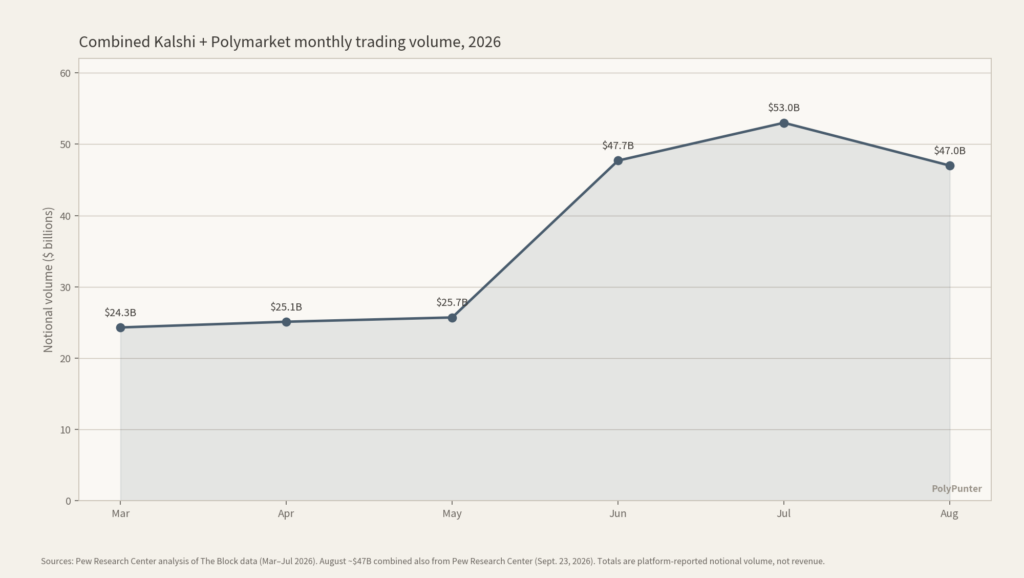
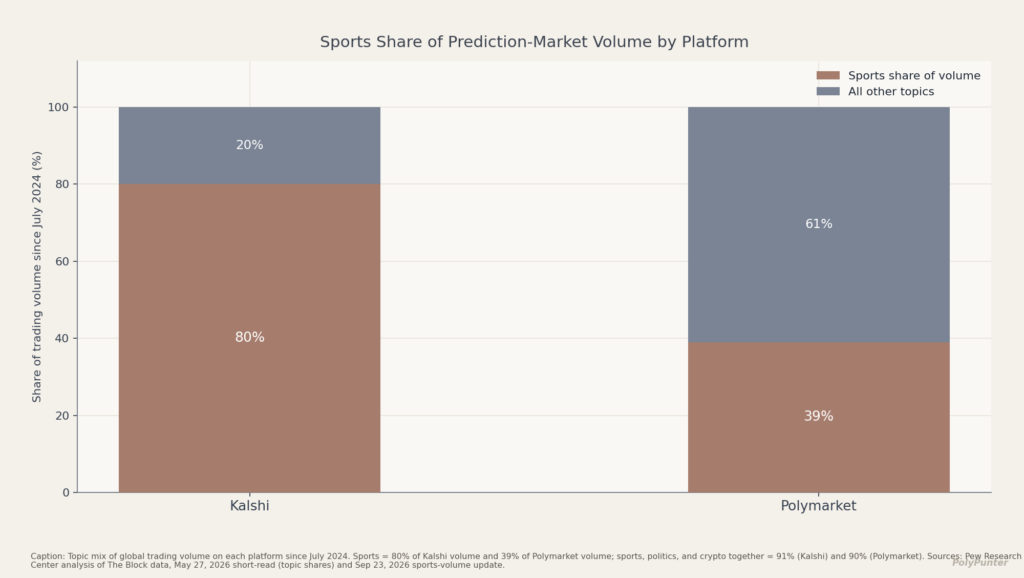
Volume is unlikely to vanish overnight. Sunday sports boards still drew heavy trading. While prohibitions are rising in several states, national prediction market volume continues to climb. In some cases, even local residents in banned areas can work around geofencing restrictions. Such is the nature of local prohibitions in a digital age.
Until the Supreme Court hears the split-circuit courts in this matter, or Congress revisits the topic with a more explicit rule, which it has made great noise about but little progress, the fight stays on two questions. Are sports event contracts swaps? If so, do they pre-empt state gambling laws and state-by-state jurisdiction? The Sixth Circuit answered no, then no again. The conclusive legal answer remains unclear.
References
- Reuters, “US appeals court rules against Kalshi, says states can regulate prediction markets”
- The Block, “Kalshi loses appeal over Ohio and Tennessee sports betting laws, widening circuit split”
- Sportico, “Kalshi Split Widens With 6th Circuit Ruling on Sports Event Contracts”
- Courthouse News Service, “Sixth Circuit says states can regulate Kalshi’s prediction market”
- Bloomberg Law, “Kalshi Can Face Ohio, Tennessee Enforcement After New Ruling”
- Covers, “Sixth Circuit Court Rules Against Kalshi, in Favor of Ohio, Tennessee”
- InGame, “Sixth Circuit Adds To Kalshi Courtroom Losing Streak”
- Law360, “Kalshi Sports Contracts Aren’t Financial Swaps, 6th Circ. Says”
- CourtListener, KalshiEX LLC v. William Orgel
- The Economic Times, “US appeals court rules against Kalshi, says states can regulate prediction markets”