
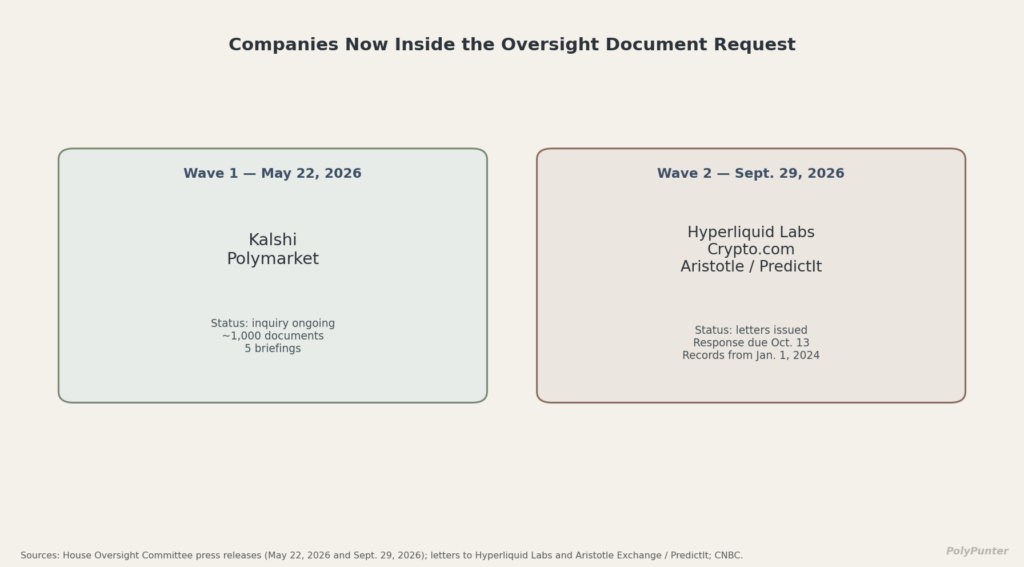
James Comer turned a Tuesday document drop into a wider hunt for unusually well-timed prediction market trades. The House Oversight Committee chairman sent requests to Hyperliquid Labs, Crypto.com, and Aristotle Exchange Inc., which runs PredictIt, asking how each company verifies account holders and flags activity that may rest on nonpublic information. The letters also seek referral logs sent to U.S. authorities.
Comer opened the same file in May against Kalshi and Polymarket and says committee staff has already collected nearly 1,000 documents and five briefings. Tuesday’s mailing adds a perpetual-futures venue, a large crypto exchange with event contracts, and a long-running political contract site. The records window requested starts January 1, 2024. The response deadline is October 13.
“As online prediction platforms grow and become more mainstream, some bad actors have exploited the platforms to make thousands of dollars by placing bets based on nonpublic information.” — James Comer, committee press release.
He wants to know whether these companies catch that suspicious activity before the payout hits. Spokespeople for the three firms did not immediately reply. But if they miss the deadline, a subpoena is the obvious next move.
What the House Oversight Letters Demand on Identity Verification and Suspicious Trading
The Committee chairman’s ask is fairly simple. Who opened the account, what tool confirmed that person, and who gets the ping when a trade looks too good to be true? Comer wants Know Your Customer policies, vendor names, and any changes to those controls since early 2025, plus the playbook for spotting and reporting odd trades over about two and a half years. He asked the same of the two big prediction markets this past Spring.
Geographic controls are also in question. Staffers want to know whether an international account faces the same checks as a domestic one, and how a company actually enforces the map. A government-event contract can reprice in minutes. A weak ID process can hide the person behind a wallet or a borrowed login.
The Crypto.com letter asked whether employees or affiliate staff traded contracts tied to token listings, custody decisions, or other in-house news they saw first. He also asked for records on any government officials who may have traded contracts linked to crypto rules or the exchange’s own regulatory status.
PredictIt’s request, sent to Aristotle Exchange CEO John Aristotle Phillips, hones in on elections, nominations, and other government actions involving current or former officials. Internal records, the letter says, are often the only way for Oversight to put a name to a well-timed ticket.
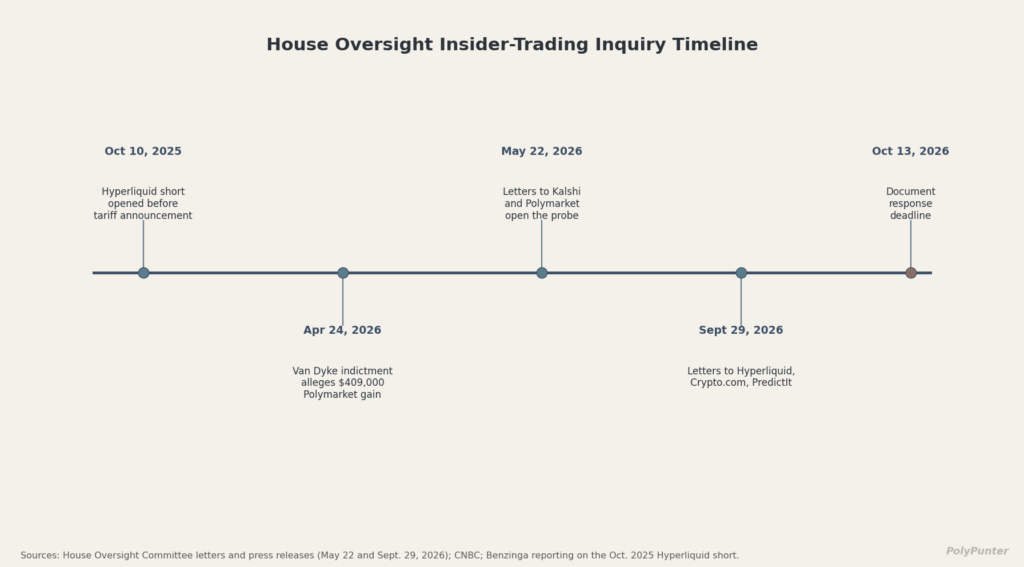
Hyperliquid Leveraged Short Before the October 2025 Tariff Announcement
The Committee letter that will draw the most public attention went to Hyperliquid co-founder Jeff Yan. Comer cited reports of “a substantial leveraged short position on the … platform within minutes of a presidential announcement concerning a U.S. tariff policy in October 2025 that was not publicly known at the time the position was established.”
Comer called the timing “precisely timed to a nonpublic government decision” and said it landed “on a platform with apparently no identity verification or mechanism to refer the responsible party to U.S. law enforcement,” according to the posted Hyperliquid letter.
The size of the book is hard to shrug off. The committee pointed to a roughly $1.1 billion short in Bitcoin and Ether perpetual futures opened about 30 hours before President Donald Trump announced 100% tariffs on Chinese imports. Later accounts said the trader closed out for more than $150 million; one earlier write-up put the gain near $192 million. Congress has not named the trader and has not said it can prove advance knowledge. But the underlying number itself is staggering.
Comer wants Hyperliquid’s identity rules, its path to U.S. authorities, and files on markets tied to Federal Reserve decisions, elections, and geopolitical events. He also asked whether current or former Hyperliquid employees or advisers hold, or have applied for, U.S. government security clearances.
The same letter cited a case already in court: the April 24, 2026, indictment of Army Master Sgt. Gannon Ken Van Dyke, who prosecutors say used classified information about the operation that captured Nicolás Maduro to make more than $409,000 on Polymarket. Place that indictment next to a nine-figure short, and the committee’s point is obvious. It thinks the problem is bigger than one venue and one product and that the ill-gotten gains could be far greater.
How the May Inquiry Into Kalshi and Polymarket Set Up Tuesday’s Expansion
Comer started this prediction market inquiry on May 22 with letters to Kalshi CEO Tarek Mansour and Polymarket CEO Shayne Coplan, according to the committee’s earlier May release. He pointed then to trades that lined up too neatly with elections and military action. He also said he wanted a record strong enough to support a ban on trading by members of Congress, administration officials, and other government employees.
Named cases keep the proceedings from sounding theoretical. A New York Times review found more than 80 Polymarket users who placed unusually timed wagers, including activity hours before U.S. and Israeli strikes on Iran. George Santos, a former member of Congress, was banned and fined after trading on his own attendance at a State of the Union address through Kalshi.
The new letters feed the same line of oversight inquiry. If companies cannot show how they would know a clearance holder opened an account, a statutory ban is no more than a slogan. If they produce the KYC manuals and referral lists by October 13, these three new companies can be put on the Kalshi and Polymarket list of firms complying with basic preventative measures. Either way, the file stays live heading into the stretch when election contracts will be among the busiest products on the board.
References
- CNBC, “Rep. James Comer expands House investigation into prediction market insider trading”
- House Oversight Committee, “Comer Continues Investigation into Insider Trading on Online Prediction Market Platforms”
- The Block, “Comer presses Crypto.com, Hyperliquid and PredictIt on identity checks and suspicious trades”
- Letter to Aristotle Exchange / PredictIt, Sept. 29, 2026 (PDF)
- Letter to Hyperliquid Labs, Sept. 29, 2026 (PDF)
- Benzinga, “House Targets Hyperliquid in Insider Trading Probe”
- House Oversight Committee, May 2026 launch of the Kalshi and Polymarket inquiry
- Unchained, “House Oversight Targets Hyperliquid, Crypto.com and PredictIt in Insider Trading Probe”
- House Oversight Committee letters archive
- CryptoNews, “House expands prediction market insider trading probe to Hyperliquid and Crypto.com”