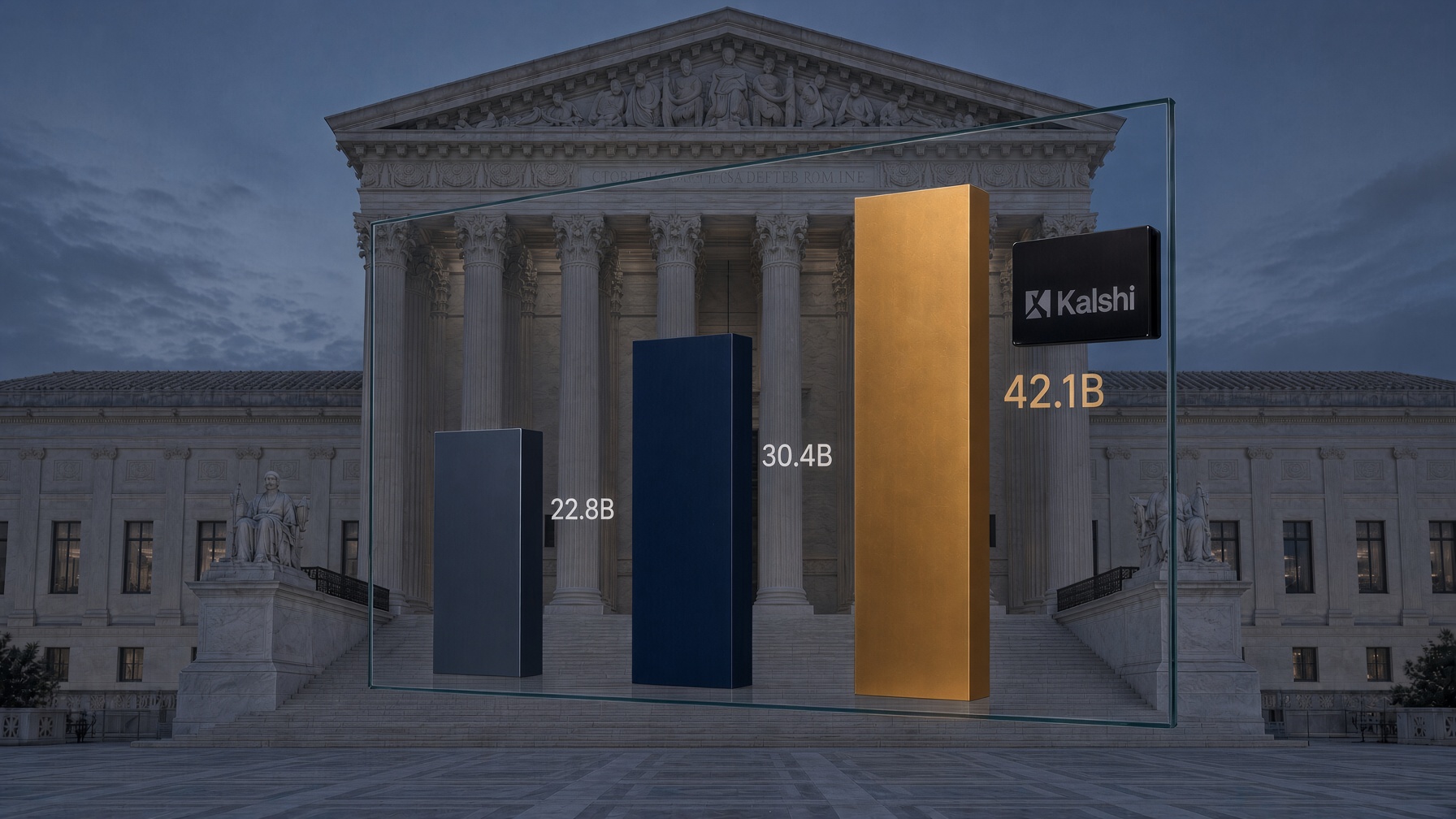
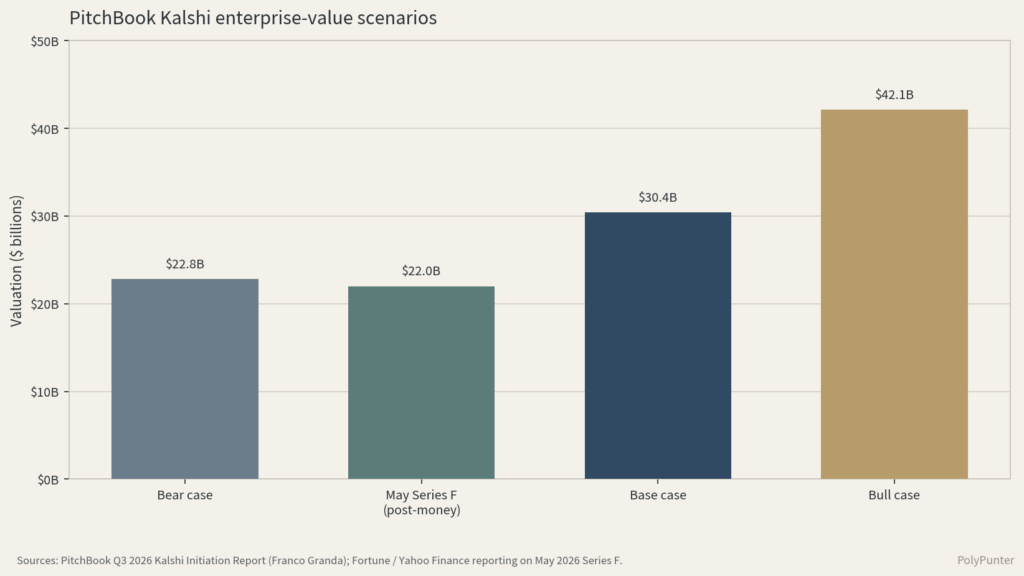
PitchBook opened coverage of Kalshi on September 23, 2026, and put a $30.4 billion base-case enterprise value on the exchange. Researcher Franco Granda’s 46-page model also sets a $22.8 billion downside case and a $42.1 billion upside case if sports event contracts stay widely available. The gap rests on what is believed to be an inevitable SCOTUS decision on whether prediction market sports contracts remain under federal auspices or are pushed to state gaming controls.
Kalshi raised $1 billion in a May Series F at a $22 billion valuation. PitchBook’s base case therefore sits about $8 billion above the last round. The same model projects $6.4 billion of revenue and $3.7 billion of adjusted earnings by 2030, but only if sports volume keeps funding fees, liquidity, and distribution.
Inside the PitchBook Kalshi Valuation Model
The PitchBook initiation report works backward from expected 2028 adjusted earnings. Because Kalshi is private, Granda draws on the company’s API, PitchBook data, Dune records, government dockets, management comments, and public-peer disclosures rather than audited annual accounts as with a public company.
Sports still drive the result. PitchBook estimates sports contracts produce about 69.9% of Kalshi’s event-fee revenue, rising to 82.4% after combo and other exotic products. Losing that book would be a significant blow to Kalshi’s bottom line, even as it grows other volume drivers, including its institutional markets with brokerages.
The valuation model treats growth as expensive. Higher volume can lower fees per contract as Kalshi pays to attract traders and keep markets tight. Perpetual futures appear as extra upside, not the core case. Partnerships with Robinhood and liquidity support from Susquehanna are reasons Granda thinks Kalshi can hold share even as smaller venues take leftovers.
Speaking with Fortune, Granda said a third major venue has little room left. “Third parties will pick up crumbs here and there, but the window of opportunity for people to get in has passed,” he said. He described Kalshi and Polymarket as a two-horse race, with Polymarket spending more on promotions and Kalshi taking a slower revenue path. This two-horse race comment will likely be countered by numerous venture investors pouring money into new prediction-market entrants.
Supreme Court Sports Contract Risk Sets the $42.1 Billion Ceiling
The optimistic case is a legal outcome alone. States and tribal governments have tried to treat Kalshi’s sports event contracts as gambling. Kalshi and the Commodity Futures Trading Commission have rebutted that those contracts are federally supervised derivatives. This central argument remains largely still in legal conflict.
The Third Circuit backed Kalshi in KalshiEX LLC v. Flaherty, limiting New Jersey’s effort to apply state gambling rules. New Jersey then asked the Supreme Court to take the case. A Kalshi spokesperson said the company cannot be “regulated by 50 different regulators.” This is their standard line, though it doesn’t really address the legal crux of the case, which isn’t purely administrative practicality.
Other courts have been less friendly. The Ninth Circuit has made sports contracts harder to defend on tribal land and in Nevada, creating a split that often draws the justices. This week, the National Council of Legislators from Gaming States filed an amicus brief supporting New Jersey. These circuit-court splits will almost certainly lead to SCOTUS review to settle the matter, or at least key portions of it, with some finality.
PitchBook’s $42.1 billion case assumes national sports access survives. The $22.8 billion case assumes sports revenue falls hard enough to force a dramatic rewrite of growth and revenue forecasts. Granda still allows for Kalshi to seek state gaming licenses after a loss. Even so, a deep sports cut would hit the 2030 earnings path that supports the $30.4 billion mark.
References
- PitchBook, Q3 2026 Kalshi Initiation Report
- Jeff John Roberts, Fortune / Yahoo Finance
- Odaily summary of PitchBook Kalshi scenarios
- ChainCatcher summary of PitchBook sports-revenue mix
- CNBC interview with Tarek Mansour
- CDC Gaming on NCLGS Supreme Court brief
- Coverage of New Jersey Supreme Court petition
- AInvest on PitchBook late-stage coverage
- Bookmakers Review on Ninth Circuit rulings