
Investment platform Public.com launched AI Agents for Prediction Markets on September 24, 2026, letting members trade Kalshi event contracts inside the same account they already use for stocks, bonds, options, and crypto. Traders can place those contracts themselves. They can also approve fixed rules so an AI agent watches implied probabilities and then sends an alert, a Kalshi order, or a ticket in another asset class. This is what they call making it really easy.
Public is selling the feature as the next step in what it calls an agentic brokerage or AI-assisted trading. Co-CEO and co-founder Leif Abraham notes that agents can monitor markets when a person is not at the screen and can run strategies a person might not execute in time. The new Kalshi product targets active, self-directed investors who want live event odds inside an existing portfolio workflow. This one-screen integration is basically a must-have step in introducing event markets to equity and crypto trading apps.
Kalshi supplies the contracts and handles execution. Members access those markets in the Public app rather than opening a separate Kalshi app. The joint note on Kalshi’s news page lists categories covering crypto, commodities, climate, economics, corporate events, markets, indices, tech and science, and politics and elections. Each bucket flags risks already in a member’s holdings, from a Federal Reserve decision to a bitcoin move or a corporate milestone.
How the AI Agents Turn Event Odds Into Orders
Public’s chatbot turns a trader’s requests into a visual plan. After approval, the plan runs as fixed code and cannot stray outside the chosen conditions. That lock-in is intentional, so a probability spike cannot send the agent hunting for unrelated tickets. It keeps the leash on.
As an example, if the implied chance of an earnings miss climbs above 60%, an agent can buy a put. If FDA-approval odds cross 75%, it can send a $5,000 market buy in a related health-care name. A rate-cut contract can trigger a trim in bank stocks.
The agent does not have to trade the event contract. Members can treat Kalshi prices as a signal only. Abraham said members can take a position on the event or use the market’s data to trigger a trade anywhere else in the portfolio. Max Crowley, Kalshi’s vice president of business development, said the tie-up places those probabilities beside stocks, bonds, and crypto instead of leaving them on a standalone screen. It’s true portfolio management, with decision-making levels set by the investor. Agent-assisted or agent-controlled is up to each person.
Public also dropped market-moving events onto stock pages, so a trader can see the related contract without leaving a quote. The firm listed three pillars: agents that watch event contracts, live probability data as a cross-asset signal, and event cards next to equities. Every automated step still requires prior approval of the rule set.
Why the Kalshi Feed Matters on Public
Public has pushed the agentic-brokerage label since launching Agents on March 31, 2026. It’s a strong hook. Founded in 2019, it now oversees billions of dollars across millions of users. The Kalshi hook gives those agents a traded price that already embeds what other traders will pay for an outcome.
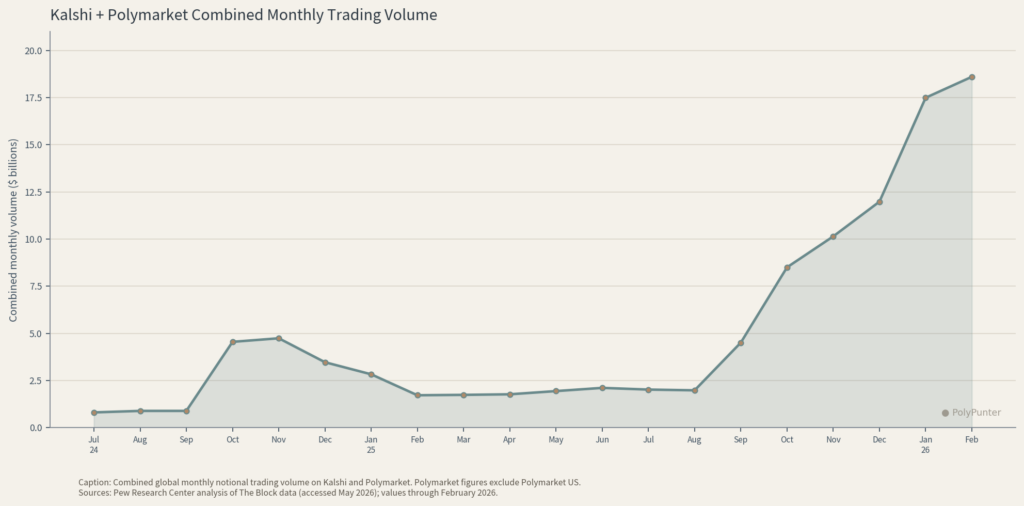
Kalshi operates as a CFTC-regulated designated contract market. Yahoo Finance noted $39.7 billion in volume for the year ending February 2026, a number Kalshi now routinely surpasses each month. That depth is part of Public’s pitch. At the same time, Kalshi remains in litigation in multiple states over sports and other event contracts. Companies like Public weigh this before allowing Kalshi into their customer ecosystems. Assume they see far more upside to this marriage than issues.
Abraham stressed that agents now work with prediction-market probability data, not only price charts. Other shops have already wired Kalshi data into institutional screens and research tools. Public’s version is retail-facing automation with a unique hard approval gate.
That sequence looks simple but can get messy fast. Implied probabilities can gap when news hits. Options, stocks, and event contracts do not always move together. Traders who treat a $0.75 price mark as a perfect leading indicator can still meet slippage, basis risk, and crowded signals in the same minute.
Controls, Thin Books, and What to Watch
Public says agents stay inside approved conditions. That design limits runaway trading. It does not remove market risk. An FDA contract can reprice faster than an equity order fills. A threshold can print and reverse before the $5,000 buy even lands. These markets move very fast, and trades don’t clear instantaneously.
Legal status adds friction. Kalshi holds federal DCM status, yet state cases keep moving, and the CFTC’s June 2026 proposed rule is not final. Public launched the Kalshi integration yesterday.
Category breadth can also hide thin books. Climate, science, and some corporate-event contracts will not always match a flagship rate-decision market. An agent that fires on a 75% move in a shallow contract can push up the price against the Public trader’s interest. Stock-page overlays may show that context. But they will do little to widen the book.
The next test is whether traders write tight rules and leave them alone, or rewrite thresholds after every noisy session. How exactly this agentic product will work with event contracts truly remains to be seen.
References
- Public Partners with Kalshi to Launch Prediction Markets and Bring Event Data to AI-Powered Investing — Kalshi News
- Public brings AI trading agents to prediction markets with Kalshi tie-up — Fortune
- Public Just Wired Prediction Markets Into Its AI Agent Layer — Yahoo Finance
- Public Adds AI Agents for Prediction-Market Trading Through Kalshi — TokenPost
- Public adds Kalshi, automates prediction markets trading via new AI agents — FOW
- Public launches AI trading agents for prediction markets through Kalshi partnership — 5 Star Media
- Public Links Kalshi Prediction Markets to AI Trading Agents — Finance Magnates
- Public on X (@public)
- Leif Abraham on X (@leifthunder)