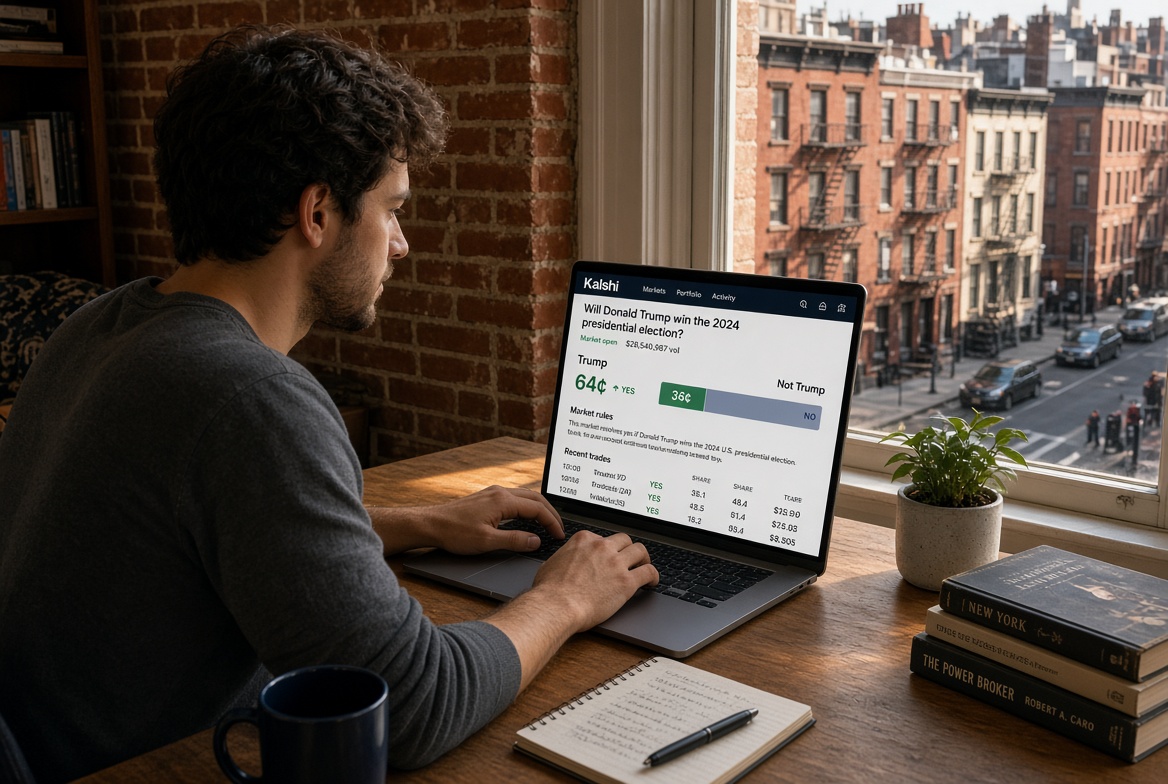
Prediction markets turn real-world questions into tradable prices that reflect probabilities. A beginner strategy starts with one basic idea: what is my forecast for this market’s outcome, and how certain am I?
As with any market, the goal in prediction markets is to buy low and sell high. But how can you do that without knowing what is low or what is high? If I told you a car was for sale for $25,000 and asked you if that was too high or too low, how would you answer? You’d say you couldn’t without knowing far more information, like make, model, year, condition, what prices were like for several similar cars in the market, etc. The same holds for prediction markets.
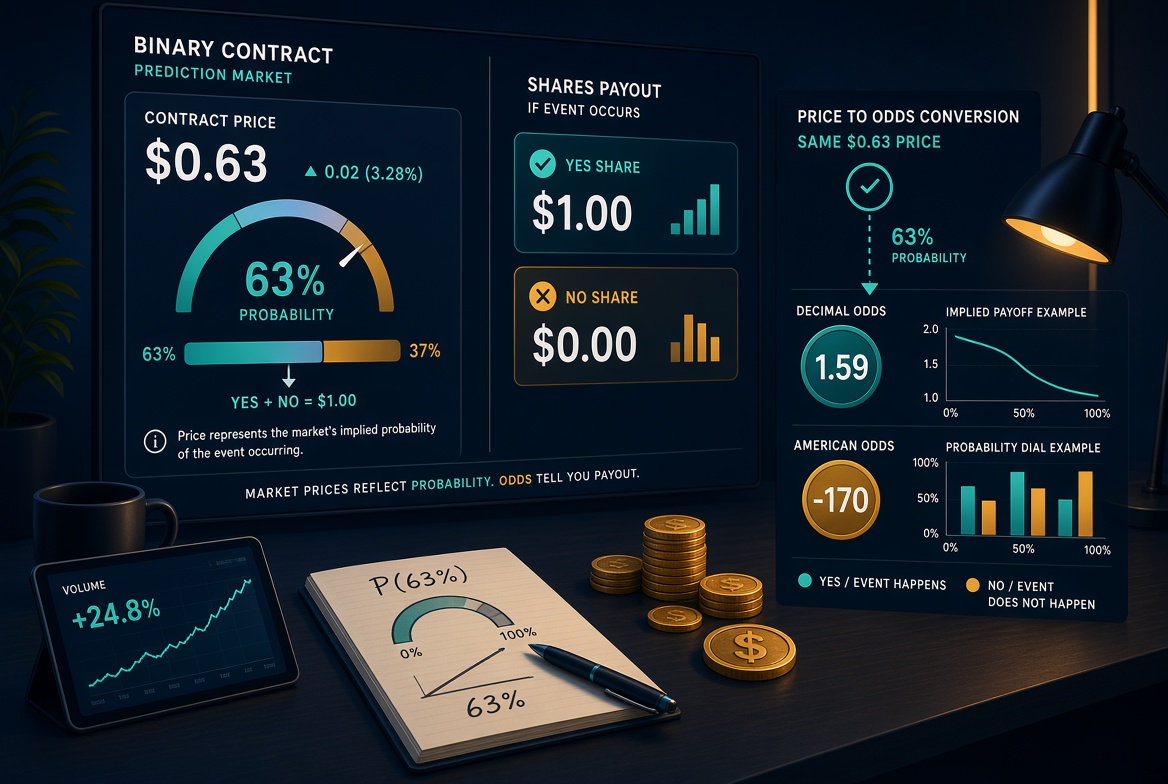
Your job is to research the topic, combine it with your existing knowledge, and formulate a prediction as a probability. Your predicted probability, as a percentage, becomes a price in cents; for example, a 60% probability equals $0.60.
Once you have your price in mind, compare it to the market price. Now you know whether the market is too high or too low. If the market is too high on the YES, you can buy the NO side. If the market is too low on the YES, you can buy into the YES. Mechanically, it’s that simple. However, it depends on your formulated price. That’s where the prediction skills matter. Your edge is your forecasting accuracy.
How Event Contracts Work
Event contracts pay you $1 for each event outcome you properly predict and $0 for incorrect outcomes. Your profit on a winning forecast is the difference between what you paid for the contract (between $0.01 and $0.99) and the $1 payout. The lower the price you buy the contract, the higher your profit if you’re right. You can purchase as many contracts as you like, so you can scale the payout by the number of contracts you buy.
For example, if you bought 100 contracts at $0.43, that would cost you $43, and if you’re correct on the side you chose, your payout could be $100, or a profit of $57. Or you could lose $43 if you’re wrong. Note that trades have transaction fees, and some platforms take a small rake on winning contracts, so your profit would be $57 in this example, minus 2-3 points in fees and other costs, depending on the venue.
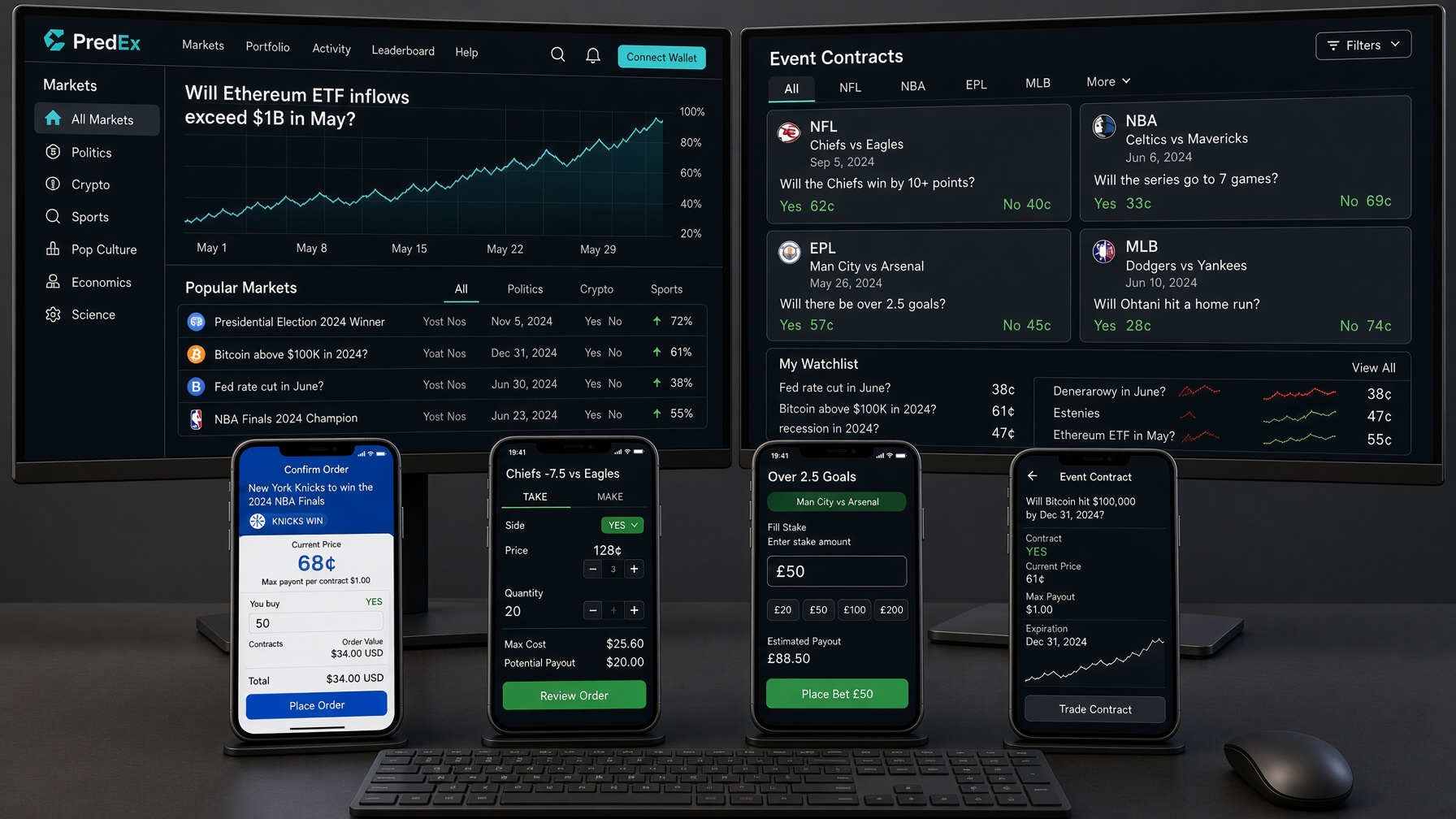
Event contracts are closer to stocks than betting slips because they become fully tradable assets once you buy them, at any time before market settlement, when the event outcome is known and finalized. Prediction markets are peer-to-peer markets where you are competing against other traders, not against a house taking bets against players. Prediction markets are about trading as much as they are about properly predicting the outcome of future events.
Prices move continuously because other traders constantly buy and sell contracts, pushing the market price up or down. A data release, injury report, or policy leak can shove a contract from $0.45 to $0.62 in minutes. You can hold a contract to settlement or sell early, locking a gain or cutting a loss. That early-exit option is why these contracts feel more like a stock than a locked betting slip.
Estimate First, Then Check the Market
As with any open market, value hunting is key.
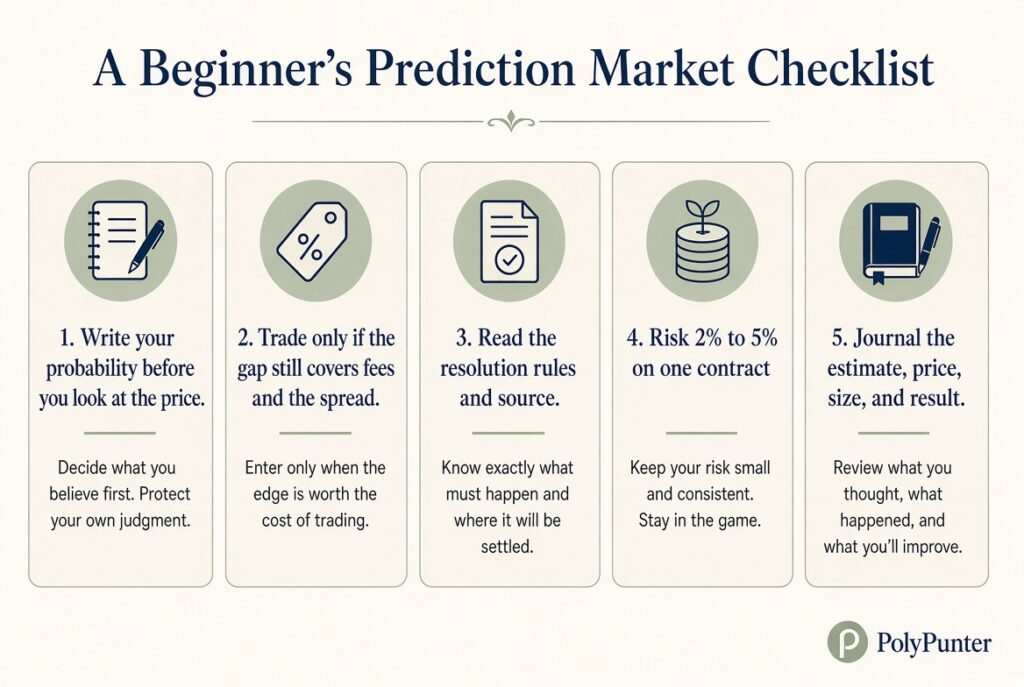
Write your own probability forecast percentage down before you glance at the screen, so you won’t be biased by what others have predicted. Have that number in hand, then check the market. If the market price is materially lower, there’s your expected value. Don’t talk yourself into buying a market that’s priced higher than your forecast because you think, “I’m super sure the outcome will turn out as I predict, so it’s okay to get in at a poor value and still win something.” Because if you were that certain, your original probability number would’ve been higher. Trust your original number.
Stay in categories you can track. Economic contracts resolve against public figures and official reports. Sports contracts resolve against final scores. Political election contracts resolve against certified results. Subjective markets with any wiggle room for interpreting the outcome lead to disputes and broken hearts. Later, when you’re more experienced in prediction markets, you can explore these areas with a more trained eye.
Trade in highly liquid markets. Liquidity basically means many traders actively trading contracts. It’s easy to buy into or sell out of a liquid market with so much trading going on, and no single transaction will move the market price itself. In contrast, thin markets have few active participants, so it’s harder to buy and sell contracts; your trade can shift market prices, so you may pay more than the listed price to get in and receive less than the listed price to sell.
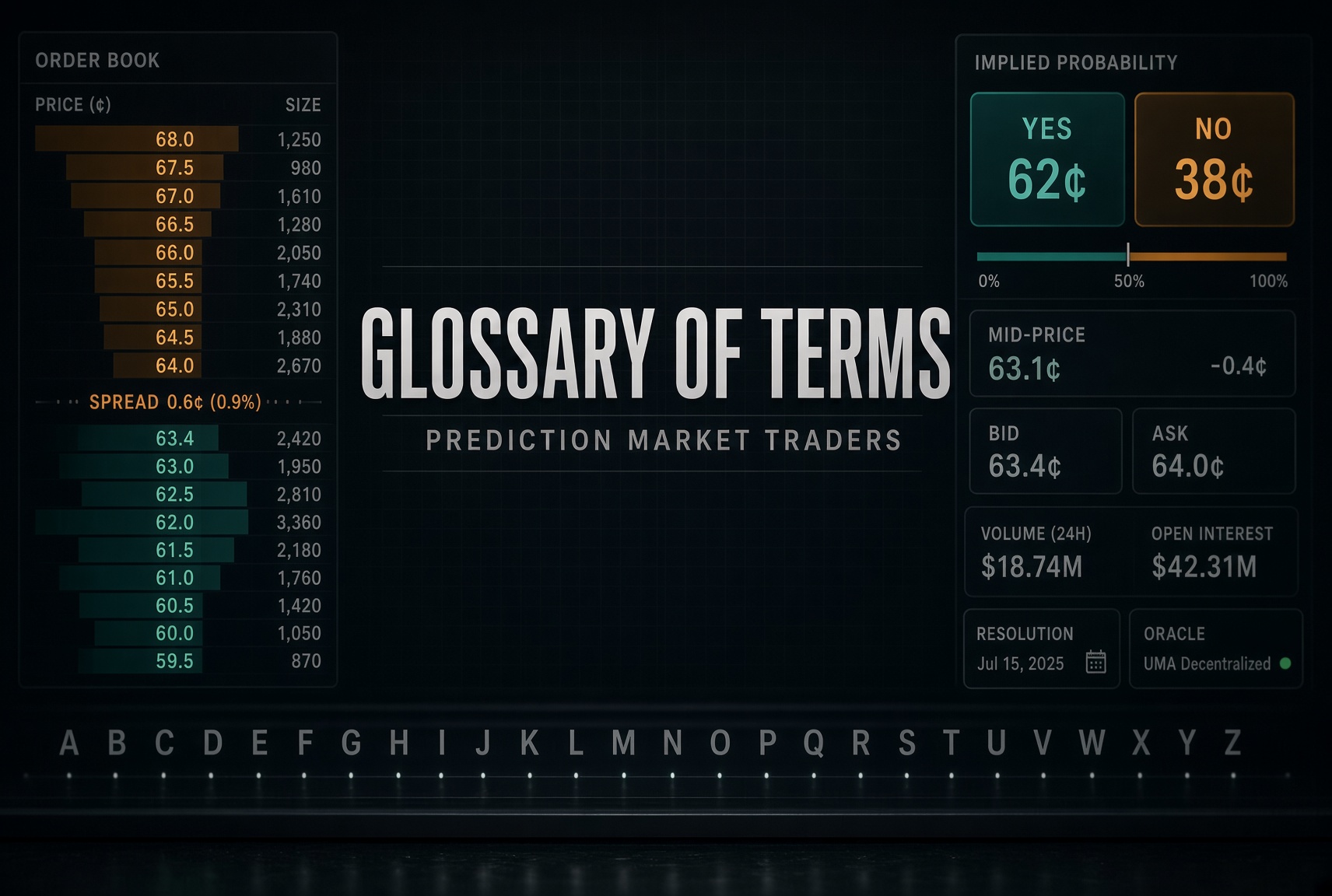
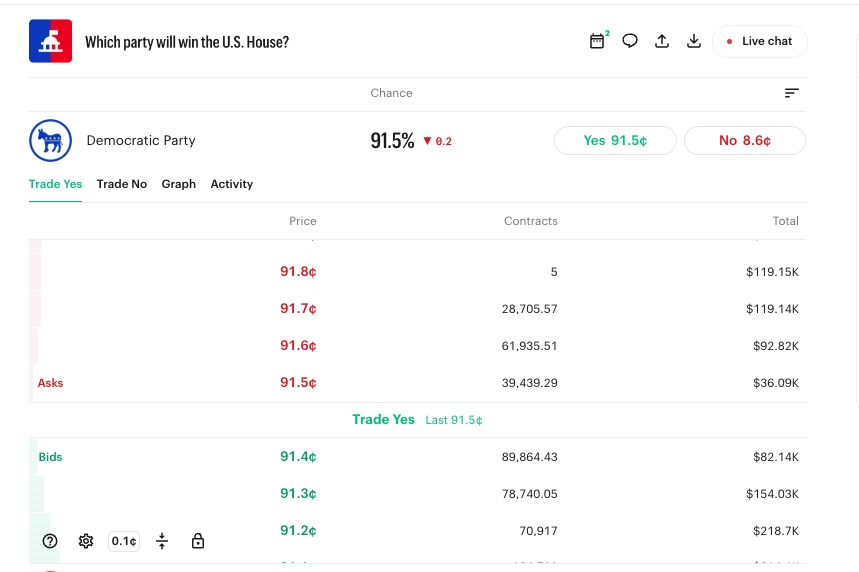
The simplest way to determine whether a market has proper liquidity is to look at the spread between the highest price buyers are willing to pay for a contract and the lowest price sellers are willing to accept. In liquid prediction markets, this will be 1 or 2 cents. If the number starts climbing higher, and certainly by 5-10 cents, that means it’s a thin market. Stay away as a beginning trader.
Here you’ll see that with “Democratic Party” as the contract option in “Which Party Will Win the U.S. House” for the 2026 Midterms, the spread between the Yes probability and the last contract sale price is only 1/10th of a cent. This is a liquid market.

A second way to check liquidity is to look at the order book for each market. That is the list of all the trades buyers and sellers have queued up for matching. If it’s robust in number and dollars, it’s a liquid market. If it has few open contract orders, it will be tough to match, and you’ll end up paying a premium price to get into the market. Exiting, should you choose to do so down the line, may be equally difficult.
You can find the order book for any contract option in a market on Kalshi by clicking on the option. Here, we clicked “Democratic Party,” and it revealed the orders for this contract. This image is just a portion of the open orders. Asks are in Red (sellers), and Bids Are in Green (buyers).
Managing Risk and Improving Performance
As with investing in any market, manage risk by diversifying holdings. Don’t put all your funds into any single contract. In fact, a general rule for risk is about 2% to 5% of total funds per contract with every contract you purchase at a price below your forecast price. For example, if you start with $400, risk no more than $8 to $20 in any one market. One advantage of prediction market trading is that the per-contract price is always between 1 cent and 99 cents, so you can afford to enter any market. This contrasts with the stock market where a single share of company equity could be priced in the hundreds of dollars.
As you actively monitor the markets you’re in, you can’t be in too many at once and do so effectively. You will want to be in a position to move out of markets on rises (or falls). Platforms like Kalshi will let you set an automated sale price on your contracts that triggers at a certain price, which can help you in a 24/7 trading market. Still, without more advanced automated trading tools, don’t be in more markets than you can effectively monitor. You are holding tradable assets now, not fixed betting slips.
Remember that when assessing probabilities, 60% means you should be right 60% of the time, or 6 out of 10 times. Losing twice in a row on a 60% probability remains likely, or three of your first five markets. Probabilities often need large volumes to bear out. It’s hard to assess your accuracy until you’ve traded in several markets. Keep a journal so you can measure your accuracy over time and recalibrate if you’re off (you’re routinely too high or routinely too low in your initial forecasting chances). The likely result is you’re very accurate in certain topic markets and less so in others.
When considering diversification, beware of being in multiple markets that seem unique but really hinge on the same outcome. Three contracts that hinge on the same vote, same economic numbers, or the same storm move together and live and die together. Spread ideas across unrelated events when you can. That is not advice to enter markets where you’re not informed. But within your preferred categories, spread your holdings across contracts that don’t depend on the same outcome.
Mistakes That Drain New Accounts
Trading the story instead of the mispricing is the first potential mistake. A dramatic headline can be fully priced in minutes. Buying after the spike often means paying $0.78 for a 70% event. That is a poor deal, even if the event pans out in your favor later. Remember the advice to forecast your price before viewing the market price, and only buy when it’s below your estimate. Chasing headlines is a different game for advanced traders with advanced toolsets who work in seconds, not minutes.
Skipping the rulebook is the second. Contracts can settle on one data series, one date, or one official statement. Close is not good enough. If the wording is fuzzy and not completely clear to you, pass. It’s not worth it.
Oversizing is the third. Doubling down after a loss can turn a single lesson into something much worse. Cap daily losses (the apps have settings for that) and walk away after a preset drawdown. The markets will still be open when you return.
Ignoring the other side is the fourth. Someone sold you that Yes contract. Crowd prices are often reasonable and quite well-informed. There may be 1,000 traders in this market as sharp as you. Your job is not to fade every number, assuming other traders have no clue. Act only when you have a reasoned gap between the market price and your own researched forecast.
Rigor and discipline are the key. If you treat prediction markets like a science class, you will fare far better than if you handle it like placing a bet. If it sounds less like fun and more like work, you’re on the right path to successful prediction market trading.
FAQ: Prediction market strategy for beginners
What is a prediction market contract?
A prediction market contract is a yes-or-no claim on a real event. Traders buy it between $0.01 and $0.99, and it settles at $1 if the claim is right or $0 if it is wrong. The price reflects the market’s implied chance, so a $0.40 contract says the event has about a 40% chance.
How should a beginner decide whether to trade?
Write your own forecast probability before you look at the price. Trade only when your number and the market price differ enough to cover fees and the spread (the final cost to purchase). If the two numbers are close, the better move is to skip the contract.
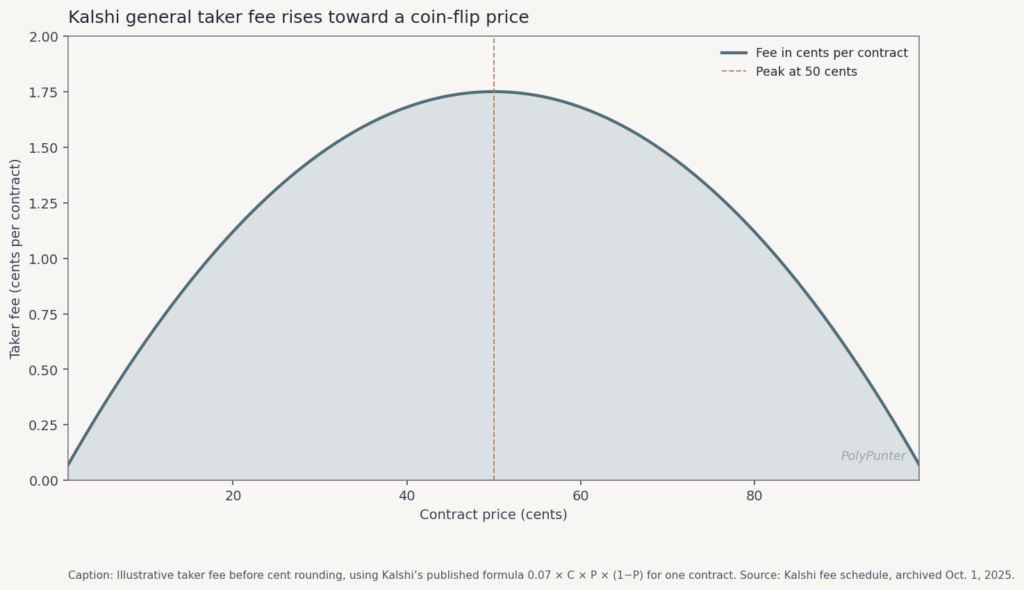
Why do fees matter more near 50 cents?
Kalshi’s published general taker fee is 0.07 × contracts × price × (1 − price), rounded up. That formula peaks at a coin-flip price. A 50-cent contract can cost about 1.75 cents in taker fees per contract, while a 10-cent or 90-cent contract costs less. Always check the live fee schedule before sizing a trade, and factor fees into your profit calculations.
How much should a new trader risk on one contract?
Keep a single contract to 2% to 5% of the money you’ve set aside for these markets. Your bankroll. A wrong call should be a lesson, not the end of the account. Keep total open risk small enough that several losses in a row don’t force you out, but that you learn from your losses. Your skills will improve over time. Rookie mistakes will happen.
What should a trader read before buying?
Read the full market rules, the resolution source, and the cutoff time. All of these rules are listed on every market page. Please read them. Two contracts can sound alike and still settle differently. Thin markets also matter: a wide spread can erase the edge you thought you had.
Are prediction markets more accurate than polls?
Most times, but not always. In a 2008 study of the Iowa Electronic Markets, Berg, Nelson, and Rietz found market prices closer to the final vote share than the comparison poll in about 74% of 964 cases from 1988 to 2004. Traders often use polls as one factor in assessing election-market probabilities, but never as their sole source.
Do most traders make money?
As with any market, some do, some do not. Prediction markets are peer-to-peer markets, so traders compete against one another, not the house. For every gain for one trader, another must lose. Galaxy Research reported on Oct. 1, 2026, that 69.2% of 2.9 million Polymarket retail accounts finished below break-even. A University of Tokyo CARF working paper also found profits tightly clustered, with the top 1% of users who had gains capturing 76.5% of those gains.
What should go in a trading journal?
Before the trade, write the estimate, price, fee, size, and why you disagree with the current market consensus price. After settlement, record the result and what you would change. That log helps a beginner learn whether their estimates are accurate and how to recalibrate their forecasts for better future accuracy. It’s like a baseball player watching their at-bats on film to recalibrate their swings.