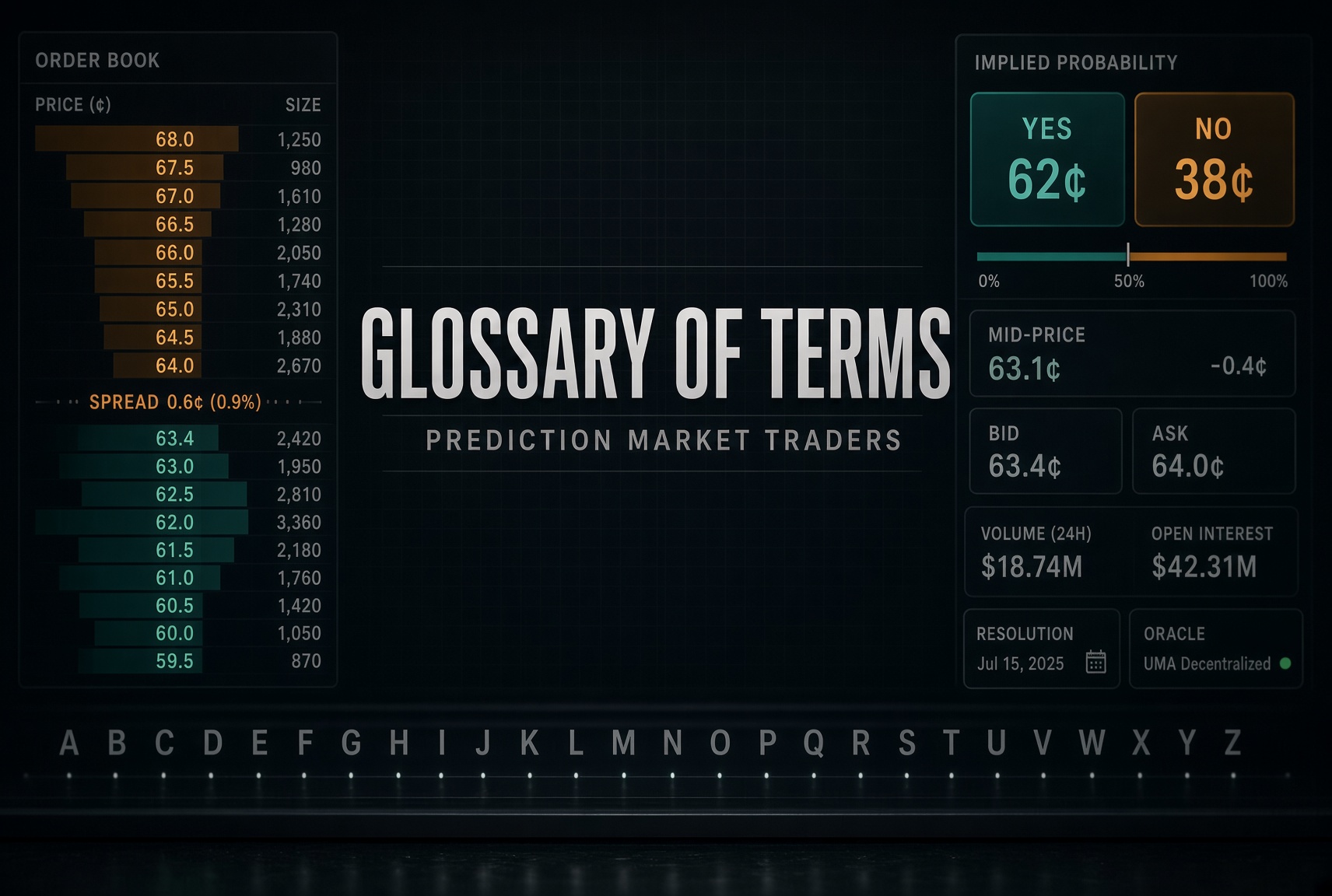
Prediction market language may seem familiar to stock market and commodity traders, but newer traders should understand key terms common to these markets. We’ve assembled 60 common terms you should know before trading in prediction markets so you won’t be challenged by the terminology.
A
Alpha
Any informational or modeling edge that makes your probability estimate more accurate than the market price. Without alpha, trading mostly means paying spreads and fees.
AMM (Automated Market Maker)
A formula-based liquidity pool that always quotes a price, so you can trade without a human counterparty. Common in older or long-tail prediction markets; less capital-efficient than a CLOB near resolution because one outcome token goes to zero.
Arbitrage
A set of trades designed to lock in profit from mispriced related contracts — for example, buying YES on one venue and NO on another when the combined cost is below $1, or buying a complete set of mutually exclusive outcomes for less than $1. It guarantees a marginal profit if executed properly.
Ask (Offer)
The price at which someone is currently willing to sell a contract. A market bidder of YES contracts pays the YES ask.
At-the-Money (ATM)
A contract trading near $0.50, implying roughly even odds. Spreads and percentage fees often peak here because uncertainty and two-way flow are highest.
B
Basis Point (bp)
One hundredth of a percentage point. A move from $0.61 to $0.63 is 200 basis points of implied probability.
BBO (Best Bid and Offer)
The highest resting bid and lowest resting ask: the tightest available prices at the top of the book.
Bid
The highest price a buyer is currently willing to pay for a market contract.
Bid-Ask Spread
The spread is the ask minus bid: the difference between what buyers are willing to pay and sellers are willing to accept. Tight spreads (1–2¢) usually mean a liquid, actively made market; wide spreads mean thin trading and expensive entry and exit.
Binary Contract / Binary Market
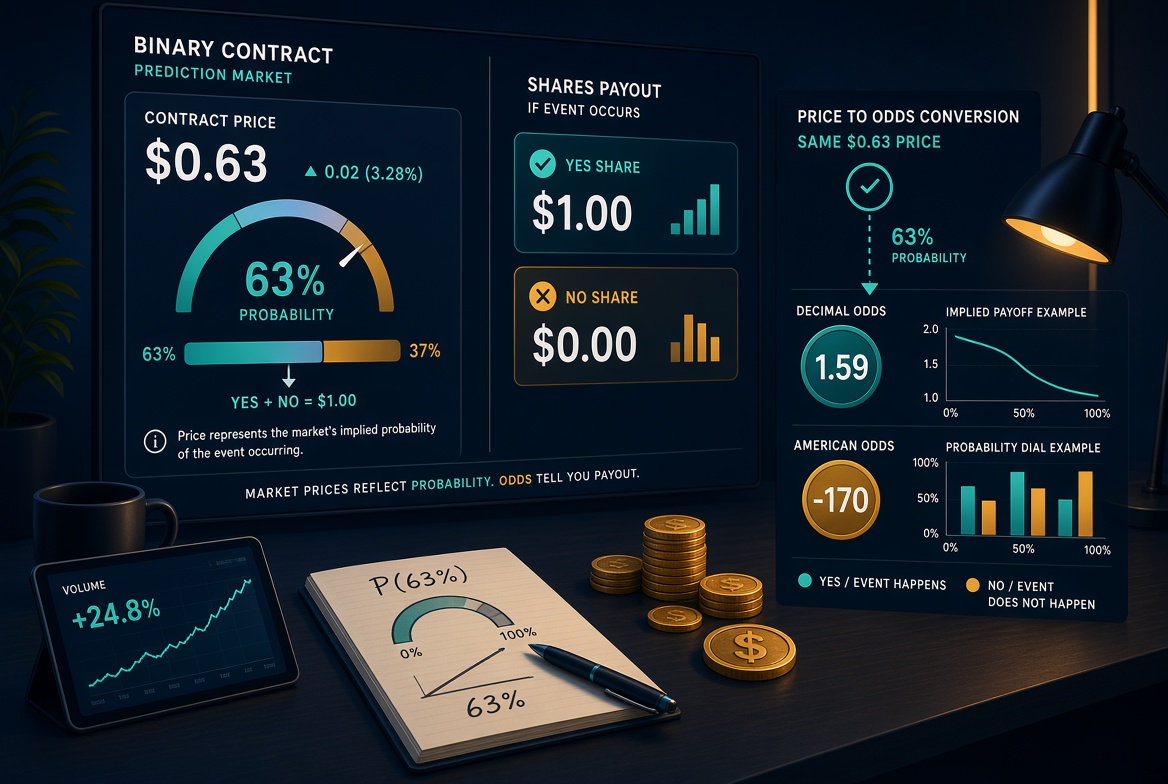
A yes-or-no instrument that settles at $1 if the stated condition is true and $0 if it is false. The foundational product of modern prediction markets.
Book Depth
How many contracts sit available on the order book at each price level. Depth, not just the spread, determines how much size you can trade before you move the price.
Brier Score
A scoring rule for forecast accuracy: the average of (forecast − outcome)², where the outcome is 1 or 0. Lower is better. Markets and individual traders are often judged by Brier score over many events.
C
Calibration
How well stated probabilities match realized frequencies. A well-calibrated 70% market should resolve YES about 70% of the time across many similar contracts. Note: the calibration must be measured across a large volume of markets, not a single outcome instance.
Cancel / Void
An outcome in which the market is unwound rather than paid $1/$0, typically when the event cannot be resolved under the written rules. Positions are usually refunded at cost or at $0.50, depending on venue rules.
CFTC
The U.S. Commodity Futures Trading Commission, which regulates designated prediction contract markets. All onshore U.S. prediction markets operate either directly with or via partnerships with a CFTC-licensed exchange.
Challenge Window
On oracle-resolved, on-chain venues, the period after a proposed outcome during which anyone can dispute it by posting token collateral.
CLOB (Central Limit Order Book)
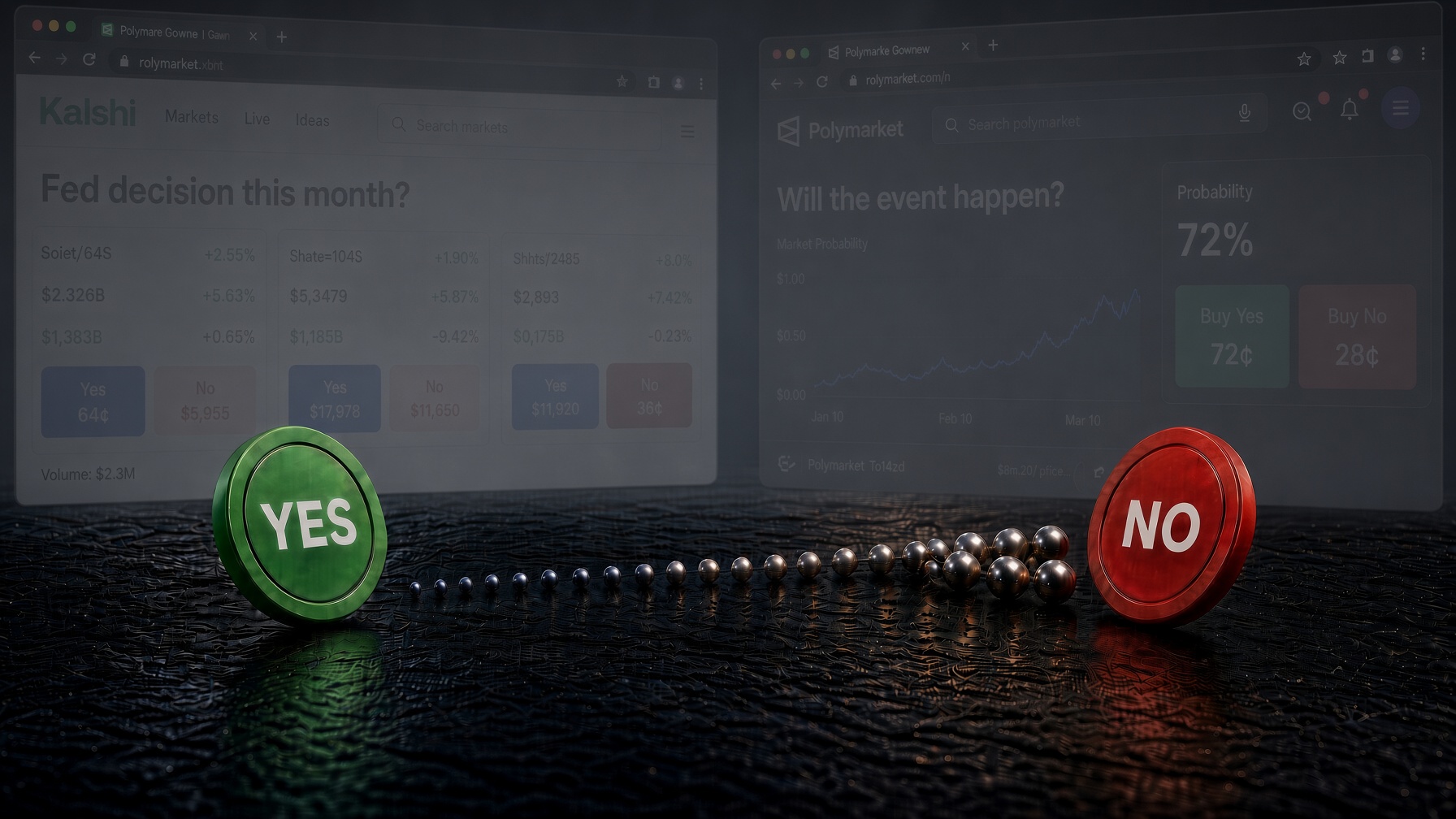
The matching engine used by Kalshi and Polymarket: resting limit orders are ranked by price, then time, and trades occur when a bid and ask cross. Contrasts with an AMM.
Complementary Outcomes
Outcomes that together cover the full event space (YES and NO on a binary; or a mutually exclusive, collectively exhaustive multi-outcome set). Their fair prices should sum to $1 before fees.
Condition ID
The on-chain identifier for a market’s resolution condition on Conditional Token Framework venues such as Polymarket. Used by contracts, APIs, and bots to track positions.
Conditional Tokens
Outcome shares minted against collateral. A complete set (one of each outcome) can be split from $1 of collateral and later merged back into $1, which is the mechanical basis for many arbitrages.
D
Designated Contract Market (DCM)
A CFTC-licensed exchange authorized to list and clear event contracts for U.S. customers under federal derivatives rules.
Dispute
A formal challenge to a proposed resolution. On optimistic-oracle systems, this typically escalates to a higher-cost voting or umpire process and can delay payout.
E
Edge
The difference between your estimated probability and the available trade price, after spread, fees, and expected slippage. Positive expected value requires an edge large enough to clear those costs.
Event
The real-world question or occurrence that a market (or group of related markets) is written on — an election, a data release, a game, a weather reading.
Event Contract
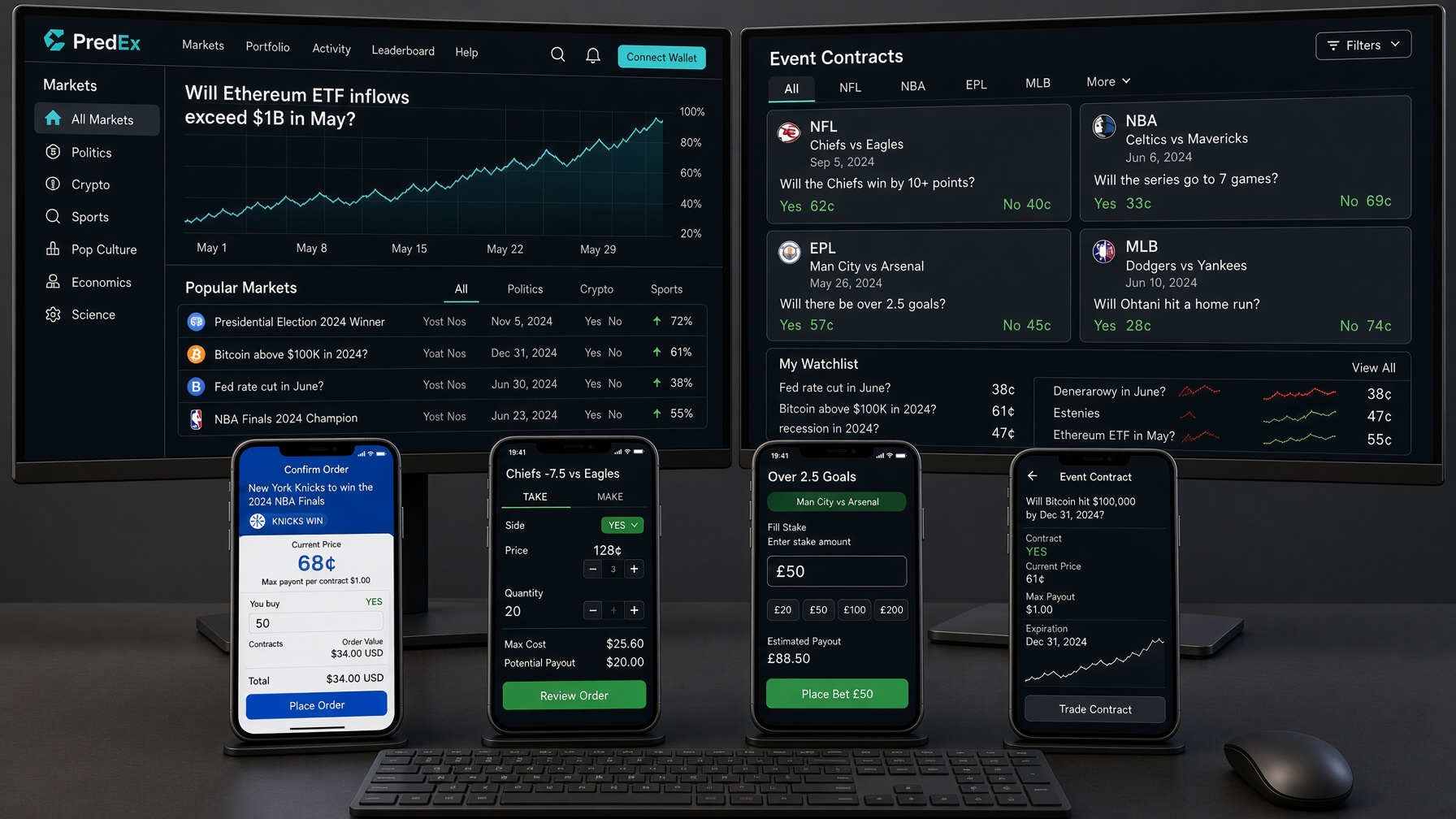
The legal and product name for a prediction-market instrument, especially on CFTC-regulated venues. Pays a fixed amount (usually $1) if the specified condition occurs, otherwise $0.
Expected Value (EV)
Probability-weighted payoff minus cost. For a YES bought at price p with true probability q, rough EV per contract is q × $1 − p, before fees and slippage. Traders hunt positive-EV tickets where they expect profit.
Expiry / Close
When trading stops. A market can close as soon as the outcome is known, or on a scheduled date even if settlement comes later. Market rules will include expiry/close information.
F
Fill
An executed trade against your posted order. Partial fills are common in thin books where not enough buyers and sellers are available to fill orders fully.
I
Implied Probability
The contract price read as a chance. A YES at $0.62 implies a 62% market-implied probability, before adjusting for fees.
In-the-Money / Out-of-the-Money
Informal labels: high-priced YES contracts (favorites) are “in the money”; cheap long-shot YES contracts are “out of the money.” Unlike options, there is no strike; settlement is still $1 or $0.
L
Limit Order
An order to buy or sell only at a specified price or better. It rests on the book until it’s filled or canceled, and it’s how market makers provide liquidity.
Liquidity
The ability to enter or exit market positions of size without moving price much. A function of spread, depth, and how reliably resting orders stay when you hit them.
Liquidity Provider / Market Maker
A market participant who continuously posts bids and asks, earning the spread (and sometimes venue rebates) in exchange for inventory and adverse-selection risk.
Long Position
Owning a market contract that pays out if that outcome resolves true in the future.
M
Maker / Taker
A maker adds liquidity with a resting limit order. A taker removes liquidity by hitting the BBO. Fee schedules often rebate makers and charge takers to encourage the former, as both are needed for smooth market operations.
Market Order
An order to buy or sell immediately at the best available prices. Fast, but you pay the spread and any slippage through multiple book levels.
Merge / Split
On-chain mechanic: split $1 of collateral into a complete set of outcome tokens, or merge a complete set back into $1. Used to mint inventory or to unwind a locked-in arbitrage.
Mid Price
The midpoint between the best bid and best ask, often used as a fair-value snapshot that ignores which side you would actually trade. A $0.61 bid / $0.63 ask implies a $0.62 mid.
Multi-Outcome Market
A question with more than two mutually exclusive results (for example, several candidates). Each outcome trades as its own contract; fair prices across a complete, exclusive set should sum to about $1.
N
NO Share
The contract that pays $1 if the event does not occur and $0 if it does. Buying NO at $0.30 is economically the same as selling YES at $0.70, before fees and inventory differences.
O
Open Interest
The number of contracts that remain outstanding: positions not yet closed or settled. Distinct from volume, which counts traded contracts over a period.
Oracle
The mechanism that brings a real-world result on-chain or into the matching engine so the market can resolve. Examples: UMA’s optimistic oracle on Polymarket; exchange-designated official sources on Kalshi.
Order Book
The live ladder of bids and asks, showing price and size at each level. Traders read it to judge liquidity, spoofing risk, and likely slippage. Refers back to an era when buy and sell orders were literally written down in a book by floor traders.
P
Payout / Settlement Value
What a resolved contract is worth. Standard binary payout is $1 for the winning side and $0 for the losing side, minus any venue fees on winnings or withdrawals.
Position Limit
A cap on how large a position one trader (or account cluster) may hold in a contract. Some smaller venues have tight limits; large DCMs often have none or much higher caps that won’t affect most traders.
Prediction Market
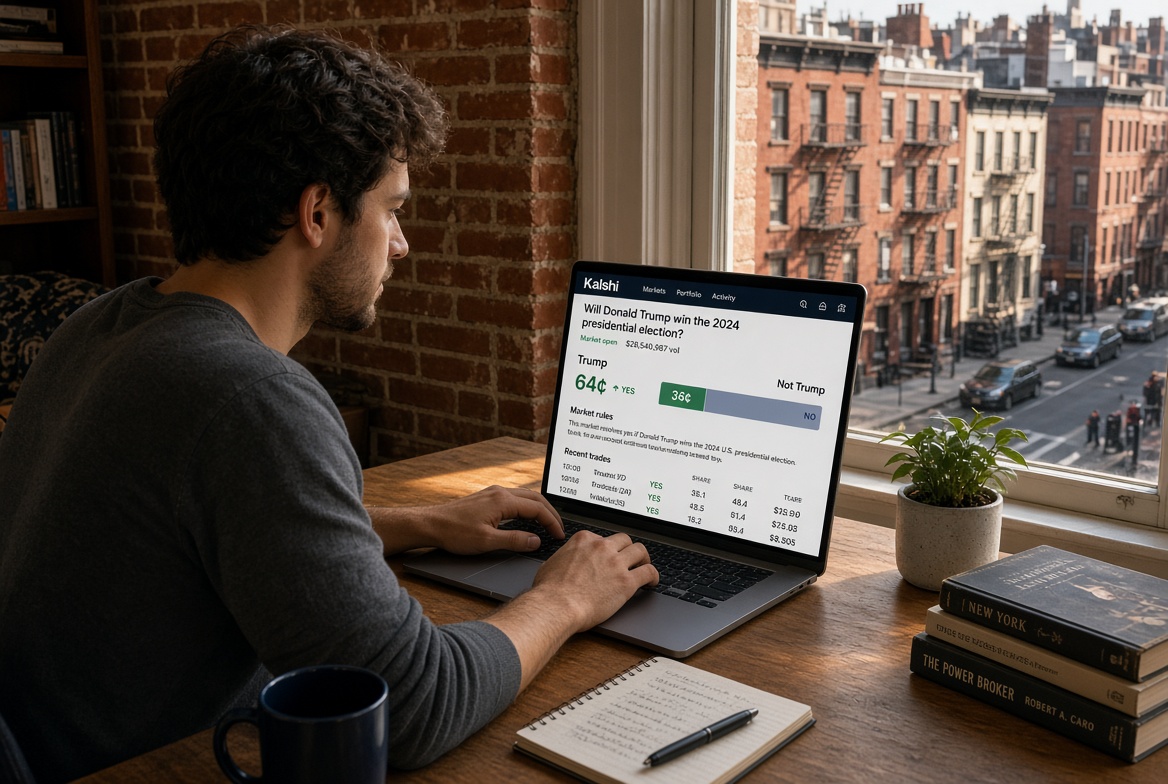
An exchange where participants trade contracts whose payoff depends on a future event. Prices aggregate beliefs into a live implied probability.
Price-Time Priority
CLOB matching rule: better prices fill first; at the same price, earlier orders fill first.
R
Rebate
A fee credit paid to makers (and sometimes to liquidity programs) for resting orders that get filled. Can flip net trading cost negative for skilled market makers.
Resolution
The process of determining the official outcome and converting winning shares to $1 and losing shares to $0. Always read the written resolution rules before trading in any prediction market. They are always posted on the market pages.
Resolution Criteria / Payout Criterion
The precise rules that define what counts as YES or a NO. Ambiguous wording remains a major source of conflict among prediction market users and platforms.
Resolution Source
The pre-declared authority used to decide the outcome: an official canvass, a statistical agency report, a governing-body box score, a specified weather station, and so on. Always read the resolution rules before trading.
S
Scalar Market
A contract that settles on a continuum between two bounds rather than strictly $0 or $1. For example, a temperature or vote-share range, with payout linear in the realized value.
Settlement
The cash or token transfer after resolution, when winning contracts are redeemed. Some venues distinguish resolution (the decision) from settlement (the payout).
Short Position
A position that profits if the named outcome does not occur, typically selling YES or buying NO. Max loss on a sold YES is $1 minus the sale price, per contract.
Slippage
The difference between the price you expected and the average price you actually received in fulfilling an order. In thin markets, slippage dwarfs the posted spread.
T
Taker Fee
The fee charged for removing liquidity. Often highest near $0.50 and lower toward the extremes on formula-fee venues.
Ticker
The exchange code for an event or market, used in search, APIs, and order routing even when the UI shows a plain-language title.
V
Volume
The cumulative value of contracts traded over a period in a given market. High volume does not guarantee current depth; always check the live order book.
W
Whale
A trader or account placing unusually large-sized orders compared to other traders. Large orders can be informed trades, hedging, or an attempt to move a thin book.
Y
YES Share
The contract that pays $1 if the event occurs and $0 otherwise. Its price is the market’s public headline implied probability for that outcome.