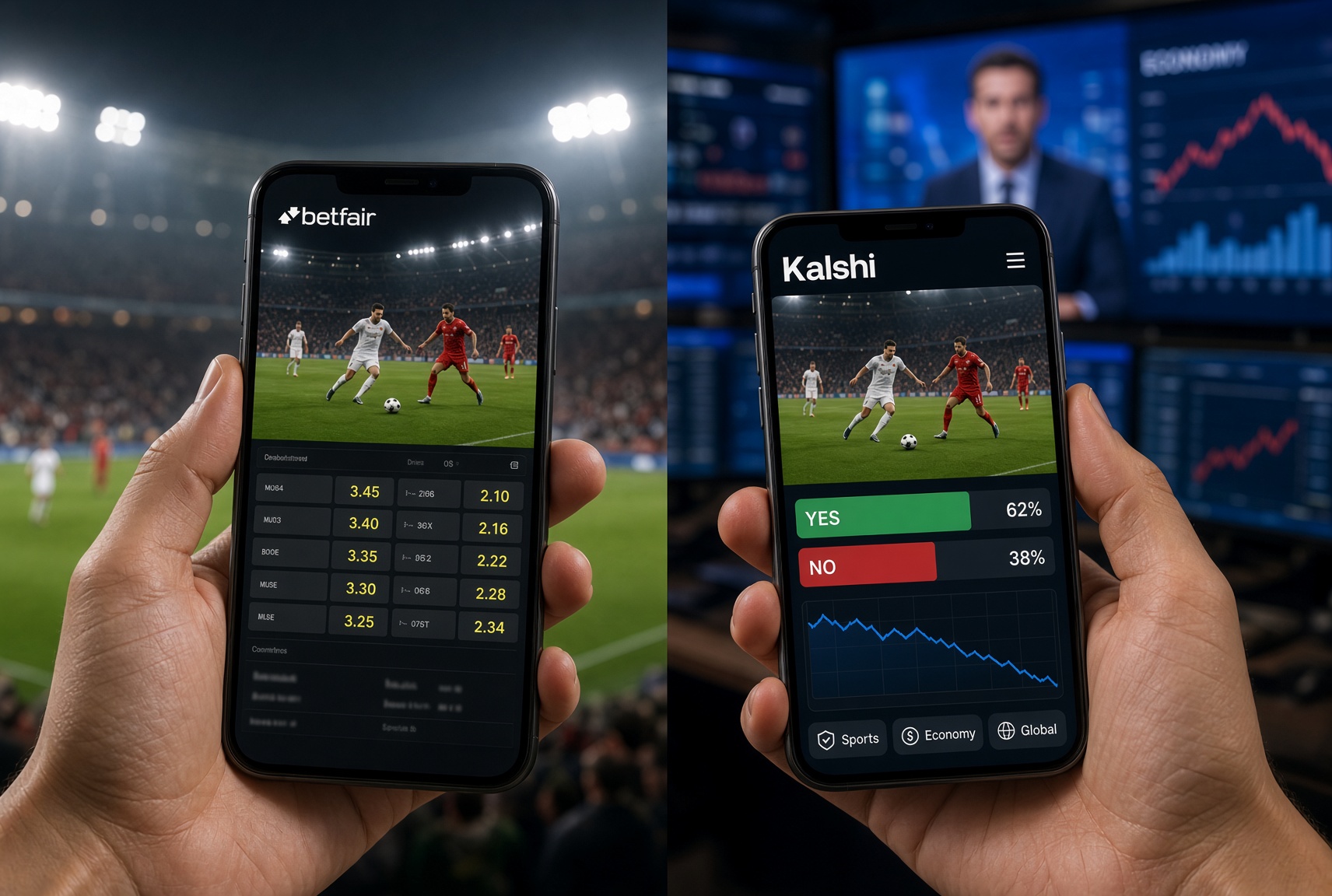
Picture a key poll dropping or a late goal hitting the hockey net. Traders on both betting exchanges and prediction markets instantly adjust their positions, and the prices you see shift in real time. Both models let people trade against one another instead of a traditional house, which is why beginners often treat them as the same thing. The practical differences in contracts, pricing, and event coverage still matter once you start placing real money.
Betting exchanges grew out of sports wagering and still focus there. Prediction markets expanded the peer-to-peer trading idea beyond sports to elections, economic releases, crypto, weather, and culture. Neither embeds a house margin or vig in every quoted price. Platforms earn revenue through commissions or trading fees, while traders set prices through supply and demand. Those shared traits create the overlap, yet the tools and rules diverge in ways that affect how you enter, manage, and exit a position.
This beginner’s guide walks through the core mechanics so you can see which style matches the events you follow and the way you prefer to trade. Understanding the split helps you avoid treating a yes-or-no contract like a back-and-lay market, and it shows where each model excels for active traders.
What Are Betting Exchanges?
A betting exchange is a marketplace where one trader backs an outcome, and another lays (bets against) it. The platform matches the two sides and holds the funds until the result is known. No bookmaker posts a price with a built-in margin. Platforms like the one Betfair describes in its explanation of how the exchange works illustrate the model clearly.
Prices appear as decimal odds. A price of 2.50 means a winning $100 stake returns $250 total before commission. You can request better odds if the current offer doesn’t suit you, and your order will sit until another trader matches it. Liquidity in the exchange (number of active traders and ease of trading) decides how quickly that happens. Major football matches (exchanges are largely international) and horse races usually have enough money available for fast fills, while smaller events can leave orders unmatched longer.
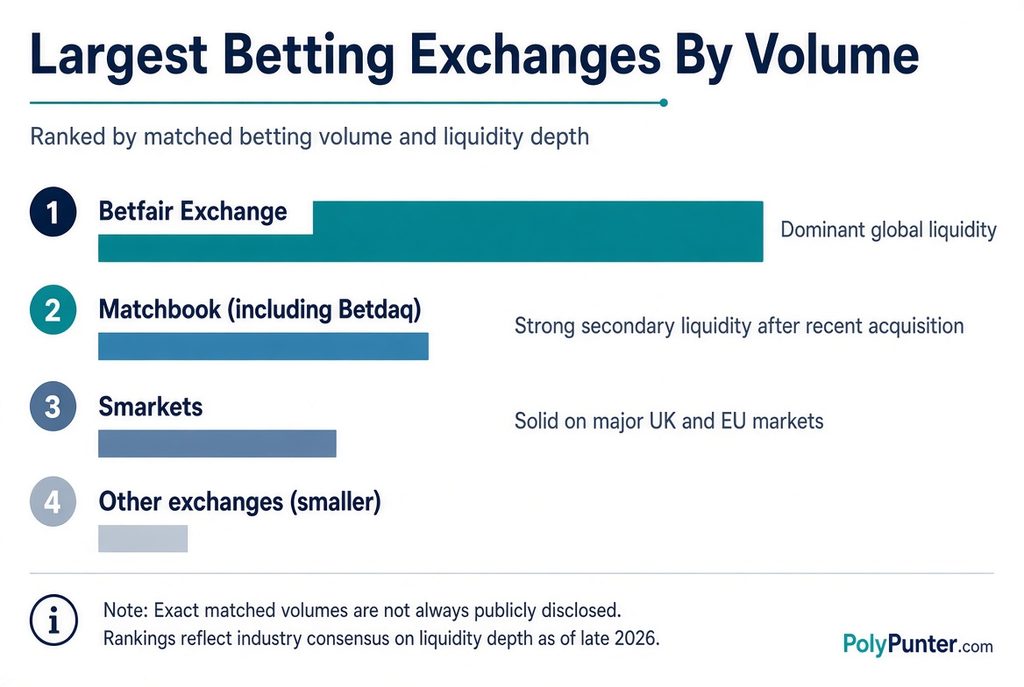
Commission is charged only on net winnings, typically 2% to 5% depending on the platform and your activity. Losing positions pay no commission. This structure rewards consistent winners because the platform does not lose money when skilled traders succeed. You can also exit early by placing an opposing bet to lock in a profit or limit a loss as odds move during the event.
In-game trading draws many users. Odds change with every goal, injury, or shift in momentum, and the back-and-lay mechanic lets you act on the opposite side of someone else’s view as games progress live. Most activity centers on sports because they offer the deepest liquidity and the longest track record on these platforms, plus the thrill of trading while watching events.
How Prediction Markets Function
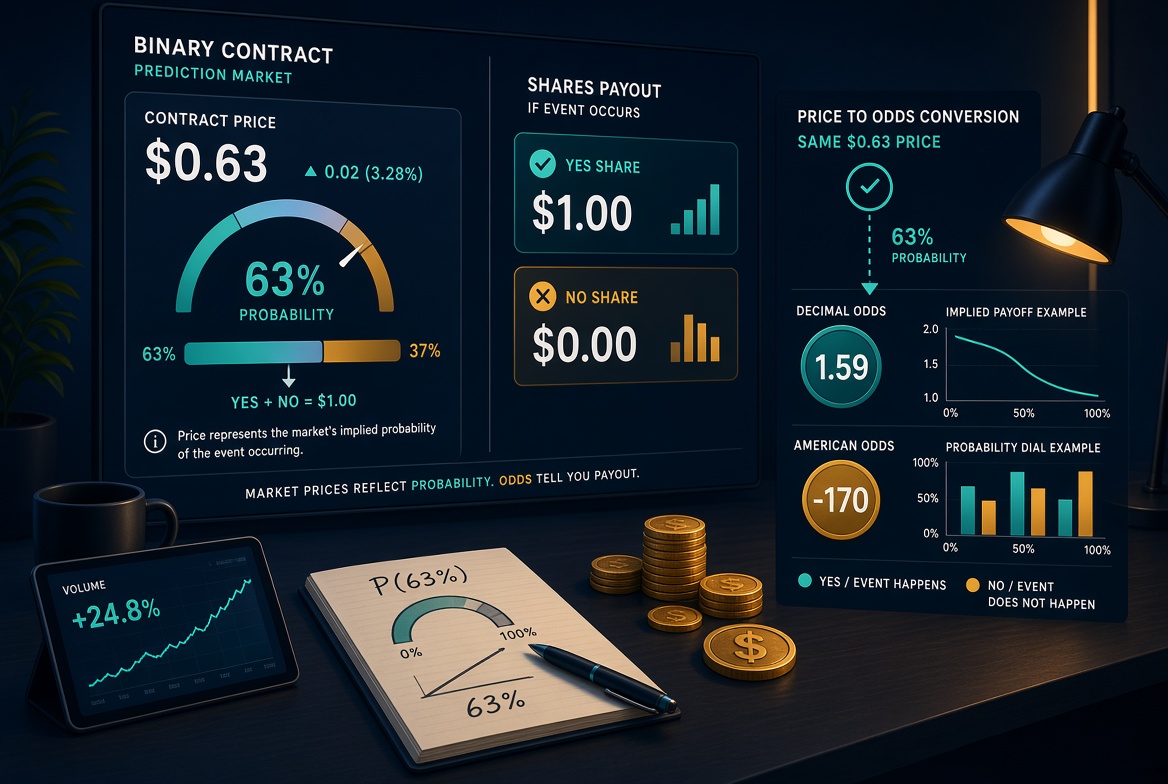
Prediction markets let traders buy and sell contracts tied to whether a specific future event outcome will occur. A standard contract pays $1 if the outcome is correct and $0 if it is not. The price, between $0 and $1, directly reflects the implied probability. A contract at $0.65 signals roughly a 65% chance the event happens, so you risk $0.65 to make $0.35 if correct, before fees. You can translate these probability prices into standard betting lines if you prefer.
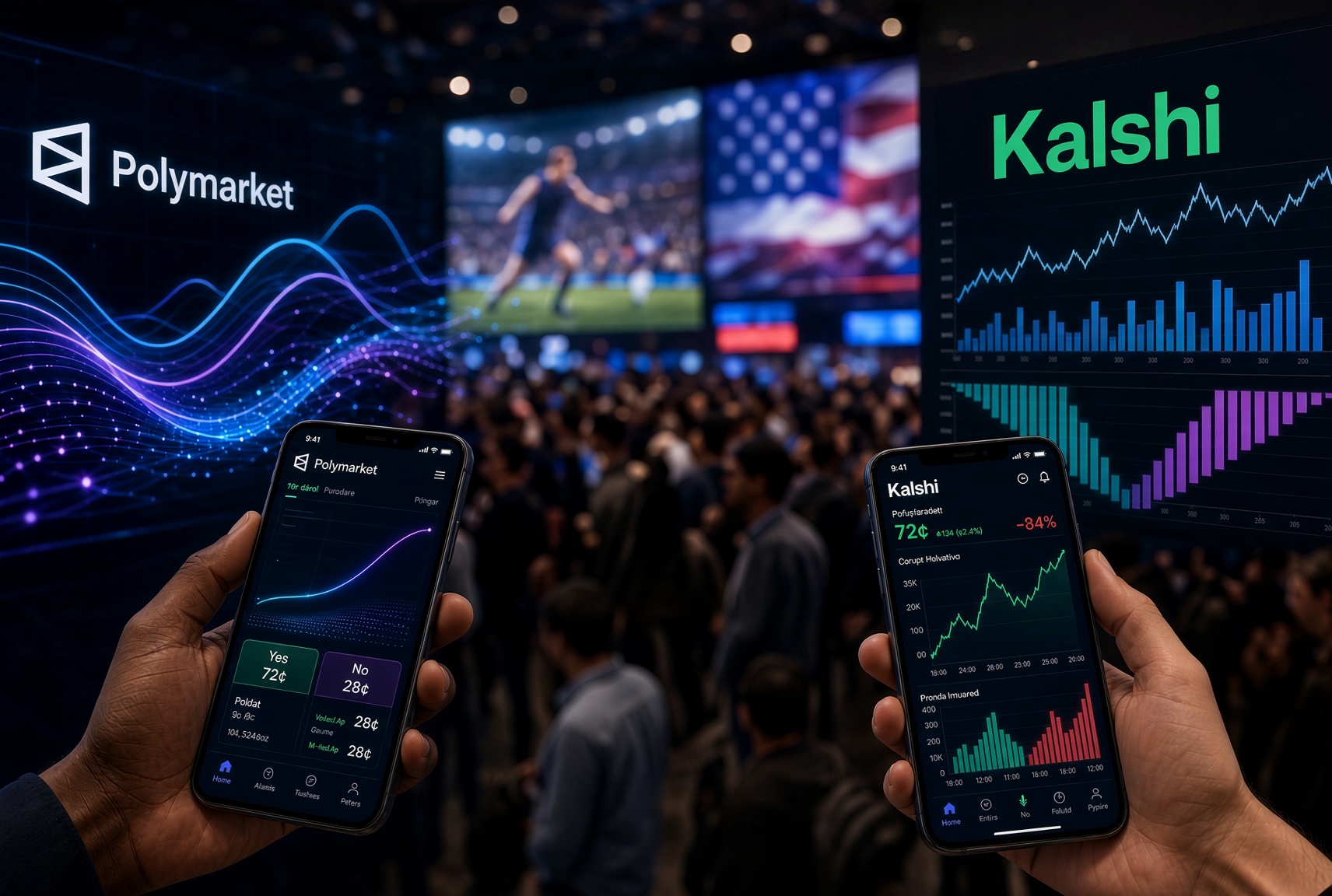
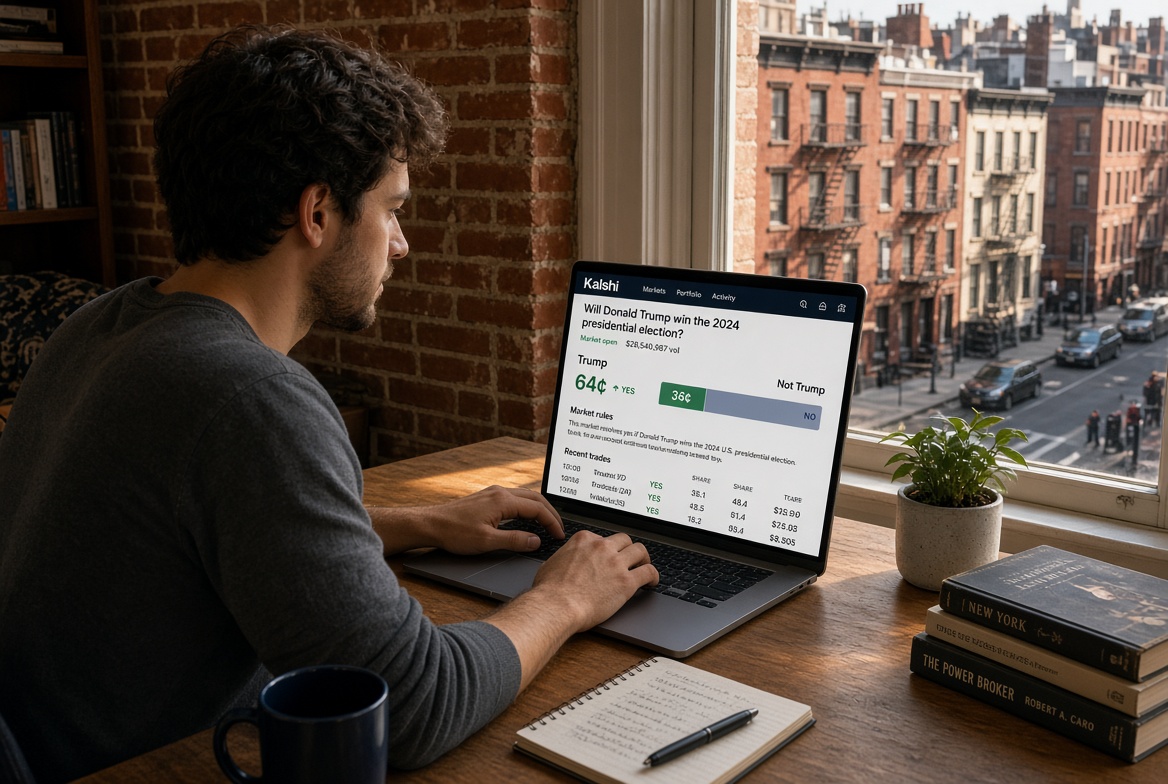
Platforms such as Polymarket and Kalshi operate this way. On Polymarket, $1 of collateral creates one Yes share and one No share. Winning shares redeem for the full $1. You can sell your shares anytime before resolution if the price moves in your favor or if you lose confidence in your forecast and want to avoid a potential full loss. An order book displays bids and asks from other traders, so prices form continuously through matching.
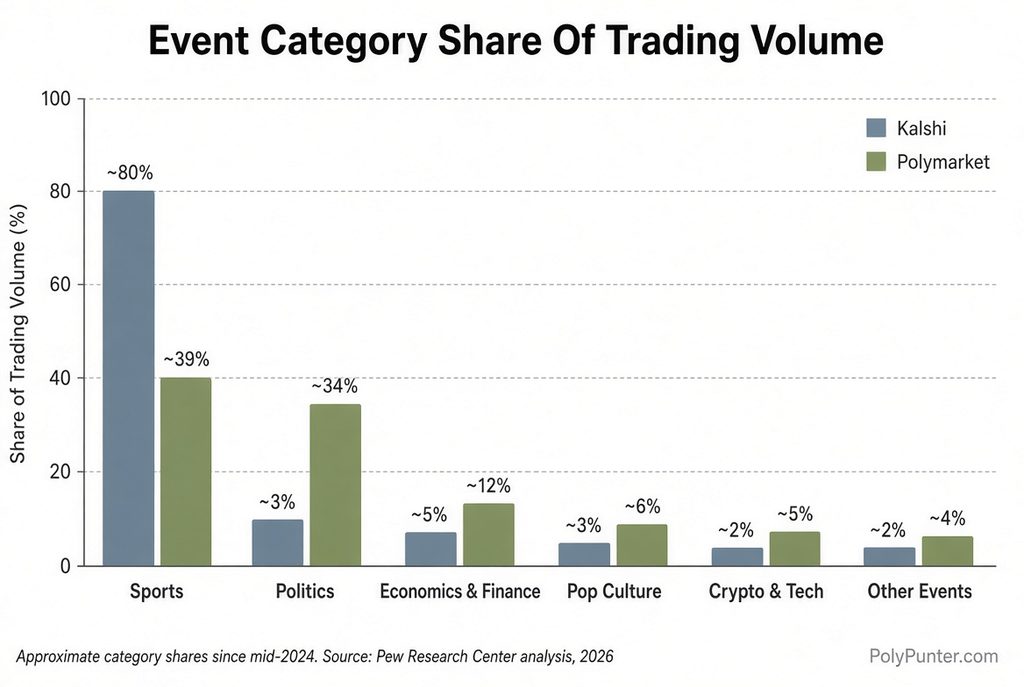
Traders study news and data, then take positions when they believe the market price underestimates or overestimates the true probability. The ability to exit early supports both longer-term views and shorter trades around fresh information. Like betting exchanges, trading continues throughout live events, such as sports.
Event coverage stretches well beyond sports into elections, interest-rate decisions, crypto pricing, weather outcomes, and entertainment awards. This breadth attracts people who follow policy or economics as closely as games. Liquidity varies. High-profile markets draw large volumes as the event approaches, while smaller ones can show wider spreads between the best bid and ask.
Core Structural Differences
The clearest difference between betting exchanges and prediction markets is how they present the trading. Betting exchanges use back and lay odds in decimal form. You explicitly take one side against someone taking the other. Prediction markets use binary contracts priced in cents that map straight to probability. Buying Yes at $0.40 is economically similar to backing an outcome, yet the prediction market interface feels closer to buying or selling a share of stock than it does to placing a bet.
Both rely on peer-to-peer matching through an order book, and neither platform takes a directional position. The practical difference shows up in language and flexibility. On a betting exchange, the lay option is central. On a prediction market, the equivalent of laying is simply buying the opposite contract. Prediction markets also use mechanisms to provide liquidity, including market-maker bonuses and incentives that encourage traders to create open-order positions.
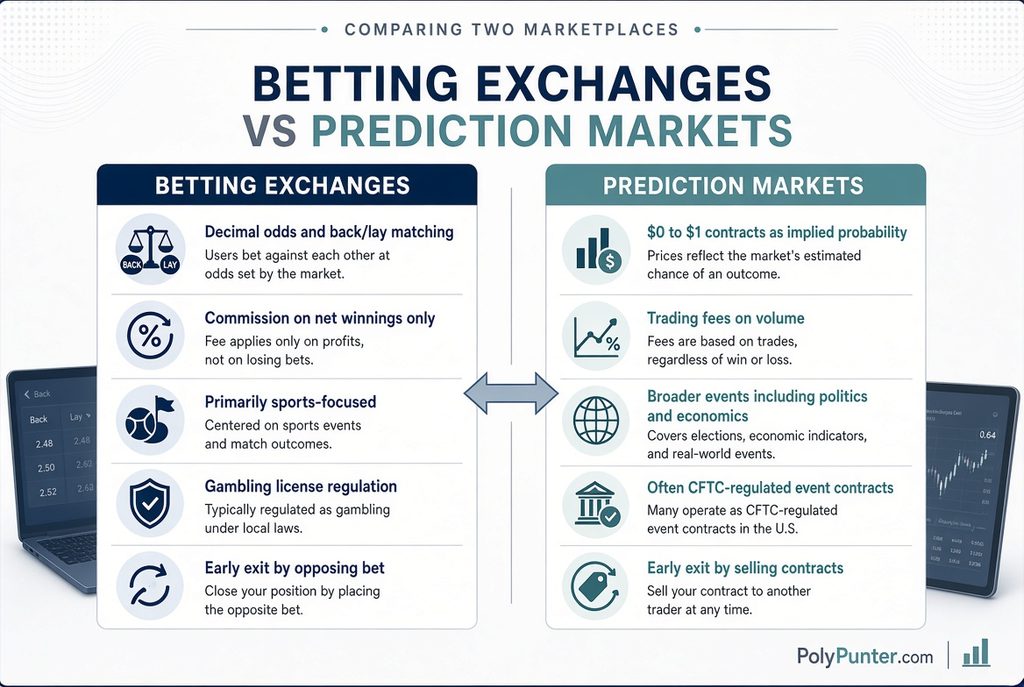
Scope further separates the two. Betting exchanges focus on sports under state gambling licenses and rely on deep sports data. Prediction markets list a wider range of events because federal CFTC regulation currently treats their contracts as financial instruments. A trader focused only on football may prefer an exchange with deeper sports coverage. Someone tracking policy decisions or economic releases will usually find more relevant markets on a prediction platform.
Both offer exit mechanics, though the steps differ slightly. On an exchange, you place an opposing back or lay to hedge. On a prediction market, you sell the contract at the current market price. In each case, the ability to exit before the final result gives you more control than a traditional fixed-odds bet, which locks until settlement.
Pricing, Fees, and Liquidity Compared
Fees hit differently across the two models. Betting exchanges typically take a commission only from net winners. If you lose overall, you pay nothing extra. Prediction markets often charge small fees on trade volume, sometimes with maker-taker differences that reward people who add liquidity by posting orders, while charging fees to those who merely purchase contracts. Exact rates vary by platform, so checking current schedules remains essential.
Because neither model embeds a house margin in the quoted price, both can offer tighter effective costs than a traditional sportsbook on popularly traded events. A sportsbook line at -110 on both sides implies roughly a 4.5% fee per side. On an exchange or prediction market, the cost is the explicit fee plus any trading spread (difference between listed price and trade settlement price). In heavily traded markets, skilled traders often get a lower all-in cost than the house take on a bet. Thin markets can reverse the advantage when spreads widen.
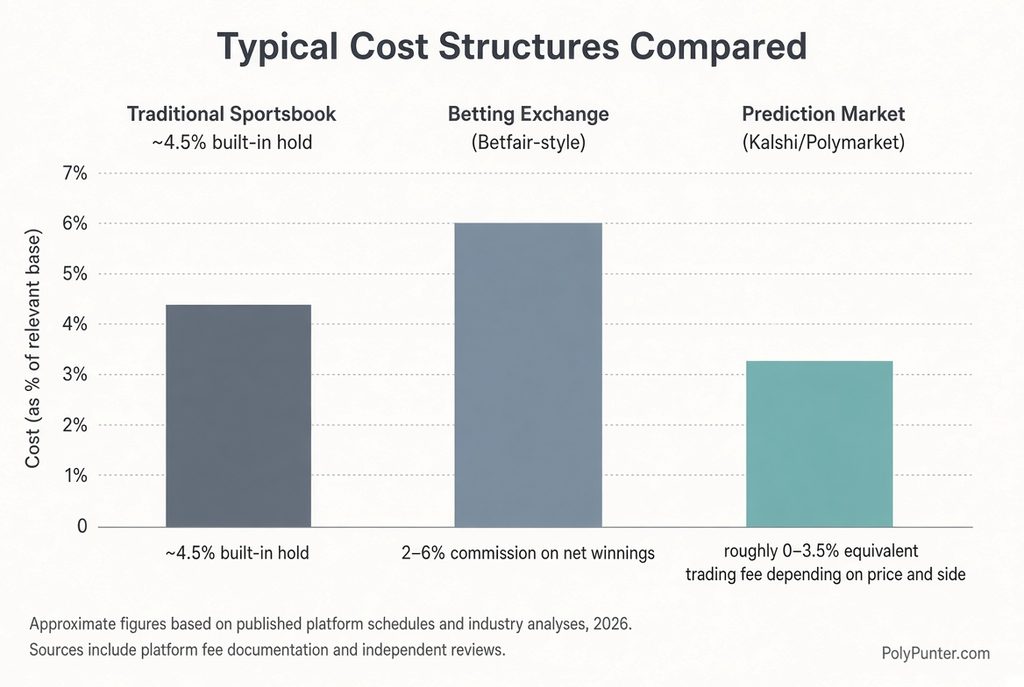
Liquidity determines whether you can get the size you want at a fair price. Major sports events on large betting exchanges usually show substantial money available at the best odds. High-profile prediction markets on elections or economic data can also attract large volumes, especially near the event. Smaller markets on either type may force you to accept a wider spread and premium or wait for a match to complete the deal, which may never happen.
Value-focused traders look for spots where the market price differs from their own probability estimate by more than the cost of trading. On a prediction market, a $0.40 contract you believe should be $0.50 represents clear expected value if your estimate holds. The same logic applies on an exchange once you convert decimal odds into an implied probability and subtract the commission. Applying that comparison consistently separates casual activity from more disciplined approaches.
Regulation and Oversight
Regulation forms one of the sharpest dividing lines. Betting exchanges generally operate under gambling licenses issued by state gaming authorities. Those licenses include rules on responsible-gambling tools, age verification, and market offerings. Platforms must comply with the specific jurisdiction that licenses them. Additionally, not all states accept betting exchange activity. Each state decides.
Prediction market platforms can operate as designated contract markets under CFTC oversight, treating the contracts as financial instruments rather than gambling products. Ongoing discussions and court cases continue to clarify the boundary between these event contracts and traditional wagering, and a few states have temporarily banned prediction markets, but few have done so to date as court rulings continue.
The regulatory difference influences available markets and access. Gambling-licensed exchanges emphasize sports. Derivatives-style prediction markets can list broader events as long as they meet the relevant fi nancial rules. Traders should always verify current legal status and platform eligibility before depositing funds. Rules can shift, and platforms may restrict access based on residency or other factors.
Choosing the Right Approach for Traders
Your preferred events and engagement style usually determine which platform type fits best. If you mainly follow sports and want to lay outcomes while trading live action, a betting exchange often feels natural. Decimal odds and the back-lay interface are familiar to anyone who already uses traditional odds formats. Deep liquidity on major sporting events supports larger sizes.
If you want to trade views on elections, economic data releases, or other non-sports events, prediction markets open that door. Probability-style pricing makes it straightforward to compare the market’s view against your own research. The ability to sell contracts before resolution supports both directional bets and shorter-term trading around news. And prediction markets also offer large-volume markets on major sporting events such as the NFL and NBA.
Many active traders use both depending on the specific opportunity. A football match might offer better depth on an exchange, while a central-bank decision appears only on a prediction market. Skills in reading order books, managing risk, and estimating probabilities transfer between the two. Start small while you learn either interface to reduce early mistakes.
Risk management stays essential on both. Position sizes should reflect how much you can afford to lose on a single trade, and spreading activity across events helps avoid concentration. Because you can exit early, you also control how long you stay exposed. Reviewing results over time, including fees paid, shows whether any edge is real. Both models are growing because people want transparent, market-driven pricing on event outcomes, and understanding the differences helps you choose the tool that matches the questions you care about most.
Frequently Asked Questions
What is the main difference between a betting exchange and a prediction market?
Betting exchanges match back and lay bets on outcomes, usually with decimal odds and a commission on net winnings, and focus heavily on sports. Prediction markets let traders buy and sell yes-or-no contracts priced between $0 and $1 that represent implied probabilities, covering a wider range of events, and typically charge fees on trade volume.
Can I exit a position early on both?
Yes. On a betting exchange, you can place an opposing bet to hedge or lock in a result before the event ends. On a prediction market, you sell the contract you hold back into the order book at the current market price.
Do either of these have a house edge like a sportsbook?
No. Both are peer-to-peer. The platform does not take the other side of your trade. Costs come from explicit commissions on winnings (betting exchanges) or trading fees (prediction markets), not a margin built into every quoted price.
Which one is better for beginners?
It depends on what you want to trade. Prediction markets often feel simpler because the price in cents reads directly as a percentage probability. Betting exchanges may feel more familiar if you already know decimal odds and sports markets. Starting small on either while you learn the interface is wise.
How do fees compare in practice?
Betting exchanges usually take a percentage only of net winnings in a market. Prediction markets more often charge small fees on each trade. On liquid (highly active) markets, both can be cheaper overall than a traditional sportsbook’s built-in margin, but check current rates on the specific platform.
Are the same events available on both?
Both offer the same sports, though betting exchanges often have deeper liquidity on major matches. Prediction markets add politics, economics, weather, and other events that gambling-licensed exchanges may not list. Some major prediction markets like Kalshi may have 5,000+ markets open to trade at any given time.
Is one more regulated than the other?
Betting exchanges typically hold state gambling licenses and are regulated by state gaming authorities. Onshore U.S. prediction markets operate as regulated financial exchanges that list event contracts. Always confirm the current status and whether the platform accepts traders from your location. When you visit the site or app, your IP address will geolocate you and tell you whether it’s allowed in your area.