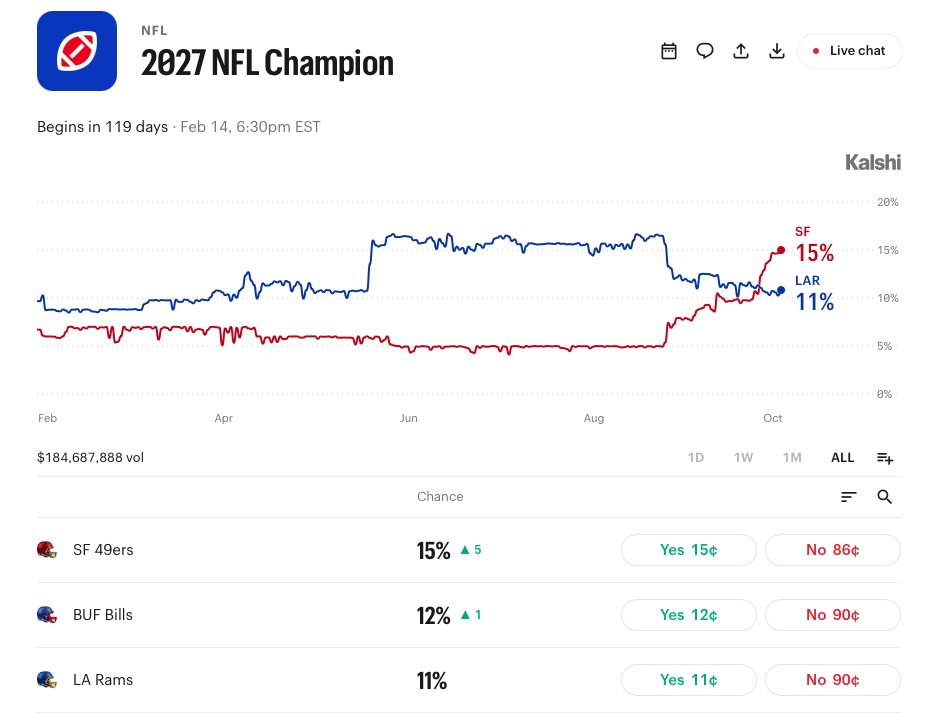
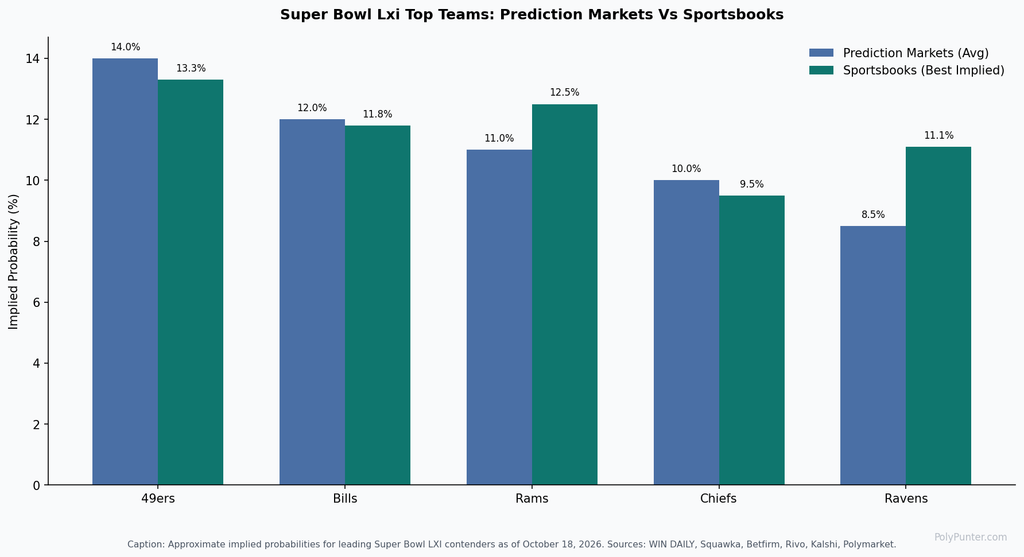
Super Bowl LXI futures contracts continue to trade actively, with live prediction-market prices often diverging from traditional sportsbook lines. On October 18, 2026, the San Francisco 49ers sat near the top of both boards. Polymarket listed them around 13%, Kalshi showed 15%, and several sportsbooks offered +650, which converts to roughly 13.3% after removing their margin. Traders convert every contract price into an implied probability and compare it directly to the de-vigged sportsbook number to spot the difference.
The Buffalo Bills and Los Angeles Rams occupied the next spots across most venues. Polymarket and Kalshi both priced the Bills near 12% and the Rams near 11%, while sportsbooks posted the Bills at +750 and the Rams at +700. These small gaps create situations where one side sometimes offers a cleaner entry. Volume on the Kalshi Super Bowl market has already surpassed $180 million, while Polymarket has drawn tens of millions across its championship and conference contracts.
How Prediction Market Prices Compare To Sportsbook Futures
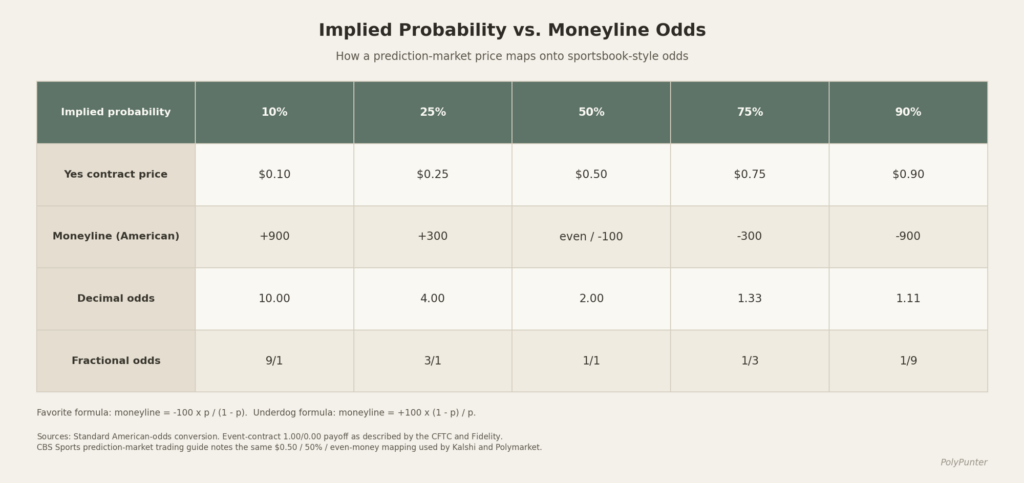
A 15¢ contract equals a 15% chance according to the traders active in that order book. Sportsbooks express the same idea with American odds, so a +650 line implies about 13.3% once you remove the sportsbook vig. When the two numbers differ by more than a point or two, traders treat the cheaper side as the better entry, whether it sits on an exchange or at a book.
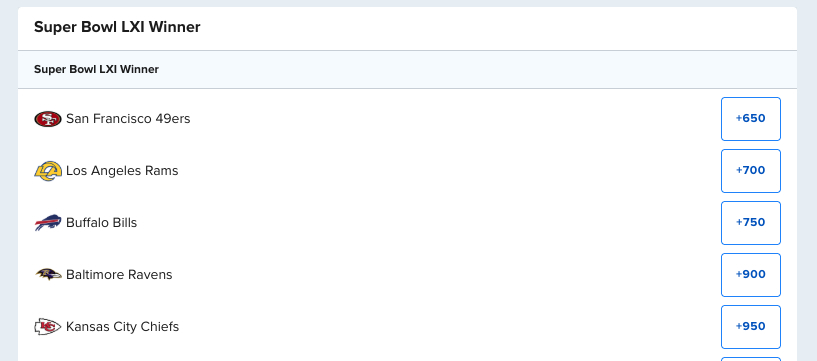
Recent snapshots show this pattern across the board. One comparison listed the 49ers cheaper at the books than on Kalshi after fees, while the Rams looked slightly better on the prediction market side. The Bills sat in between, with the advantage shifting depending on how you read the numbers. These gaps rarely stay open once volume increases, yet they appear often enough that active traders check both sources daily.
Conference and division futures follow the same math. NFC Championship contracts on Polymarket have already traded millions, with the 49ers and Rams again leading. Traders who see a team underpriced relative to the sportsbook consensus can buy the Yes contract and hold or exit before settlement. They can also sell Yes if they believe a favorite is overvalued, taking the opposite side without needing a matching No price at every sportsbook.
World Series and NBA Championship markets operate under identical mechanics. A recent Polymarket World Series price sat near 64%, while Kalshi was a point higher, and traders could instantly compare both figures to American odds at major books. The process rewards speed and basic arithmetic more than loyalty to any single platform.
Volume And Trading Patterns In Championship Markets
Total volume on the Kalshi 2027 Pro Football Champion market exceeded $184 million by mid-October, with daily figures still climbing. That liquidity lets larger traders enter and exit without moving the price as much as they would on thinner sportsbook futures boards. Polymarket’s Super Bowl and related NFL futures contracts have added tens of millions more.
The two venues do not always move in lockstep. Over a 24-hour window, the 49ers can be up a few points on one platform and flat on the other. Traders watch those divergences, buying the lagging price and selling the leading one when the gap exceeds costs. The same behavior appears in daily game markets, where Polymarket and Kalshi prices sometimes sit a point or two away from the de-vigged consensus at the books.
Sports-specific volume reinforces the pattern. One Sunday NFL game comparison showed Kalshi handling most of the money while Polymarket offered a tighter price on one side. Traders who already hold Super Bowl positions often layer shorter-term contracts on top, using the same implied-probability math. The activity creates a continuous link between weekly games and the championship board.
Secondary markets add further volume. Kalshi contracts on which brands will advertise during the game have already traded millions, and those prices move independently of the team futures. Traders can express views on the event’s cultural side without touching the sports outcome.
Value Hunting And Price Discrepancies
Value appears wherever a prediction market price sits meaningfully below the sportsbook consensus after the vig is removed. One model comparison on October 18 placed the Bills higher than the combined Kalshi-Polymarket price, flagging them as underpriced relative to that projection. Traders don’t need the model to be correct; they just need the market price to look cheap compared with the books they can access.
Buying No on a heavy favorite creates another form of value. If a team trades at 15% on Kalshi, the No side costs 85¢ and pays $1 if that team fails to win the Super Bowl. Sportsbooks rarely offer an equivalent “not to win” price at the same tight margin, so traders who want to fade a popular name often find the cleaner expression on the exchange. That structure keeps both sides of the board liquid, a market action not required where sportsbooks are the house.
Daily updates show these opportunities rotating through the field. A team that looks expensive on Monday can look cheap by Thursday after a strong or weak performance. Traders who hold positions across both prediction markets and sportsbooks can rebalance when the gap widens, selling the higher price and buying the lower one. Over time, this activity tends to pull the two sets of odds closer.
Conference futures add another layer. A trader who likes a team’s Super Bowl chances but sees better value in the conference-winner contract can size the two positions differently. The rule stays consistent: convert every price to a probability, remove the sportsbook margin, and act only when the difference exceeds fees and expected slippage.
Implications For Futures Pricing Through The Season
Liquid prediction market contracts have already changed how some traders approach long-dated NFL futures. Instead of locking in a sportsbook price in August and waiting until February, they can adjust continuously as new information arrives. A contract bought at 8% in September can be sold at 12% in October if the team’s outlook improves, locking in a gain without waiting for the Super Bowl.
Sportsbooks still hold advantages in depth on certain teams and in promotional offers. Prediction markets counter with transparent order books, the ability to sell at any moment, and prices that reflect only the money currently willing to trade. The two systems now feed each other: a sharp move on Kalshi or Polymarket often appears on the books within hours, and vice versa.
As the regular season continues, the gaps between the two will keep appearing and closing. Traders who track both sources, convert every line into an implied probability, and act only when the difference covers costs will keep finding entries. The Super Bowl board is simply the largest and most visible example of a pricing relationship that now runs through nearly every major sports futures market.
References
- Super Bowl & NFL Futures Odds 2026-27: Live Prices & Favorites
- NFL Super Bowl LXI Odds 2027: Model vs Market
- 2027 NFL Champion Odds & Predictions
- Super Bowl LXI Futures for 2027: Vegas Odds Betting Lines
- Polymarket Odds: Live Prices for Every Big Market
- Kalshi 2027 Pro Football Champion Odds
- Prediction Markets News and Analysis
- How to trade NFL MVP and Super Bowl futures on ProphetX, OG.com, Kalshi, and Polymarket