

Whether Tarek Mansour’s dire warning about sports event contracts falling under state-by-state gaming regulation is entirely accurate, entirely a scare tactic, or somewhere in between remains up to the reader to decide. When such vast sums of commercial revenue are under discussion, it’s always wise to look beyond the headlines and slogans.
Kalshi chief executive Tarek Mansour told a DC Fintech Week audience on October 14 that intensifying state challenges to sports event contracts leave the industry with a binary choice: stay or go. Speaking near Washington, he argued that if courts side with state gambling authorities, regulated platforms will not simply adapt to a patchwork of local rules. Instead, they will leave the United States entirely.
Mansour said the company feels “pretty good” about its overall legal position even after recent appellate losses. He rejected the idea that the fight is merely about which domestic regulator wins. “It’s not a choice of state versus federal market,” he stated. “It’s a choice of whether prediction markets exist in the U.S. or whether they go offshore.” The remarks arrive as multiple federal circuits have reached conflicting conclusions on whether the Commodity Exchange Act preempts state gambling statutes for contracts traded on a designated contract market.
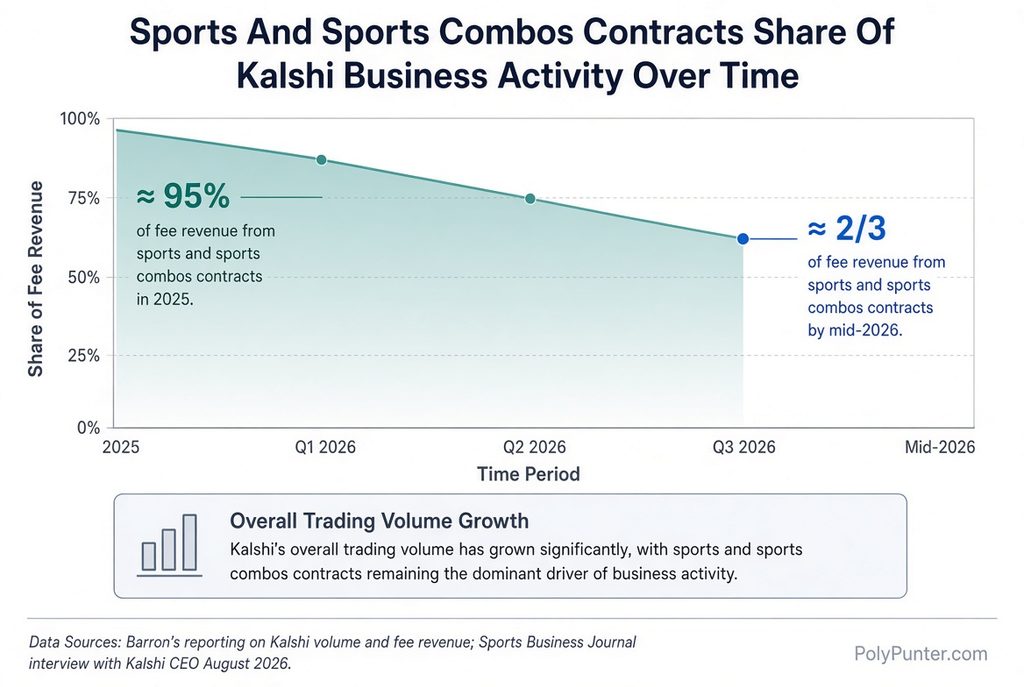
Sports event contracts have driven rapid growth for Kalshi and similar platforms. Mansour called the claim that these contracts lack economic consequence “ludicrous.” He pointed to the Commodity Exchange Act’s evolution from agricultural futures to energy and metals, and then to less tangible instruments such as swaps. In his view, the statute already accommodates the products Kalshi lists under Commodity Futures Trading Commission oversight. Kalshi’s legal opponents, including dozens of state attorneys general and multiple tribal nation plaintiffs, dispute his interpretation.
Conflicting Appellate Rulings Shape The Current Legal Landscape
Federal appeals courts have split on the core question. The Third Circuit ruled for Kalshi in a New Jersey dispute, finding that federal commodities law prevails. By contrast, the Ninth Circuit allowed Nevada to enforce its gaming statutes against the platform’s sports contracts. On September 25, a unanimous Sixth Circuit panel sided with both Ohio and Tennessee, affirming the denial of a preliminary injunction in one case and vacating an injunction in the other.
Judge Julia Smith Gibbons wrote that Kalshi had not shown its sports-event contracts meet the statutory definition of a swap. Even assuming they did, the court held that the Commodity Exchange Act neither expressly nor impliedly preempts the states’ gambling laws. The opinion emphasized that sporting outcomes lack the inherent financial character of traditional swaps such as interest-rate or commodity-price contracts. As a result, Ohio and Tennessee regulators may continue enforcement efforts while litigation proceeds.
After their loss at the circuit level, New Jersey officials have petitioned the Supreme Court to resolve the emerging circuit split. Interested parties, including the National Football League, have already filed an amicus brief with the high court opposing Kalshi’s position. Kalshi has also sought full Sixth Circuit review of the Ohio and Tennessee decisions. Meanwhile, at least four states have secured court orders restricting what the platform can offer within their borders, and roughly twenty states are involved in related litigation.
Company counsel have argued in legislative settings that blocking federally regulated contracts does not eliminate demand. Traders simply migrate to unregulated offshore venues that lack the consumer protections and market surveillance Kalshi maintains. Many of these same arguments were used in ultimately successful attempts to legalize sports gaming at the state level, as sports betting was already available to U.S. based customers via numerous major offshore sportsbooks.
Mansour has previously noted that the platform voluntarily declines to list certain contracts involving war, assassinations, or members of Congress, distinctions that disappear once activity moves outside U.S. jurisdiction. Again, this is both a self-compliment and something of a threat rolled into one.
CFTC Actions And Market Maker Activity Draw Additional Scrutiny
The Commodity Futures Trading Commission has moved to reinforce its role. Recent agency actions include a rule and a proposed rule clarifying that event contracts fall within the definition of swaps subject to exclusive federal oversight, not state gambling statutes. Kalshi and the commission have consistently maintained that designated contract markets operate under the Commodity Exchange Act, not under state gaming codes.
Mansour also addressed social-media claims that fixed-size orders inflated trading volume in the platform’s bitcoin and ether perpetual-futures markets. Relatedly, there were wash-trading allegations in these markets. He attributed the recurring order sizes to legitimate market-maker activity and described much of the online commentary as misunderstanding how markets function. “They’re just complicated,” he said. “They’re not easy to understand.” The exchange has not altered its public reporting in response to the allegations.
State challenges have focused almost exclusively on the sports segment, leaving other categories largely unchallenged for now.
Implications For Traders And Future Regulatory Clarity
If courts ultimately endorse broad state authority, platforms face a practical choice: exit contested states or relocate operations offshore. Mansour’s comments suggest the latter is the more likely path for any firm that seeks uniform national rules. Offshore venues already list many of the same sports and political contracts, often with thinner surveillance and fewer restrictions on contract types. Polymarket remains offshore, and while it cannot serve U.S.-based customers, practical alternatives exist.
U.S. consumer-protection requirements differ significantly between regulated and offshore platforms. Federally regulated platforms operate under CFTC rules that require market surveillance, position limits in certain cases, and intermediary registration. State gaming regimes impose their own licensing, tax, and advertising requirements. An offshore shift would leave neither set of rules fully applicable, a point company representatives have made in state legislative hearings.
The Supreme Court could review the case this term or next. Until then, the circuit split leaves operators navigating inconsistent rulings. Some states may pause enforcement pending clarity from higher courts; others may press forward. Much of this is about politics and money, and those two incentives tend to shift.
The outcome will also affect how other financial venues approach event contracts. Traditional exchanges and newer platforms have watched the litigation closely. A definitive Supreme Court decision favoring federal preemption would likely accelerate product launches into this space. They are moving quickly now, despite the uncertainty. A decision favoring state authority would constrain the category inside the United States and shift volume elsewhere.
References
- Kalshi CEO says state-led oversight of U.S. prediction markets would push them out — CoinDesk
- Kalshi CEO warns state oversight could push prediction markets offshore — Crypto Briefing
- Kalshi CEO defends prediction markets amid insider trading concerns — The Block
- Sixth Circuit Rules Against Kalshi in both Ohio, Tennessee — Sports Betting Dime
- Tennessee Wins Appeal in Major Sports Betting Fight with Kalshi — Tennessee Attorney General
- Kalshi Can Face Ohio, Tennessee Enforcement After New Ruling — Bloomberg Law
- Sixth Circuit Deepens Circuit Split — Blank Rome
- Kalshi loses appeal over Ohio and Tennessee sports betting laws — The Block