
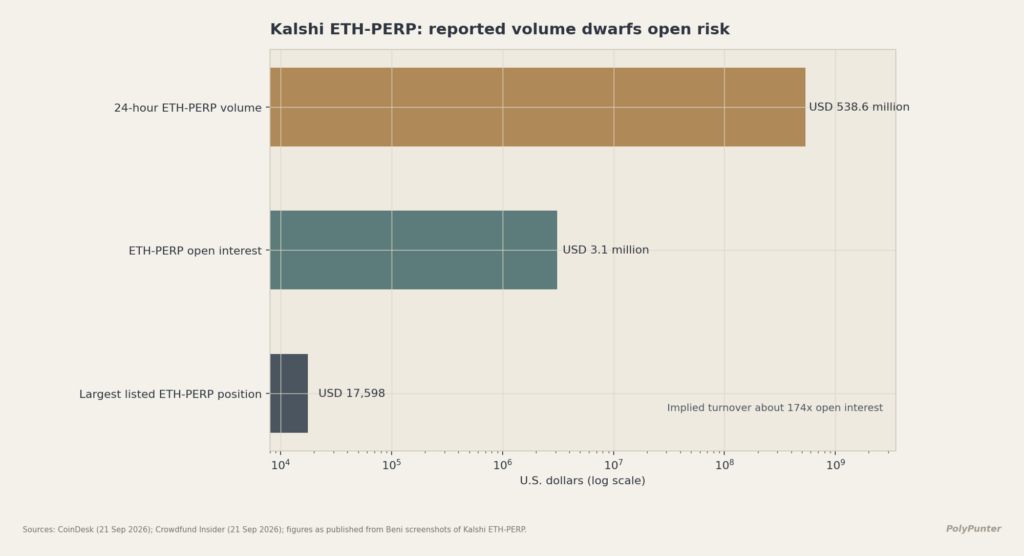
A public fight over Kalshi ether perpetual futures volume exploded across X this weekend and carried into Monday. Former quant Beni, co-founder of Stealth Neolab, posted screenshots showing about $538.6 million in 24-hour ETH-PERP turnover against roughly $3.1 million of open interest. That is a 174x volume-to-open-interest ratio, or a full book turning over about every eight minutes.
He then flagged one repeating clip. In his follow-up thread, the same $5,500 ticket made up 48% to 58% of all ETH-PERP notional across four days. Kalshi’s public leaderboard listed the largest ether-perp holding near $17,598. To Beni, huge turnover, a tiny live book, and one recycled size did not look like crowded risk at all.
Kalshi’s crypto lead, posting as IcoBeast.eth, rejected the charge. He said the first complaint mixed event-contract share charts with perpetual futures data. As of September 21, 2026, no Commodity Futures Trading Commission case has accused Kalshi of washing these contracts. The live argument is narrower: how the headline number is built, who can trade almost for free, and why one $5,500 size keeps dominating the feed.
What the $5,500 ETH-PERP Pattern Showed
Wash trading is buying and selling with yourself or a partner so reported turnover rises while little genuine position risk remains. It’s fake volume. Beni’s first thread opened with “Kalshi fakes their crypto volume, and I can prove it” and told readers to pull Kalshi’s own feed. Open interest is contracts still open. Volume is contracts that changed hands. When volume runs 174 times open interest, the market is spinning far faster than the inventory of live bets.
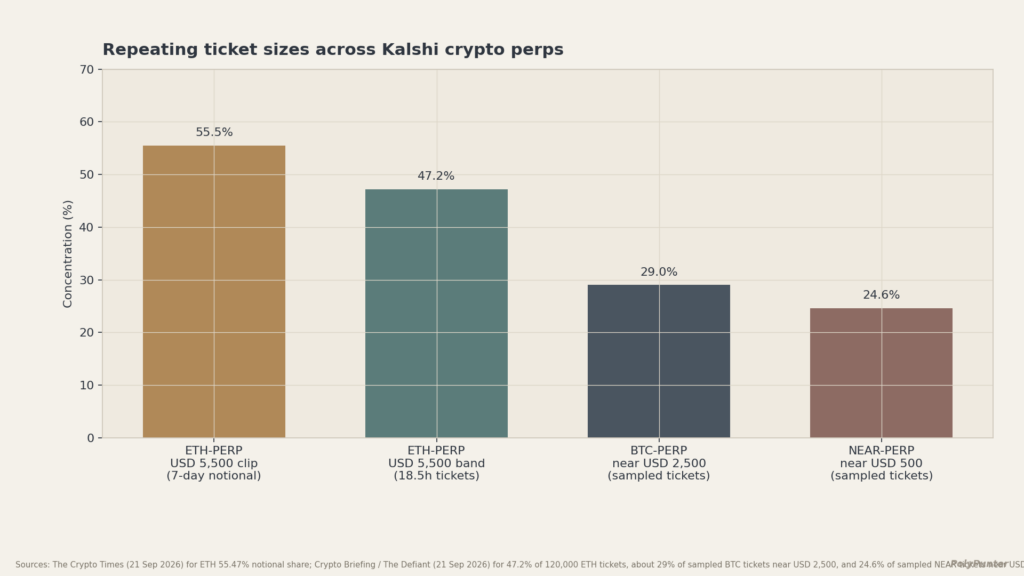
One review of 529,318 ether-perp trades over seven days found about $2.22 billion in notional, with roughly $1.23 billion, or 55.47%, clustered near $5,500. A separate pass over 120,000 consecutive KXETHPERP trades covering about 18.5 hours found 47.2% of tickets in a tight band that later drifted toward about $5,425.55 after 03:00 UTC on September 21, good for 62.75% of that sample’s notional.
Bitcoin perps leaned toward $2,500 clips in one sample. NEAR tickets bunched near $500. Ether still showed the sharpest pile-up. A repeating size can come from a bot, a quoting routine, or coordinated flow. It does not name the accounts on both sides. The public data show a dominant ticket and a thin open-interest base. They do not prove Kalshi directed matching trades. And Kalshi has now officially denied such a charge.
How Kalshi Answered the Fake Volume Charge
IcoBeast.eth said wires got crossed. Beni’s first chart, he argued, measured event-contract share from Artemis, not perpetual futures turnover. “We don’t do rebates for crypto prediction markets,” he wrote, adding that contract-to-dollar math matches other event venues. He also rejected the claim that Kalshi hand-picks self-clearing members, calling fair access a regulatory requirement. No trader can be treated differently.
He then pointed at the rest of the industry. CME, Hyperliquid, and Binance all pay for liquidity, he said, and some offshore books even run negative maker rebates. Kalshi’s difference, in his telling, is disclosure: incentive programs on a designated contract market must be filed publicly as a federally regulated exchange.
He also explained why screen dollars can dwarf cash posted. Kalshi tracks volume off maximum potential payout rather than margin spent. Buy 100,000 contracts for $30,000 and the book can record $100,000 of volume. That convention inflates the headline even when the trade is real. But it still doesn’t explain why one $5,500 size would own session after session. That remains an unexplained oddity.
Beni said he archived the files on three clouds. IcoBeast.eth asked why anyone would wash a book that charges fees. But after the rebate math spread, that line carried little weight.
The CFTC Rebate Filing Behind the Fee Fight
The incentive terms are public. KalshiEX LLC runs a Temporary Perpetual Fee Rebate Program for self-clearing members, described in a CFTC portal filing and in a September 2 update certified September 16. Crypto perp taker fees can be rebated down to 0.003% of trade value. Makers can net the same 0.3 basis points the other way.
Kalshi’s worked example shows the maker rebate exceeding the raw maker fee, so makers can receive a net payment while takers pay a matching net charge. Combined cost on one trade is not supposed to go negative. The floor, after adjustments, is zero. Critics seized that detail: two eligible members can trade with almost nothing left for the exchange.
The same update excludes fees tied to self-matching, wash trading, or pre-arranged trading, including trades under inquiry. The chief regulatory officer can drop a firm from the program. Commission staff had already warned in August that steep volume rewards can push firms to trade only to hit targets. That note named no venue and opened no case, but you’d imagine the warning didn’t come out of thin air.
Beni treated the near-zero combined fee as motive. If spinning the same $5,500 size costs almost nothing, the disincentive on empty turnover disappears. Kalshi treats the exclusion language as the brake. Traders reading both documents see a design that can make liquidity cheap and a surveillance clause meant to keep cheap liquidity from becoming a joke.
Why Thin Open Interest on a Loud Book Still Matters
Perpetual futures depend on trust that the other side is real. Margin, funding, and liquidation all assume genuine risk is changing hands. When the largest advertised ether-perp position is five figures and the 24-hour number is nine figures, discretionary traders start asking who is absorbing flow. Is the liquidity real?
High turnover can be honest. Market makers quote both sides, hedges flip all day, and funding windows force inventory through the book. Early products also look jumpy, and IcoBeast.eth admitted the U.S. perp build is young and immature. Organic flow, though, rarely repeats one ticket with 48% to 58% share across multiple sessions.
Kalshi keeps listing more perp products and has filed to extend the structure toward single-stock contracts. Volume is the scoreboard those listings will be judged on. If that scoreboard is notional convention plus cheap member-to-member flow, rivals will keep calling it paid marketing. If it is genuine risk transfer, the $5,500 clip should fade as more accounts arrive.
Until identified counterparties appear or the Commission opens a public case, the record stays tight. A regulated book posted huge ether-perp volume, tiny open interest, and a dominant repeating size. The venue denies washing that book and points to filed controls. More evidence to come.
References
- Beni (@beniduboss), X thread on repeating $5,500 ETH-PERP trades
- CoinDesk, Kalshi faces ‘fake crypto volume’ allegations
- Crowdfund Insider, Kalshi rejects wash trading allegations as ratio hits 174x
- The Crypto Times, accusations over repeated $5,500 perp trades
- Crypto Briefing, ether perpetual futures wash trading allegations
- BeInCrypto, why thousands of identical $5,500 trades put Kalshi in the spotlight
- CFTC filing, KalshiEX LLC Temporary Perpetual Fee Rebate Program