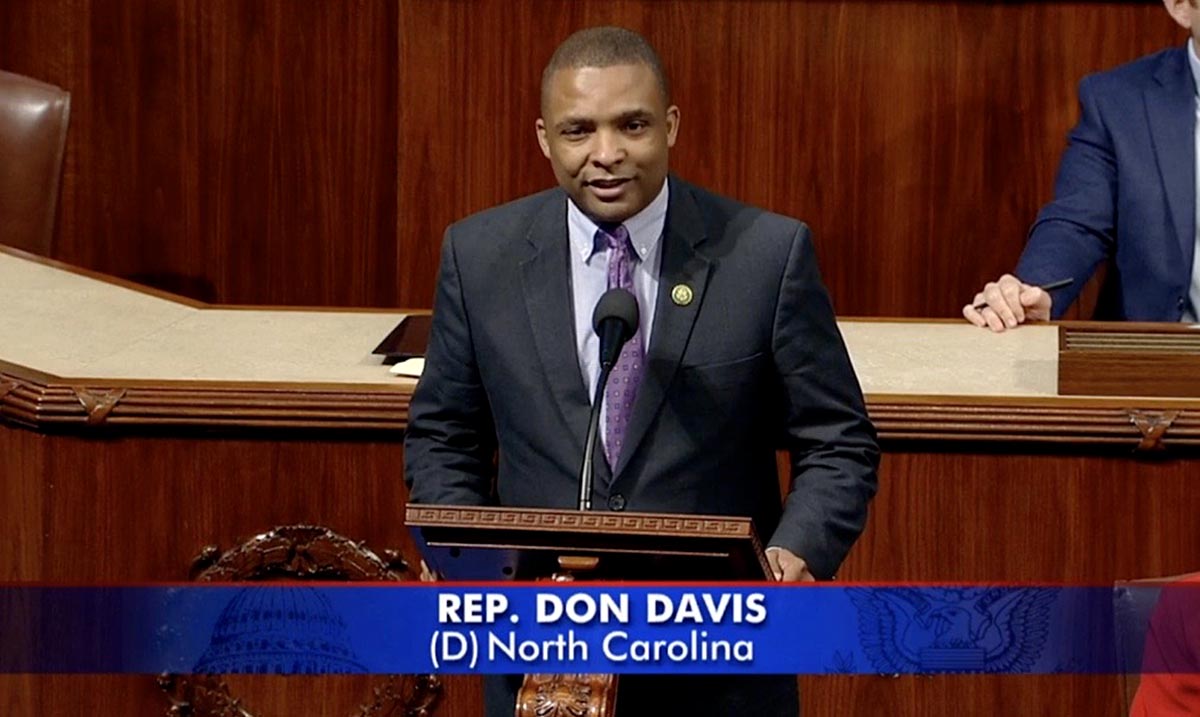
Rep. Don Davis introduced the No Betting on Your Own Race Act on Monday, aiming to stop federal candidates from trading election event contracts tied to their own races. The bill would set a fine of the greater of $10,000 or three times the net financial gain. Davis offered it during a pro forma session; the House and Senate are not scheduled to meet again until after the midterms, so the measure has little chance of making it onto the books before Election Day.
The push follows a Kalshi settlement with Laurie Buckhout, the Republican nominee running against Davis. She bought less than $1,000 of contracts related to her own candidacy, cooperated with the inquiry, and accepted a three-year suspension and a $2,589.96 penalty. “I bet on myself. Literally,” she said. “It was a dumb mistake, and as soon as I learned there was an issue, I worked to make it right.” Of course, she’s not the first politician to make such a “dumb mistake” and get caught, so you wonder how much is actually a mistake and how much is dumb.
Davis is treating that case as the reason Congress should write a rule the platforms already enforce. “We don’t want our athletes to bet on their games,” he said. “A candidate running for federal elected office should be treated exactly the same and should not be allowed to trade on their own election.” The bill would not alter Buckhout’s settlement. It would turn a private business compliance action into a public penalty that applies to every federal candidate, not only the ones an exchange happens to flag for review.
What the candidate election contract ban would require
The No Betting on Your Own Race Act would bar federal candidates from trading prediction-market contracts related only to their own elections. (Other Congressional bills seek to ban all prediction market trading for current officeholders.) The three-times multiple matters because a small position can still produce a large bill if the contract moves hard before resolution. A candidate who lost money could still owe the $10,000 floor.
Davis framed the candidate self-trading prohibition as a consistency problem. Platforms have already been blocking people who can influence an outcome. After the Senate acted in the spring, non-incumbent candidates remained outside that chamber’s rule. His bill is written to cover federal candidates left out of that earlier step.
Because the House is in a pro forma posture, introduction of this bill is the only step we’ll see for now. A bill filed when members are not in regular session can sit until the next Congress picks it up. Meanwhile, campaign committees are already deep into the Fall calendar, which this bill will not affect regardless of its ultimate disposition.
How the Kalshi settlement pushed the bill forward
Kalshi’s notice of settlement, filed as KDA-2026-0009 and effective August 28, found that Buckhout violated Rule 5.17(z). That rule bars a trader who is a decision maker, or who influences the underlying event, from trading the related contract. Once she was a candidate and a listed market option, the compliance department treated her as someone with direct influence. The settlement notice says she cooperated and accepted the findings.
The $2,589.96 penalty was more than double the position size described in the notice, and it included a three-year ban on direct or indirect access. The punishment was the first of its kind in a high-profile House contest that could affect the balance of power.
Buckhout is a retired Army colonel who briefly served as acting assistant secretary of defense for cyber policy. In a statement, she said residents were dealing with healthcare, gas, groceries, and housing “while my opponent treats a congressional election as an opportunity to cash in,” and called the ban “a disqualifying breach of public trust.”
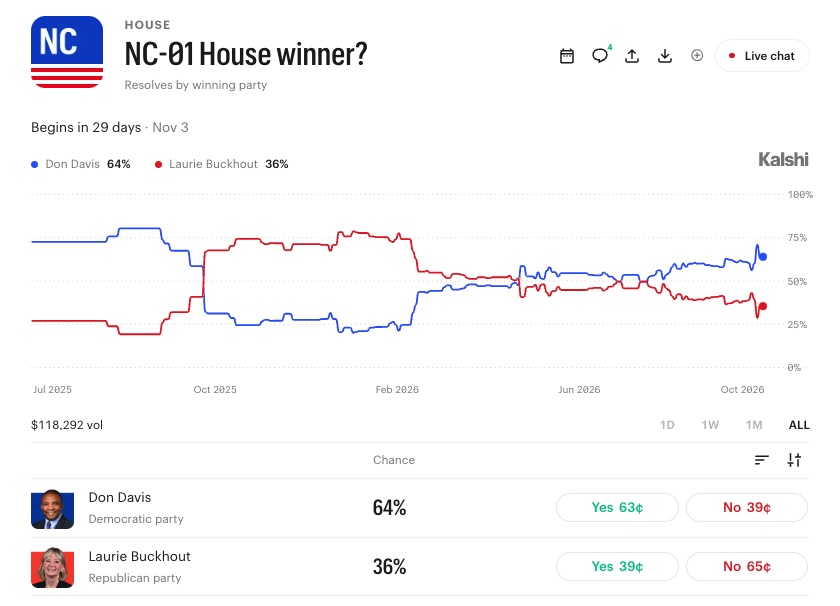
Trading on the contest did not stop. The general-election market had drawn $74,393 in volume around the time of the notice, with Davis near 61% and Buckhout near 41%.
Earlier suspensions and the Senate trading rule
Buckhout was not the first candidate Kalshi sanctioned. In April, the exchange suspended three congressional candidates for five years after trades tied to their own prospects: Mark Moran, Ezekiel Enriquez, and Matt Klein. Klein and Enriquez settled for $539.85 and $784.20. Moran, who did not settle, was fined $6,229.30. Moran said he traded $100 on himself and wanted to get caught. He was also a former reality television show contestant.
Those April cases sat well below the dollar level in the Buckhout notice, yet they produced longer bans. The pattern is what Rep. Davis is pointing to: exchanges are already running a candidate-trading suspension process, while federal law still has a gap for people who are running but do not yet hold office.
On April 30, the Senate approved a resolution barring senators and their offices from trading on prediction markets. Kalshi chief executive Tarek Mansour applauded the step, said the exchange already blocks members of Congress, and urged the House to follow. Polymarket said its rulebook already prohibited the conduct and backed writing it into law. That resolution did not reach non-incumbent Senate candidates, which is the lane Davis is trying to close.
A separate House proposal is already on the table. In June, House Administration Chairman Bryan Steil introduced the Stop Lawmakers from Predicting Act. The committee release says it would bar members, spouses, and dependent children from wagering on a specific government policy, government action, or political outcome. Violators would owe $2,000 or 10% of the transaction value, whichever is greater, plus the net gain, and they could not pay the fine with official allowances or campaign money.
Why the penalty schedule lands after Election Day
Traders pricing House races this month are still operating under exchange rules, not under the $10,000 floor Davis wants written into statute. An exchange can fine one nominee and lock the account. It cannot bind every federal candidate on every venue. Although Kalshi already treats a candidate as a decision maker under Rule 5.17(z), another platform could write a narrower screen, or miss the trade until after the contract settles.
The math also differs from Steil’s member ban. His fee starts at $2,000 or 10% of the transaction, then adds the net gain. Davis’s floor is $10,000 or three times the net financial gain. A candidate who made $4,000 on a self-referential contract would face $12,000 under the Davis formula, before any exchange penalty. Later committees would have to decide how to measure “net financial gain” if positions were closed, expired, or offset.
Buckhout’s case remains the cleanest illustration on the board. She acknowledged the trades, paid more than she put in, and lost access for three years. Davis called that a breach of trust and then filed a bill Congress cannot take up before voters decide the rematch. The Senate rule he is trying to extend already drew public support from both Kalshi and Polymarket, which undercuts the claim that platforms want candidates in these markets. They do not. It’s clearly minimal dollars at stake but an entire media and political landscape full of headaches.
References
- CNBC: House Democrat wants to ban candidates from trading on their own race
- Kalshi Notice of Settlement, KDA-2026-0009, Laurie Buckhout
- The New York Times: Kalshi Suspends Republican House Candidate for Betting on Her Own Race
- Carolina Journal: Kalshi suspends NC-1 candidate Buckhout for trading on her own race
- USA Today: Kalshi fines North Carolina candidate for betting on her own race
- WITN: Rep. Davis calls Buckhout Kalshi suspension a disqualifying breach of public trust
- Queen City News: Legal Analyst: Kalshi suspends NC candidate for betting on her own race
- AP News: Kalshi fines and suspends 3 congressional candidates
- The Guardian: Prediction site Kalshi fines three US candidates who bet on own elections
- Decrypt: Kalshi Suspends House Candidate Laurie Buckhout for Betting on Herself
- CNBC: U.S. senators ban themselves from prediction markets trading
- House Administration Committee: Chairman Steil Introduces the Stop Lawmakers from Predicting Act
- POLITICO: George Santos and Kalshi’s first-ever lifetime ban
- TokenPost: House Bill Would Bar Candidates From Trading on Their Own Elections