
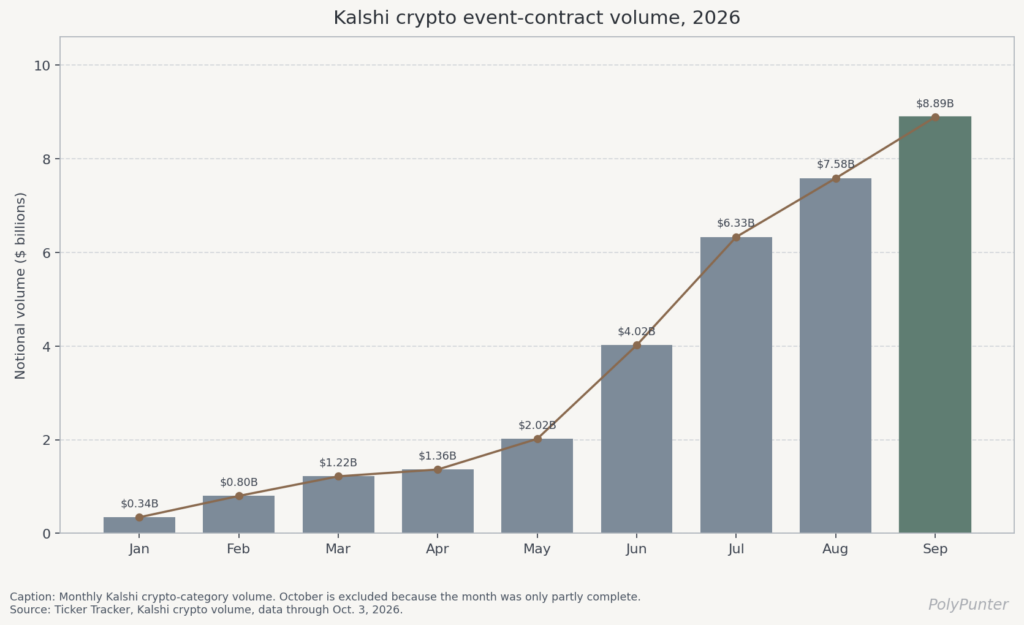
Kalshi’s crypto event-contract volume did not creep higher this year; it exploded into the stratosphere. Crypto volume on the exchange rose from $343 million in January 2026 to about $8.9 billion by September, more than 20 times in eight months. This meteoric rise supports a claim from Robinhood chief executive Vlad Tenev thatcrypto-linked contracts are already taking a disproportionate share of activity, and sports contracts could become the minority in volume within a few years.
A Kalshi crypto-volume tracker put January at $343.4 million and August at $7.58 billion, matching those rounded figures. September then reached $8.89 billion. Much of the growth sits in a narrow product: whether Bitcoin finishes a 15-minute window above a target price. Those contracts recycle the same question all day, so notional volume can swell even when the coin itself isn’t making a historic move as traders recycle positions into successive, continuous markets.
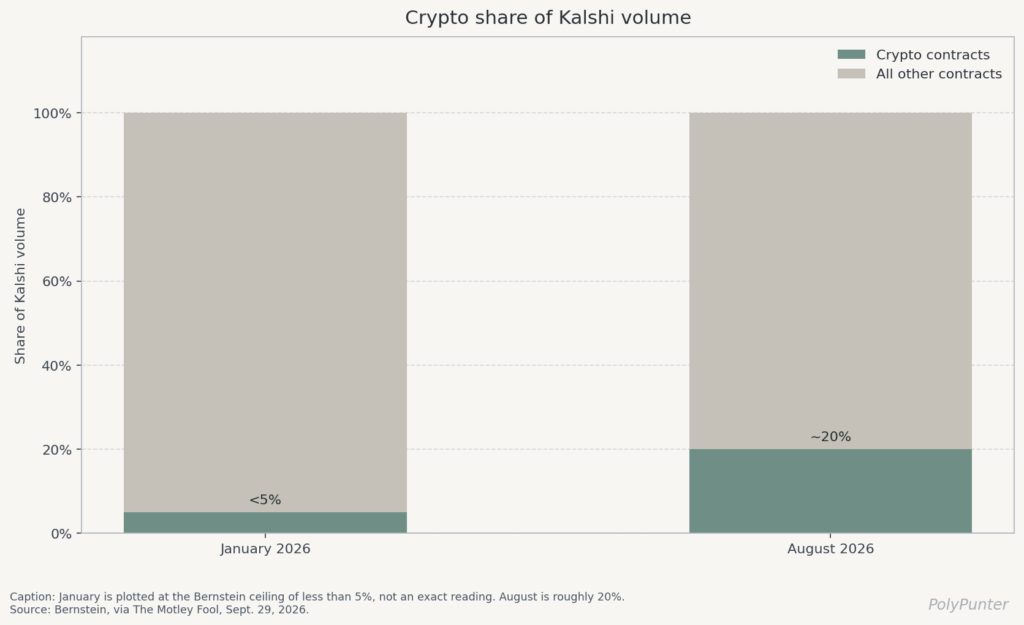
How Kalshi crypto volume scaled from January to August
Crypto contracts on Kalshi rose from less than 5% of total volume in January to roughly 20% by August.
Short-duration contracts explain a lot of the dollar jump. 15-minute cryptocurrency markets increased from $53.8 million in January to approximately $4.8 billion in July. Once a product can reset every quarter hour, a busy session can stack volume that a daily contract never could. These contracts turn over four times per hour, creating tremendous volume churn.
Still, the wider book did not follow the same growth line. Combined Kalshi and Polymarket volume fell 14.5% in August to $45.33 billion, the first monthly drop in a year after a World Cup-heavy summer, and Kalshi’s own total slipped 7.3% to $37.17 billion. Crypto’s rise in that softer month makes the category shift hard to dismiss. Sports and tournament contracts cooled in August, and the crypto line kept climbing.
Because the contracts are marked at face value, the billions are notional activity, not company revenue and not customer deposits. A busy 15-minute series can turn over many times without anyone holding a position into the next hour. That distinction matters when readers measure Kalshi’s crypto line against Robinhood’s revenue and treat them as the same kind of number.
What the September book says about Bitcoin contracts
The week ended September 20 offered a sharper snapshot than the monthly totals. Sports contracts still made up 21% of Kalshi’s trading volume. Contracts bundling several outcomes accounted for 62%. That new bundled contracts category complicates any simple story that crypto replaced sports. A bundle can mix a game, a price level, and another event into one position. While that number isn’t broken down, it’s estimated that sports combos make up almost all of it.
Bitcoin’s 13% share is still a large standalone slice for a single asset, especially next to a sports share that had already fallen to 21%.
Kalshi’s crypto contracts, like the ones Robinhood routes to traders, often ask whether Bitcoin finishes above a target at the end of a 15-minute window. The question is easy to understand and easy to repeat. It also has little to do with holding the coin long term. A trader can be active all afternoon and still have no view on where Bitcoin should be next year. You’re trading your forecast of super short-burst movements.
Why Robinhood is tying the surge to a wider shift
In the second quarter, Robinhood brought in $156 million from prediction-market activity, up more than tenfold from a year earlier. In August 2026, event contracts traded 15 times ahead of the year-earlier pace, with August count at 4.7 billion contracts, and the company called prediction markets its fastest-growing business, while crypto spot-trading revenue fell over the same stretch.
On September 18, Tenev told Jim Cramer on CNBC’s Mad Money that other categories, including crypto, were already taking a disproportionate share. “I think within a few years, sports will actually be in the minority,” he said. He has cast sports as a wedge that pulls people in, with the wider menu of contracts expected to carry more of the activity later. The Kalshi climb is the exchange-level version of the pattern he described on air.
Robinhood’s setup has also widened. The company launched event contracts through Kalshi, later added Rothera, its CFTC-licensed joint venture with Susquehanna, and took minority stakes in Crypto.com and the prediction-market spinoff OG.com. More pipes into the same demand can lift contract counts even if each venue’s crypto share moves at a different speed.
The revenue contrast is already visible. Prediction-market revenue at Robinhood scaled, while the older crypto-trading line did not keep pace. A contract on a 15-minute Bitcoin move can produce fee income without requiring the customer to buy and hold the coin on the spot book. Bernstein’s longer view has crypto and other financial assets growing from 12% of volume in 2025 toward nearly half by 2035, passing sports, but that path depends on products beyond the quarter-hour coin contract. This is also a tremendously long-horizon forecast in a new market, so take it as highly speculative.
What short-window Bitcoin contracts change for traders
The appeal is obvious. A 15-minute contract needs no earnings model and no multi-year thesis. It needs a price, a clock, and a willingness to be wrong quickly. Losses can stack across many small windows in a single session, and the notional billions on the monthly chart do not mean each contract exited easily at a fair price. It simply means churn.
Treating these contracts as a substitute for owning Bitcoin misses what they settle. They pay out on a short-price condition, then expire. Professional analysts have argued there is no strong case for moving a long-term crypto allocation into this kind of trading. This speed-round market is really something completely different.
Fee drag is the other quiet cost. A February 2026 column for the Center for Economic Policy Research looked at more than 300,000 Kalshi contracts and found an average pre-fee loss of 20% per contract. The same work found the contracts’ implied probabilities too biased to treat as clean odds. High turnover makes that gap matter more, because a trader who rolls 15-minute contracts all day faces the fee structure again and again.
The open question is whether crypto traders stay with the 15-minute contract once the novelty fades, or whether longer crypto questions take a larger share of the next leg. Bitcoin at 13% of a late-September week’s volume for Kalshi shows a book that is diversifying at least into a second strong category.
References
- Lawrence Nga, The Motley Fool, “Robinhood CEO Vlad Tenev Says Crypto Will Lead a Surge in Prediction Market Trading Volume,” October 3, 2026
- Ticker Tracker, “Kalshi Crypto Volume: Daily and Monthly Trading Volume,” data through October 3, 2026
- Pew Research Center, “Sports trading drives boom in prediction markets’ trading volume,” September 23, 2026
- The Motley Fool, “Bernstein Forecasts Annual Prediction Market Volume Will Top $10 Trillion by 2035,” September 29, 2026
- Blockonomi, “Kalshi’s 2026 Trading Volume Tops $148B, Making Up 85% of All-Time Activity,” August 9, 2026
- KuCoin News / TheCryptoBasic, “Kalshi and Polymarket Prediction Market Volume Drops 14.5% in August,” September 2, 2026
- Decrypt, “Morning Minute: Robinhood CEO Bets Crypto Will Beat Sports at Prediction Markets,” September 22, 2026
- BeInCrypto, “Robinhood CEO Says Crypto Event-Contracts Will Overtake Sports Markets,” September 21, 2026
- CNBC Television, “Robinhood CEO Vlad Tenev goes one-on-one with Jim Cramer,” YouTube, September 18, 2026 (embedded above)