

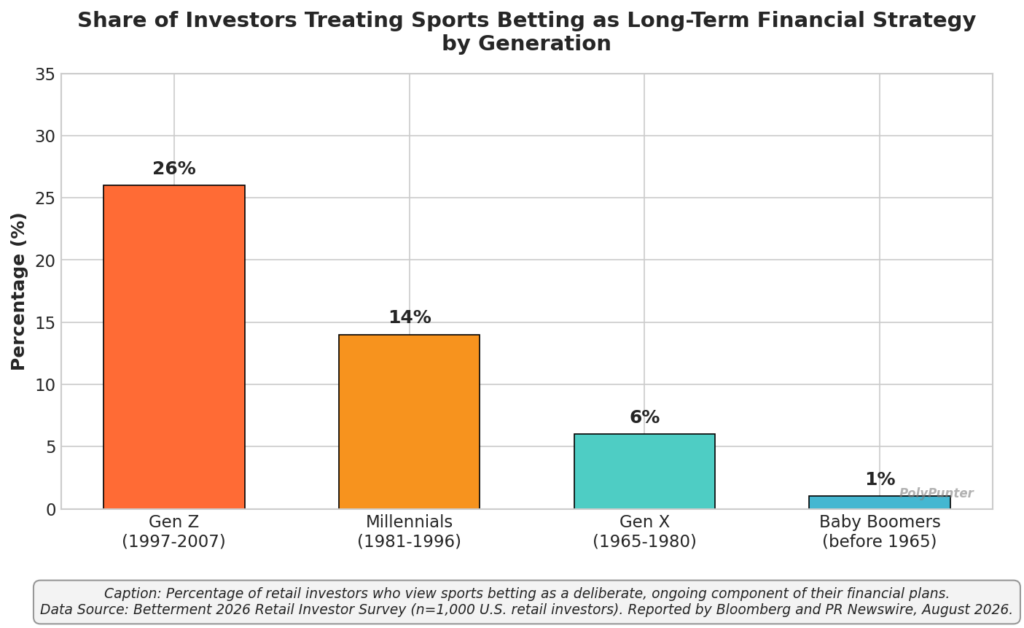
Younger retail investors are rewriting their financial playbooks by folding sports betting into long-term wealth strategies. Betterment’s 2026 Retail Investor Survey of 1,000 U.S. investors shows 26% of Gen Z (born 1997–2007) treat sports betting as a deliberate, ongoing part of their plans, while 52% redirected money meant for investing into sports betting over the past year. The contrast with older groups is stark: only 14% of millennials, 6% of Gen X, and 1% of baby boomers share that view. And very generally speaking, it is not a positive sign.
Betterment CEO Sarah Levy clearly flagged the risk. “When a prediction market or sportsbook starts to feel like a retirement strategy, we have a problem,” she said, noting these products drive repeated short-term action rather than steady multi-year progress. The survey data also show that social media now ranks as the top financial news source for 60% of Gen Z investors, up from 45% a year earlier, accelerating the shift away from traditional stocks.
How Gen Z Retail Investors Are Shifting Money from Stocks to Sports Betting
Many Gen Z investors are actively pulling capital from equity holdings (the stock market) and routing it toward sports betting opportunities that feel faster, more engaging, and offer the potential for outsized returns. The 52% redirection rate confirms this is not casual experimentation but a calculated reallocation for a majority of the cohort. Social feeds deliver constant updates and trends that position sports betting as a practical wealth tool, weakening the legacy division between entertainment spending and serious money management. Also, a potentially serious negative development for this generation.
Bloomberg’s reporting on the findings highlights how sports betting now competes directly for dollars that once flowed into stocks. Eric Balchunas, senior ETF analyst, reacted to the numbers by underscoring both the 52% shift in funds and the 26% who treat sports betting as a core long-term strategy. Wealth platforms are taking note as the percentages circulate.
Meanwhile, AI tools are shaping choices for nearly half of investors who trust them, with Gen Z showing greater comfort using those tools for long-term planning. Combined with heavy reliance on social media, these inputs are accelerating the integration of sports betting into everyday financial routines.
Generational Divides in Treating Sports Betting as Long-Term Financial Strategy
Younger investors, facing tighter economic pressures, are elevating sports betting from a side activity to a structured planning element, and the data confirm the practice is intentional rather than impulsive or unwitting.
Levy’s warning against treating sportsbooks as retirement vehicles underscores the distinction between engineered short-term risk-taking and the disciplined habits required for lasting goals. Betterment, which manages more than $70 billion for over one million customers, is already refining its product design and education to reach younger clients through digital channels while emphatically drawing that distinction.
These generational gaps are prompting broader questions about how capital will be allocated in coming years. Funds that might have purchased shares are instead fueling sports-related activity, potentially reshaping portfolio patterns for an entire generation of investors if the trend continues.
What the Betterment Retail Investor Survey Means for Future Wealth Building
As digital platforms make sports wagering seamless, Gen Z is embedding it into ongoing strategies rather than treating it as pure recreational or social diversion. The 60% social-media figure for financial news signals a durable change in how information reaches this group and how decisions form. Social media levels the playing field for businesses seeking to gain the “investment” dollars of a younger generation, including sportsbooks and prediction markets, putting them on an even marketing footing with traditional investment companies. Platforms focused on automated long-term investing, such as market indexes, must now address clients who primarily source guidance from feeds and experiment freely with alternative sales approaches.
Levy’s remarks in the company’s release frame the dual task: meet younger investors where they already spend time, while keeping the distinction between trend-chasing and durable wealth creation clear. That is unlikely to fully counter this trend, but it could mitigate the sharp trajectory and peel off the more thoughtful segment.
Gen Z is voting with its capital, incorporating sports betting into its long-term strategy. The next several years will show how that choice performs relative to traditional equity paths, and the most obvious answer is: not too well. Meanwhile, wealth platforms need to refine their tools and messaging to capture attention without endorsing high-variance habits as core to planning.
References
- Betterment’s 2026 Retail Investor Survey Reveals a New Generation of Investors Is Blurring the Lines Between Information, Advice, and Entertainment
- Gen Z Investors Turn to Sports Betting to Build Wealth – Bloomberg
- Betterment Flags Gen Z Shift to Social Media, AI and Sports Betting in 2026 Investor Survey
- Eric Balchunas’ post on Gen Z sports betting survey findings
- Betterment survey shows sports betting gains ground with Gen Z investors in the U.S.