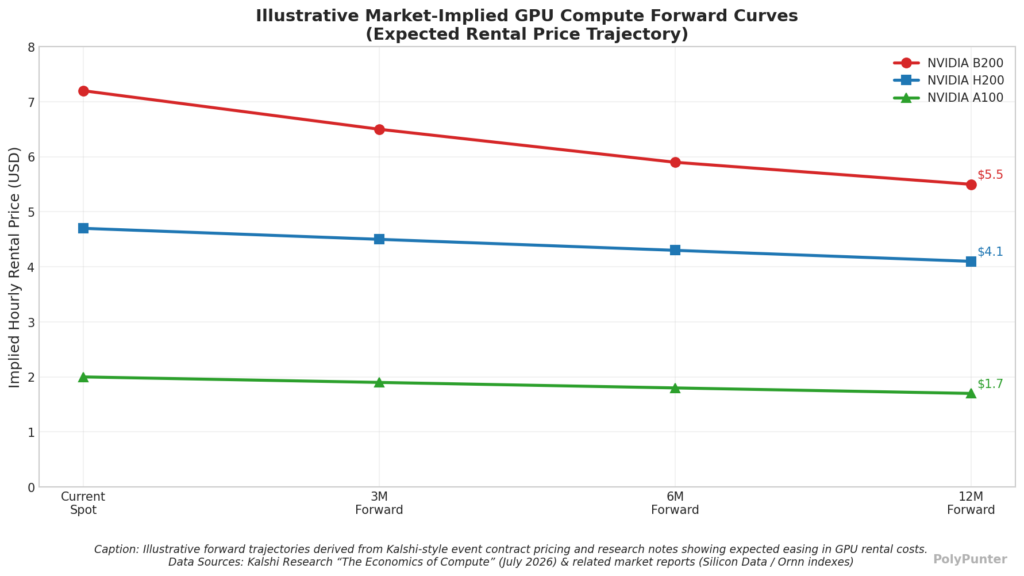
Kalshi is advancing technology market pricing by launching market-implied forward curves for GPU compute costs while broadening its tech IPO contracts. The mid-July release converted event contracts on NVIDIA chip rental rates into a continuous view of expected future prices stretching a year or longer. Traders can track implied hourly costs for the B200, H200, and A100 chips as they update in real time, offering companies that consume large volumes of computing power a public signal clearer than private deals.
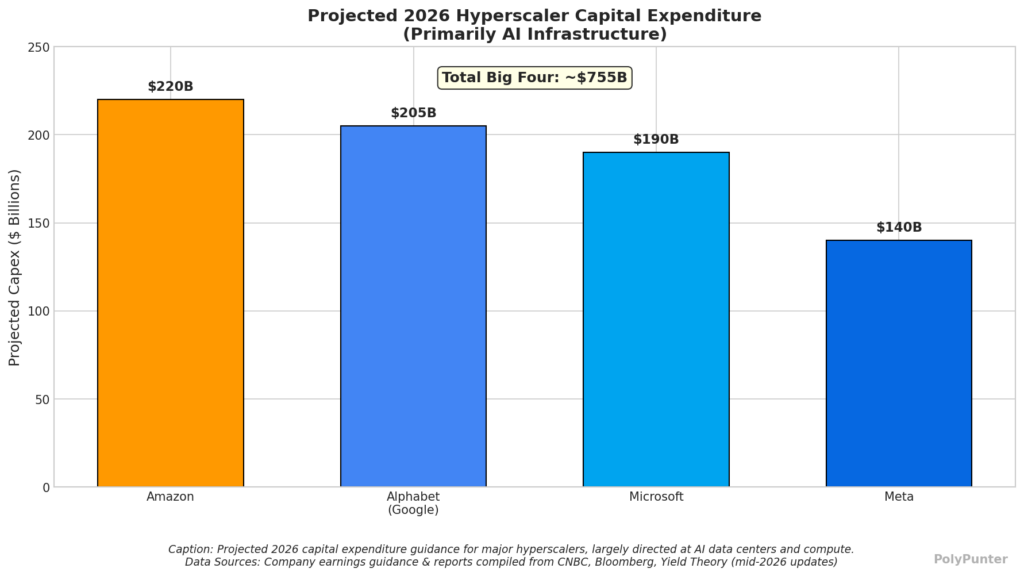
The curves are derived from live trading in weekly and monthly contracts that settle against verified average hourly rates. An algorithm combines those prices into a smooth path showing where costs are expected to head. Kalshi’s chief risk officer, Udesh Jha, called the product a route to transparent price discovery, of the kind long available for energy and metals, but not so raw computing power as an industrial commodity. Hyperscalers have already committed more than $700 billion to compute this year, with the overall market projected to reach $7 trillion to $10 trillion by 2030. It’s a massive market.
At the same time, Kalshi’s IPO category continues to add contracts on companies moving toward public listings. Prediction market volumes across names ranging from Discord and Kraken to various AI firms have climbed into the millions of dollars. The pairing of compute pricing tools and IPO odds places both physical infrastructure risk and capital-market timing on the same forecasting platform.
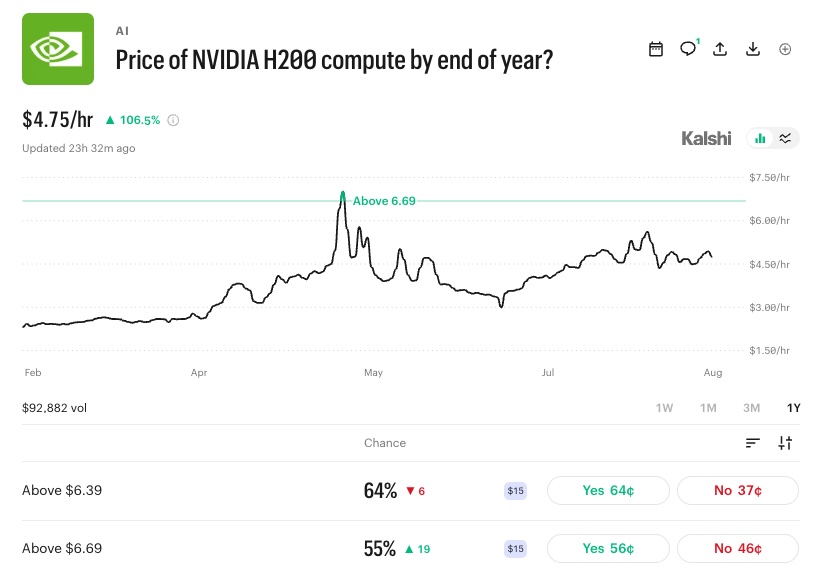
How the GPU Compute Forward Curves Operate
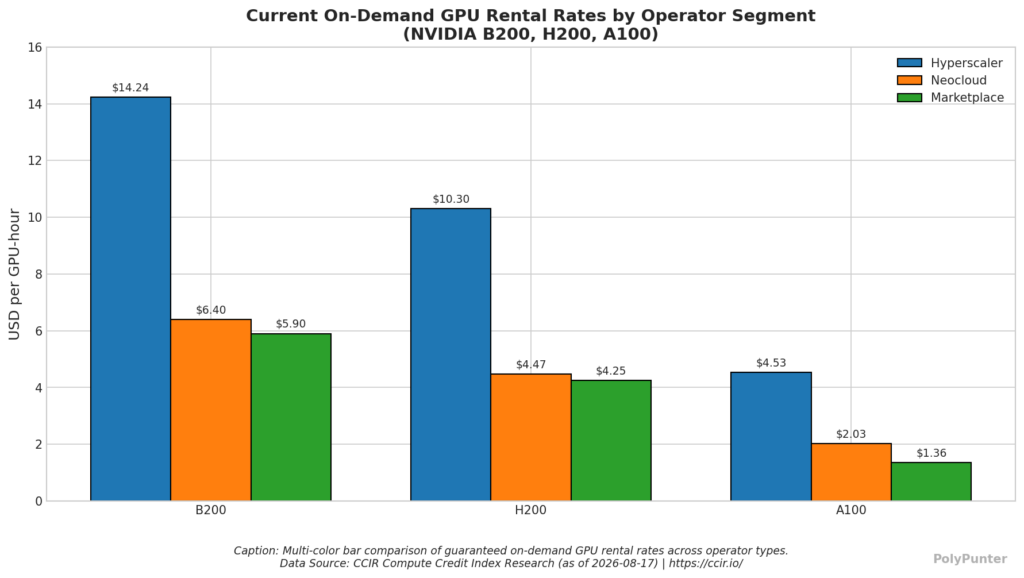
Each curve begins with contracts that resolve on average hourly rental rates drawn from indexes of live cloud prices. For the NVIDIA B200, traders currently assign elevated odds that costs remain near recent highs before declining later in the year. The H200 and A100 curves appear flatter, pointing to steadier pricing as older inventory expands. Kalshi posted the first versions directly on its market pages so anyone can view the implied path without trading.
Block trading is now open for larger positions, enabling data-center operators and inference labs to lock in rates months in advance. Neocloud providers and hyperscalers occupy the supply side while training labs and reinforcement-learning services form the demand side. Both gain a public benchmark that replaces opaque over-the-counter arrangements. The curves also reveal generational differences: the newest B200 shows a decline over time as traders anticipate lower prices amid rising supply, while legacy chips remain more stable.
Kalshi’s research team followed with a closer examination of the numbers. U.S. data-center counts are now expected to exceed 5,000 by year-end, a sharp upward revision. Semiconductor manufacturing growth is priced at 18.4% for 2026, accelerating from earlier years. These signals feed back into the forward curves, linking real-world capacity to market expectations for computing power demand.
The launch puts Kalshi ahead of traditional exchanges still awaiting clearance for cash-settled compute futures. CME Group and Intercontinental Exchange have outlined similar plans, yet Kalshi’s event-contract version is already generating data. It intends to be the established forerunner in this sector.
Tech IPO Markets Build Activity on the Same Platform
Kalshi’s financials category continues expanding its IPO contract roster. Traders can position on whether companies will announce or complete listings by set dates, covering software firms, crypto exchanges, and AI developers. Recent volume across the broader IPO group has surpassed $1 million, with individual contracts clearing hundreds of thousands of dollars in notional value.
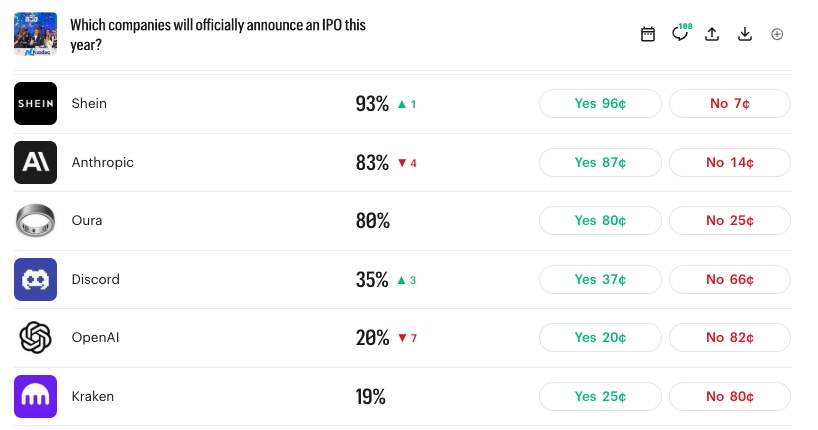
Odds have moved on high-profile AI companies. These markets settle on public announcements or the start of trading, delivering a transparent probability unavailable from private rounds or confidential filings. The contracts sit beside the compute curves, allowing traders to link infrastructure costs directly to the capital-raising calendars of the firms that rely on that infrastructure.
CEO Tarek Mansour underscored the larger goal in a post announcing the compute curves. He noted that compute still lacks the standardized tools found in mature commodities, and that market prices can help create them. The same approach applies to IPO timing: scattered private information becomes a single, tradeable probability. Volume data from the IPO category show ongoing activity, with implied probabilities updating as financing news emerges, creating a living map of expected public-market arrivals and ever-increasing interest from both the finance community and individual retail traders who track these markets.
Why the Dual Expansion Matters for Technology Pricing
AI infrastructure spending is setting records, yet chip costs have remained largely private. Kalshi’s curves change that dynamic by turning rental rates into continuous public signals about a key component of AI sector costs. Companies planning multi-year buildouts can now see where the market prices future scarcity or surplus, reducing the chance of overpaying for capacity or underestimating supply.
On the IPO side, the contracts supply parallel clarity. Private valuations for leading AI firms have soared into the hundreds of billions, but the path to public trading stays uncertain. Traders pricing those paths on Kalshi generate a real-time consensus that investors and boards can track to understand public perception. The dual offering creates a rare meeting point of physical and financial risk in one venue.
References
- Kalshi builds a forward curve for computing power
- GPU compute forward curve — Kalshi
- Kalshi Ramps Up Effort to Build Markets for AI Computing Power
- Ipos Odds & Predictions 2026
- Tarek Mansour announcement on GPU compute forward curves
- The Economics of Compute | Kalshi Research
- Kalshi launches GPU compute forward curves for AI hedging
- Crypto-style derivatives reach AI compute
- “Compute Is the New Oil”: Kalshi Just Launched a Way to Bet on the Future Price of AI Computing Power
- Kalshi Announces Compute Forward Curves