Election polling, economic polling, and public opinion polling have been around for decades, and have defined our outlook on elections, economics, and opinions. However, over the last few years prediction markets have emerged as a strong alternative which have been the focus of interest for their success in predicting events better than conventional surveys.
So, which is better?
The answer is simple. Prediction markets may also be more effective when there is a lot of new information and money to be made, like in a fast-paced political event, as they continuously roll in new information. Though they are not flawless. The accuracy of the forecast may be influenced by market liquidity, traders’ actions, and by the rules for resolution.
Here we’ll explain the difference between prediction markets and opinion polls, discuss where they work best, and then delve into why neither of them should be considered the gospel truth.
What Are Prediction Markets?
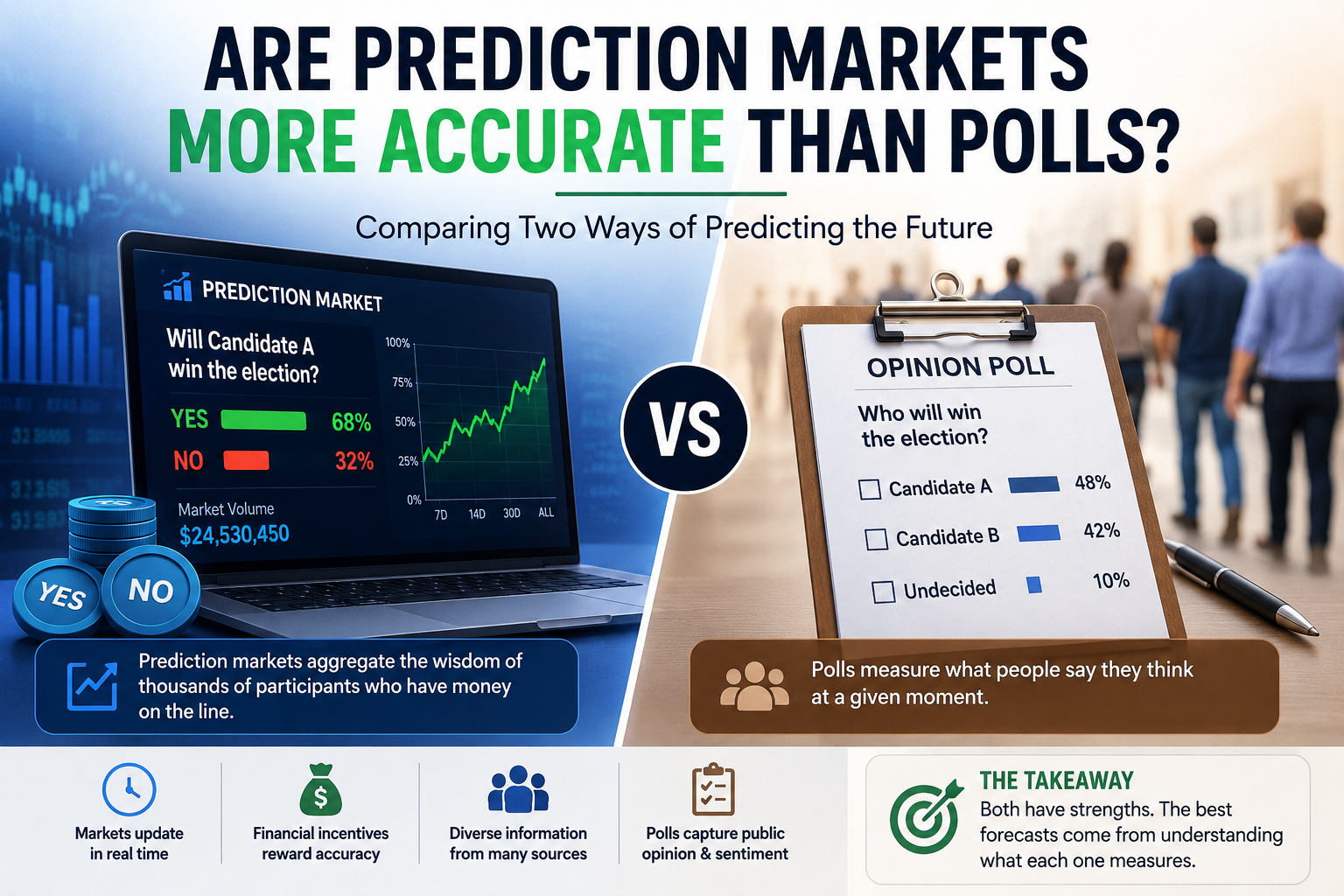
Prediction markets allow participants to buy and sell contracts based on the future events. Every trade updates the market’s implied probability.
For example:
- Candidate A: 68%
- Candidate B: 32%
Rather than measuring opinions, prediction markets aggregate the expectations of traders who have money at risk.
What Are Opinion Polls?
The opinions are gathered from a sample and the information extrapolated to the whole population.
Polls attempt to answer questions like :
- Who will voters support?
- What percentage approves of a policy?
- Which party leads nationally?
While polling has improved over decades, it depends heavily on sampling quality, response rates, demographic weighting, and survey methodology.
Prediction Markets vs Polls: The Key Difference
The biggest distinction is what each measures.
Polls measure current opinions.
Prediction markets are markets that are based on expectations of future outcomes.
A voter may say that he or she supports candidate A but places a bet on candidate B because they believe undecided voters will split their vote.
This distinction is the essence of prediction markets being forward-looking.
Why Prediction Markets Often Perform Better
Several structural advantages help prediction markets forecast many political events more effectively.
1. Financial Incentives
Every incorrect trade costs money.
Participants are rewarded for being right—not for expressing opinions.
This creates a powerful incentive to seek better information before placing a trade.
2. Continuous Updates
Polls are snapshots.
Prediction markets never stop updating.
Breaking news, debates, economic reports, scandals and policy announcements can all move prices within minutes.
3. Diverse Information Sources
Markets combine information from:
- Political analysts
- Journalists
- Economists
- Professional traders
- Local observers
- Statistical models
Instead of relying on one survey, prices reflect thousands of independent decisions.
When Polls Still Have the Advantage
Prediction markets are not always superior.
Polls remain valuable because they directly measure public opinion.
They often perform better when:
- Markets have low liquidity.
- Few participants are trading.
- Events are highly localized.
- Regulatory restrictions reduce market participation.
Polls also provide demographic insights that markets cannot, such as age, education, gender, or regional voting preferences.
Real-World Accuracy
Research consistently shows that prediction markets perform especially well in political forecasting.
Markets generally adjust faster than polls when new information emerges, particularly during election campaigns.
However, performance varies across categories.
Political markets tend to be the most reliable because they attract deep liquidity and informed participants. Sports and geopolitical markets often show weaker calibration due to greater uncertainty, lower information quality, or ambiguous settlement rules.
Why Prediction Markets Sometimes Fail
Although prediction markets can outperform polls, they still make mistakes.
Common reasons include:
Low Liquidity
Thin markets can be moved significantly by a few large traders.
Insider Information
Participants with access to privileged information may influence prices before the public learns the news.
Market Manipulation
Large positions can temporarily distort probabilities, especially in smaller markets.
Ambiguous Resolution Criteria
Even if the real-world event seems obvious, unclear contract wording can lead to unexpected outcomes.
Should You Trust Prediction Markets Over Polls?
The best approach is to use both.
- Polls reveal what people currently think.
- Prediction markets estimate what is most likely to happen.
- When both agree, confidence generally increases.
- When they diverge, it’s often worth investigating why.
That disagreement can reveal shifting sentiment, breaking information, or structural weaknesses in one forecasting method.
The Verdict
Prediction markets are not prediction machines but they often offer a more dynamic and incentive-compatible forecast than traditional polls.
They excel at speed, information collection and financial responsibility. In the meantime, polls are still important in gauging what voters are thinking and what trends are developing among voters of different demographics.
Do not consider one to be a substitute for the other, rather use them as complementary forecasting tools. Polls tell you what people are thinking right now, prediction markets tell you what events are likely to happen next.
If you want a deeper, data-driven breakdown of how prediction markets perform across politics, sports, crypto, and geopolitics, along with the factors that influence their accuracy, read our pillar guide: Polymarket vs Reality: We Tracked 50 Markets to Resolution — Here’s the Unfiltered Data. It expands on the evidence behind these conclusions and provides a broader view of prediction market performance.