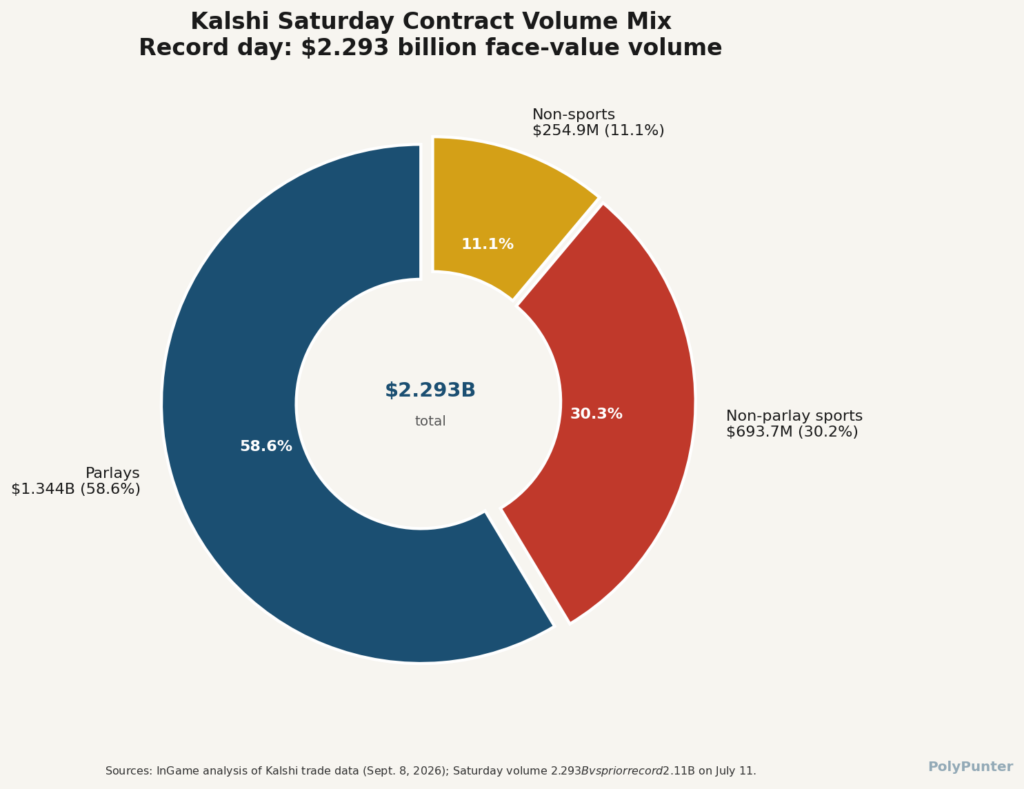
Kalshi posted its biggest trading day of the year on Saturday, September 5th, then spent the next day unwinding a settlement that fired too soon. College football’s first full Saturday pushed the exchange to $2.293 billion in contracts, beating the $2.11 billion mark set July 11 during World Cup quarterfinals. Parlays (“combos”) drove $1.344 billion, or 58.6% of that flow. Single-game sports contracts added $693.7 million. Everything else added $254.9 million.
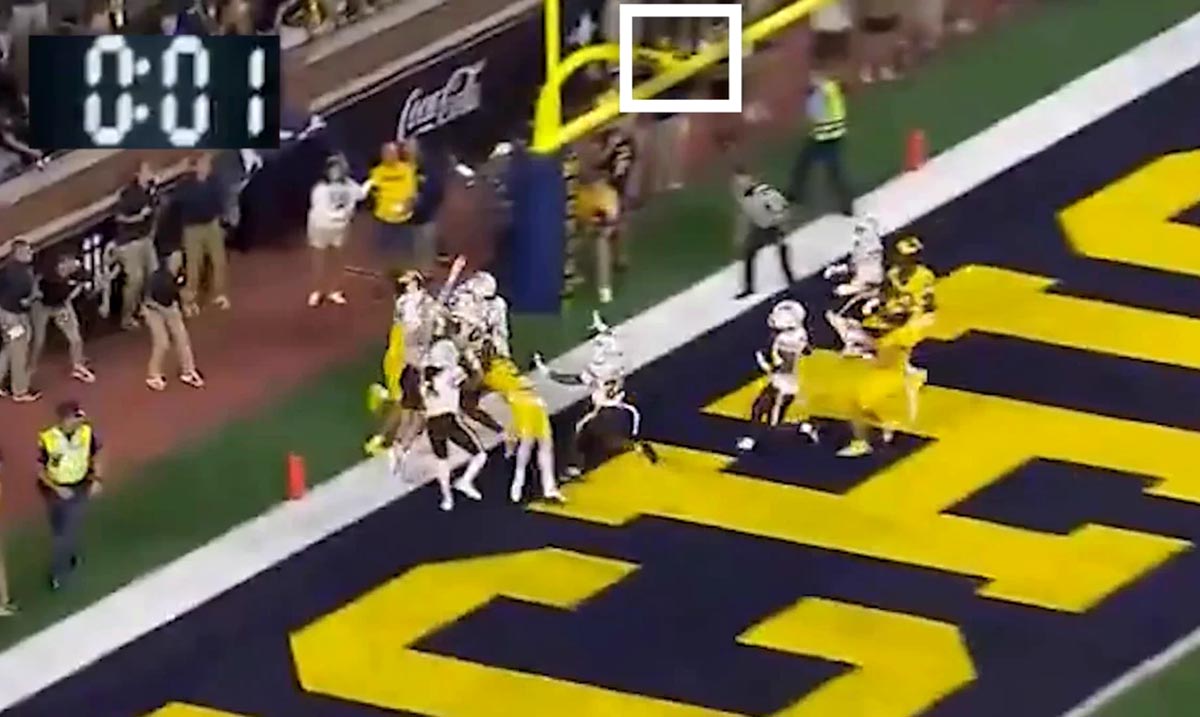
That large headline number should have been the story. Instead, a single ending stole it. Western Michigan led 12-7 when Bryce Underwood’s first Hail Mary for Michigan sailed out of the end zone, and the clock showed zeroes. Kalshi immediately paid traders holding Western Michigan contracts. Replay officials then restored one second to the game clock. Subsequently, Underwood on a second Hail Mary hit JJ Buchanan for a 47-yard score; Michigan won 13-12, and Kalshi had to claw back the first payouts.
That particular game market drew about $18.6 million before the final result stuck. It was a sliver of Saturday’s book and still the contract everyone kept refreshing.
The Clock Hit Zero. The Market Did Not Wait.
Western Michigan Broncos players were already celebrating when crews ruled that defender Micah Davis had touched the ball after jumping from out of bounds with time still showing. The Big Ten later released synced camera video supporting the call. That did little to quell the outrage from Western Michigan. Still, Underwood got one more snap. Buchanan caught it. The official result flipped on the literal replay.
Kalshi confirmed it had “wrongly and prematurely settled” the market, reversed the first payments, reimbursed traders marked as losers, and then paid Michigan Win holders.
Kalshi Sports had hyped the swing in real time, posting that one trader held a $2,265 Western Michigan position with a potential $93,201 payout “if the score holds.” That did not hold.
Coinbase, which routes some contracts through Kalshi, handled the mess differently. It said an erroneous settlement underpaid certain winning positions, promised to make those accounts whole, and told customers that money already paid under the first result would stay put.
A Record Saturday Still Needed the Fine Print
Saturday’s $14.5 million in fees for Kalshi still trailed the $17.2 million collected on July 11. Face-value volume looks enormous because parlays count both sides of every match and market makers often sit on the short-priced legs. Taker-side volume, closer to cash actually at risk, sat at $540 million. That is still a huge Saturday.
College football’s opening four days generated about $790 million across venues, with Kalshi taking most of it. Saturday alone produced nearly $250 million in NCAA-linked contracts on the exchange, up almost 300% from the same Saturday a year earlier. Sports and combo contracts now dominate weekend flow, which is why one disputed ending can create so much public disruption.
Kalshi’s market page for the series still shows more than $15 million across related contracts after settlement. The winner market resolved to Michigan. Spreads that had priced a blowout never got close. The heavy favorite needed a second heave and a conference review to get off the field.
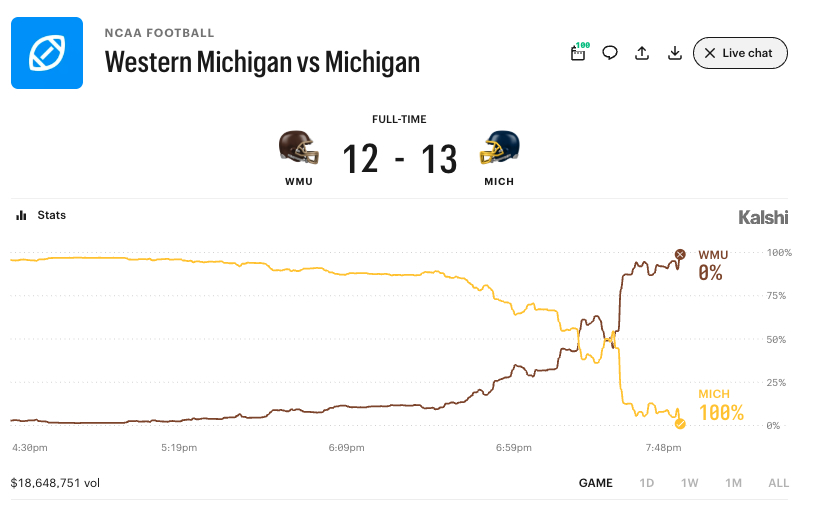
Traders Watched Money Appear, Then Disappear
Emails followed the reversal. One note said the market “was initially settled to the wrong outcome” and later “re-settled to the correct result.” Some balances that briefly showed Western Michigan winnings later dropped those credits. Reports said a $50 courtesy credit accompanied at least some clawbacks, though not every account holder said they received one.
Mike Florio at NBC Sports reached for the obvious line: it ain’t over till it’s over. ReadWrite quoted Kalshi saying it “corrected the result to a Michigan win, making sure all Kalshi customers got paid out correctly.” That statement arrived after the clawbacks. Traders who spent against the first credit found the correction late. Traders who held Michigan the whole time waited longer than one extra second on a stadium clock.
Underwood told reporters he thought the game was over when he saw zeroes. Buchanan said he just attacked the ball. AP and ESPN accounts match the same chain: an incomplete first throw, a celebration, a review, one second restored, and a catch. Fresh sideline video circulating this week again shows the clock hanging on:01 as Davis meets the ball. That clip will not change Saturday’s books. It does show why a feed that keys off a zeroed scoreboard can fire too soon.
The Next Close Game Will Test the Same Rule
Live college football does not pause for a settlement meeting. A contract that expires “after a winner is declared” still has to decide when that declaration is official. Kalshi’s rules for the series pointed to NCAA and ESPN sourcing. Those sources needed replay. The exchange moved first anyway.
Saturday proved demand for weekend sports contracts is strong enough to set records. It also proved that settlement speed that works on a clean final can fail when officials keep working after the scoreboard goes dark. Traders now have the case study in their history tabs: a $2.293 billion day, an $18.6 million game, and a payout that had to run twice.
NFL week one is already loading. The next messy ending will show whether the extra second stays on the clock long enough for the books to catch up.
References
- InGame: Kalshi record volume and payout snafu
- BeInCrypto: Wrong-side payout before the comeback
- NBC Sports: Chaotic outcome for Kalshi
- ReadWrite: Kalshi reverses settlement error
- ReadWrite: Coinbase response
- AP News: Second-chance Hail Mary
- ESPN: Clock controversy recap
- Yahoo Sports: Clock reset and final score
- CBS Sports: Replay and Big Ten statement
- Kalshi market page for the game
- Covers: Week 1 college football totals
- WDIV Local 4: Hail Mary video
- Marshall Cohen on X
- Kalshi Sports on X