
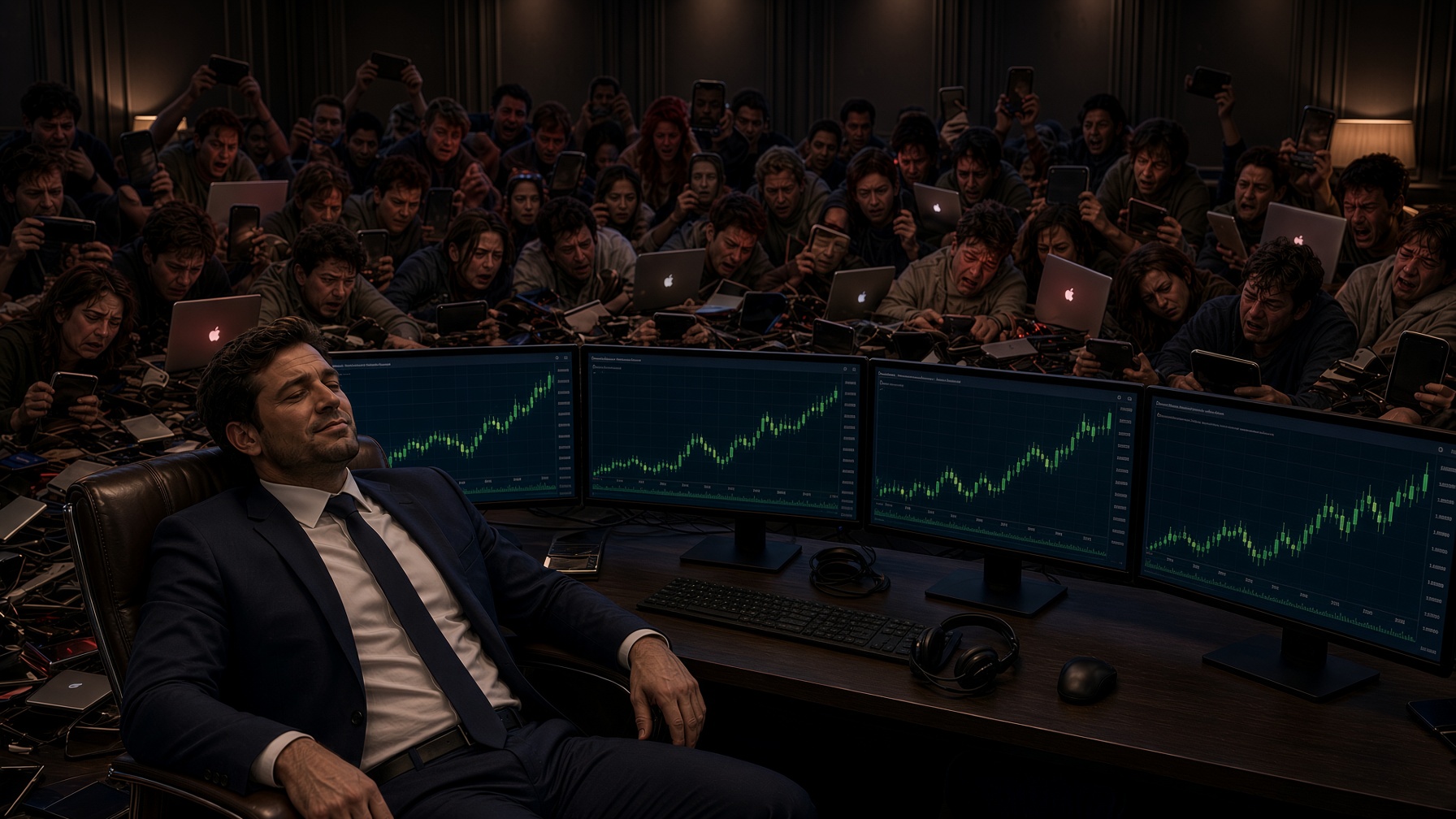
Prediction markets offer the mechanics to forecast economic, financial, scientific, and world affairs with far greater accuracy than traditional polling, surveys, or independent research outlets. The probability output of those forecasts, expressed in contract prices, benefits the entire public. Go look on Polymarket. The market data is free and now widely used by professionals across many sectors.
However, the traders who stake these markets and generate this public good are rewarded in very unequal measure. The financial rewards from market outcomes end up in a relatively thin slice of traders’ accounts. While this could be chalked up to simple meritocracy and winner-take-all outcomes, the health of these markets, and their ability to offer this public utility, relies on a broadly competitive market landscape and informed and savvy traders. If large percentages feel their informed opinions have no chance of success, they will opt out. You will be left with a small cohort of perpetual winners and essentially those addicted to the wagering who can’t help themselves, even if they continually lose. And the public utility of these markets collapses.
To understand this market issue, think of event market payouts as information rent: the extra return collected by people and machines closer to news, latency, capital, online tools, and private knowledge than everyone else. With this economic model in mind, we can start to examine who collects the rents and who pays the rents.
The Crowd Supplies the Price. A Few Accounts Collect the Surplus
A Wall Street Journal review of 1.6 million Polymarket accounts found that 67% of profits went to 0.1% of accounts. Fewer than 2,000 wallets collected nearly $500 million. More than 70% of users finished in the red. The typical account was down $1 to $100. The worst-performing tenth lost about $4,000 each.
Kalshi spokeswoman Elisabeth Diana said the firm recently saw 2.9 unprofitable users for every profitable one. She noted that concentration exists across finance. The comparison is revealing. Event contracts were supposed to harvest dispersed knowledge with far more democratized opportunities for informed traders, not rebuild the same payoff pyramid we see in the traditional financial sector.
A Bloomberg News wallet study found more than 100,000 accounts lost at least $1,000 after the start of 2025, almost twice the number that made that much. Everyday users, taken together, were down $131 million. High-volume accounts that looked heavily automated collected a matching $131 million, much of it among 823 wallets that cleared more than $100,000 each.
University of Toronto finance professor Charles Martineau said many people did not expect profits to bunch so tightly. Platforms sell the image of the town square for traders, where everybody has equal opportunity. And that may be technically correct. But in practice, and as a public relations issue, the cash-flow map looks like a private club with a public ticker.
Any free-market system will create relative winners and losers. But long-term sustainability and the health of underlying systems correlate, to some degree, with stark differences in outcomes. This is especially so if the masses that lose feel the system inherently favors the few winners, rather than an entirely fair contest. This isn’t an argument for equity of outcomes, but for ensuring the opportunities are even and the playing field as even as possible. And making this readily apparent.
Wisdom of Crowds, or Wisdom of the Few?
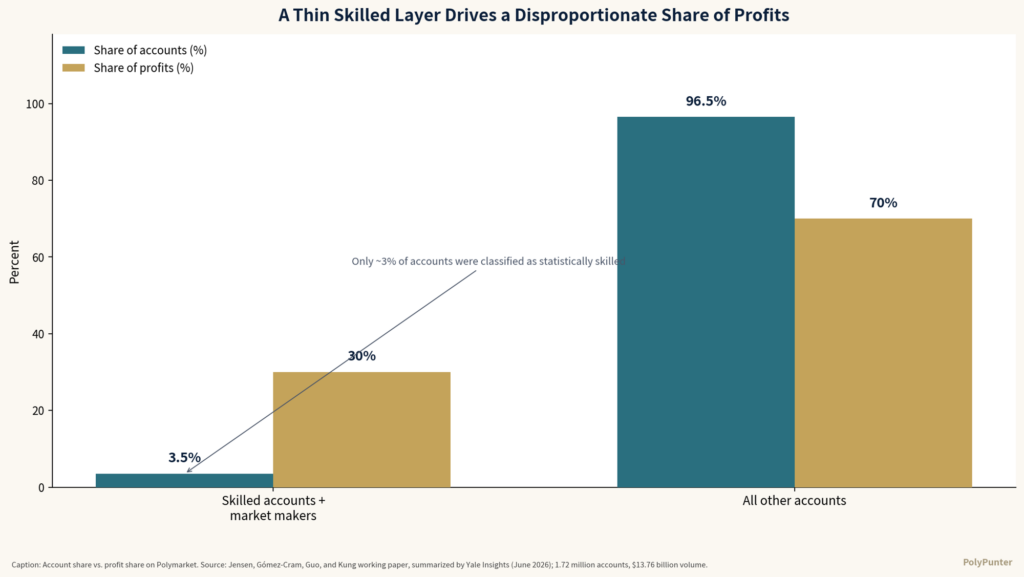
Yale Insights summarized work that tested the crowd-wisdom story against two years of Polymarket data covering 1.72 million accounts and $13.76 billion in volume. About 3% of accounts looked statistically skilled. Those books, plus a sliver of market makers, were fewer than 3.5% of accounts and still captured more than 30% of total profits. Most of the rest could not be attributed to chance.
You can still generate market intelligence from an uneven market. But calling a market with relatively few skilled and savvy traders pitted against a much larger cohort of less prepared traders “collective intelligence” hides who is collecting the rent. The public sees the market probability consensus. The people setting it are not a representative jury. They are, by and large, a small set of accounts with time, code, and balance-sheet room to lean on a price until it moves.
University of San Diego finance professor Joshua Della Vedova added an awkward wrinkle. Retail accounts picked winning outcomes more often than bot-like wallets. They still lost money because they entered the market late and paid less favorable prices. The edge was execution timing, not forecasting accuracy. This could be even more damning to the prediction market sector brand, as it suggests that the most informed individual traders will still lose to more likely institutional-level traders with more advanced (and costly) trading software. Then it becomes a track meet where some entrants have raggedy and tattered old shoes, and others have state-of-the-art engineered running shoes. Is the fastest runner actually winning?
Researchers at the University of Toronto, HEC Montréal, and ESSEC Business School, covering 2.4 million users and $67 billion in volume, found that 68.8% of Polymarket users lost money since 2022. A summary of that work also noted that about 5% of wallets accounted for roughly 75% of trading.
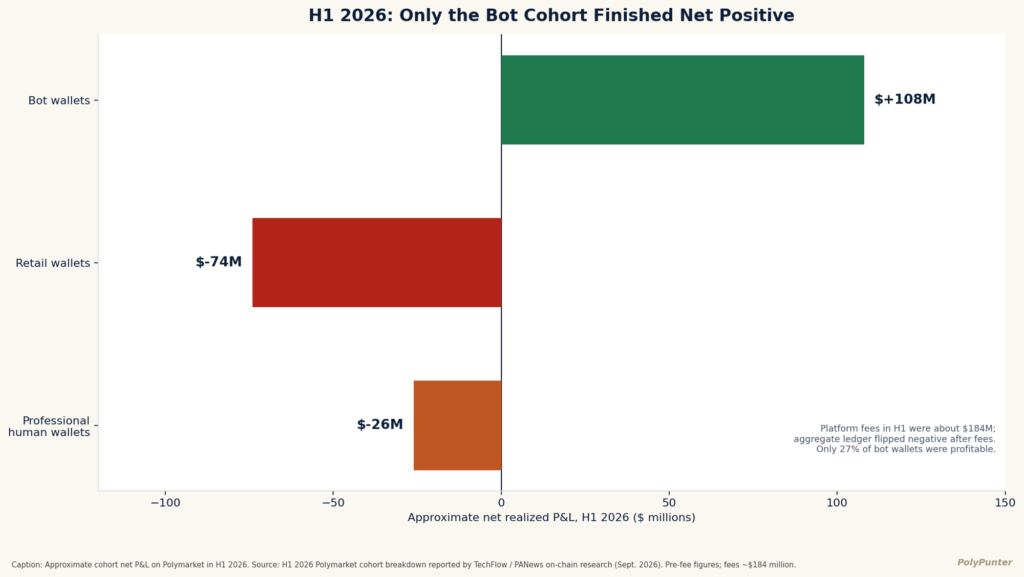
An H1 2026 cohort split circulating among on-chain researchers found that bots were the only group with overall net profit, about $108 million, even though most bot wallets still lost. Retail books were down about $74 million. After fees of roughly $184 million, the whole ledger flipped negative. The fastest code does not need everyone to lose in the same way. It only needs the average book to pay rent.
Private Knowledge Becomes a Private Payday
Speed is only one path to collecting rent. Privileged knowledge is the uglier one. Event contracts turn the outcome of almost any future event into a tradable claim. If you have privileged access to the people who can enact these outcomes, the outcome contract is basically a withdrawal window, with your only limitation being the risk of discovery and consequences.
The Commodity Futures Trading Commission charged Google software engineer Michele Spagnuolo with using nonpublic Year in Search data from Google to trade Polymarket contracts, alleging about $1.2 million in profits. Ironically, Spagnuolo worked in engineering to improve Google’s security. He used that access to trade as an insider on Polymarket. A parallel criminal case followed.
A New York Times examination flagged more than 80 users with suspicious patterns and more than 11,000 accounts showing a mix of long-shot timing, brand-new wallets, and near-perfect records on narrow topics. Those signs do not prove a leak in every case. They do show how easily a market built to surface information can pay the person who already controlled or had access to that outcome information.
Bloomberg later found that winnings on flagged insider-like trades bunched at the top. The top 1% of profitable wallets in that slice took more than half the money, and 57% of those wallets were created less than a day before the trades. One cluster of 38 linked addresses bet on Iran and Venezuela markets with a 98% win rate and about $1.6 million in profit. Insider information is an edge that no skill or level of legal, allowable information access can beat in these markets.
The Maduro-capture contract became an insider trading parable for the same reason. A new account put roughly $30,000 on the outcome shortly before the raid and walked away with more than $400,000. Gambling-industry consultant Dustin Gouker said it defied belief that no inside knowledge was involved. Belief is not proof. The distributional result still stands.
Legal scholars Nizan Geslevich Packin and Sharon Rabinovitz warned in Science that commercial platforms can invite democratic manipulation as well as gambling-like harm. Information rent is the cash version of that loop: money, belief, and political action start steering one another.
Bloomberg Radio’s Denista Tsekova walked through flagged Polymarket activity here:
Settlement Games Are Rent by Another Name
Some transfers never require a secret memo. They require a clock. A CoinDesk report on five-minute bitcoin contracts described last-second spot trades that appeared to shove a reference price across a settlement line, then snap back. Researchers tied $8.2 million in those windows to 821 accounts. Excluding market makers, 93% of the losses in the suspect windows landed on retail accounts.
Polymarket later changed those rules. The repair is welcome and revealing. When resolution can be bumped in five seconds, “prediction” is a polite word for microstructure hunting.
None of this requires pretending prices are worthless. Political contracts have, in several cycles, moved faster than poll aggregators. Rate-decision books often tighten around data releases with far more discipline than cable segments. A household staring at a live probability of various policy initiatives or economic forecasts can rightfully believe this may be the more accurate number available to the public.
The mistake may be in treating usefulness as fairness. Prediction markets can publish a probability while a professional minority collects the spread, the latency edge, and, in the worst cases, the leak. The rent.
If event contracts are just another betting rail with a research halo, that lends credence to the side pushing to tax and regulate them as a gambling platform. If they are a public information utility, the rent problem is a design failure, not a personality flaw in retail users. Enforcement against rule-breaking is rising, but the profit engine that rewards the best-informed book has not been redesigned. It has been asked to look a little ashamed, like a drunk uncle at Thanksgiving, while it keeps getting invited back.
What Would Have to Change
If the public number is the product worth defending, the rent has to be narrowed on purpose. Position limits that still allow hedging, but block warehouse-sized harvesting would help. So would longer settlement windows on short-duration contracts. So would hard bans on questions whose outcome is controlled by a small set of identifiable insiders. (The CFTC is already considering some of these issues as it updates certified market requirements and regulations.)
A wallet created twenty minutes before a military raid should not be able to take full advantage of public curiosity and market volume driven heavily by media interest. Exchanges should also publish, in plain language, the share of volume coming from the top percentile of accounts, the retail win rate, and how often brand-new wallets dominate a contract’s profit. This is basic transparency, the kind which is available to sports bettors via state gaming regulation, even if many gamblers remain uninterested in the true odds of winning.
Don’t sell event contracts as household rescue money or a recreational source of extra income. A tool most casual users lose on shouldn’t be framed as a side hustle. Honesty about expected loss is not anti-market. It’s quite the opposite. (And something that several other industries, including colleges and universities, should definitely have been sharing for several decades now.)
References
- Wall Street Journal, “Why Almost Everyone Loses—Except a Few Sharks—on Prediction Markets”
- Bloomberg News, “Most Traders Lose on Polymarket and Winners Look Like Bots”
- Yale Insights, “Wisdom of the Few?”
- BeInCrypto summary of wallet research
- CFTC charges against Michele Spagnuolo
- The New York Times on suspicious Polymarket bets
- Bloomberg on insider-like trading clusters
- Axios on the Maduro-raid contract
- Packin and Rabinovitz, “Prediction markets as a public health threat,” Science
- Neil Mehta on X
- CoinDesk on settlement-window trades
- Roosevelt Institute on real-world pressure from markets
- The Atlantic on enforcement actions
- Bloomberg Radio video on insider trading in prediction markets