
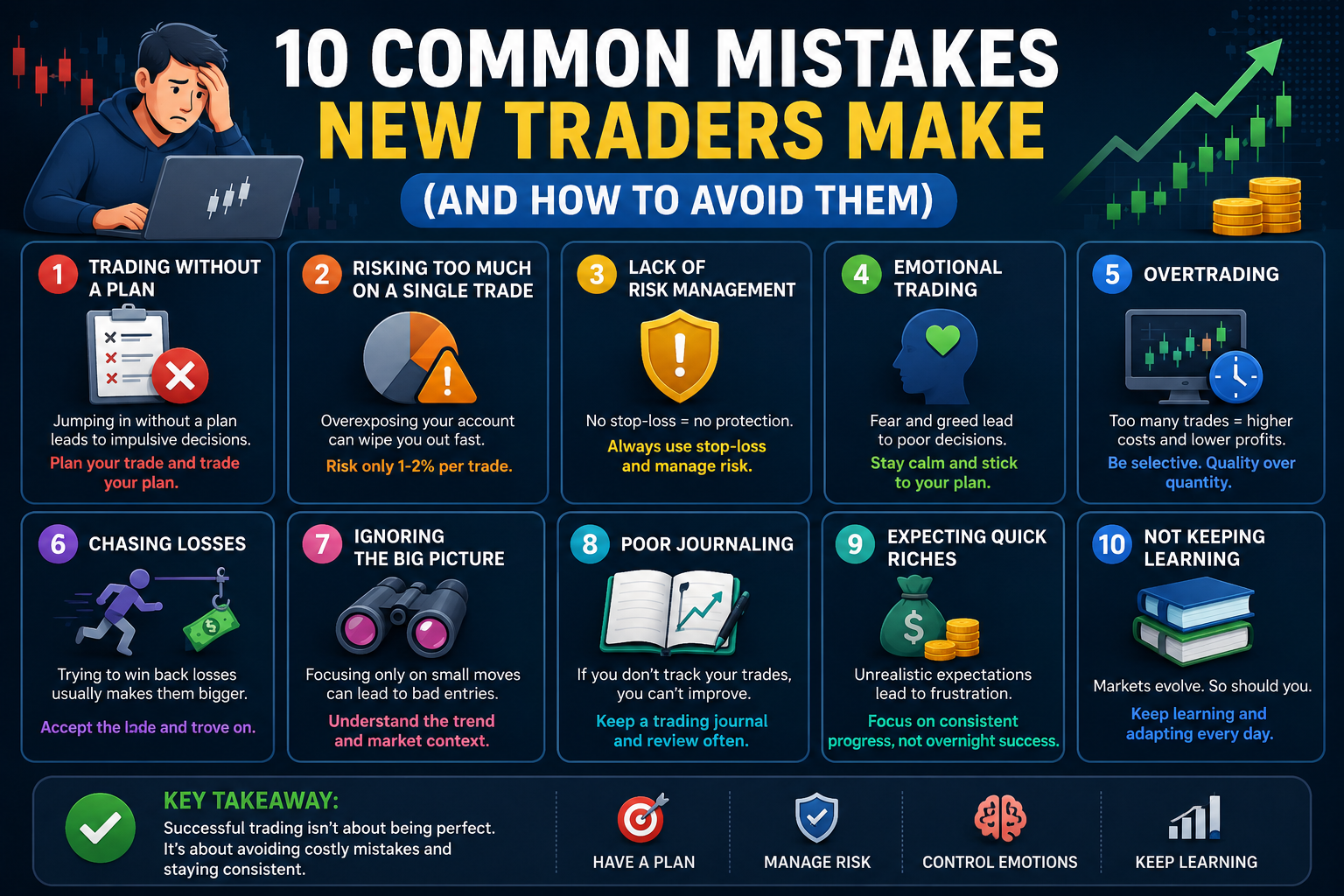
All new traders lose money along the way. That is not a scare tactic, it’s the nature of learning curves. However, there is a significant difference between losses resulting from true market risk and losses resulting from avoidable, repeatable mistakes. In fact, nearly every trader’s account blowup, particularly in their first year, traces back to a small set of common mistakes new traders make over and over again, often without realizing it until the damage is done.
This article walks through the ten mistakes that show up most often, why they happen, and what you can actually do differently. None of this requires a finance degree. Most of it just requires slowing down and being honest with yourself about your habits.
1. Trading Without a Plan
This is the one almost everyone is guilty of at the start. You open a chart, something looks interesting, and you click buy. Written reasons for trade, no target, no exit if it’s a bust. It is similar to trading but with added sets of steps.
This one isn’t too hard to do, but it does take self-discipline! Before putting anything down, make a note of why you are taking a trade, where you will get out if you’re right, and where you will get out if you are wrong. If you are unable to respond to the three questions on paper, click the button when you are done.
A lot of traders resist this because it feels slow. But the traders who last years, not months, almost always have some version of this habit, even if it’s just a few lines in a notes app.
2. Putting Too Much Money Into One Trade
Sometimes it’s a feeling of excitement that occurs when the setup is “perfect.” Perhaps it’s a stock that is all the rage or a coin that is on the rise for the entire week. That excitement tempts people to go bigger than they normally would, sometimes their entire account balance in a single position.
The problem is obvious in hindsight but invisible in the moment: no single trade should have the power to seriously hurt you. One popular rule of thumb is to risk 1-2% of your capital on a single trade. This way, even if you experience several losses, you still have the opportunity to continue trading and to keep learning and improving, rather than starting from scratch.
It’s worth saying that this rule feels overly cautious when you’re winning. Nobody follows a 1-2% rule and feels like a genius after a good week. But the whole point of the rule is to protect you during the weeks that don’t go well, and those weeks come for everyone eventually.
3. Skipping Risk Management Entirely
Many new traders do their best to determine when to open a trade and almost nothing of their effort goes to determining what to do if the trade fails. When it matters, risk management should be ignored in favor of chart patterns or breakouts, which are more entertaining.
So Practical risk management is like this: always put a stop in place, know your risk-to-reward ratio before you enter the trade, and never move your stop further away just because you don’t want to admit the trade is not working.
There’s also a quieter version of this mistake: having a stop-loss in theory but not actually respecting it. Plenty of traders set a stop, watch the price approach it, and then cancel it at the last second hoping for a bounce. That’s not risk management anymore, that’s just delaying the decision.
4. Overtrading
Overtrading usually comes from one of two places: boredom or frustration. Either the market feels slow and you want action, or you just took a loss and want to “do something” to fix it. Both lead to the same outcome, too many trades, too little thought behind each one.
More trades also means more fees, more spread costs, and more chances for a mediocre setup to turn into a loss. One way to keep this in check is to set a hard limit on how many trades you’ll take in a day or week, and treat hitting that limit as a signal to stop, not a suggestion.
Sitting in cash and doing nothing is a legitimate trading decision. New traders rarely believe that until they’ve been burned by ignoring it. There’s an odd kind of pressure that builds when you’re watching charts all day and not doing anything, like you’re wasting time if you’re not in a position. That pressure is worth resisting.
5. Letting Emotions Run the Show
Fear and greed get mentioned so often in trading content that they’ve become a bit of a cliché, but that doesn’t make them less real. Greed keeps you holding a losing position because you’re sure it’ll turn around. Fear makes you sell a winning position five minutes after it starts moving in your favor, just to lock in a small gain.
Neither of those decisions comes from analysis. They come from how you feel in that exact moment. A rules-based approach, where you decide your entries and exits ahead of time and then follow through regardless of your mood, removes a lot of this problem. It won’t remove it completely. Nothing does. But it puts a system between your emotions and your money.
If you notice you’re checking a position every few minutes, that’s usually a sign the position size is too big for your comfort level, not that the market is doing anything unusual.
6. Chasing Trades Out of FOMO
You’ve probably seen this play out: a stock or crypto asset goes up fast, social media lights up with people posting their gains, and you jump in near the top because you don’t want to miss the next leg up. Then it reverses, and you’re the one left holding the bag.
This is one of the most common mistakes new traders make, and it’s almost entirely psychological. The fix is patience: wait for a pullback, wait for confirmation, or just accept that you missed this particular move. There will always be another setup. Missing a good trade costs you nothing. Chasing a bad one can cost you real money.
It also helps to remember that by the time something is trending on social media, a lot of the easy money on that move has usually already been made by people who got in earlier and quieter.
7. Never Keeping a Trading Journal
There are many new traders who make a trade and then move to another one without taking any notes. There is no record of what they were thinking, how it went or why they got in. Otherwise you’re just re-doing it in silence, and you’ll be difficult to catch on any pattern if you don’t review your own.
A journal doesn’t need to be complicated. Date, asset, entry and exit price, position size, your reasoning, and the result. Reviewing it once a week is usually enough to start noticing things, maybe you consistently exit winners too early, or maybe you always break your own rules after a red day.
Some traders add a short note about how they felt during the trade too, calm, anxious, rushed. That small detail often explains more about the outcome than the actual chart does.
8. Trading Off Tips Instead of Your Own Research
It’s tempting to take a shortcut. Someone in a group chat says a stock is about to move, or a YouTube video makes a confident prediction, and you place the trade based on that alone. The problem is you haven’t actually built any understanding of why the trade makes sense, so if it goes wrong, you don’t know why, and if it goes right, you don’t know why either.
Tips can be a starting point for your own research, but they shouldn’t be the entire decision. Take the time to look at the chart yourself, check the fundamentals if it’s a stock, and form your own opinion before risking money on someone else’s. Over time, this is also just how you get better at trading. Copying someone else’s calls doesn’t build any skill of your own.
9. Ignoring What Kind of Market You’re In
A strategy that works well when a market is trending can fall apart completely in a choppy, sideways market, and vice versa. Many people become adept at one technique and use it in all situations, forgetting that something has shifted and they are in a new situation for which they need to adapt their approach.
It takes time to learn to recognize when the market is trending, ranging or simply moving around without any direction, but it is well worth the time. Sometimes the smartest move is recognizing that current conditions don’t fit your strategy and stepping back until they do, rather than forcing trades into a market that isn’t cooperating.
10. Revenge Trading After a Loss
This may be the worst damage in the list as it can multiply rapidly. You lose money, you feel frustrated and you get right into another trade, this one may be even bigger than the previous one, to make back your losses. It rarely works as the choice is not a set up, it’s based on emotion.
In the long run, the smart thing to do, even though it’s tempting in the short term, is to get off the screen after a loss. Don’t rush into anything, just give yourself some time first, an hour, a day, sometimes more. Traders lose money as a part of their business. It is not a good idea to attempt to blot them out right away; it invariably makes them larger.
A useful question to ask yourself before that next trade is simple: would I be taking this exact setup if I hadn’t just lost money? If the honest answer is no, that’s usually enough reason to wait.
Common Mistakes New Traders Make: Bringing It All Together
None of these mistakes are unique or rare. Nearly every trader who’s been in the markets for more than a year or two has made several of them, often more than once before the lesson actually stuck. What separates traders who improve from those who quietly give up isn’t talent, it’s usually just the willingness to look honestly at their own habits and adjust.
If you’re just starting out, don’t try to fix all ten of these at once. Pick two or three that feel most relevant to how you’ve been trading, work on those specifically, and let the rest come with time. It’s a matter of protecting capital and creating workflows first before gambling on big wins and most traders who get past the initial couple of years will agree.
Frequently Asked Questions
What is the biggest mistake new traders make?
Trading without any plan is usually considered the most common starting point. It leads to inconsistent decisions and makes every other mistake on this list more likely.
How much should a beginner risk on a single trade?
A commonly used guideline is 1-2% of total trading capital per trade. It’s not a hard rule, but it’s a reasonable starting point for protecting your account while you’re still learning.
Why do so many new traders lose money?
It’s rarely one single reason. Usually it’s a mix, no clear plan, poor risk management, emotional decisions, and taking too many trades without a strong enough reason for each one.
Is keeping a trading journal actually worth the effort?
Yes, even a simple one. It’s the easiest way to spot patterns in your own decision-making that you’d otherwise miss.
How long does it usually take to become consistently profitable?
It varies a lot from person to person, but most experienced traders would say somewhere between one and three years of steady practice and review, not weeks or months.
Related Articles
Expand your knowledge with these in-depth guides:
How to Get Started Trading on Prediction Markets