

The Securities and Exchange Commission is still reviewing filings for prediction market ETFs that would actually hold event contracts. Filings are already in for funds that would hold the contracts themselves, and the SEC is still deciding what it will allow and where it will draw the line.
The comment cuts through a long stretch of quiet. Roundhill Investments, Bitwise Asset Management, and GraniteShares filed back in February for more than two dozen funds that would wrap binary event contracts inside ordinary ETFs. The idea is to let traders take the exposure straight through a regular brokerage account instead of opening a separate account on a designated contract market.
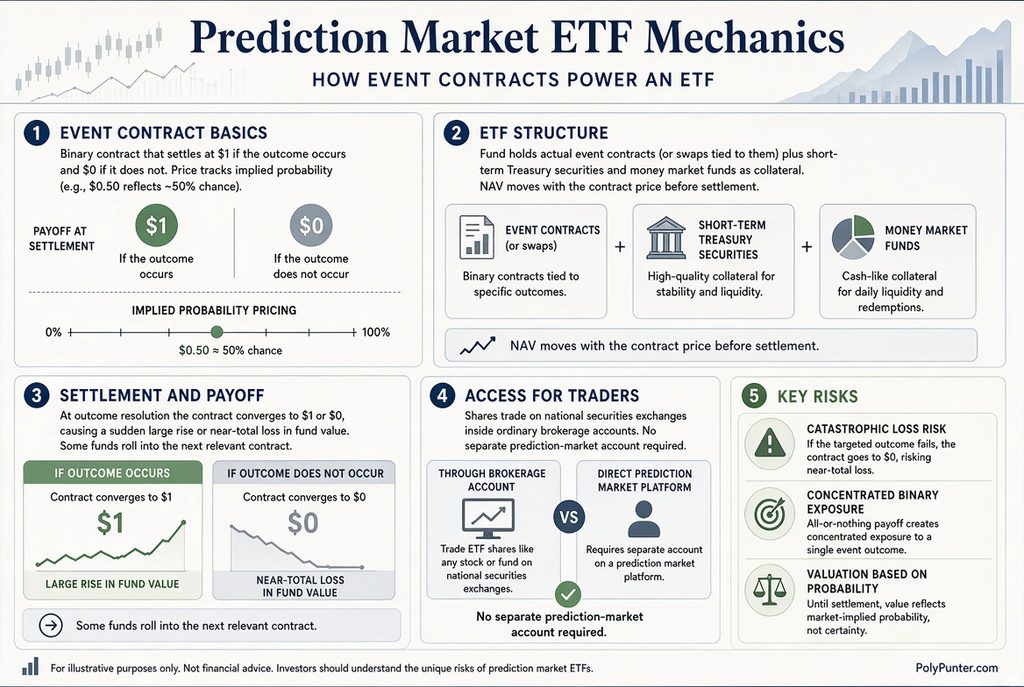
These funds are not the same as the equity products that simply hold stakes in the companies running the platforms. A contract that pays $1 if the outcome happens and $0 if it does not would sit at the center of the portfolio. Traders could then buy and sell the ETF shares during normal market hours without learning a new interface or moving money to another account. All of these trader venues seek seamless integration.
Seyffart Highlights Filings For Contracts Holding Products
James Seyffart of Bloomberg’s X-post makes clear that the issuers want to hold the actual contracts rather than use synthetic exposure or equity stakes. Roundhill’s RPM series has separate funds for Democratic and Republican control of the presidency, the Senate, and the House. Bitwise filed a matching set under its PredictionShares brand and also included contracts tied to Bitcoin hitting $100,000, Ethereum hitting $3,500, and West Texas Intermediate crude oil clearing a set price in 2026. GraniteShares filed similar contracts on political outcomes.
Later filings pushed the idea further. Tidal Trust submitted two funds in July that would hold baskets of event contracts, one aimed at economic, climate, and policy outcomes and another at sports leagues. Those came after the SEC had already opened its broader request for comment. The earlier single-contract designs put all the risk on one binary outcome, while the basket versions spread the exposure across several contracts that still settle the same way.
Seyffart has been watching these filings since they first landed. Roundhill originally set a May 5 effective date for its six funds under the automatic 75-day rule. The SEC stepped in before that window closed and asked for more detail on how the funds would value the contracts, when a market would be considered decided, and what risks it would disclose to investors. The sponsors agreed to hold off while the agency reviewed products that invest mainly in instruments that aren’t securities.
His latest note keeps the same careful tone he has used on other new ETF categories. He has said before that the SEC does not look fully comfortable opening the door to every kind of event contract available on the platforms. The review appears focused on finding a workable boundary rather than shutting down the entire concept. That boundary will decide whether election contracts, economic-data contracts, or only certain non-political ones ultimately get through.
SEC Weighs Permitted Structures For Event Contract ETFs
The agency made the review formal on June 30 by publishing a request for comment on novel ETFs. The document asks whether a fund that invests mainly in non-security assets, such as event contracts, can still count as an investment company under the Investment Company Act’s subjective test. It also questions whether the usual rules for ETF arbitrage, creation and redemption, and the 75-day effectiveness window give staff enough time to examine these new structures. About 85 comment letters came in before the window closed in late August.
SEC Chairman Paul Atkins had already told staff to gather public input, saying novel products raise novel questions. Brian Daly, director of the Division of Investment Management, told the ETF Prime podcast in mid-October that the staff is reasonably close to a proposal based on what it heard. Commenters pushed for a predictable process and for the agency to stay neutral across different asset types. Sponsors wanted enough transparency so copycat filings don’t undercut the first filer within hours of a new idea.
The request does not lay out specific rule language. It asks open questions about how to disclose the risk that a product could lose substantial value if the targeted outcome fails. It also looks at how valuation should work when a contract’s price moves with polling, news, and shifting sentiment long before the official settlement date. Those details will shape whatever order or rule change eventually comes out.
At the same time, the SEC has cleared a different set of binary contracts on Cboe. Those are structured as options on a security and cover key performance indicators reported by 23 companies, including Apple, Nvidia, and Tesla. Robinhood is expected to offer them to retail traders. The move shows the agency is willing to approve certain binary payouts under securities rules while it continues to study the CFTC-regulated event contracts that the pending ETFs would hold.
Issuers Prepare Products For Brokerage Account Access
Roundhill, Bitwise, and GraniteShares built the funds to rise if the targeted outcome occurs and fall near zero if it does not. The prospectuses say the funds would hold the event contracts directly or use related swaps, with short-term Treasury securities and money-market funds as collateral. Pricing would follow the implied probability in the underlying market. A contract trading at $0.50 would signal roughly a 50% chance of the outcome, and the ETF’s net asset value would move with that price before settlement.
Bitwise’s Matt Hougan has said the firm sees prediction markets growing in both size and importance, which makes client exposure hard to ignore. GraniteShares chief executive Will Rhind has noted that new products often need extra review around liquidity and investor protections. The issuers look ready to tweak the mechanics once the SEC decides what it will allow. The later products from Tidal Trust add portfolio managers who select and rebalance across multiple contracts, which may ease some of the concentration worries that showed up in the comment letters.
A different product, the Tema Trading & Prediction Markets ETF, launched in September under the ticker DICE. It holds equity stakes in companies including Kalshi and Polymarket through special-purpose vehicles, along with publicly traded companies such as Robinhood and Coinbase. That fund does not hold event contracts. Seyffart’s comments draw a clear line between the pending filings and this equity approach. Traders who want exposure to the probability of a specific outcome, rather than to the platforms’ growth, will need the contract-holding products still under review.
If the SEC allows the structures, the shares would trade on national securities exchanges and show up in regular brokerage accounts. Traders could buy or sell during normal market hours without funding a separate prediction-market account. The ETF wrapper also brings the usual reporting, tax treatment, and custody setup. Those features help explain why the issuers have kept the filings alive even after the initial delay.
What Approval Could Mean For Traders
Approval would give traders a brokerage-account path into binary outcomes that currently require a direct account on a designated contract market. Someone who wants exposure to the probability of a particular election result or economic data point could simply add the matching ETF to an existing portfolio. Because the contracts settle at $1 or $0, the position carries the same all-or-nothing risk as the underlying instrument. The prospectuses warn that investors could lose substantial amounts of money if the outcome does not occur.
Volume on the leading platforms has climbed quickly. Combined notional activity on Kalshi and Polymarket reached tens of billions of dollars in the first months of 2026 and has grown ever since. Even a modest slice of that activity moving into ETF form could create a category measured in the billions. Earlier estimates suggested that a 1% shift of then-current platform volume could produce roughly $1.6 billion in annual ETF trading, while a 10% shift could approach $16 billion. And that number is even higher now.
The products would also open a channel for institutional traders who prefer regulated, exchange-listed instruments and standard custody. Some portfolio managers have said the structure could hedge around known event dates such as elections or Federal Reserve decisions. Retail traders would still face the same binary payoff and the same risk of a near-total loss. Disclosure documents will need to spell those features out clearly so the familiar ETF label does not suggest more diversification than the single-contract designs actually provide.
References
- James Seyffart on X, October 22, 2026
- InvestmentNews, SEC seeks comment on prediction-market ETFs after May pause
- CryptoSlate, SEC reviews more than 24 ETFs that could bring election betting to brokerage accounts
- Reuters, US SEC review delays first prediction-market ETFs
- Cornerstone Research, Prediction Market ETFs: Structure, Regulation, and Open Questions
- SEC.gov, Request for Comment on Novel ETFs
- ETF Prime via Fidelity, SEC’s Brian Daly on the Path for Novel ETFs
- Morningstar, Know When to Fold ‘Em: Why the SEC Should Reject Prediction-Market ETFs
- The Block, First prediction market ETFs could launch next week, Bloomberg analyst says