
Polymarket US has filed a federal lawsuit accusing Ohio of imposing unconstitutional barriers to interstate commerce through its online sports-betting licensing rules. The complaint, Case No. 26-1502 in the U.S. District Court for the Southern District of Ohio, Eastern Division, names Attorney General Andy Wilson and several Ohio Casino Control Commission members as defendants. QCX LLC, operating as Polymarket US, seeks a declaratory judgment and injunction to stop the state from applying its gambling laws to a CFTC-designated exchange.
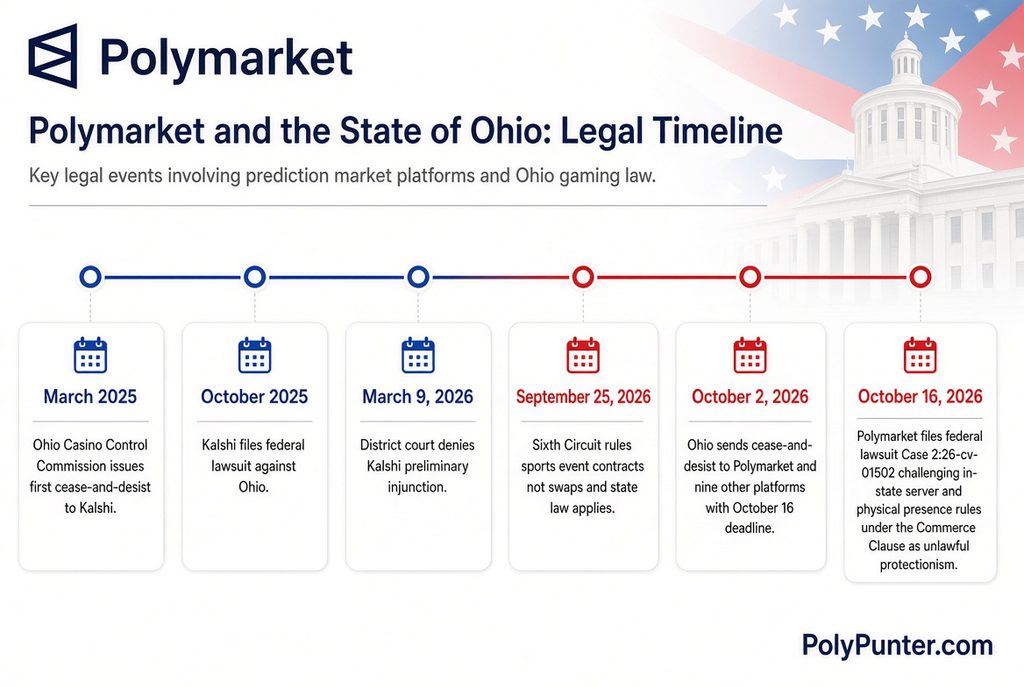
The suit follows cease-and-desist notices the commission sent on October 2 to Polymarket and nine other companies, demanding they stop offering sports event contracts to people in Ohio. Those letters came after a September 25 Sixth Circuit decision that rejected federal preemption claims for similar contracts. Polymarket now argues that Ohio’s specific licensing conditions go further and violate the dormant Commerce Clause.
Gaming lawyer Daniel Wallach flagged the filing on X, calling the rules “unlawful protectionism” that require in-state physical presence and in-state servers. His post noted that the server mandate may respond to the federal Wire Act’s restriction on cross-border sports wagering transmissions. The complaint’s first page, shown in the post, confirms the case caption and relief sought.
Polymarket US Files Complaint to Block Ohio Enforcement
The action asks the court to declare that Ohio cannot treat sports event contracts on a federally designated market as unlicensed sports gaming. Polymarket US maintains that it operates under exclusive CFTC jurisdiction and that state enforcement would cause immediate harm Congress has prohibited. This is the standard supremacy argument, but wrapped in a new legal package. Defendants include Wilson, Interim Executive Director Andromeda Morrison, Chair Thomas J. Stickrath, and other commissioners.
This filing continues a series of preemptive suits by QCX LLC against state regulators. Earlier cases have produced mixed results on whether the Commodity Exchange Act blocks state gambling laws. The Ohio complaint adds a Commerce Clause claim focused on discrimination against out-of-state companies rather than pure preemption.
Most recipients of the October 2 notices continued operating past the October 16 response deadline while relying on federal status. A News 5 Cleveland report showed state officials stressing consumer safeguards and revenue collection as platforms held their ground. The coverage underscores the practical stakes for traders who can still access the contracts while the legal fight proceeds.
Ohio’s Physical Presence and Server Rules Draw the Challenge
Ohio Revised Code Section 3775.04 requires a Type A sports gaming proprietor to either hold a Type B retail license or maintain at least one operational place of business in the state with multiple regular employees. Section 3775.11(C) separately requires that the network server accepting wagers through an online sports pool be located in a secure facility inside Ohio. Administrative Rule 3775-9-02 reinforces the location rule by requiring that servers or equipment accepting wagers sit within the state and be managed by a licensed entity in a controlled data center.
These conditions require an out-of-state operator to establish local staff or infrastructure before it can serve traders physically in Ohio. Polymarket contends the requirements favor companies with an existing Ohio footprint and burden national exchanges that already meet federal standards. The dormant Commerce Clause bars states from protecting local economic interests by discriminating against interstate competitors.
Under the current structure, Ohio’s licensed operators generate significant volume. One recent month produced $658.9 million in handle and roughly $13.8 million in tax revenue at the 20% rate on adjusted gross gaming revenue. State officials say the rules protect consumers and keep tax dollars in Ohio. The lawsuit argues that the same goals can be achieved without mandating server or employee relocation.
Geolocation already confines activity to traders inside the state. Adding physical-presence and server mandates layers further barriers that licensed sportsbooks navigate through partnerships with casinos, racinos, and sports teams. Polymarket argues that extending those barriers to a CFTC exchange crosses into unconstitutional protectionism. It’s an interesting legal argument. Or perhaps merely a desperate Hail Mary. We’ll see how the courts respond.
Sixth Circuit Decision and Cease-and-Desist Notices Frame the Dispute
On September 25, a unanimous Sixth Circuit panel held that sports event contracts do not qualify as swaps under the Commodity Exchange Act and that the act does not preempt Ohio or Tennessee gambling laws. The ruling, in consolidated appeals involving KalshiEX LLC, affirmed a lower-court denial of an injunction in Ohio and vacated an injunction in Tennessee. It gave the Casino Control Commission a clearer path to act against other platforms.
The commission responded on October 2 by sending letters to ten companies, including Polymarket, Coinbase, Robinhood Derivatives, and Underdog. Each notice ordered the recipient to cease offering or facilitating sports event contracts to Ohio residents and to confirm compliance in writing within 14 days. Morrison stated that the products lack required protections for young and vulnerable people and that the commission must act to preserve integrity. The letters warned of civil penalties and possible criminal exposure for unlicensed sports gaming.
Governor Mike DeWine has called the prediction market offerings pure gambling that tries to avoid state rules and taxes. Attorney General Wilson has likewise insisted that platforms follow the same standards as traditional operators. Polymarket’s spokesman has continued to say CFTC rules, not a patchwork of state statutes, govern the activity. The new Commerce Clause claim supplies an alternative argument if preemption claims continue to face resistance.
Ohio has also joined 39 states asking the Supreme Court to review state authority over sports event contracts. That petition seeks a definitive ruling on whether classic sports outcomes remain subject to traditional state power. Polymarket’s protectionism argument adds another layer that could affect how far states may condition market access on local infrastructure.
Commerce Clause Argument and the Wire Act Connection
The complaint’s central claim is that requiring an in-state physical presence and in-state servers discriminates against interstate commerce. Such rules favor entities already operating in Ohio and raise costs for national platforms that want to serve in-state traders. Courts have invalidated similar local-presence conditions when they operate as economic protectionism rather than evenhanded regulation.
The server-location mandate may also reflect the federal Wire Act, which generally bars the interstate transmission of sports wagers via wire facilities. The act includes a limited safe harbor for betting information moving between jurisdictions where the activity is legal, but it still restricts transmission of the bets themselves. Many states that legalized online sports gaming have required in-state servers to limit Wire Act exposure. Ohio’s statute requires the accepting server to be in a secure in-state facility and bans locating the critical equipment elsewhere.
If the server rule exists primarily to satisfy the Wire Act, that federal statute could supply a legitimate justification that survives Commerce Clause scrutiny. The court will need to decide whether the requirements are narrowly tailored to a valid federal concern or instead function mainly as a barrier that shields local operators. Forcing a nationwide designated contract market (DCM) to relocate core infrastructure for each state would multiply expense and fragment operations. The outcome could influence similar rules in other states that demand local presence or servers for online sports gaming.
References
- Daniel Wallach’s X post announcing the Polymarket challenge
- Ohio Revised Code Section 3775.11 on online sports pools and server location
- Ohio Revised Code Section 3775.04 on Type A license physical presence requirements
- Ohio Administrative Code Rule 3775-9-02 on sports gaming system server location
- InGame coverage of Ohio cease-and-desist letters to 10 platforms
- Covers.com report on the October 2 notices
- News 5 Cleveland video on Ohio officials and prediction market enforcement
- Blank Rome analysis of the September 25 Sixth Circuit decision
- PlayUSA report on Ohio and 39 states seeking Supreme Court review
- SBC Americas summary of the expanded crackdown after the appeals ruling
- Legal Sports Report on the ten recipients and compliance deadline
- Gamble Verdict explanation of the Wire Act’s application to sports wagering
- Greenberg Traurig insights on the Wire Act after Murphy v. NCAA
- Betting News report on recent Ohio sports betting handle and revenue figures
- RG.org summary of June 2026 Ohio handle, revenue, and tax collections