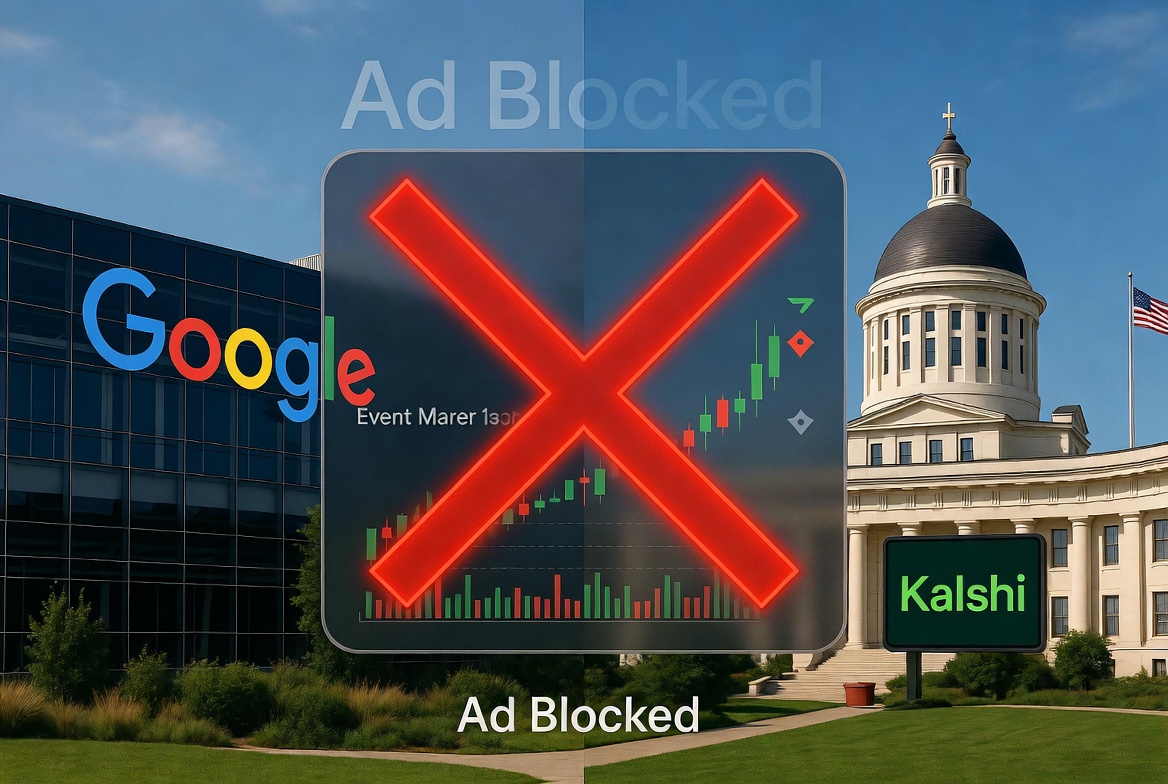
Google has rolled out a targeted restriction on prediction market ads in Ohio that immediately limits how traders access event contract through Google, the world’s largest advertising networks. Effective June 2, 2026, the tech giant updated its policies to prohibit prediction market contracts and related product advertisements in Ohio, marking a significant shift that traders and platform operators are closely watching.
This move comes as platforms like Kalshi continue battling state regulators in court while asserting federal oversight under the Commodity Futures Trading Commission. While Google previously opened doors to these ads in most U.S. states earlier in 2026, the Ohio-specific prohibition aligns the company with ongoing regulatory tensions in Ohio.
Google’s Policy Update Delivers Fresh Setback to Event Contract Visibility
Traders relying on search engine marketing for discovery now face reduced reach in our nation’s 7th most populous state. Google’s official announcement states clearly:
“In June 2026, Google will update our Prediction markets policy in the United States to prohibit the advertisement of prediction markets contracts and related products ads in Ohio.”
Consequently, such advertising became prohibited effective June 2, 2026.
This restriction now narrows a policy Google had expanded in January 2026, when it began permitting ads for CFTC-regulated platforms across most states except Nevada. The Google decision highlights the complex interplay between federal commodity regulations and state-level concerns over sports-related event contracts. And now, how advertising networks are complying with current legal rulings as these fights continue.
Ohio Casino Control Commission interim executive director, Andromeda Morrison, responded positively even though he insists the Commission never asked Google for this restriction:
“The Ohio Casino Control Commission did not solicit any particular action from Google, but applauds Google for its efforts to ensure that marketing targeting Ohioans fully complies with Ohio law.”
Note: Google also allows/limits ads for sports betting apps and casinos in accordance with each state’s laws regarding such activity.
Context of Broader Regulatory Battles Shaping Platform Futures
Prediction market platforms have positioned event contracts as federally supervised swaps designed essentially for hedging and price discovery. Yet states continue pushing back, filing cease-and-desist orders and defending their authority to protect sports betting activity in their state. Ohio stands out in these disputes, having sent cease-and-desist letters to multiple operators in April 2025 and successfully defending against an injunction request from Kalshi.
Meanwhile, Kalshi is actviely fighting back with team of lawyers, engaged in multiple lawsuits across federal and state courts. The CFTC has supported the platforms in several instances, suing states attempting to block prediction market activity. Google is obviously paying attention to these updates.
Google’s Approved Locations for Prediction Market Advertising
Status
Details
Prohibited
Nevada and Ohio – Full ban on prediction market contracts and related ads
Approved (with certification)
United States (excluding Nevada and Ohio) – Requires CFTC authorization and Google certification
Google maintains strict eligibility criteria even in approved areas, requiring platforms to hold all applicable licenses and complete a certification process, as detailed in its full Prediction Markets Policy.
Ohio’s Stance on Sports Betting and Event Contracts
Governor Mike DeWine, who supported sports betting legalization in 2023, has publicly expressed concerns about its societal effects in recent months. But once the states start taking in sports betting tax money, these concerns tend to be far more subdued. States never give up revenue once it’s begun. Now, Ohio is bound to defend these sports betting operators paying those taxes against interloping prediction market operators threatening that money.
Key Timeline of Recent Developments
Date
Event
January 2026
Google expands prediction market ads to most U.S. states (excluding Nevada)
April 2025
Ohio issues cease-and-desist letters to operators
June 2, 2026
Google implements Ohio-specific ad prohibition
Ongoing
Kalshi and others litigate against state enforcement actions
Platform Strategies Adapting to Advertising Constraints
Operators are already pivoting. Some are emphasizing mobile app downloads through alternative channels, while others invest in content marketing that educates traders on market opportunities without direct advertising promotion.
Despite the Ohio restriction, broader national interest in prediction markets only continues to grow. They’ve reached what many might call an escape velocity, where they’ve become popular and integrated enough throughout the consumer public that any reversal is incredibly unlikely. Many may recall the same state and sportsbook operator angst when sports betting apps came about after the 2018 SCOTUS ruling. Lots of debates and arguments, and eventually widespread adoption by most states.
Looking Ahead: Implications for Market Growth and Regulation
The Google policy change underscores a now maturing industry where technology, finance, and regulation intersect. It’s messy, but it will get worked out with some kind of splits because there’s simply too much money on the table to make it all go away. As litigation progresses, new courtroom outcomes should influence Google’s future policy adjustments.
The PolyPunter staff works tirelessly to bring you the latest and most insightful news, information, and tips on the fast-growing economic, financial, and social phenomenon that is prediction markets.