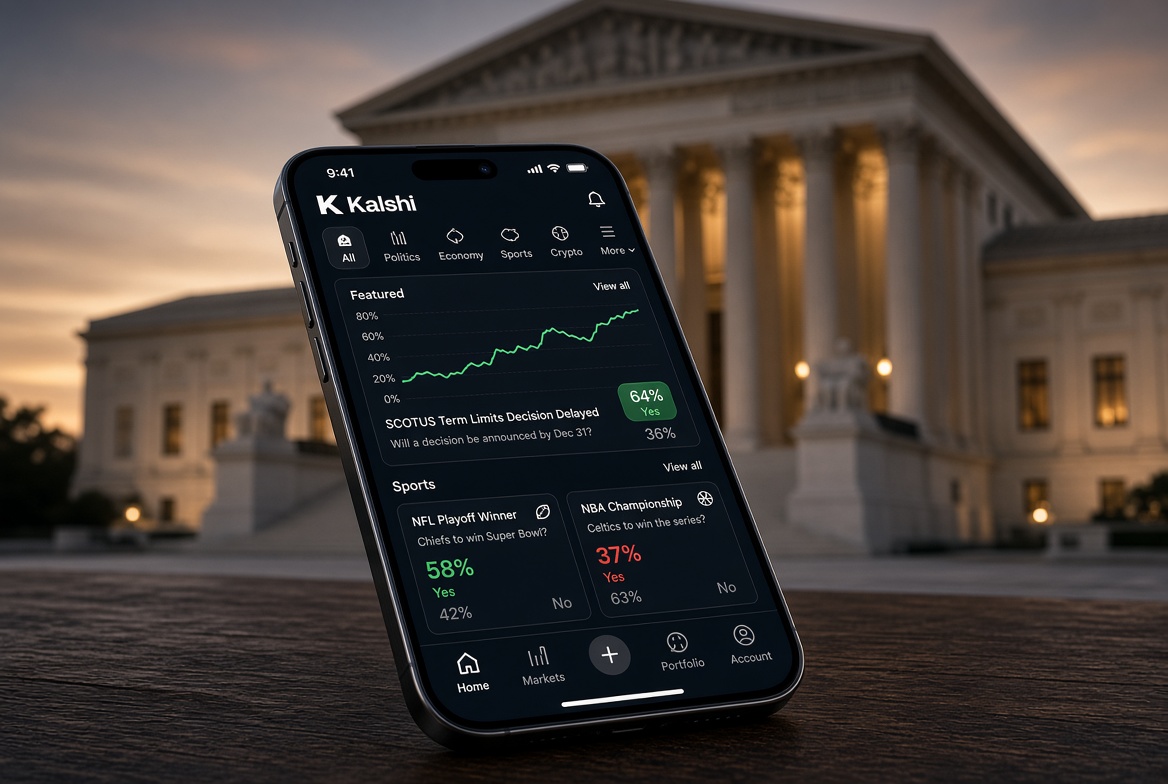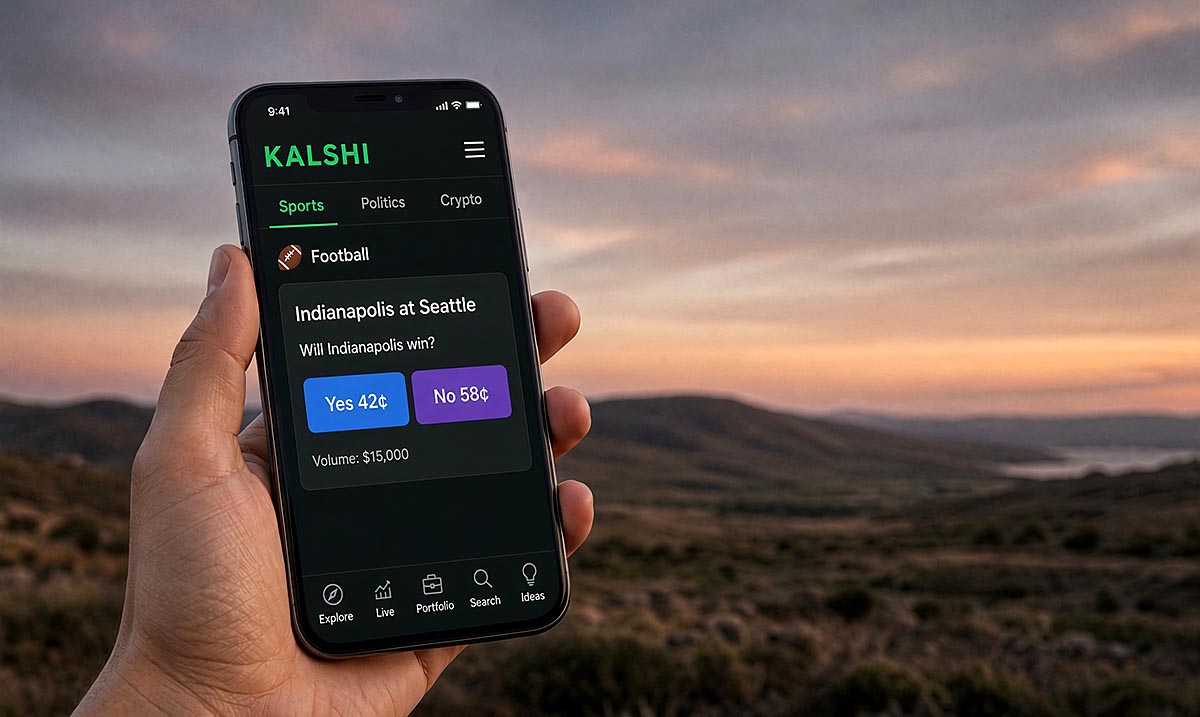
By late September, more than $750 million had already changed hands on 2026 election contracts at Kalshi and Polymarket. People started calling this the first prediction-market midterm election for a reason. The contracts do not just forecast results. They put a live probability number on nearly every House seat and Senate race. The public, campaigns, donors, media, and anyone with a phone watch the probabilities move and use the information accordingly.
Most of the chatter so far still surrounds whether the markets will beat the polls again. But that question, while socially and scientifically interesting, is really secondary to the practical impact. Tradable probability now exists in the open and updates with every order that makes up that $750 million (and growing) volume mark. This isn’t about waiting a week for a new poll to update some RealClearPolitics averages. This is 24/7 real-time election forecasting data.
When a forecast market number sits on a tight House race in the final stretch, it can alter when money arrives, how messages are framed, and whether some voters even bother to cast a ballot. Election administrators have warned that this visibility fuels disinformation and misinformation and opens new paths for people to trade on inside campaign information. There’s no doubt staked-money election markets have downsides. But the upsides of more, not less, accurate public information exist, and best viewed relative to the status quo.
Where the Money Actually Is
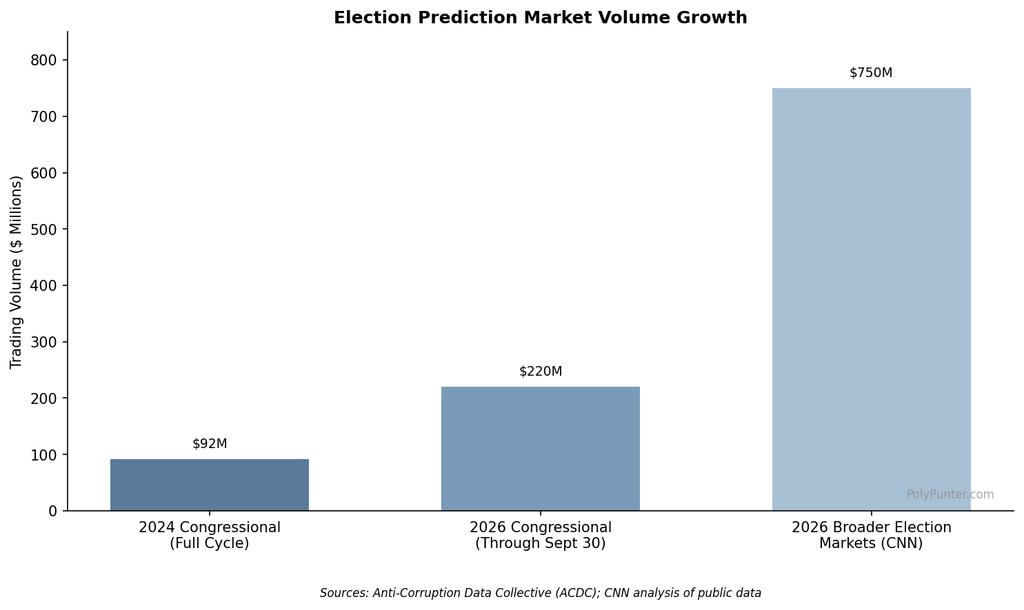
Volume on these contracts has already blown past the entire 2024 congressional cycle on the narrower measures. The Anti-Corruption Data Collective (ACDC) tracked more than 21,000 congressional markets through the end of September and counted more than $220 million wagered on those races alone, against $92 million for all of 2024. CNN’s broader tally of election-related contracts across the two platforms totaled $750 million. ACDC figures the full cycle of congressional contracts could land between $1.4 billion and $1.6 billion if the pace picks up like it did last time, all the way to Election Day.
The money is not spread evenly. Texas Senate, Maine, Michigan, and South Carolina pull the bulk of it. On Polymarket’s international side, ACDC found that the top 1 percent of wallets account for roughly 70 percent of the congressional volume. Many individual House markets stay thin, often under $100,000 in total volume, while the big chamber-control contracts on who runs Congress have drawn a combined $32 million. Kalshi has pointed out that election trading this year already exceeds 2024 levels. It’s grown six times faster than its football volume from the year before.
The Media Treats Prediction Markets Like Polls, As Gospel
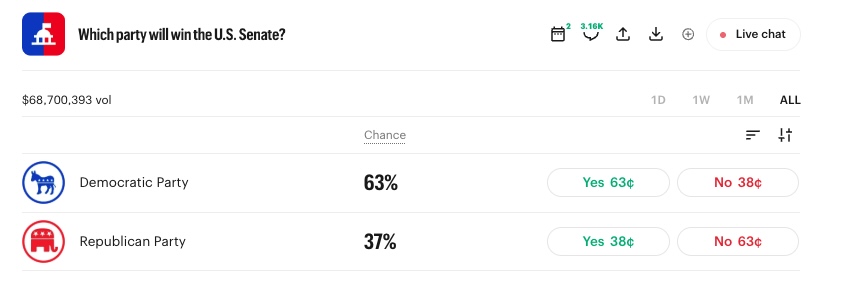
CBS News, which partners with Kalshi, has started treating the prices as another layer of its coverage. A September segment walked through how traders were pricing House and Senate control right next to the usual polls. That framing makes a 62-cent contract on Democratic Senate control feel like researched information rather than a side bet. Campaigns watching the same numbers treat it that way too.
Most people checking the prices never place a trade. Kalshi says three in four users look at the markets only for information, and on midterm contracts the ratio of viewers to traders runs five to one. The price therefore works less like a pure forecast and more like a public scoreboard, updated by the second, that everyone can see at the same time.
How a Moving Number Changes Decisions
Polls arrive with margins of error and stay fixed until the next release. Because polls from the same company are often separated by a week or more, the general public rarely tracks changes using the same polls. Media outlets often report poll changes as shifts between different polls. This makes it hard to draw statistically sound conclusions because polling companies use different mechanisms and sampling processes, making it like comparing apples to oranges.
Market prices shift with every trade and show up as a simple probability. A campaign watching a House race slide from 48 cents to 55 cents for the other side over a weekend suddenly has information that didn’t exist in the same form under the old system. That information can change spending and campaign framing on short notice.
In 2026, donors are paying attention. When a price moves against a candidate, checks can slow even if the underlying polls haven’t caught up yet. A quick improvement can pull in money that might otherwise sit until the next public survey. Because the price never stops, the feedback is tighter than the old rhythm of waiting days or weeks for fresh polling. Campaigns that once sat on their hands between releases can now reach out to donors almost in real-time with good news.
The Impact on Turnout
Turnout is harder to pin down, yet the logic is familiar. Voters who read the price as nearly settled may skip returning their ballot or staying home if their side looks safe (or lost). They may turn out in larger numbers if the race looks closer than they expected. Studies on polling and participation have long shown that a sense of closeness lifts turnout. A widely cited live price can strengthen that effect, especially once local outlets start embedding the contracts next to regular news coverage. The danger works both ways: a thin market that jumps on a few large orders can create a false impression of closeness or certainty that doesn’t match the actual electorate. That opens the market to partisan manipulation.
Messaging moves with the number too. A candidate trading at 40 cents may lean harder into turnout appeals and base mobilization than one sitting at 60 cents. The other side can point to the price itself as proof of weakness. Because the figure is public and keeps updating, it becomes part of the information environment both campaigns have to address. Polls have always shaped strategy. The difference now is speed and precision. Those unfamiliar with probabilities and prediction markets may also see 70% as an unyieldingly dominant lead, as it would be in a poll. But prediction markets react to new information far more dynamically than personal-preference polls.
Thin Books and Cheap Narrative Moves
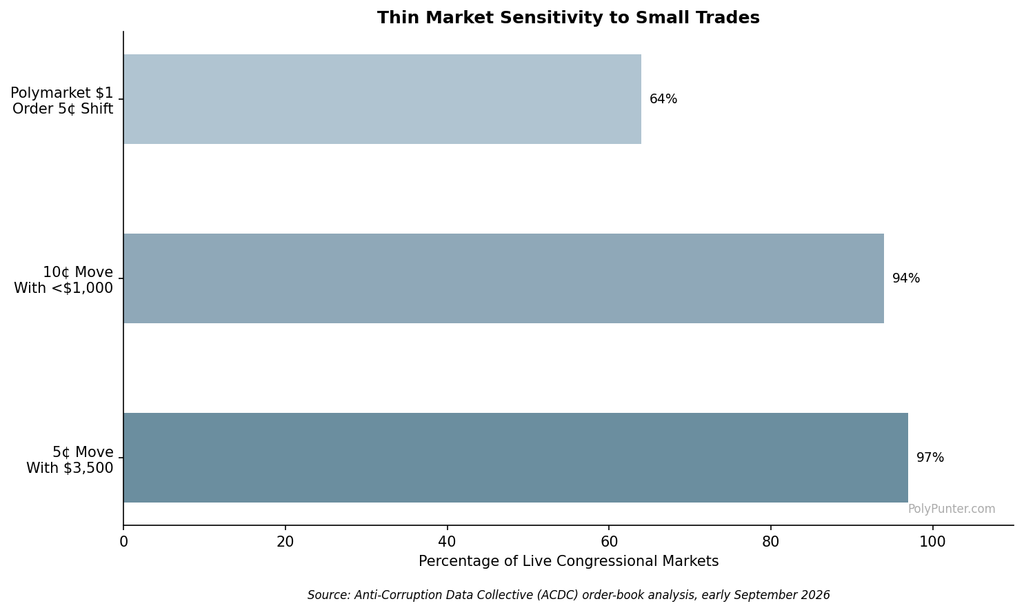
ACDC’s review of live order books showed that small trades can move most congressional markets. In 97 percent of active markets in early September, a single bet of $3,500, the federal individual contribution limit, could move the price five cents or more. Ninety-four percent could move ten cents on something under $1,000. On many thin Polymarket markets, an open order around $1 could shift the displayed price five cents without anyone on the other side filling it.
That matters because outlets and accounts regularly treat the prices as forecasts. Someone with a motive can spend far less than a television ad costs, move a thin contract, and watch the new number travel. ACDC flagged one case in the Texas Senate primary where a $1,240 trade moved a candidate’s price 11 cents; Newsweek then ran a story based on the updated Polymarket figure. The same opening exists in dozens of competitive House races where total volume stays low.
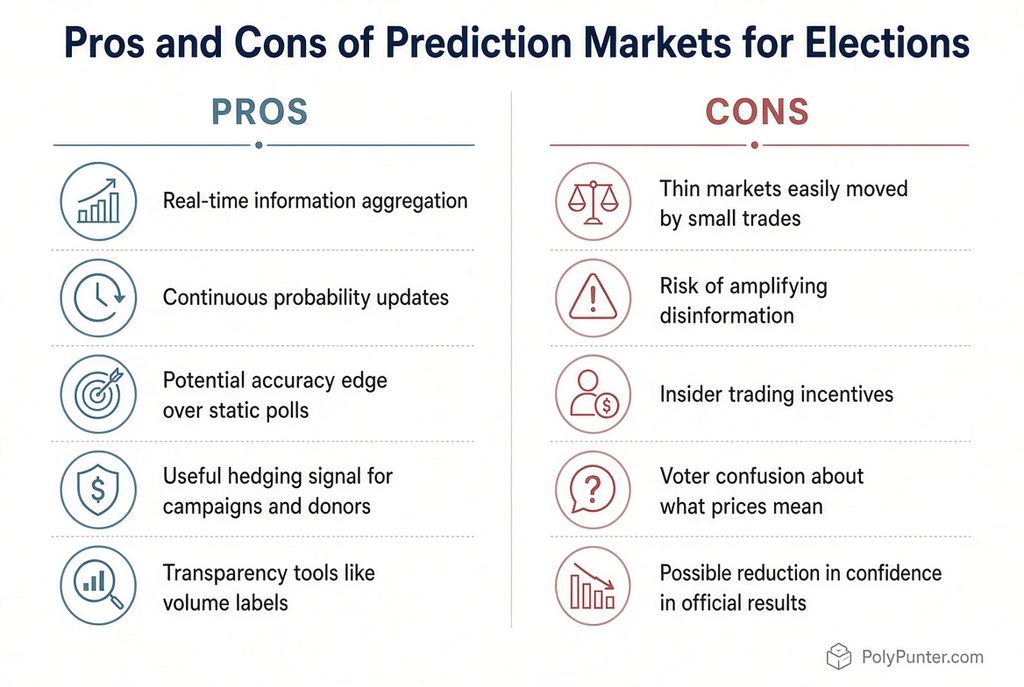
The platforms have added some transparency. Kalshi labeled low-volume markets under $10,000 and started publishing Brier scores that measure how its probabilities stack up against what actually happens. It also added real-time feeds that show individual trades as they occur. These steps recognize the issue without removing the underlying problem. A labeled thin market can still get cited by people who skip the label. ACDC has told campaigns, reporters, and donors to handle low-volume prices carefully for exactly this reason: small orders can produce outsized effects on the story being told.
Disinformation and the Confusion Problem
Election administrators have commented, as you might expect, against election forecast markets. Dean Logan, registrar-recorder for Los Angeles County, told CNN he would prefer the markets simply stay away from elections. After the June mayoral primary, his office dealt with a surge of “destructive” claims as the results began to diverge from the prices. Influencers, some under paid partnerships with the platforms, pushed ideas about fraud involving late ballots and vote totals that did not add up. Logan’s staff spent real time answering the resulting questions about the count’s accuracy and security. Of course, Logan failed to mention that his county’s slowest-in-the-country vote-counting process has long invited accusations of fraud and corruption, well before prediction markets.
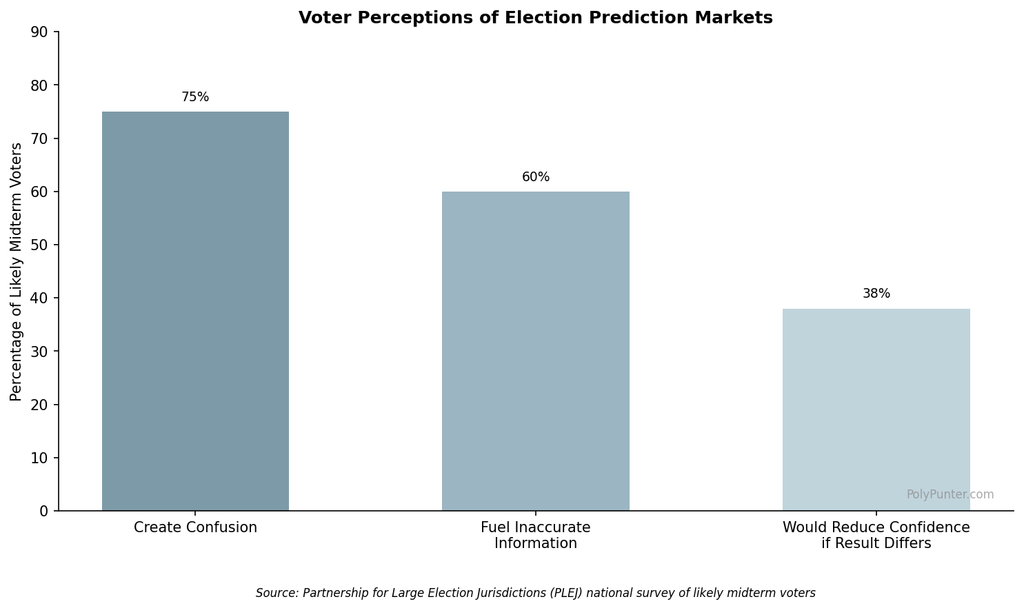
A survey commissioned by the Partnership for Large Election Jurisdictions found that 75 percent of likely midterm voters think prediction markets create confusion, and 60 percent say they push inaccurate election information. Nearly four in ten believed the odds represented either votes already counted or official projections from election officials. Thirty-eight percent said their confidence in an official result would drop if it differed from the market price.
Election Officials Do Not View Prediction Market Favorably
Barb Byrum, election clerk in Ingham County, Michigan, noted that people treat the contracts as signs of who will win, but they are simply the product of traders trying to profit. But that’s a technical point, not an insightful one. This same legitimacy issue has occurred for decades, when election results differ from pre-election polling. The fact that a larger share of the general public can now easily see and read election market data daily shouldn’t be deemed a principal difference merely because it’s a more transparent system. Unless you believe all prognostication data should be kept strictly private, with legal consequences for violations. And some people do feel that way.
Senators Mark Warner and Alex Padilla sent a letter to Kalshi and Polymarket in August asking about paid influencers who had spread false election claims, including theories of widespread fraud. The senators noted that some of the same people had posted similar content about the SAVE Act while under paid partnerships. The platforms have said they tell influencers to take down posts that break the rules, but the episode showed how marketing money can amplify unfounded claims. But again, that paid-influencer issue now cuts across every sector of society. It’s hardly a prediction market-specific issue.
Inside Information Without the Usual Rules
Elections lack the disclosure requirements that apply to securities. No clear equivalent of Regulation FD (fair disclosure) exists for a campaign’s internal numbers, a candidate’s health, or a sudden endorsement. Kalshi has suspended multiple candidates from trading on their own races. Reporting has also described campaign staffers placing bets on races they worked. The platforms say they check for this activity using Federal Election Commission data and send suspicious accounts to authorities, yet former FEC commissioners have noted that those checks will miss some cases. The temptation to turn a quick buck on privileged information is strong.
ACDC has also flagged a set of “knowable” markets: contracts on whether a candidate drops out, where a president holds a rally, or what someone says at a debate. These have already drawn more than $20 million. Because people inside a campaign can know the outcome in advance, the incentive to trade on non-public information is straightforward. Election offices in several places have started adding warnings against insider trading to staff training and, in some cases, formal bans on election trading by workers. Jared DeMarinis, Maryland’s elections administrator, said the threat grows as platforms get cited more often as a substitute for polling.
Platforms respond that their markets supply unbiased information and that they run surveillance built for political contracts. Polymarket has claimed a 98 percent accuracy rate one day before elections. These utility arguments for better public information hold sway, though they clearly don’t directly counter the election-integrity issues.
When the Price Becomes Part of the Campaign
The under-examined piece is not whether the markets are more accurate than polls on average. It is whether these public, dynamic forecast markets change the incentives around close races. This timeliness and accuracy, and greater turn toward prediction markets for “good data” on elections, is a double-edged sword. With societal and financial stakes so high in elections, this introduces a new pathway for potential corruption, abuse, or simple mismanagement by media outlets. At the same time, there is a “baby and the bathwater” case to be made here.
The ability of certain people to misuse new market technology and tools has never really been the basis for banning it. Stricter rules and more oversight, surely. But prohibition? The internet itself has thousands of crimes committed across its networks daily. We treat these crimes like offline crimes: take reasonable preventive measures, educate the public, and track down violators as best we can. But so far only dictatorial regimes have chosen to actually shut down the internet.
Thin Markets Are the Undeniable Issue
Thin markets make the loop especially brittle. Because so many House contracts can be moved for modest amounts, the risk is not only that the price is wrong, but that it is cheap to get it wrong and then amplify. Or even that misdoers try to manipulate markets for relatively small sums to artificially prop up a preferred candidate. While this is all but impossible in liquid markets and major races, it’s definitely an option for agenda-driven outsiders in less-traded races.
Campaigns and parties now face a choice that earlier cycles didn’t force. They can ignore the prices and risk being surprised by shifts in how donors and voters see the race, or they can watch and respond, which treats the markets as a normal strategic input. Either path pulls the contracts deeper into the process. The first prediction-market midterms are therefore not just a new forecasting device. They can change the timing of money, the shape of messages, and the confidence voters place in the certified results once they arrive. How much that helps or hurts democratic decision-making remains to be seen. But we need to view it in the context of the advantages election prediction markets offer, especially compared with polling. Consider it alongside preventative measures that avoid prohibition or throwing the baby out with the bathwater.
References
- CNN: The ‘first prediction-market election’ scrambles the midterms
- RG.org: Midterm Prediction Market Trading Tops $750M; Watchdog Sees $1.6B
- Reuters: Inside the booming market for US midterm election bets
- ACDC: Midterm election prediction markets are extremely vulnerable to manipulation
- Kalshi: Transparency features for 2026 midterm election markets
- YouTube: CBS News – Here’s what Kalshi’s prediction markets think will happen in the 2026 midterms
- YouTube: Leeja Miller – The Coming Kalshi Elections
- PR Newswire: PLEJ poll on voter concerns about election prediction markets
- Sen. Warner: Letter on prediction market influencers and election disinformation
- WIRED: Election Officials Are Preparing for Prediction Markets to Sow Chaos in the Midterms
- USA Today: Insider trading on Kalshi and Polymarket threatens the 2026 midterms
- Reuters/Ipsos: Most Americans oppose betting on elections