Let’s start by admitting I am not privy to insider details within Kalshi’s executive management. An analysis of their corporate strategy is only an outsider’s view. They are a private company, not bound by the disclosure requirements public companies must provide to shareholders or the public. This is purely supposition. Educated supposition, but still just a personal opinion.
Prediction markets have surged in trading volume, new entrants, and media, political, and social attention over the past year. No one has overtaken Kalshi, the market leader, and now it is lapping Polymarket in that race. Kalshi’s trading volume has grown 20x in the past 14 months. The company announces new high-value business partnerships and marketing deals weekly, sometimes daily. Its growth in sports event contracts is on track to surpass the leading sportsbooks.
Yet being number one in a controversial business sector puts you squarely in the legal crosshairs. That’s a truism that exists independently of the actual level of warranted offenses or abuses. Add to that mounting attention in political circles, and you have a recipe for a series of legal conflicts. And Kalshi has those in bunches.
Kalshi faces a growing legal fight with many states over sports-event contracts. The company has chosen a legal strategy that could be kindly called: contest them at every front, at every step, every time. Or more plainly called: delay. Not for delay for delay’s sake. Certainly not to make legal proceedings costly for their litigant adversaries. States have rather large budgets. And states that could lose millions in sports betting tax revenue will spend to preserve that revenue, if not enhance it, with prediction market revenue as well. But they delay to keep building and growing value, resources, and partnerships that strengthen their legal, political, and consumer connections.
Delays keep Kalshi contracts trading, volumes, revenue, and company valuations climbing, but they leave retail traders exposed to sudden geographic restrictions if states ultimately prevail.
The Circuit Split That Forced the Issue
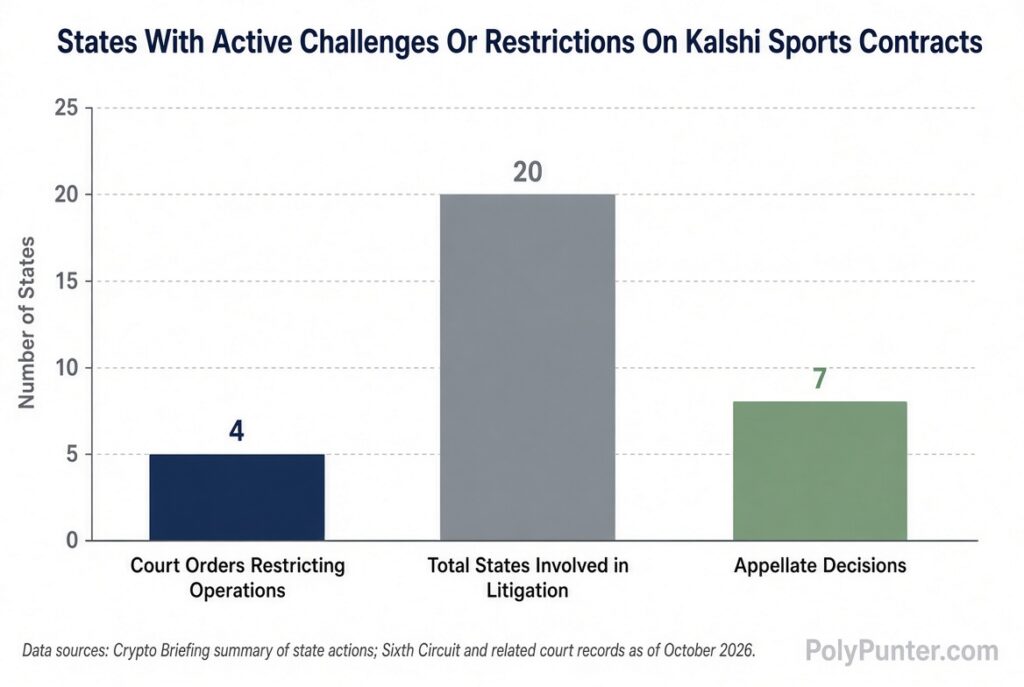
Appeals courts have split on whether sports-event contracts on CFTC-registered platforms fall under exclusive federal jurisdiction. In April 2026, the Third Circuit sided with Kalshi, treating the contracts as swaps that preempt state gambling laws. The Ninth Circuit ruled the opposite in August, allowing Nevada to enforce its statutes, and the Sixth Circuit followed in September for Ohio and Tennessee. The conflict makes Supreme Court review likely, but Kalshi doesn’t seem interested in a high-court ruling, which would at least reasonably likely move sports event contracts into state gaming authority purview.
New Jersey petitioned for certiorari on September 2, 2026, in Flaherty v. KalshiEX. Thirty-nine states plus the District of Columbia later filed an amicus brief urging the Court to hear the case; the NFL and American Gaming Association filed their own amicus briefs siding against Kalshi’s claims of federal-only regulation. The Court extended Kalshi’s response, originally due in early October, to November 9. A litigator working with the company told Semafor that pending rehearings and forthcoming CFTC rules muddy the waters. The firm accepts that the justices will eventually decide the issue, but it sees no need to force that moment now. Clearly, New Jersey state officials and their peers feel otherwise.
Procedural Maneuvers That Extend the Timeline
Kalshi has sought rehearing in both the Sixth and Ninth Circuits, citing the CFTC’s new rulemaking specifically around sports event contracts as grounds for further review. Nevada, an original plaintiff, has opposed Kalshi’s Ninth Circuit request, arguing the pending regulation would not change the outcome. These petitions add steps that delay finality even if they fail.
Gaming representatives see the combination of extensions and rehearings as a sign of caution. American Gaming Association spokesperson Rob Lockwood told Semafor the company appears “spooked” by the prospect of SCOTUS taking the case next year. Is this merely rhetorical jokeying by the AGA, or does it reflect a genuine belief? Who knows. All parties to these legal disputes have financial incentives at stake.
The Supreme Court has until January to choose cases for the current term. If the Court grants review of the New Jersey request, arguments would likely occur in early 2027, with a decision possible by June. Kalshi’s month-long extension and rehearing petitions push that timeline further back. Meanwhile, the platform continues to list sports contracts in most states, except a small number where courts have granted temporary injunctions, with weekly notional volumes regularly topping $15 billion during football season.
The delay may be as much a business decision as a legal one, preserving the current rapid-growth operating environment while the status remains unresolved. This growth includes not only trading volume, but also large, complex operating and marketing deals with major business partners. Will severe and broad collateral fallout be mentioned as these legal conflicts proceed? Probability 100%.
Too Big to Fail
The expression “too big to fail” predates the 2008 housing-bubble collapse, but it gained popularity as a rationalization Congressional leaders used to support massive bailouts of major U.S. corporations and banks facing collapse after the financial crisis. The general theory is that these large institutions are so financially interconnected that letting any one fail triggers a domino effect of additional collapses and, soon enough, the entire world falls into a massive depression.
Is it a viable theory? Yes. Did it also make it easier to pass $700 billion in bailout funding? Yes. How much was really needed depends on hindsight analysis alone. In the moment, it was hard to debate beyond hypotheticals.
As a general rule, being a big, interconnected company is seen as a net positive for an American enterprise in the political and legal process. Being large, well-resourced, and able to spend on political donations and lobbying offers an obvious benefit. Then there are the “too big to fail” applications, where your downfall, or even a sudden diminishment or curbs on your business, would adversely affect several other companies and investors, who themselves are also too big to fail and politically connected.
It’s fair to say Kalshi would be naive, and its advisors negligent, if it didn’t consider this path to fortification. Grow as fast as possible, take in institutional investment cash, build significant interconnectivity with Wall Street banks, brokers, AI and other tech companies, and even increase political donations and lobbying. Too big to fail.
CFTC Rulemaking as a Parallel Shield
On October 9, 2026, the CFTC proposed a rule that would expressly include event contracts on sports, politics, cultural events, and weather in the definition of a swap. Chairman Michael S. Selig said these products are commodity derivatives under the Commodity Exchange Act and within the agency’s exclusive jurisdiction. Comments are due 30 days after Federal Register publication.
A companion interim final rule excludes traditional casino-style gambling from the swap definition, aiming to draw a clearer boundary. The CFTC has also moved to disallow certain sports event contracts that focus on non-game-related elements such as player availability and referee calls. The Commission is clearly working within the current political and legal landscape to counter arguments from state-led opposition and the courts.
Kalshi has cited this rulemaking in its rehearing petitions, arguing courts should wait for the agency’s view. States and gaming groups counter that a CFTC rule proposal cannot resolve the statutory preemption question already before the courts. The measures may strengthen Kalshi’s litigation posture, yet they do not override existing circuit rulings or the underlying legal question of whether Congress intended trading on sporting events to be covered as commodity derivatives in the CEA.
For now, the rebuttal and rehearing request process gives Kalshi more time while traders continue operating amid uncertainty.
What the Delay Means for Retail Traders
If states prevail, platforms may need to immediately geoblock sports contracts if or until they obtain state gaming licenses in the jurisdictions where they operate. Some states have already issued cease-and-desist letters or sought injunctions. Losing federal preemption could force navigation of dozens of different regimes, with new 21 age-gating, taxes, and responsible-gaming rules and limits. The tax portion would be especially painful for Kalshi, as some states, like New York, tax sports gaming at rates as high as 50% of revenue.
Millions of users could lose access to sports markets with little warning unless they follow unfolding news. 4 million people currently actively trade on Kalshi, where sports markets continue to dominate.
Legal delays keep those outcomes at bay for now, but traders who have built positions around continued access carry uncertainty with every contract. Institutional capital that could invest in prediction markets has stayed cautious even as trading volumes skyrocket. Notable firms have invested in Kalshi, including Sequoia Capital, Andreessen Horowitz (a16z), and Morgan Stanley. Others have noted they are playing it cautiously until these major legal conflicts are more fully resolved.
Volume Growth Continues Under the Legal Cloud
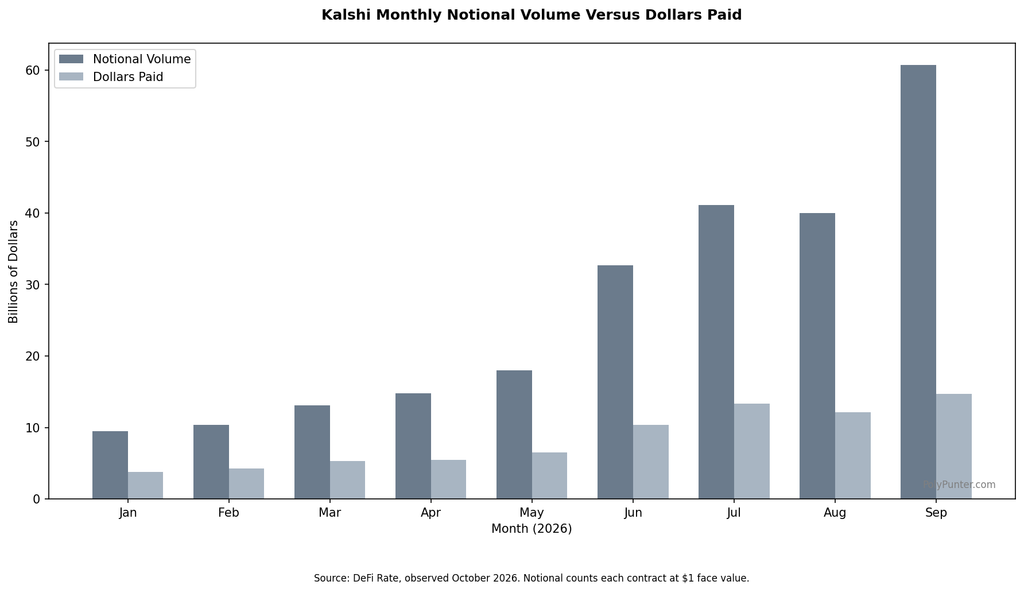
Despite the litigation, Kalshi has posted successive volume records through 2026. Weekly notional figures rose from the low teens of billions earlier in the year to peaks above $18 billion in early October. NFL games and related combo markets have driven much of the activity, with the platform capturing roughly 78 to 80 percent of reported prediction-market volume in recent weeks. Expansion into short-duration crypto and economic contracts has added more fee revenue, even as notional figures greatly outpace the cash actually transferred, the basis for Kalshi’s transaction-fee revenue model.
Kalshi’s approach preserves the environment producing high volumes while leaving open the chance that CFTC rulemaking or a favorable Supreme Court outcome locks in federal preemption. Opponents argue the same delay allows expansion of a product that states and tribes view as unlicensed gambling.
What Happens in the Near Future
The litigation will affect more than one company. Other platforms, including those backed by sports-betting operators like FanDuel and DraftKings, are watching closely. A Supreme Court decision affirming federal preemption would likely accelerate entry by well-funded competitors and add more contract listings. A decision favoring state authority would raise compliance costs, reduce post-tax revenues, and potentially shrink sports offerings. Tribal governments remain divided, with some pursuing partnerships and others challenging the contracts under the Indian Gaming Regulatory Act. Public surveys continue to show a strong majority of Americans view sports prediction markets as sports betting by another name.
Kalshi’s procedural steps have postponed a definitive Supreme Court confrontation until at least 2027. During that window, the company can keep listing contracts in all but a few states now, grow its user base, and benefit from refined CFTC rulemaking that may further support its arguments. The current Presidential administration clearly supports Kalshi, and its family members have direct financial relationships with Kalshi and other prediction market operators. For its part, Congress seems largely opposed to fully regulating prediction markets federally, especially sports and political markets. But it hasn’t organized enough to pass new legislation clarifying the existing CEA.
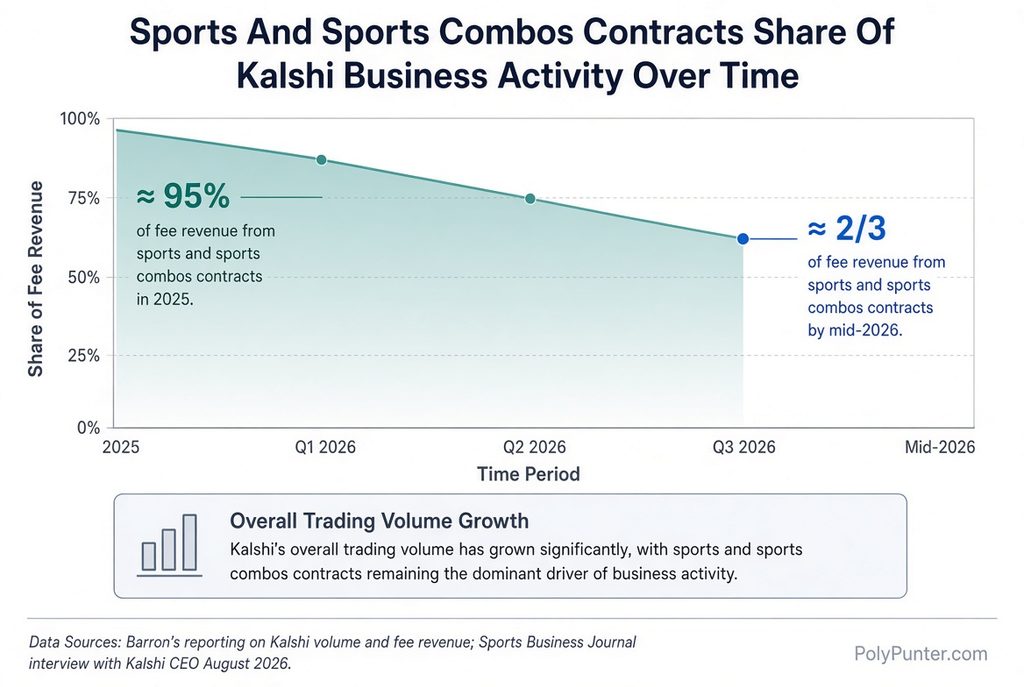
States and their allies, sportsbook operators and tribal nations with gaming interests, continue pressing for a quick review; additional circuit decisions could strengthen their case. Retail traders benefit from uninterrupted access for now, yet remain exposed if the legal outcome shifts. The industry is operating in a provisional state: ever-growing notional volumes, escalating company valuations in investor raises, near-daily almost daily announcements of new business, tech, and marketing partnerships with major firms, and growing political lobbying and donations, all while these major legal conflicts at the heart of 80% of Kalshi’s trading remain unanswered.
Whether the delay strengthens Kalshi’s position or merely postpones a difficult reckoning will become clearer in the months ahead.
References
- Kalshi in no rush for Supreme Court ruling in fight with states — Semafor, October 16, 2026.
- CFTC Seeks Public Comment on Notice of Proposed Rulemaking Concerning the Inclusion of Certain Event Contracts in the Definition of Swap — CFTC, October 9, 2026.
- Kalshi Volume: Daily, Weekly & Monthly Data Charts — DeFi Rate.
- Supreme Court Could Rule on Sports Prediction Markets by June ’27 — Covers, October 7, 2026.
- 39 States Urge Supreme Court To Review Kalshi Dispute — Gambling.com, October 8, 2026.
- NFL, 39 states urge Supreme Court to take up Kalshi case — SBC Americas, October 9, 2026.
- States Ask Supreme Court to Clarify Authority Over Prediction Markets — The State AG Report, October 15, 2026.
- Kalshi’s “Fake Volume” hides a real fee engine — DefiLlama, September 24, 2026.
- New Jersey Files Petition For Supreme Court To Consider Prediction Case — InGame, September 2, 2026.
- CFTC announcement of event-contracts proposed rulemaking — X post by @CFTC, October 9, 2026.