

Black swan events arrive suddenly and reshape systems in ways difficult to predict. Existential risks threaten humanity’s long-term survival, including unaligned artificial intelligence and abrupt climate shifts. Prediction markets attempt to assign tradable prices to these low-probability yet high-impact outcomes by allowing traders to buy and sell contracts that pay out based on real-world resolutions.
Traditional forecasting often treats such events as too remote to warrant serious attention. Equity markets do, of course, factor in calamitous events and their potential impact on businesses. But these are typically recurring natural disasters or manmade events such as floods during rainy seasons or brewing military conflicts. Prediction markets differ in that they attach direct financial consequences to accuracy about cataclysmic events that have never occurred before.
Yet serious questions remain about whether these markets can handle the demands of truly rare or poorly defined catastrophes. Liquidity often stays thin, and resolution criteria prove hard to set. Still, the cost of ignoring such risks entirely makes exploring these tools worthwhile.
Defining Black Swan Events and Existential Risks in Forecasting
Black swan events combine rarity with massive consequences and appear obvious only after they occur. They are, by their very definition, unpredictable. Existential risks go further, endangering humanity’s future potential through scenarios such as engineered pandemics, runaway artificial intelligence, and the singularity. These categories overlap when low-probability chains produce civilization-scale harm.
Forecasters using conventional models frequently assign near-zero odds because past data offers scant precedent. The result leaves societies underdiscussed and unprepared when extreme outcomes materialize. You might say that COVID was a good recent example of this.
Prediction markets impose a different discipline by requiring ongoing price discovery through active trading. We can imagine the Doomsday Clock, often reset to various times before midnight, to express a probability of global nuclear war based on changing threat levels. But the time is set by a small board of nuclear scientists, whose knowledge and expertise are fairly narrow and largely academic.
How Prediction Markets Incentivize Discovery on Rare Events
Traders on prediction markets stand to profit or lose based on the accuracy of their views. This direct stake motivates deeper research into obscure data and alternative scenarios. Prediction markets pull together dispersed knowledge more effectively than methods that rely solely on voluntary sharing or on opinions from experts or avid researchers within a single field.
The continuous trading format allows probabilities to adjust instantly rather than waiting for scheduled reports, such as the twice-a-year Doomsday Clock update. A single piece of new evidence can move prices dramatically within minutes. Such responsiveness gives decision makers timely signals that static or scheduled forecasts often miss.
However, this incentive system functions best when trading volume supports large positions without major price swings. Thin markets let individual bets distort signals or leave prices stuck. Building depth for tail-risk contracts (contracts that offset the odds of major asset repricing) therefore remains a central task for platform builders.
Limitations in Liquidity and Resolution for Tail Risks
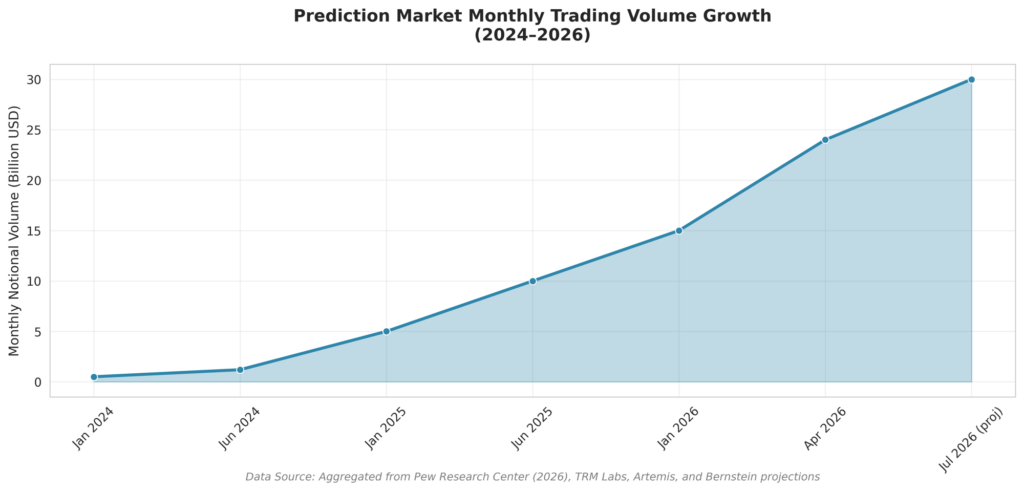
Contracts on events with probabilities below a few percent draw limited trading because potential payouts feel distant. Even at PolyPunter, we have cautioned traders generally against taking positions in such edge-case contracts. Traders naturally favor opportunities with clearer paths to resolution and higher activity. Prices for many existential scenarios therefore stay wide or illiquid for extended periods, muting their efficiency and accuracy.
Market makers face parallel disincentives when wide spreads are needed to hold risk over years. This environment reduces the very information flow that gives prediction markets their edge. Hybrid models that pair markets with scenario planning can help identify high-value contracts worth supporting. Building contracts around stepped-stages toward an existential threat may be a more practical model.
Resolution adds another layer of difficulty. Determining whether an existential event has occurred often involves subjective judgment or incomplete data. Oracle systems work well for verifiable milestones yet struggle when outcomes themselves alter the conditions for judgment. Clear advance rules and appeal processes reduce post-event disputes but cannot eliminate every ambiguity.
Examples from Pandemics, Artificial Intelligence, and Climate
Prediction platforms hosted contracts on disease outbreaks and laboratory-origin questions years before 2020. Trading reflected shifting beliefs as evidence grew rather than remaining fixed. These early markets showed that even low-probability health events can attract interest when clearly framed. As we learned during COVID, scores of sectors were drastically affected by the pandemic.
Similarly, platforms continue to offer contracts on artificial intelligence milestones such as whether an AI can generate a full high-quality movie from a prompt by early 2028. Activity around these questions reveals real-time views on both progress and associated dangers. Traders following technical developments move prices as new benchmarks emerge from labs. These are the stepping stones to larger questions about AI takeover and potential doomsday scenarios related to machine takeover of life-and-death decision-making, at scale.
Climate-related contracts tied to temperature thresholds or permafrost stability have also appeared. These markets require ongoing monitoring of scientific data as conditions change. Traders who track research contribute to price formation and keep attention on accelerating risks. These are natural offshoots of popular weather prediction markets, largely used as risk-hedging tools, but they provide contracts that correlate with existential matters such as global warming.
Behavioral and Structural Barriers to Effective Pricing
Psychological tendencies such as availability bias lead many to focus on recent or vivid events while downplaying abstract tail risks. Prediction markets push back against such biases by rewarding those who overcome them with profits. Financial consequences of disasters obviously supply stronger motivation than warnings alone.
Yet overconfidence can still lead to mispricing when few traders possess relevant specialized knowledge. Markets on obscure existential topics may therefore reflect a narrow set of views. Diversifying the pool of active traders helps broaden the information base and improves signal quality.
Efforts to lower entry barriers and provide clear explanations of contract mechanics should support wider engagement. These steps strengthen price discovery across a broader range of tail-risk topics without altering core incentive structures.
Ways to Strengthen Prediction Markets for Existential Risks
Platform operators can prioritize contracts on high-stakes scenarios even when early liquidity looks low. Partnerships with research groups should help identify the most policy-relevant questions worth pricing. Such collaboration links academic risk analysis to continuously updating market mechanisms.
Regulators can clarify rules on resolution and the use of information without creating unnecessary barriers. Clear guidelines reduce legal uncertainty that currently deters some market creators. Balanced oversight preserves the incentive properties that make these tools effective while addressing concerns about market manipulation for short-term profiteering.
As refinements accumulate, prediction markets can complement rather than replace other forecasting methods. Scenario exercises common in academia identify blind spots, while markets provide quantitative calibration over time. The combination gives society a more complete set of tools for confronting low-probability high-consequence futures.
Finally, as mentioned, platforms can offer stepping-stone markets toward these greater cataclysmic events. Building a logical chain of event contracts that serve as precursors to these existential events. For instance, Russia attacking NATO or deploying a tactical nuclear weapon in its war in Eastern Europe would be a market that ties into a forecast of a multinational nuclear conflict and potential for actual Doomsday.
The Enduring Value of Prediction Markets Despite Their Limitations
No single forecasting method achieves perfection when facing events outside historical experience, such as black swan events like COVID. Prediction markets nevertheless deliver transparent ongoing probabilities that force direct engagement with uncomfortable possibilities. This transparency marks progress over approaches that quietly assign zero weight to tail outcomes.
Traders betting on these contracts perform a public service by revealing where collective knowledge stands at any moment. Price movements communicate shifts faster and more continuously than periodic reports from traditional institutions. Yet realizing fuller potential requires deliberate work on liquidity, resolution, and contract design. Ignoring these practical issues risks leaving important risks underpriced. Investing effort in refinements now will determine whether prediction markets mature into reliable instruments for assessing existential risk.
References
- Polymarket official platform examples of contracts on AI capabilities and related events
- Research paper examining informational value of event contract prices
- CNBC reporting on prediction market developments and related risks
- Stanford Law analysis of surging prediction market activity and regulatory context
- Congressional Research Service report on prediction market policy issues
- SSRN repository of academic studies on prediction market performance
- Nassim Taleb resources on black swan concepts and tail risks
- Commodity Futures Trading Commission materials on event contracts and oversight
- Analysis of prediction market category growth including non-sports segments
- Pew Research Center data on prediction market trading volume trends
- Sidley legal analysis of prediction market compliance considerations
- TRM Labs report on prediction market volume scaling