

This is more of a hypothesis than a statement. But the existence of sports prediction market contracts, which some call sports betting, may be a business hit for the major prediction markets, but it may also be their fundamental undoing. Not simply as a legal matter and the ongoing battles with states, but as an underpinning for their very value proposition: superior forecasting.
Prediction markets offer the promise of powerful consensus engines for uncovering truth. Traders stake money on forecasts of future events, and the resulting prices reflect collective wisdom, more accurate than any polls, surveys, or pundits. Yet a rapid shift toward sports betting contracts now threatens to undermine that core strength. Volumes have exploded, but the focus on sporting event outcomes risks turning these platforms into sophisticated entertainment venues rather than reliable forecasting tools.
This sports-event dominance brings in large sums of money and excitement while diverting attention from markets for elections, policy outcomes, and scientific questions: contracts with broader societal benefits. The result could erode what made prediction markets special.
Explosive Growth Driven by Sports Contracts
Trading activity across major prediction market platforms has surged in recent years. Overall volumes reached $64 billion in 2025 and are now on track to exceed an amazing $325 billion in 2026. At least one sector analyst suggests $1 trillion in volume by 2030. Meanwhile, sports events account for the bulk of this expansion on the largest regulated exchange, Kalshi.
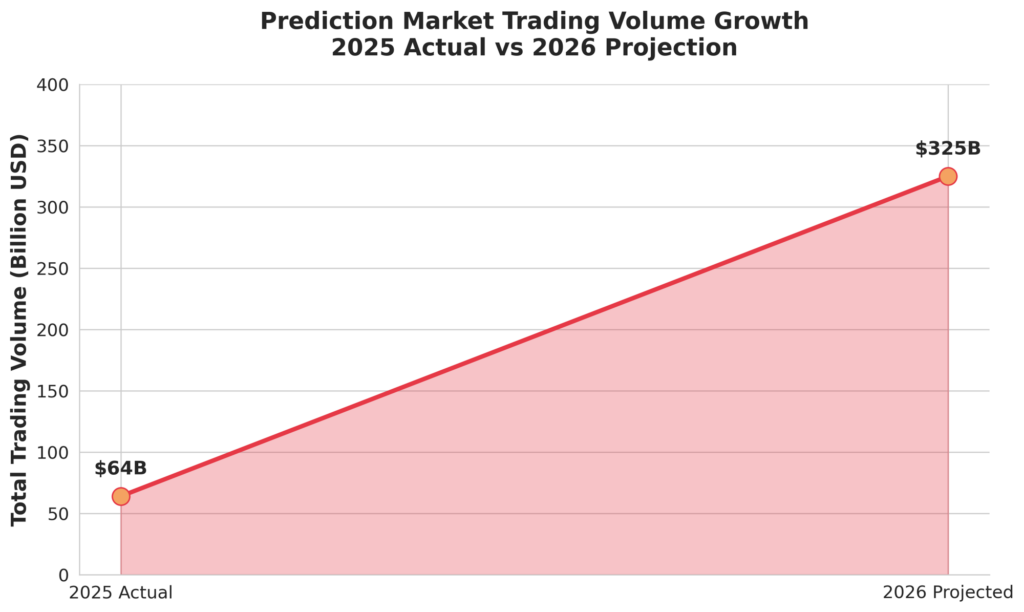
Data from platform trackers show that Kalshi handled roughly $9.5 billion in a recent month, with sports contracts representing about 90 percent of its notional volume. Polymarket shows a similar though less extreme pattern, with sports rising alongside politics and crypto. This pattern emerges clearly in recent trading breakdowns.

These numbers highlight how sports now drive the business. Platforms earn fees on every trade, so higher-volume categories receive more promotion. That’s basic business. Sports events happen around the clock, especially if you’re considering international ones, creating constant opportunities for new contracts and increased volume.
The Original Vision of Prediction Markets
Prediction markets work by allowing people with skin in the game to freely buy and sell “probabilities” for event outcomes. When many independent views come together, crowd wisdom often provides a superior estimate of probability compared with traditional means such as polling. This mechanism draws from theories about dispersed knowledge and the power of incentives to reveal accurate information.
Early prediction markets were based on academic projects, such as the Iowa Electronics Market (IEM), and focused on elections and policy questions. Prices were adjusted in real time based on probabilities as new facts and information emerged. The results often outperformed traditional surveys. The mechanism rewarded those who gathered and processed accurate information effectively; therefore, it drove greater accuracy.
Researchers tracking these systems have long noted their edge in aggregating insights across complex topics. The design encourages careful thinking because wrong bets cost real resources. This setup differs sharply from casual personal commentary or opinion polling, which tends to drive much of the narrative on these topics.
However, the explosion in volume due to the introduction of sports event contracts changes the picture. Daily sports contracts now flood the interface, capturing most trading activity. Serious markets on longer-term events receive comparatively less attention. Less attention means lower volume, fewer independent traders, and lower accuracy.
How Sports Focus Changes Market Dynamics
By its very nature, and as studied over long periods, sports betting attracts users who enjoy quick resolutions and familiar outcomes. Sporting event predictions end within hours or days and deliver fast payouts. This pace suits entertainment and, as some will note, gambling addiction, but offers limited value for building a deeper understanding of uncertain futures.
Markets on topics such as elections, oil futures, or climate policy require sustained research and patience. Those contracts resolve over weeks or months and demand ongoing, continuous information gathering and position updates that readjust market pricing. When sports dominate the platform, fewer resources flow toward developing rich markets on weightier subjects.
In addition, precision on prop bets like player stats creates opportunities for specialized knowledge that may not translate to broader forecasting skills. Yet the bigger issue lies in opportunity cost. Every hour spent analyzing a basketball game represents time not spent on economic indicators or geopolitical developments. Over time, this shift trains traders and platforms alike to prioritize volume over informational depth.
Now, one might postulate that sports event contracts merely capture a crowd intent only on sports forecasting or betting, and who would never add their skills or voices to other topics. So it’s not really affecting trading volume or the resources allocated to the more serious markets. Which may be at least somewhat accurate, numbers-wise; it misses the marketing, product development, and internal resources that platforms like Kalshi itself put into sports event contracts that could otherwise be going toward these other markets. Not surprising given the relatively young company’s desire for revenue, but still a material impact.
Evidence of Eroding Forecasting Strength
Academics and long-time market observers have begun expressing concern about this direction. In discussions about the current boom, some who helped shape early prediction-market thinking now worry that mainstream adoption dilutes the focus on collective knowledge. Wider adoption brings more casual activity but risks weakening the signal on important questions.
Platform incentives reinforce the pattern. Fee structures reward platforms that maximize raw trading activity, and sports deliver that volume in abundance. Developers respond by creating more sports contracts and aggressively marketing them. Consequently, the overall mix of available markets tilts away from topics where accurate forecasts could influence real-world decisions. No offense to World Cup match outcomes.
Platform Economics Fuel the Sports Emphasis
Operating a prediction market platform involves high costs for compliance, technology, and market making. High-volume categories help cover these expenses through transaction fees. Sports events provide reliable recurring volume that keeps the engines turning. These are for-profit businesses, unlike outlets like IEM, which serve academic interests.
Executives at leading platforms have every incentive to lean into what works. Compared to more complex policy markets, sports contracts require less customization, simpler, clearer resolutions, and already have a massive base of interested, current traders and bettors. They appeal to the millions of people already comfortable with betting apps.
However, this business logic carries a hidden cost. Markets on more critical issues may suffer from lower liquidity and slower price discovery. Traders with valuable information about policy or technology trends find fewer attractive outlets when sports dominate the menu.
When prediction markets tilt heavily toward sports and entertainment, society misses chances to improve forecasts on topics that affect daily life and long-term planning. Economic indicators and regulatory outcomes benefit from aggregated incentivized views. Sports dominance crowds these out. New users entering the space first encounter an environment built around recreational topics. This first impression can shape expectations and reduce interest in using the same tools for serious inquiry later. Imagine hosting an economic conference on the floor of a Vegas casino.
Paths Forward to Reclaim Forecasting Value
Platforms could experiment with features that highlight non-sports markets or allocate resources to improve liquidity in those markets. Better interfaces for discovering policy or science contracts might draw more thoughtful trading activity without eliminating popular sports options. A broader solution could be to spin off the sports markets altogether into a separate platform, though, given the current dominance of sports across Kalshi, it may be more of a blow to the non-sports-related markets than a help, at least initially.
Traders themselves hold power through where they place bets and attention. Supporting markets during meaningful events signals that accuracy on important topics retains value. Over time, such choices could influence platform priorities. Kalshi could modify fee structures to encourage deeper dives into its currently more niche contract areas, creating incentives and promotions to expand interest in these markets.
Nevertheless, the current trajectory only shows sports continuing to expand its share. Without deliberate efforts to protect space for high-stakes forecasting, the informational promise of these markets may continue fading.
Prediction markets sit at an interesting crossroads. Their rapid commercialization brings scale and visibility that earlier versions lacked. At the same time, the sports-betting emphasis risks reducing a promising mechanism to another form of entertainment consumption. Nothing wrong with entertainment consumption, but it could be argued that we already have nearly unlimited outlets for that interest.
In the end, the sports betting takeover does not destroy prediction markets overnight. Instead, it gradually redirects their energy toward areas where the societal return on accurate prediction stays lower. Preserving room for markets that tackle harder questions could help retain the distinctive value these systems once promised.
References
- From Opinions to Odds: Emerging Trends in the Prediction Market Landscape (FalconX, February 2026)
- Prediction Markets are Surging – Here’s What You Need to Know (Stanford Law School, April 2026)
- Prediction Market Theorists Question Kalshi, Polymarket Boom (Bloomberg Businessweek, July 2026)
- Prediction Markets: New Players, New Rules | Future of Finance 2026 (Milken Institute)
- Prediction Markets: Policy Issues for Congress (Congressional Research Service, March 2026)
- Paradigm Prediction Markets Data Tracker