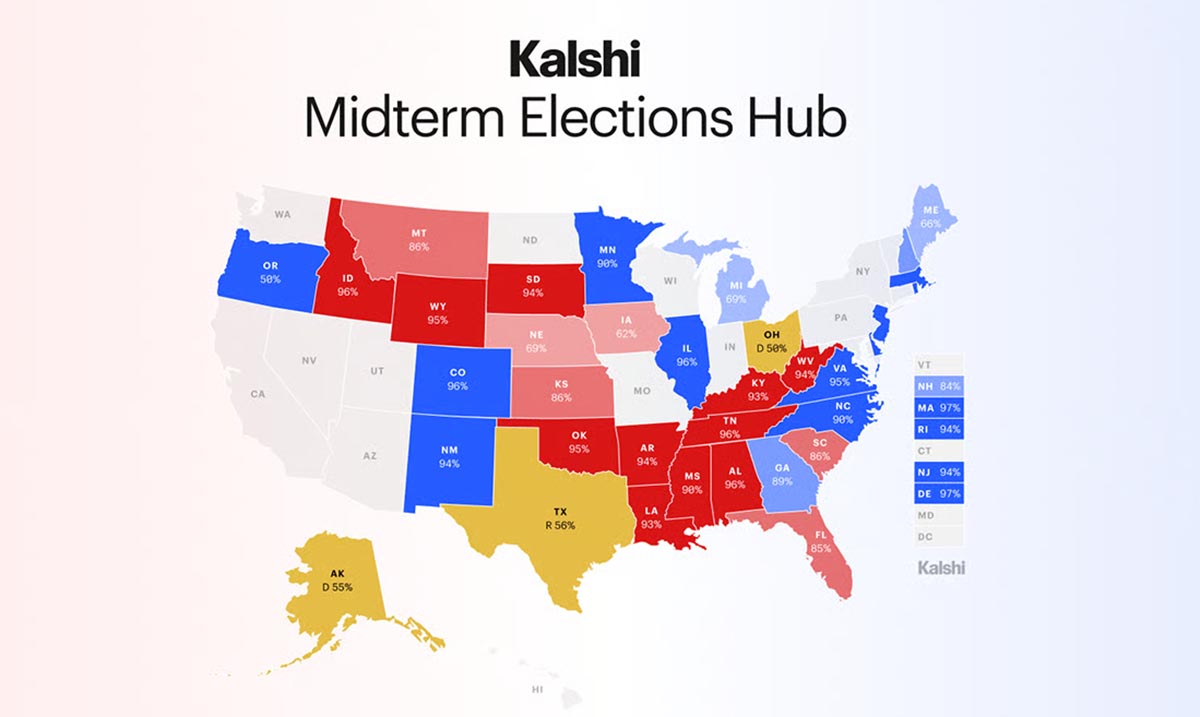
Trading volumes have exploded in recent weeks in U.S. midterm election markets as savvy bettors and partisan political types pile into contracts, with millions flowing into markets forecasting which party will seize the Senate, House, and key state governorships. For many people, General Elections are their sports and midterms, well, close enough to their Super Bowl.
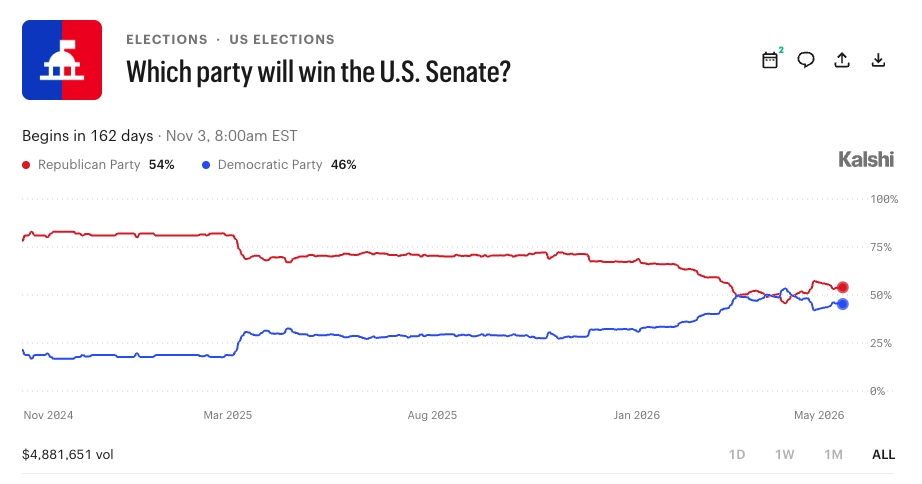
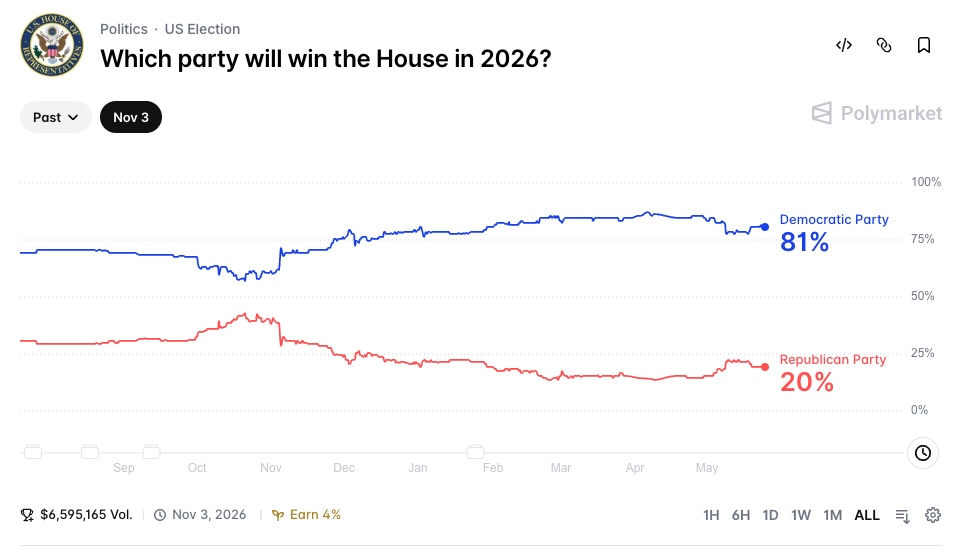
Traders currently appear convinced that historical midterm dynamics, which suggest the party in the White House loses seats in Congress, could dramatically reshape Washington’s power structures by November 2026. While Republicans hold a slight edge in prediction markets for Senate retention, Democratic prospects for flipping the House stand out as particularly strong.
Republicans Maintain Narrow Favorite Status for Senate Control
As of today, prediction markets currently price Republicans at around 52% to keep the Senate majority after the 2026 midterms. Traders are watching midterms closely, with 33 Senate seats up for grabs, and several highly competitive races that could swing the chamber. As trading activity intensifies, subtle shifts in probabilities reflect evolving views on candidate matchups and national mood. View the live Senate control market here.
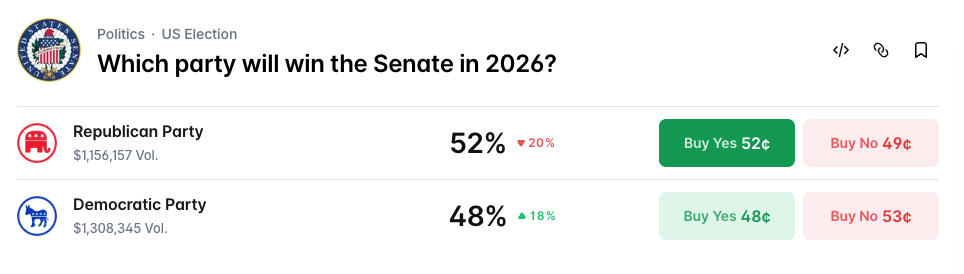
Markets on exact seat counts add nuanced contracts for more serious traders to consider. For instance, the chance of Senate Republicans holding 47 or fewer seats trades around 26%, while exactly 50 seats sits near 17%. These granular contracts let traders hedge specific outcomes that could determine majority control, especially with potential tiebreakers (e.g., U.S. Vice President votes) in play.
Volumes on Senate-related markets have already reached several million, signaling deep engagement, with over five months before the General Election. Check Kalshi Senate winner odds.
Democrats Dominate House Control Markets With Strong Probability
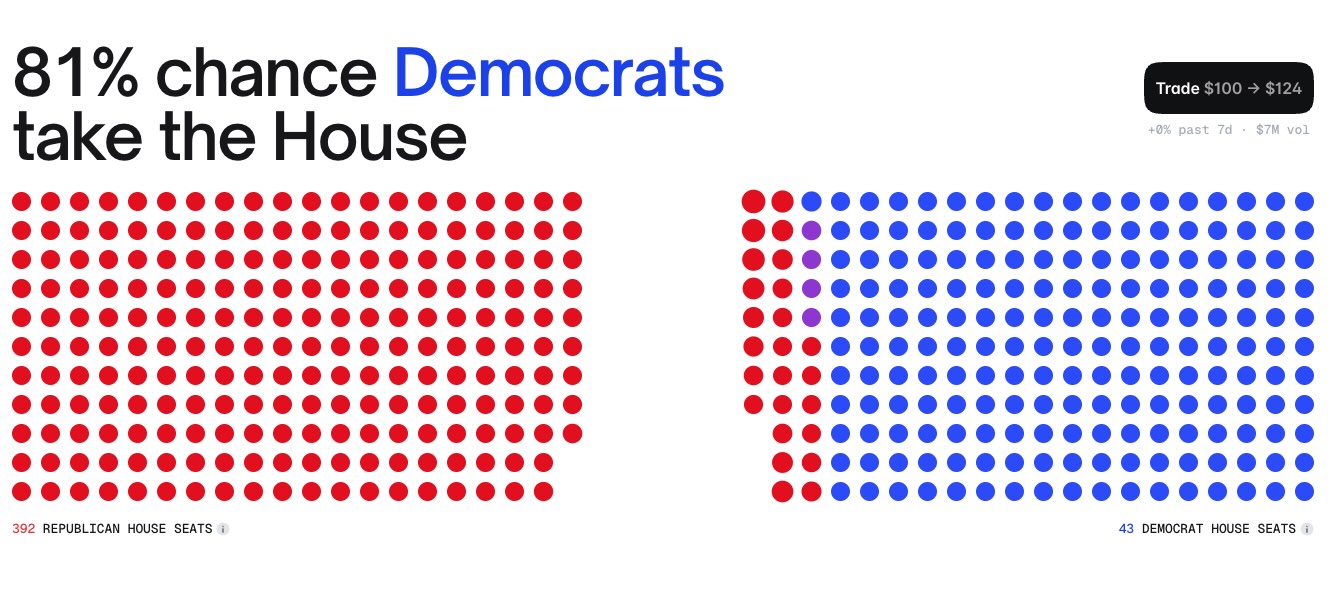
Democrats command a notable 81% implied probability of taking the House in 2026, according to leading platforms, a figure that has climbed steadily amid ongoing national sentiment trends and published polling.
With all 435 House seats contested, traders are betting heavily on a Democratic wave that could deliver the chamber by a reasonably comfortable margin. This outlook aligns with traditional midterm patterns, in which the President’s party often loses seats. And with the margin of Republican Party control in the House already very slim, traders are seeing party-control swap as a highly likely scenario. See current House control probabilities.
House popular-vote margin markets and individual district contracts further illustrate traders’ lean toward at least a small Blue Wave. Explore the Kalshi House winner market.
Balance of Power Scenarios Heat Up Trading Activity
| Scenario | Current Probability | Trading Volume |
|---|---|---|
| Democrats Sweep (D Senate, D House) | 46% | $1.84M |
| R Senate, D House | 33% | $1.40M |
| Republicans Sweep (R Senate, R House) | 19% | $1.41M |
| D Senate, R House | 2% | $1.07M |
This table captures the leading balance-of-power outcomes as of late May 2026, with total volume exceeding $7 million on Polymarket’s balance-of-power market. Democrats sweeping both chambers leads the field, though a split with Republicans holding the Senate remains a popular secondary bet. These figures evolve rapidly as new polling data and campaign developments emerge. View Kalshi’s balance of power combo.
California Governor Race Draws Massive Volume as Key State Battle Looms
California’s gubernatorial contest has generated over $25 million in trading volume, making it the hottest gubernatorial market nationwide. Current odds favor Xavier Becerra at approximately 62% to win the election, with Tom Steyer trailing at around 25% and the Republican candidate trailing at 9%.
However, California holds a “jungle primary” in which voting is not party-based, and the top two vote-getters advance to the General Election. In that regard, Steve Hilton is predicted to be one of the top two to advance, at which point any of the Democratic choices will be the clear favorite. Track California governor markets live.
High liquidity in these markets allows large positions to be entered and exited with relative ease. See Kalshi California governor odds.
Broader Governor Races Reflect National Trends
Several other gubernatorial contests feature notable activity, including open seats and incumbent defenses that could tip numerous states to opposing parties. Prediction markets are pricing various Democratic candidates favorably in select battlegrounds, though volumes remain lower than in California.
Because gubernatorial outcomes can ultimately affect redistricting, policy implementation, and future presidential positioning, holistic market traders treat them as interconnected pieces of the larger midterm puzzle. Shifting probabilities here frequently correlate with congressional market movements.
This is why we say here at Polymarket, if you’re just in/following one market in a sector, you’re not really trading smartly.
This video explores detailed mapping and forecasting for the 2026 Senate races, offering visual context on competitive districts and potential flips.
References
- Polymarket 2026 Midterms Predictions
- Polymarket Senate Control Market
- Polymarket House Control Market
- Polymarket Balance of Power Market
- Polymarket California Governor Markets
- Kalshi Senate Winner Market
- Kalshi House Winner Market
- Kalshi Congress Balance of Power
- Kalshi California Governor Race
- 2026 Midterms Prediction Map Video
- Economist 2026 Midterm Model Video