
The reasons why prediction markets tend to forecast political outcomes better than traditional polling are varied and complex. The most obvious being that pollsters are asking you who you support as a candidate, not which candidate you believe is going to win. Think about the variance between those two questions. The former invites you to answer based on partisan political support. There may even be elements of social stigma related to declaring your support for an unpopular candidate. Yet another variable. In contrast, the prediction market asks you who you think is going to win. It’s not asking you to be a poll respondent, but rather the author of the prospective results. Completely different process.
The second reinforcer of honest evaluation is staking money. Adding personal bias to your forecasts costs you nothing in an informal setting. Declaring in 2024, you thought Trump (or Harris) would win, costs you nothing to be wrong. It’s flippant. An empty gesture. No skin in the game prediction. Now add money. People take money very seriously. It’s a signal to the market, and to your wallet, that things just got serious. Bet “next beer” on a sporting event outcome, and it’s all fun and games. Bet $100, and suddenly you are thinking with your analytical brain, not your heart. Prediction markets are the wisdom of crowds, and now everyone in the crowd has money on the line. It’s serious.
That all being said, one wonders, as with sports betting, how much homerism or partisan wishing plays a role in users buying contracts on prediction markets like Kalshi on deeply “cable TV news” level political issues. Take, for instance, the predictive question:
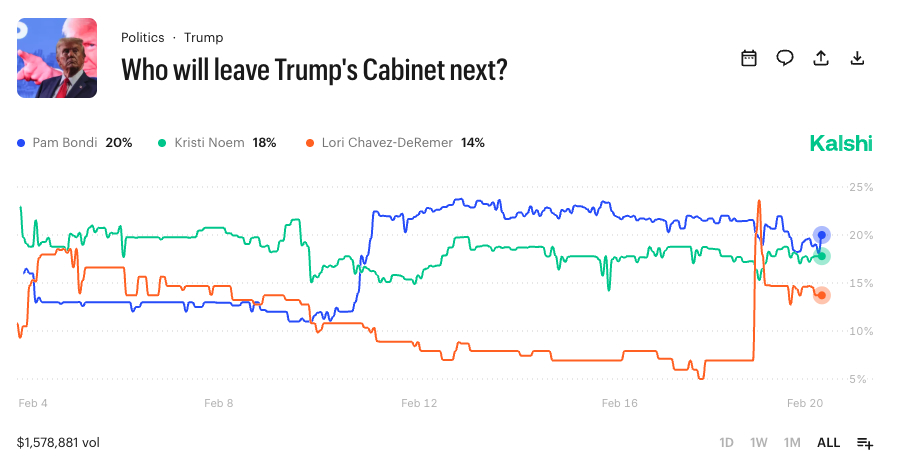
“Who will leave Trump’s Cabinet next?”
When I think about a rational evaluation of a prediction market, I think first and foremost, why was this question asked?
Questions on Kalshi and other prediction market platforms are created by the staff. They often solicit recommendations from the user base, but imagine that user-generated questions are really more of a way to generate interactivity and user interest than an operational need. The business goal of these platforms is to generate volume. Like any marketplace, the more trading that occurs, the more accurate the pricing, the more robust the analysis that drives that pricing, and ultimately, the more revenue is raked in by the platform.
But there is a secondary goal with Kalshi, as with its competitors. They want to build a broader user base.
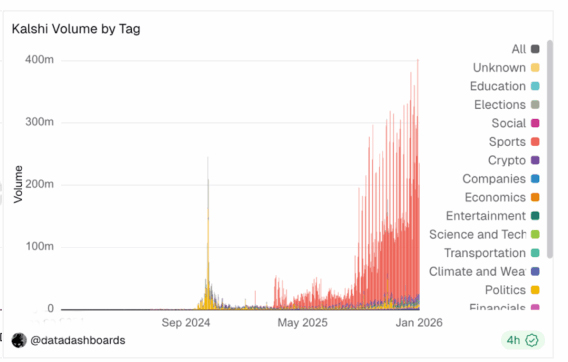
Sports are by far the most compelling contract event category for the Kalshi prediction markets. It accounts for up to 90% of prediction market activity, depending on your source. Politics is second. With major political events drawing a massive volume in certain markets. Now, Kalshi and others are adding culture, entertainment, and more whimsical categories of markets to expand their user base. Search “Taylor Swift” on Kalshi and prepare for an endless list of market questions regarding Taylor Swift, either as the subject matter or a leading prediction option. Now, guess what Taylor Swift and the Super Bowl combined is for the demographic that watches cable TV news nightly? Tabloid-level politics. Add in anything “Trump,” and now you have immediate, native, and strong interest.
“Who will leave Trump’s Cabinet next?” offers up a list of what you might consider the second tier of Trump cabinet officials, most of whom are not the least bit known by most people who aren’t avid political new junkies. Noem, Lutnick, Chavez-DeRemer, Bondi, Greer, and many more have had money put into their markets.
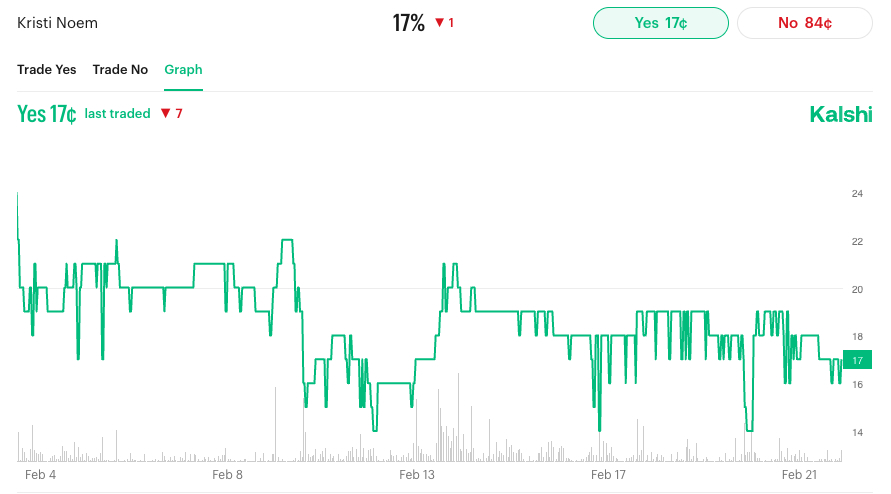
Viewing the timeline, you see spikes and drops, noting the high volatility in this event, largely tied to daily news events and likely the target of derision on one or more political news channels. This might make you wonder about the seriousness of the analysis in this now nearly $1.6 million volume event. It really should. Most of the more pop-culture or lighthearted events on these platforms have lower volume. Those aforementioned Taylor Swift markets, plentiful as they are, are largely tiny in contract volume. A few thousand dollars. Not $1.6 million.
Is that low-hanging fruit for opportunistic forecasters?
You’d think. But maybe you should rethink. Because this is some madness, imagine in your purely analytical, non-political, objective mind who Trump may ask to leave his cabinet. There are no firings, and voluntary departures typically happen after the halfway point of the terms, the midterms. Now you’re both imagining not only who might do what that would cause a layoff — as speculators are doing in this market along news event points — ICE tragedies may fall on Noem, Lutnick’s name comes out in the Epstein files, etc. — and now remind yourself, who decides on how to respond to these events? It’s not Hannity or Maddow. It’s not necessarily even rational management actors. It’s Trump and Trump alone. You’ve not only added a forecasting variable layer in the most unpredictable Chief Executive in our nation’s history. This is inherently irrational actor gaming. But there’s $1.6 million in this irrational game.
As we move along in this process, I will occasionally give personal recommendations on specific prediction market events. Others on this site may do so as well. But more important than the prediction is the thinking behind it. This was true in sports betting with learning the decision algorithms of the sharks, as it is in prediction markets, breaking down the basic analysis of which markets might be more or less attractive to even engage in the first place. It’s going to be a wild ride.