Is there sports betting on prediction markets? Absolutely, yes. Platforms like Kalshi and Polymarket have revolutionized how people wager on sports outcomes, blending financial trading with event forecasting. Unlike traditional sportsbooks such as DraftKings or FanDuel, these prediction markets allow users to trade contracts based on real-world events, including NBA games, Super Bowl winners, and Olympic medal counts. This article explores the intricacies of sports betting on these platforms, how it functions, its distinctions from conventional betting, the swirling legal debates, and its profound effects on the broader sports betting ecosystem.
Prediction markets operate as exchange-traded platforms where participants buy and sell “event contracts”—binary options that pay out based on whether an event occurs (yes/no). For sports, this means betting on outcomes like “Will the Patriots win the Super Bowl?” with contract prices reflecting market-implied probabilities. As of 2026, these markets have seen explosive growth, with Kalshi reporting over $10 billion in monthly trading volume, much of it from sports. This surge has drawn both enthusiasm and scrutiny, positioning prediction markets as both innovators and disruptors.
We’ll define key terms—such as “market makers” (entities that provide liquidity by quoting buy/sell prices)—to ensure clarity for newcomers. By the end, you’ll understand why these platforms are gaining traction and the challenges they face. Whether you’re a sports fan, bettor, or industry observer, this guide provides a balanced view of this emerging phenomenon.
What Are Prediction Markets?
Prediction markets are financial exchanges where users trade contracts on the outcomes of future events, aggregating collective knowledge to form probabilities. Unlike stock markets, which trade company shares, prediction markets focus on events, with sports being a major category. Platforms like Kalshi and Polymarket facilitate this by allowing users to buy “yes” or “no” shares, priced between $0 and $1, where the price indicates the market’s perceived likelihood.
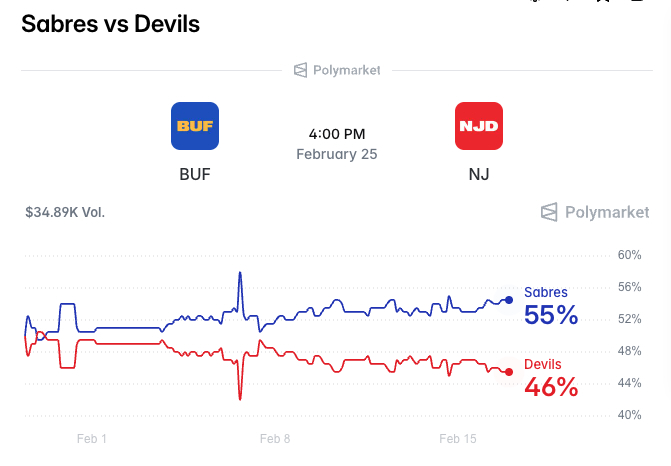
For instance, if a contract on “Will the Chiefs win Super Bowl LX?” trades at $0.65, it implies a 65% chance of victory. If the event happens, “yes” holders receive $1 per share; otherwise, $0. This structure incentivizes informed trading, as accurate predictions yield profits.
Kalshi, regulated by the U.S. Commodity Futures Trading Commission (CFTC), offers U.S.-focused markets, including sports like NBA spreads and Olympic hockey. Polymarket, initially crypto-based and now relaunching in the U.S., covers global events, from UEFA Champions League winners to NBA MVPs. Both platforms have seen sports dominate volumes—85% on Kalshi and 39% on Polymarket (expected to rise).
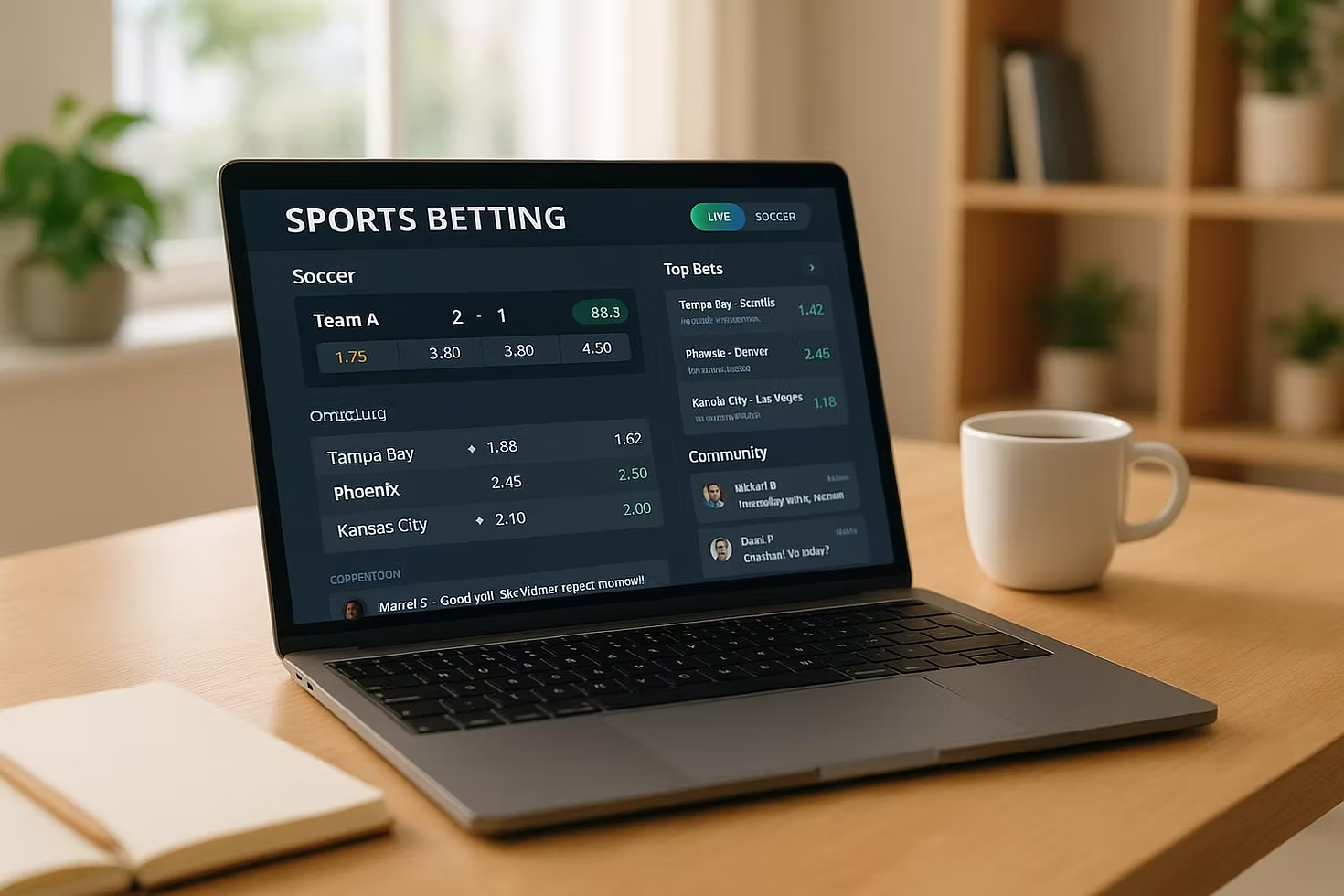
This image shows a typical prediction market interface for sports betting on Polymarket, highlighting live odds and trading options.
Historical Context
Prediction markets trace back to the 1980s with academic experiments like the Iowa Electronic Markets, but sports integration surged post-2018’s PASPA repeal, legalizing sports betting in many states. Kalshi launched in 2021 as a CFTC-regulated exchange, while Polymarket, founded in 2020, faced a 2022 U.S. ban but relaunched in 2025. By 2026, sports betting on these platforms will have become a multibillion-dollar niche, challenging traditional models.
How Sports Betting Works on Kalshi and Polymarket
On Kalshi and Polymarket, sports betting involves trading event contracts rather than placing fixed-odds wagers. Users deposit funds (USD on Kalshi, crypto on Polymarket), browse markets, and buy/sell shares. Liquidity is provided by market makers—algorithms or firms quoting prices to facilitate trades.
For example, on Kalshi, you might trade a contract on “Will the Lakers cover the spread vs. Clippers?” Buying “yes” at $0.50 means risking $0.50 per share for a potential $0.50 profit if correct. Trades can be held until resolution or sold earlier for gains/losses based on price fluctuations.
Polymarket operates similarly but with blockchain settlement, offering markets like “Who will win the 2026 NBA Championship?” with high volumes on events like the Super Bowl. Both platforms feature leaderboards, real-time updates, and tools for tracking positions.
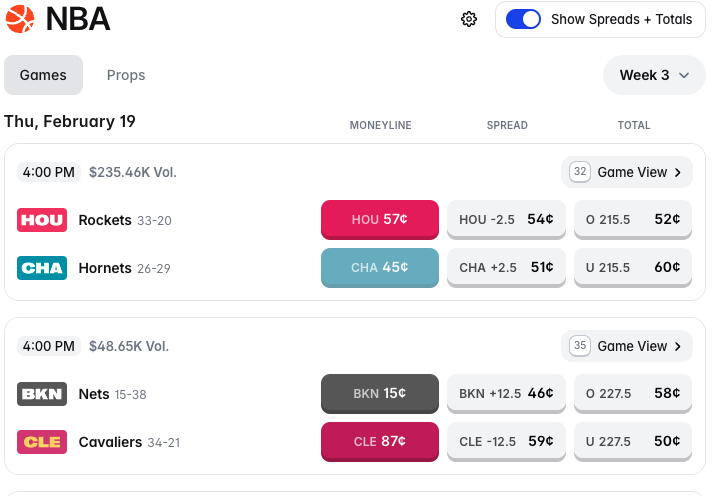
This screenshot depicts Polymarket’s sports betting interface, showing various markets and probabilities.
Step-by-Step Process
- Sign Up and Fund Account: Create an account, verify identity (KYC on Kalshi), and deposit funds.
- Browse Markets: Filter for sports categories, e.g., NBA, NFL, Olympics.
- Analyze and Trade: Review probabilities, volumes, and trade history before buying/selling.
- Resolution: Markets settle based on official sources; winners receive payouts minus fees (e.g., 2% on Polymarket wins).
Risks include volatility and potential losses, but the peer-to-peer nature often yields better odds than sportsbooks.
Differences from Traditional Sports Betting
Traditional sports betting involves wagering against a bookmaker (the “house”) with fixed odds, while prediction markets are peer-to-peer exchanges where users trade with each other, setting prices dynamically. This fundamental shift creates several key differences.
| Fixed bets; parlays are common but risky | Prediction Markets (Kalshi, Polymarket) | Traditional Sports Betting (DraftKings, FanDuel) |
|---|---|---|
| Structure | Peer-to-peer trading; no house edge | Bet against bookmaker with built-in vig (margin) |
| Pricing | Dynamic probabilities (0-100); crowd-driven | Fixed odds set by oddsmakers |
| Availability | Nationwide (federal regulation); accessible in non-gambling states | State-regulated; limited to 39 states + D.C. |
| Markets | Beyond sports: politics, weather, entertainment | Primarily sports-focused |
| Fees | Low (e.g., 2% on wins); no vig | Higher vig (4-10%) |
| Risk/Reward | Trade anytime; potential for hedging | Fixed bets; parlays common but risky |
This chart compares trading volumes across categories on prediction markets, showing sports’ dominance.
Prediction markets emphasize information aggregation for better forecasts, while traditional betting prioritizes entertainment with house advantages. However, critics argue that prediction markets are essentially unregulated sportsbooks.
Legal Controversies
The rise of sports betting on prediction markets has ignited fierce legal battles, primarily over whether they constitute gambling subject to state laws or federally regulated derivatives. Kalshi and Polymarket claim CFTC oversight exempts them from state gambling regulations, allowing nationwide access—even in states like California and Texas where sports betting is illegal.
States disagree, viewing these as disguised sportsbooks. Massachusetts banned Kalshi’s sports markets, leading to lawsuits. Nevada obtained a restraining order against Polymarket. New York AG warned of risks like insider trading. Over 20 lawsuits in seven states challenge these platforms.
Insider trading concerns arise, as seen in Polymarket’s $400,000 Maduro bet. Tribal gaming interests claim prediction markets undermine their compacts. Courts have issued mixed rulings, with some favoring states and others platforms. The CFTC supports prediction markets, but state pushback could escalate to the Supreme Court.
Key Cases
- Massachusetts vs. Kalshi/Polymarket: Bans and lawsuits over state overreach.
- Nevada Injunctions: Halting sports contracts.
- New York Cease-and-Desist: Against Kalshi.
These controversies highlight tensions between innovation and regulation, with potential for federal clarification.
Impact on the Overall Sports Betting Market
Prediction markets are disrupting the $16 billion U.S. sports betting industry, siphoning billions in wagers—estimated at $8 billion annually—from traditional sportsbooks. Stocks like Flutter (FanDuel) have declined amid competition, with analysts predicting a 2% drop in Super Bowl handle due to platforms like Kalshi.
Traditional operators are responding by launching their own prediction apps—DraftKings Predictions, FanDuel Predicts—to recapture market share. This hybrid approach blurs lines, but prediction markets’ nationwide access gives them an edge in untapped states.
This chart illustrates U.S. gaming revenue trends, showing online sports betting’s growth amid prediction market competition.
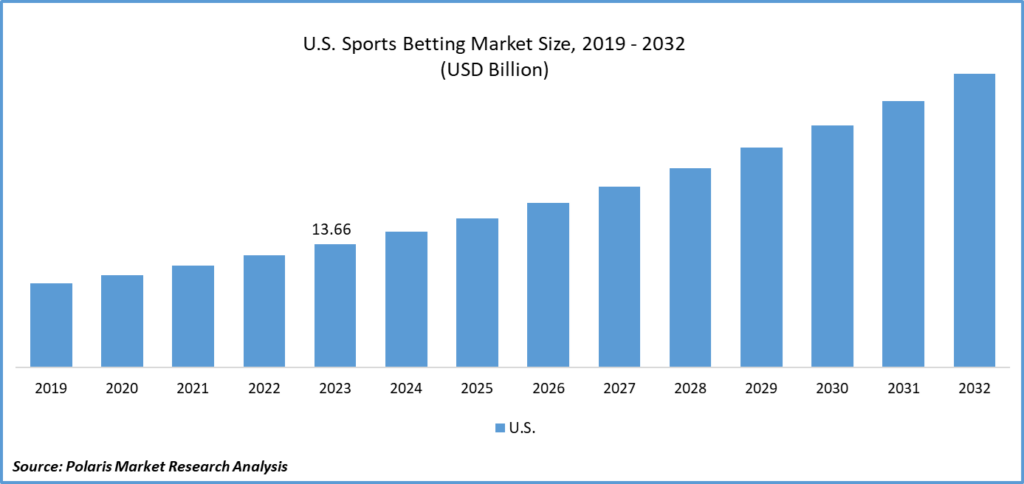
Positive impacts include better odds, transparency, and fan engagement. However, risks like addiction and insider trading loom, prompting calls for regulation. Tribal gaming faces threats, potentially undermining sovereignty. Overall, prediction markets could grow to $10 billion by 2030, reshaping the industry.
Future Implications
As legal battles unfold, prediction markets may integrate more with finance, but stricter rules could curb growth. For sports betting, this means innovation but also competition, benefiting consumers with choices while challenging incumbents.
Conclusion
Sports betting on prediction markets like Kalshi and Polymarket represents a paradigm shift, offering dynamic, peer-driven wagering that’s accessible nationwide. While differing from traditional betting in structure and regulation, it faces significant legal hurdles and is reshaping the industry by diverting volumes and spurring adaptations. As debates continue, these platforms highlight the fine line between forecasting and gambling, with profound implications for bettors, regulators, and the market at large.

The PolyPunter staff works tirelessly to bring you the latest and most insightful news, information, and tips on the fast-growing economic, financial, and social phenomenon that is prediction markets.


