As the 2026 California gubernatorial election approaches, with the primary set for June 2 and the general election on November 3, prediction markets are buzzing with activity. This race to succeed term-limited Governor Gavin Newsom in the Golden State has drawn a crowded field of candidates from Los Angeles, San Francisco, and beyond. Leading the pack in market odds is Democratic Congressman Eric Swalwell, whose odds hover around 50-56% across platforms like PredictIt, Polymarket, and Kalshi.
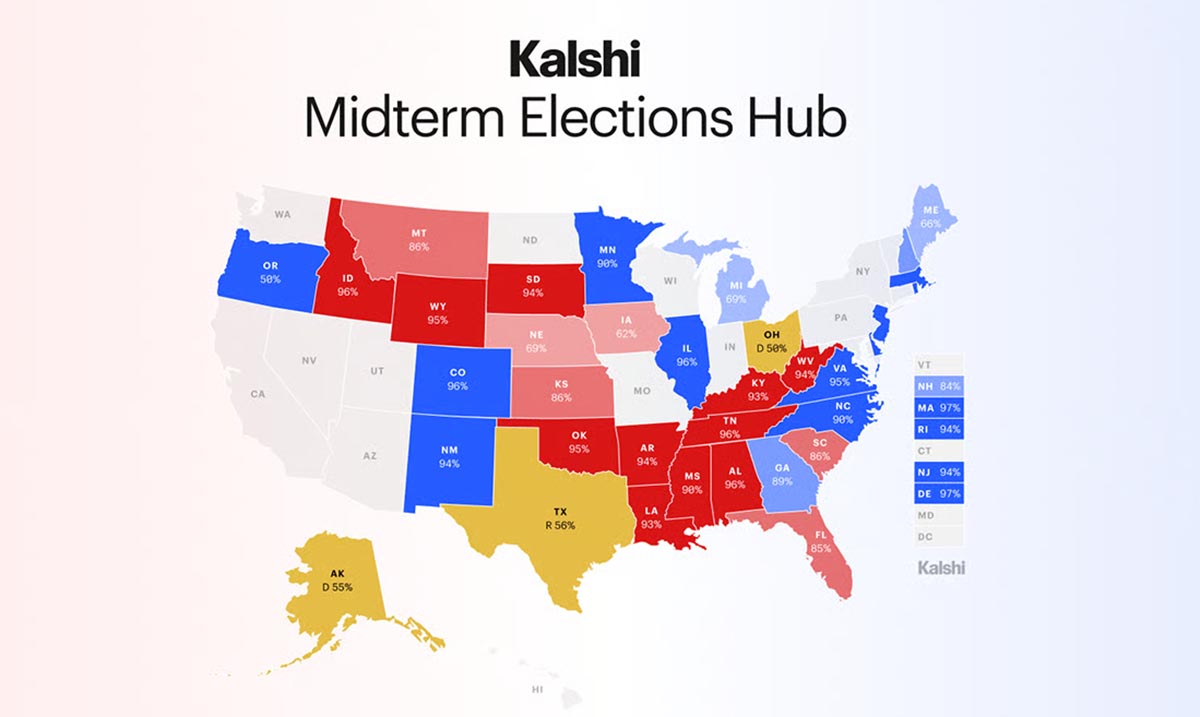
With California’s unique top-two primary system, where the two highest vote-getters advance regardless of party, speculation is rife about potential Republican advances in a state dominated by Democrats. Markets reflect this uncertainty, pricing Democrats at 87-94% to win the governorship overall, but individual candidate odds show a fragmented Democratic field splitting votes.
Basics of PredictIt.org
PredictIt.org is a prominent platform for trading on political outcomes, operating as a non-profit research project under the auspices of Victoria University of Wellington in New Zealand. Launched in 2014, it functions under a “no-action” letter from the U.S. Commodity Futures Trading Commission (CFTC), allowing U.S. residents to participate in limited-stakes markets for academic purposes. Users buy and sell shares in yes/no contracts on events like the California Governor race, with share prices ranging from 1 to 99 cents, directly corresponding to the implied probability of an outcome.
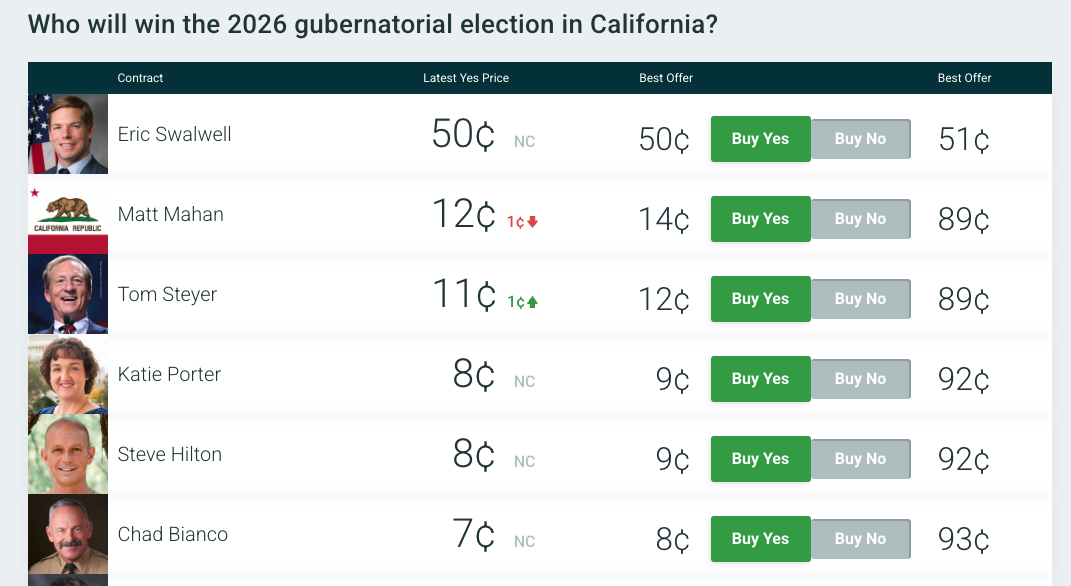
For instance, if a share in Eric Swalwell winning the election trades at 53 cents, that implies a 53% chance according to market participants. PredictIt caps individual investments at $850 per market to maintain its educational focus and prevent high-stakes gambling. The platform charges a 10% fee on profits and 5% on withdrawals, ensuring operations remain tied to research on crowd wisdom in forecasting. Traders in California can use it to gauge real-time sentiment on local races, with markets updating continuously based on news from news items such as key endorsements or new poll results.
PredictIt’s interface is user-friendly, allowing account creation with basic verification. Shares can be bought or sold at market prices or through limit orders, and markets are resolved based on official outcomes, such as those certified by the California Secretary of State. This setup provides a unique lens into voter sentiment across the state.
Current Prediction Market Odds for Key Candidates
As of February 21, 2026, prediction markets show Eric Swalwell as the frontrunner, reflecting his strong name recognition from his time in Congress representing the East Bay Area near San Francisco. On PredictIt, Swalwell’s yes shares trade at 50 cents, implying a 50% probability. Polymarket, known for its crypto-integrated trading, prices him at 54%, with a significant volume of over $345,000. Kalshi, another CFTC-regulated platform, has him at 54%, with trading volume exceeding $2.8 million.
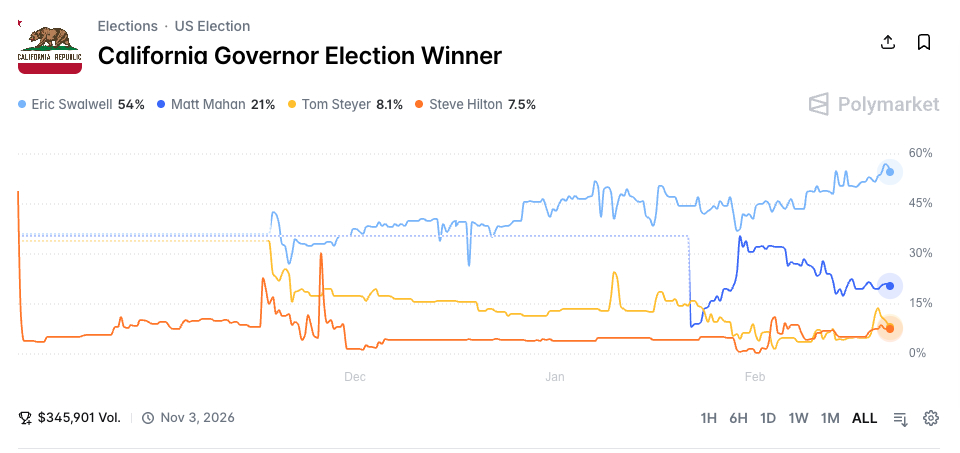
Trailing Swalwell is San Jose Mayor Matt Mahan, a Democrat whose Silicon Valley roots appeal to tech-savvy voters in the Bay Area. His odds stand at 13% on PredictIt, 21% on Polymarket, and 12% on Kalshi. Billionaire Tom Steyer, with his environmental focus resonating in coastal cities like Los Angeles, is at 9-10% across boards. Former Congresswoman Katie Porter, popular in Orange County near San Diego, holds 8% on PredictIt and 6% on Polymarket.
Republican candidates add intrigue, with political commentator Steve Hilton at 8-9% and Riverside County Sheriff Chad Bianco at 8%. These odds suggest markets see a slim but possible path for Republicans in the top-two primary, especially if Democratic votes fragment in populous areas like Los Angeles County. Remember, these are odds to win the General Election, not finish in the Top Two in the Open Primary. Any Democratic candidate is likely to have far higher odds of winning the General Election than any Republican candidate, given the heavily Democratic leaning voter registration in the state.
| Candidate | Party | PredictIt (%) | Polymarket (%) | Kalshi (%) | Average (%) |
|---|---|---|---|---|---|
| Eric Swalwell | Democratic | 52 | 56 | 54 | 54 |
| Matt Mahan | Democratic | 13 | 21 | 12 | 15 |
| Tom Steyer | Democratic | 9 | 10 | N/A | 9.5 |
| Katie Porter | Democratic | 8 | 6 | N/A | 7 |
| Steve Hilton | Republican | 8 | 9 | N/A | 8.5 |
| Chad Bianco | Republican | N/A | N/A | 8 | 8 |
| Democratic Party Win | N/A | 79 (House control related) | 87 | 87 | 84 |
This table highlights the consensus around Swalwell’s lead, but also the variability across platforms, which traders can exploit for arbitrage opportunities.
(Arbitrage would be to purchase contracts for the same event across different prediction platforms that hedge your positions in a manner such that you will win some amount regardless of the outcome. This process is heavily frowned upon in traditional sports betting platforms that use shared information services that try to identify traders arbitrage across multiple platforms. Since the amount you guarantee to earn yourself via arbitrage is a small fraction of the total amount of money stakes, making arbitrage worth undertaking requires large betting amounts. That is how it is often flagged.)
Key Candidates and Their Strengths
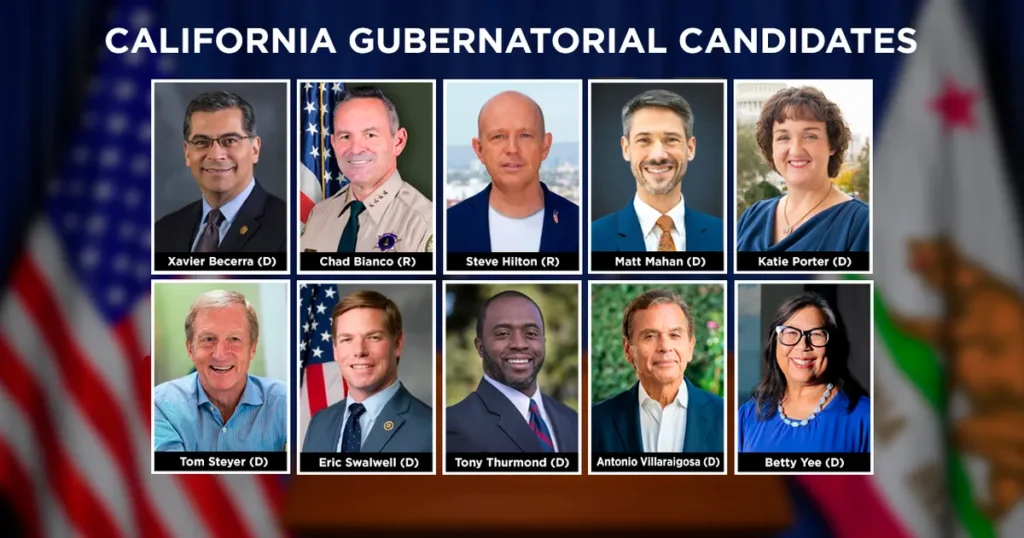
Eric Swalwell, a U.S. Representative from Dublin near San Francisco, has surged in markets due to his national profile and endorsements from figures like Senator Adam Schiff. Markets price him high because of his national stature, name recognition, and fundraising prowess, raising millions from donors in Los Angeles and Silicon Valley.
Steve Hilton, a former Fox News host and British political strategist now based in California, appeals to conservative voters in inland regions like Riverside and the Central Valley. His outsider status and criticism of Sacramento’s bureaucracy have boosted his polling, leading markets to give him 8-9% odds despite California’s Democratic lean. Hilton is predicted to be the higher voter getter between himself and the other Republican candidate, former Sheriff Chad Bianco.
Katie Porter, known for her whiteboard takedowns in Congress, draws support from progressive voters in Southern California. However, recent polls show her slipping, reflected in lower market odds. Other notables include Tony Thurmond from Oakland and Antonio Villaraigosa from Los Angeles, both with single-digit support but potential to surge in the primary if they are able to secure special interest campaign funding.
Polling vs. Prediction Markets: A California Perspective
While markets favor Swalwell, recent polls tell a different story. An Emerson College poll from February 18 shows Steve Hilton leading with 17% among likely voters statewide, followed by Swalwell and Bianco at 14%. Undecided voters stand at 20%. Aggregates from 270toWin give Hilton a slight edge in primary simulations.
This discrepancy highlights how markets incorporate betting sentiment, often from informed traders in tech hubs like San Francisco, while polls capture broader voter intent in more diverse regions. The top-two system amplifies this, with simulations showing a 15% chance of two Republicans advancing, per tools like the Governor Simulator.
Factors Influencing the Race in Key California Regions
Several elements are driving market movements. Endorsements play a big role: Swalwell has backing from labor unions in Los Angeles, while Hilton garners support from conservative groups in the Inland Empire. Economic issues like housing costs and inflation are top concerns, favoring candidates with business ties like Mahan. Mahan has a built-in executive reputation as the current mayor of San Jose, a major metropolis of one million residents as of 2025.
Geopolitical tensions and federal policies under President Trump influence odds, with markets pricing potential U.S. strikes on Iran at 73%, which could impact California military bases in San Diego. Additionally, the fragmented field—over 20 declared candidates—raises the risk of vote splitting, particularly among Democrats in populous Los Angeles County (one-quarter of the entire population in the state).
Historical trends show California hasn’t elected a Republican governor since 2006 (Arnold Schwarzenegger). The top-two primary, implemented in 2012, has led to all-Democrat general elections in recent cycles. Markets reflect this, with Democratic win odds at 87%, but Republican Bianco and Hilton both given chances to reach number two in the primaries, ensuring that Democrats won’t automatically keep the gubernatorial office.
Potential Scenarios and Market Speculation
One hot topic in prediction markets is the “perfect storm” scenario where two Republicans lock out Democrats in the primary. Simulations peg this at 7-15%, boosting odds for Hilton and Bianco. If that happens, markets would shift dramatically, with Republican win odds jumping from the current 11-12% to 100% as this was now the guaranteed outcome.
Another angle is third-party candidates, like the Green Party’s Butch Ware, but markets dismiss them with odds below 2%. Traders are also watching for withdrawals, as seen with Toni Atkins suspending her campaign, which could consolidate support for frontrunners like Swalwell in the Bay Area.
Conclusion: Watching the Markets in California’s Election Year
As California heads into this election cycle, prediction markets offer a real-time barometer of the race’s twists. With Eric Swalwell leading, but polls show a tighter contest. Whether through PredictIt’s academic lens or Polymarket’s high-volume trades, these platforms provide insights into who might next occupy the governor’s mansion in the state capital. As odds fluctuate with news, the 2026 race promises to be one of the most-watched in the nation.