
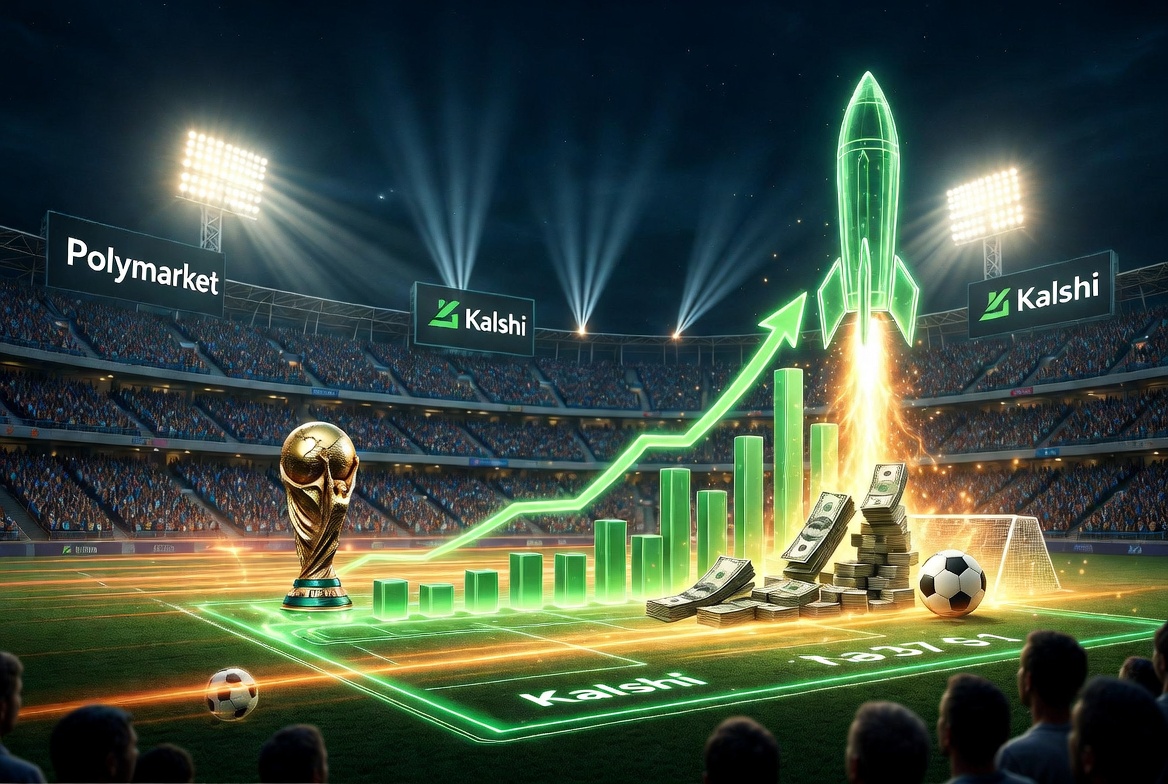
Never-ending debates over whether sports prediction markets are merely sports betting by another name are worthwhile, but they tend to obscure the real story of 2026: the massive growth in user adoption and volume on sports prediction markets, and, as we would argue, the massive improvements in sports market information.
Sports prediction markets differ from sportsbooks in that they are peer-to-peer markets for sports outcome contracts, rather than bettors taking on the “house” with preset odds. In prediction markets, consensus outcome probabilities are set by the pull and tug of traders freely buying and selling positions, more like the stock market. The platforms themselves earn entirely off transaction fees and are entirely agnostic to any given outcomes. It’s trader-vs-trader rather than player-vs-house, a battle of forecasting, research, and insight. You’re playing the market as much as you are specific sporting event outcomes.
Prediction market platforms offer continuous trading, with prices reflecting real-time updates. Unlike a sportsbook bet where your wager, outcome, and odds are all fixed in stone at the time of placement, event contracts on prediction markets can be traded at any time to modify positions. If probabilities improve after you buy into the event contract, you can sell it for a profit to another trader. Similarly, if you’re pessimistic on a purchased contract, you can sell it off before taking a full loss. The “bet” is a living, tradeable thing until the event concludes.
This prediction market setup rewards deep research, an understanding of your own expected probabilities relative to the market’s current views, and quick action in response to injuries or in-game shifts. As such, sports prediction markets deliver both excitement and sharper forecasts than many traditional options. As more and more sports leagues and events blend these into their overall sports experience, they become as much a fan experience and source of entertainment as they are a betting experience.
Comparison of Traditional Sportsbooks and Sports Prediction Markets
| Feature | Traditional Sportsbooks | Sports Prediction Markets |
|---|---|---|
| Pricing Mechanism | Fixed odds set by the house | Dynamic market prices driven by traders |
| Trading Flexibility | One-way bets placed before the event | Continuous buying and selling until resolution |
| Information Value | Limited beyond final payout | Real-time probabilities that aggregate crowd knowledge |
| Hedging Options | Rare after bet placement | Easy position adjustments based on live developments |
| Regulatory Focus | Primarily state gambling rules | Event contracts under evolving federal oversight, like CFTC rules |
| Entertainment Layer | Standard win-or-lose excitement | Stock-like trading experience with community discussion |
The Explosive Rise of Sports Event Contracts
Sports event contracts now drive massive activity across leading prediction market platforms. Kalshi directed roughly 87 percent of its recent yearly volume toward sports-related trading. Polymarket sees daily sports contract volumes reaching tens of millions of dollars during peak seasons. This sports market surge contributes to overall prediction market volumes, pushing toward hundreds of billions, with one analyst estimating a trillion in total trading volume on prediction markets by 2030.
Traders continue to express increasing interest in prediction market trading, as these contracts remain liquid and are constantly updated in value by incoming news. Events range from moneyline outcomes to creative props on player stats or series results. Consequently, the format attracts both casual fans seeking betting thrills and serious traders hunting edges, often those with no underlying interest in sports as fans.
The 2026 NBA Finals and the 2026 World Cup have been major breakthroughs for sports prediction markets over their sportsbook competitors, with Polymarket’s global trading focus driving over $2.5 billion in volume on its World Cup Winners market alone (and climbing throughout the tournament). Kalshi and Polymarket, respectively, are now 3rd and 4th behind only DraftKings and FanDuel for U.S. sports wagering, ahead of all other sportsbooks.
We covered about a month ago the story of a stock analyst at BNP Paribas who put a caution on DraftKings stock, because he believes that the large number of dual platform users, sportsbooks and sports prediction markets, will ultimately choose the latter for their singular sports wagering venue. We’ve seen the stocks of both DraftKings and the parent company of FanDuel drop over the past year, as both sportsbooks have responded by launching their own prediction-market offerings. They see it coming.
Delivering Actionable Information Through Aggregated Market Wisdom
Unlike sportsbooks, where odds are set to maximize the house’s profits, sports prediction markets are set by aggregating scattered analyses from staked traders into clear probability signals. Live prices act as barometers of public consensus, melding thousands of investors’ opinions into a single, ever-changing price.
These signals often prove sharper than static expert picks. Media outlets have picked up on this and are increasingly using prediction-market probabilities to put sporting-event outcomes into context for their viewers rather than relying on a handful of retained analysts.
The continuous, iterative format delivers updates faster than traditional analysis cycles. Accuracy improves with sufficient liquidity and diverse input. Historical performance shows strong calibration across major sports because the mechanism incentivizes the discovery of overlooked details that only one trader of many needs to uncover.
As a definitional matter, the larger and more active these prediction markets become, the more accurate their predictions become.
The Promising Future of Converging Betting, Entertainment, and Information
Sports prediction markets are rapidly expanding both contract breadth and partnership deals across the industry. New integrations with data analytics and real-time, official league sports data feeds, such as those from SportsRadar, promise more seamless, around-the-clock, in-game experiences. Growing volumes signal sustained interest, which should bring more liquidity and a wider range of contracts in the coming seasons.
This trajectory points toward deeper embedding in sports culture, with league deals, promotions, and entertainment options for fans. Future developments may connect prediction platforms with media broadcasts and team analytics.
Maintaining accuracy and fairness and addressing legal and regulatory issues will determine long-term success. These platforms already demonstrate a powerful blend of financial mechanics and sports passion, as seen on the world’s largest prediction markets
The convergence happening now creates opportunities for fans, traders, and the sports industry. Dynamic pricing reveals insights fixed betting systems miss or simply don’t care about while adding interactive fun. Continued refinement of rules and features will accelerate adoption. Continued rapid growth in sports prediction markets seems inevitable, with only legal rulings perhaps standing in their way.
References
- Prediction markets in 2026: Key trends reshaping forecasting, trading, and regulation – MetaMask
- Prediction Markets – CNBC
- Prediction Markets are Surging – Here’s What You Need to Know – Stanford Law School
- Emerging Trends in the Prediction Market Landscape – LinkedIn
- Why Prediction Markets Are Gaining Global Attention in 2026 – Finextra
- Polymarket – The World’s Largest Prediction Market
- Prediction market – Wikipedia