
The Commodity Futures Trading Commission’s Division of Market Oversight is intensifying its review of how designated contract markets handle new listings. On July 24, 2026, the division issued an advisory that marks the second warning this year against improper self-certification practices for event contracts. The guidance specifically targets broad, template-style filings that combine multiple variations into a single submission while trading volume in these contracts continues to rise quickly.
Staff explained that these broad, sweeping filings leave critical details incomplete. Reviewers therefore cannot fully examine settlement methods, data sources, or core-principle compliance for every version. As a result, the division has stated that such overstuffed templates should no longer be submitted.
Closely related event contracts may still advance as a class in limited situations, provided genuine similarities in structure and risk exist. Prediction markets that cannot meet that standard must instead file individual certifications or seek formal approval under existing regulations. This is a pushback by the CFTC on a liberal self-certification process that has expedited prediction markets’ expansion but may have become too loose.
Key Provisions of the Latest CFTC Event Contracts Advisory
The Division of Market Oversight made clear that broad template-style certifications prevent proper evaluation under Commission Regulation § 40.2. When many potential outcomes sit inside one package, staff cannot confirm that each version includes the required terms, conditions, explanation, and analysis. Consequently, the advisory will draw a firm line against these filings.
Acceptable alternatives remain available. Closely related contracts can still receive class certification when the shared elements truly justify the grouping. Markets may also choose voluntary approval under §§ 40.2(d) or 40.3 for greater certainty. In every case, the emphasis falls on supplying contract-specific details rather than generic language about a broad class.
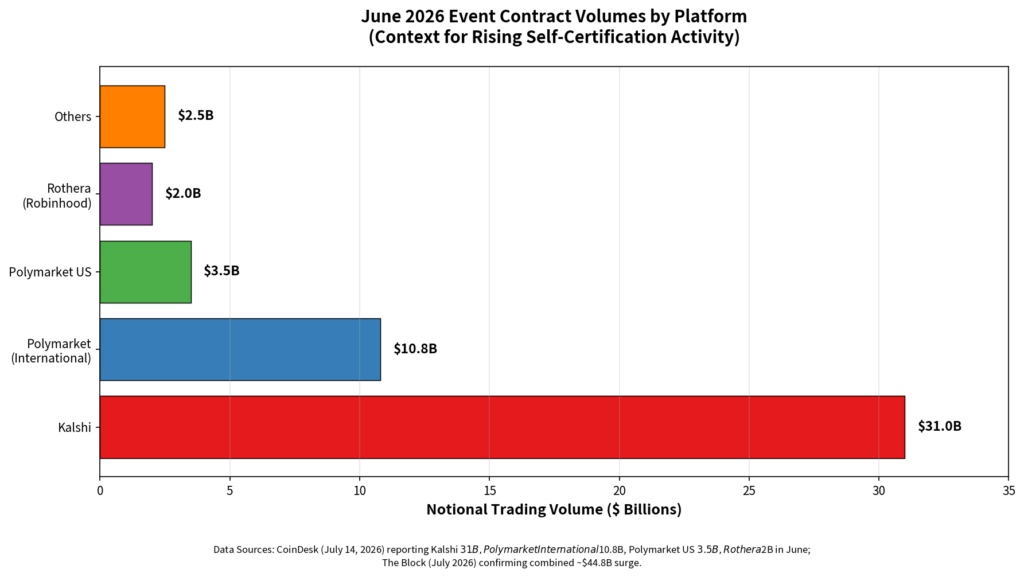
Many designated contract markets kept relying on templates even after earlier reminders from the CFTC to be more specific. By failing to separate individual permutations, those markets created gaps that essentially blocked full compliance checks. The new advisory is a direct signal that shortcuts will no longer be tolerated.
Designated contract markets must now treat every permutation as a distinct product that needs its own supporting materials. Applications can no longer rely on boilerplate covering an entire series. Instead, they have to map settlement mechanics and data reliability for each version, lengthening preparation time, though now lowering the risk of later rejection.
Class certifications remain possible, yet the threshold for proving similarity has risen. Operators must document commonalities carefully and avoid stretching definitions simply to accelerate the process. Compliance officers are updating internal checklists and training product teams on the new expectations so that requirements are embedded early in the design stage.
Near-Term Impacts on Listings and Operations
Markets currently preparing large series face the most immediate work. Any template already in the pipeline will have to be broken apart or rewritten to satisfy the advisory. Staff working under tight deadlines are prioritizing high-volume contracts first and shifting less critical ones to later windows.
The second warning also ends any remaining leniency. Earlier guidance this year produced limited change, so the rapid follow-up signals that continued non-compliance could prompt stronger CFTC negative responses. Operators are conducting internal audits of recent submissions and separating previously bundled families into smaller, coherent sets.
Some teams are exploring the voluntary approval route for clearer regulatory certainty. Although the path requires more upfront engagement, it can eliminate post-listing challenges. These shifts are reshaping daily workflows inside product-launch teams at the prediction market platforms.
Outlook Following the Second Warning
The Division of Market Oversight will track how quickly designated contract markets revise their practices. Follow-up reviews of recent filings are already under way, and any continued use of broad templates will draw immediate, non-positive attention. Markets that demonstrate rapid compliance should experience smoother interactions with staff in the months ahead.
Looking further out, the advisory establishes a lasting tone for future guidance. A short adjustment period is likely as platforms refine processes. Once the new standards settle, listing flows should stabilize, and new contract quality should rise. Markets that align internal workflows now will keep pipelines moving while slower competitors catch up. The coming quarter will reveal which operators have fully absorbed the message.
The second warning underscores a straightforward reality: rapid growth in event contracts requires equally rigorous oversight, else the result could be diminished prediction market contract quality. The division has set a clear boundary, and the industry will adapt to remain on the correct side of it. The CFTC is their biggest ally.
References
- CFTC Releases Advisory on Self-Certification of an Event Contract Series
- U.S. regulator warns prediction markets against cutting corners in event contracts
- CFTC Warns Prediction Markets Over Blanket Self-Certifications
- News & Insights – Prediction Market Tools

The PolyPunter staff works tirelessly to bring you the latest and most insightful news, information, and tips on the fast-growing economic, financial, and social phenomenon that is prediction markets.