

Record-breaking trading volumes during major events like the Super Bowl have intensified scrutiny on prediction markets. Platforms such as Kalshi and Polymarket registered billions in trades tied to the game’s outcomes, halftime shows, and advertisements.
This surge prompts a critical question: do these markets function as sophisticated financial instruments or as unregulated forms of sports wagering? Industry stakeholders, including sportsbooks and lawmakers, offer varied responses to this ongoing debate. The discussion reveals deep divisions over regulation, economic impact, and market integrity.
The Surge in Prediction Market Activity During High-Profile Events
Super Bowl LX marked a pivotal moment for prediction markets with unprecedented trading volumes. Kalshi reported over $1 billion in trades on game day alone, surpassing previous records by a significant margin. Polymarket contributed nearly $800 million across related contracts, bringing the combined total to over $1.6 billion. Analysts attribute this growth to expanded offerings on player performances, commercial appearances, and even celebrity mentions. Sportsbooks observed parallel increases in traditional bets, yet prediction platforms captured a notable share estimated at up to 20% of overall wagering activity. This overlap fuels arguments that the two sectors compete directly for user engagement.
Trading patterns during the event highlighted dynamic price movements driven by real-time information. Contracts on the winning team fluctuated as the game progressed, reflecting collective trader sentiment. Halftime show markets, including predictions on performer setlists, drew over $300 million in volume. Advertisement-related contracts, such as brand mentions, added another layer of speculation. Data from industry trackers showed a 39% year-over-year increase in Super Bowl-related prediction trading. Such figures underscore the platforms’ appeal during tentpole events, where users seek diverse outcome-based opportunities.
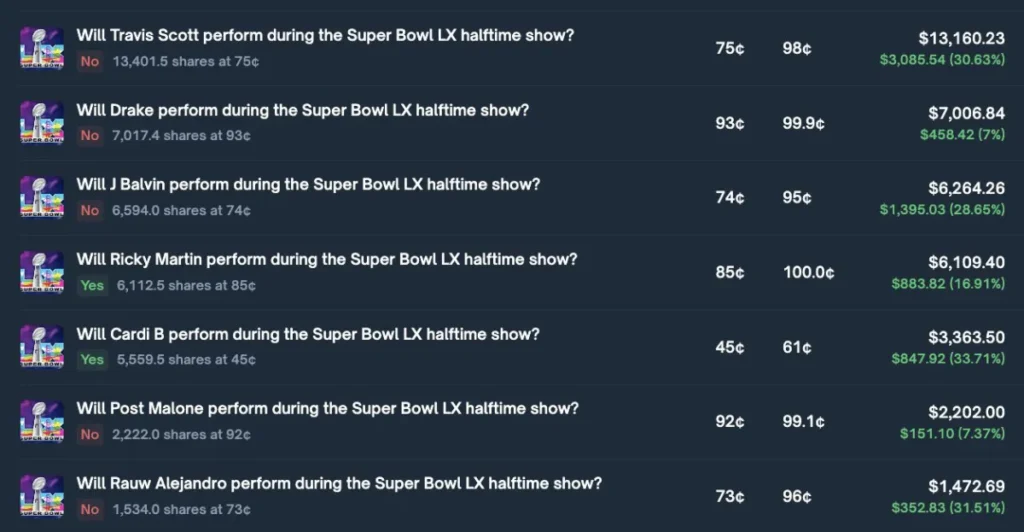
Market participants range from casual traders to institutional players, broadening the ecosystem’s reach. Volumes spiked 2,700% on certain platforms compared to the prior year, signaling rapid adoption. Critics point to this growth as evidence of gambling-like behavior masked by financial terminology. Proponents counter that the mechanisms aggregate information more efficiently than traditional polls or odds-setting. The event’s scale amplified calls for clearer distinctions between the sectors. Responses from established gambling operators varied, with some viewing the rise as a competitive threat.
Structural Distinctions Between Prediction Markets and Traditional Wagering
Prediction markets operate on a peer-to-peer model in which users trade contracts with one another. Prices adjust continuously based on supply and demand, representing implied probabilities of outcomes. Sports betting typically involves fixed odds set by a bookmaker, creating a house edge. Contracts on prediction platforms expire at $0 or $1, depending on the event’s resolution. This binary structure emphasizes forecasting accuracy over entertainment value. Traders can exit positions before settlement, adding a layer of flexibility absent in many conventional bets.
Regulation plays a key role in differentiation, with prediction markets subject to federal oversight by bodies like the CFTC. Sports wagering adheres to state-specific laws, limiting nationwide access. Platforms highlight their role in information aggregation, where collective wisdom refines probabilities. Bookmakers focus on risk management through vig (juice) on each wager. Liquidity in prediction exchanges comes from market makers, ensuring smooth trading. In contrast, sportsbooks manage books to balance action on both sides.
Event coverage in prediction markets extends beyond athletics, encompassing politics and economics. Sports-focused contracts, however, mirror traditional prop bets on games. Fees in prediction trading often apply per contract, without built-in house advantages. Users perceive this as fairer, though long-term losses remain common due to market inefficiencies. The debate centers on whether these differences justify separate classifications. Observers note that user experiences can feel interchangeable, especially during live events.
| Aspect | Prediction Markets | Sports Betting |
|---|---|---|
| Trading Model | Peer-to-peer exchange | Against the house |
| Pricing Mechanism | Dynamic, market-driven probabilities | Fixed odds with vig |
| Regulation | Federal (CFTC) | State-level gaming commissions |
| Contract Range | Broad (sports, politics, finance) | Primarily sports-focused |
| Exit Options | Trade out before resolution | Limited cash-out features |
| Purpose Emphasis | Information aggregation | Entertainment and risk |
Differences between models and regulations often determine operational scope. Pricing and exit strategies influence user strategies and outcomes. Broader contract availability in prediction markets attracts a diverse set of participants. Emphasis on purpose affects public perception and policy approaches. These elements collectively inform whether the sectors warrant distinct treatments.
Legal and Regulatory Perspectives on Market Classification
States challenge the federal status of prediction markets, arguing they encroach on gambling territories. Nevada’s Gaming Control Board filed enforcement actions against platforms like Kalshi, seeking injunctions. Courts weigh whether contracts constitute wagering under state laws. Federal regulators oversee derivatives and event contracts. This tension creates uncertainty for operators expanding sports-related offerings. Lawmakers propose bills to clarify boundaries, including bans on sensitive topics.
Critics label prediction platforms as unregulated casinos, citing similarities in user behavior. Proponents defend them as valuable forecasting tools, distinct from house-banked games. Legal precedents from past cases influence current battles. Some states require prediction operators to obtain gaming licenses. Others block access, viewing nationwide availability as unfair competition. The Supreme Court may eventually resolve these conflicts through appeals.
Industry associations lobby for unified frameworks to protect consumers. Responses include enhanced surveillance for insider trading risks. Platforms partner with tech firms to monitor anomalies in real-time. Ethical concerns arise over profiting from non-public information. Regulators balance innovation with safeguards against manipulation. The evolving landscape reflects broader shifts in the financial and gaming sectors.
For insights into regulatory developments, refer to analyses on platforms expanding under CFTC licenses. Smarkets’ recent filing highlights efforts to navigate U.S. markets legally. Such moves underscore the push for federal approval amid state pushback. Comparisons between major platforms reveal how compliance strategies differ. Beginners often seek guidance on these distinctions to inform participation.
Responses from Sportsbooks and Industry Stakeholders
Sportsbooks monitor prediction markets closely, assessing potential impacts on revenue. Executives at companies like Caesars express caution, opting for observation over entry. They prepare technology for possible integration or competition. Some view the rise as diluting traditional wagering pools. Others explore partnerships to blend models. Data suggests minimal cannibalization thus far, though long-term effects remain unclear.
Analysts predict slower growth for sports betting due to market saturation. Prediction platforms’ national reach offers advantages in untapped regions. Bookmakers advocate for level playing fields through consistent taxation. Responses include lobbying efforts to classify prediction sports contracts as gambling. Industry panels discuss hybrid approaches to capture shared audiences. Stakeholders emphasize consumer protection across both sectors.
Trading volumes during events like the Super Bowl prompt reevaluations of competitive dynamics. Sportsbooks report record handles, yet acknowledge parallel surges elsewhere. Executives note difficulties in quantifying direct competition. Some adapt by offering exchange-style features within regulated frameworks. The discourse highlights opportunities for collaboration amid rivalry. Neutral observers suggest both can coexist with clear delineations.
Lawmakers’ Views and Policy Implications
Lawmakers are introducing legislation to address perceived loopholes in prediction markets. Proposals include restrictions on war or death-related contracts. They argue that such bets incentivize harmful behaviors or insider abuses. Others support expansion for economic benefits and better forecasting. Bipartisan efforts seek reforms balancing innovation and ethics. Hearings feature testimony from regulators, operators, and critics.
Policy debates center on national security risks from sensitive markets. Lawmakers question whether platforms jeopardize public interest. Responses vary by party, with some favoring deregulation for growth. Others prioritize state rights in gambling oversight. Bills aim to standardize classifications across sectors. The process involves input from diverse stakeholders to shape future rules.
Economic analyses inform discussions on taxation and revenue sharing. Prediction markets generate substantial activity without state-level taxes. Lawmakers explore ways to capture shares for public funding. Neutral stances emphasize evidence-based approaches over ideological biases. Policy outcomes could significantly redefine market boundaries. Ongoing dialogues reflect broader societal views on risk and speculation.
Ethical Considerations in Outcome-Based Trading
Ethical questions arise over profiting from real-world events in prediction markets. Critics highlight incentives for the spread of misinformation or manipulation. Platforms implement safeguards like trade monitoring to mitigate risks. Users debate the morality of sports contracts versus broader topics. Neutral analyses suggest markets improve transparency when properly regulated. Stakeholders advocate for self-imposed limits on controversial subjects.
Insider trading concerns parallel those in financial markets. Prediction platforms face scrutiny over their advantages in non-public information. Responses include AI-driven surveillance for anomalies. Ethical frameworks guide platform policies on market creation. Public perception influences adoption and regulatory tolerance. Balanced views acknowledge both benefits and potential harms.
Social impacts extend to user demographics, with younger participants drawn to accessible trading. Studies examine addiction risks comparable to gambling. Platforms promote responsible practices through education. Ethical discourse evolves with technological advancements. Neutral experts call for ongoing evaluations of societal effects. The debate underscores the need for integrity in all speculative activities.
Future Implications for Markets and Regulation
Prediction markets’ trajectory hinges on resolving classification debates. Growth projections indicate multi-billion valuations for leading platforms. Integration with technologies like AI could enhance monitoring and efficiency. Sportsbooks may adopt hybrid models to compete effectively. Regulatory clarity would stabilize operations and attract investment. Future scenarios include expanded event coverage or restricted categories.
Industry consolidation looms as smaller players merge with giants. Global expansion faces varying legal landscapes. Neutral forecasts predict sustained interest in high-stakes events. Policy shifts could harmonize federal and state approaches. Stakeholders prepare for evolving user preferences and innovations. The sector’s maturation depends on addressing current controversies.
Economic contributions factor into future policies. Prediction markets provide data for decision-making in various fields. Challenges include maintaining fairness amid rapid growth. Responses from all sides shape sustainable paths forward. The ongoing evolution reflects broader trends in finance and entertainment. Balanced progress requires collaboration among diverse interests.
References
- Are prediction markets just sports betting by another name? How legal battles are taking shape – The Athletic
- Prediction Markets vs. Sports Betting: Similar Mechanics, Different Structures
- Predictably, “Prediction Markets” Are Just Casinos
- What Are Sports Prediction Markets? Key Questions Answered
- Super Bowl Gives Prediction Bets Record $1.2 Billion Trading Day
- Prediction market Kalshi reached $1bn in trading volume
- $1.63B in Super Bowl Prediction Market Volume, $304M on Culture: Full Data Breakdown
- Prediction Markets Are The Super Bowl’s Breakout Winners
- Smarkets Files for CFTC License to Expand into US Prediction Markets – PolyPunter
- Ultimate Glossary of Prediction Markets Terms and Slang 2026 Edition – PolyPunter
- Prediction markets aren’t just gambling
- Prediction markets are causing such disruption for casinos and sports betting companies
- BREAKING: Adam Schiff has introduced a bill to ban bets on war and death in prediction markets