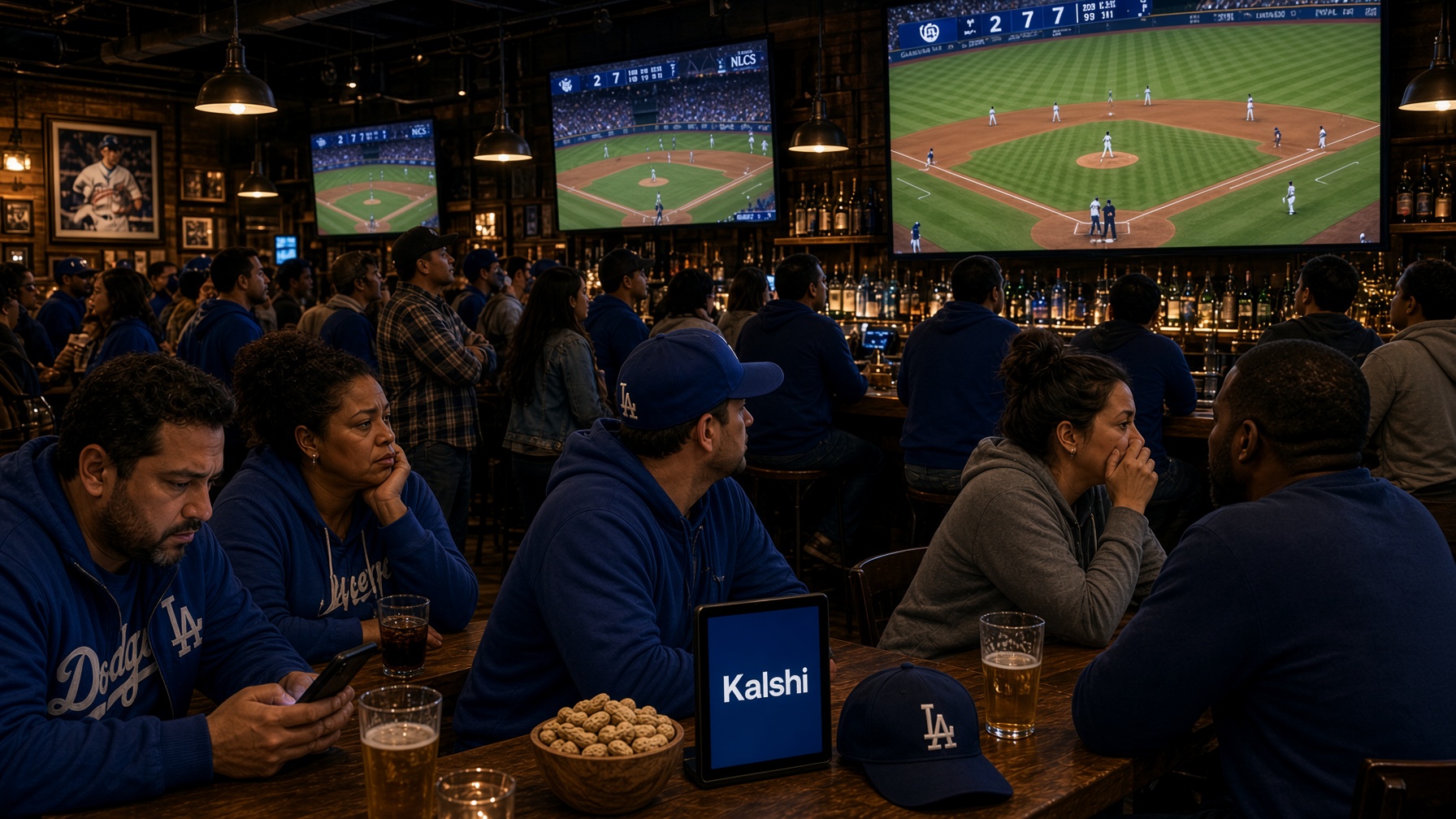
Los Angeles Dodgers fans still haven’t quite recovered from seeing their star-filled team swept out of the National League Championship Series by the Milwaukee Brewers. But some Angelenos actually took out “insurance” on that possibility.
A Los Angeles hospitality group that runs 25 bars, many near Dodger Stadium, bet $60,000 on Kalshi that the Dodgers wouldn’t make the World Series. After the Brewers swept the series, the position paid out at nearly double the stake. That money helped cover the revenue those bars lost when packed houses that would’ve come with more LCS games and certainly World Series games went poof.
The group had been banking on stronger sales from more home games. Once the Dodgers got eliminated, that traffic dried up. The Kalshi position plugged part of the revenue gap.
This kind of trade is becoming more common. Some businesses use specific prediction-market contracts to cover binary risks that regular insurance policies handle poorly. Sports results that drive local and direct spending fit the pattern especially cleanly.
Columbia University law professor Joshua Mitts said the Dodgers trade worked a lot like bespoke insurance. He pointed out that other business risks could be handled the same way if liquid markets exist. You pay a known amount up front and collect if the specific bad outcome hits. That may sound familiar, since that’s how basic insurance works. Only this insurance pays out immediately, without an insurance adjuster visiting and months of potential squabbles and delays.
How the Dodgers Trade Worked for Local Bars
The hospitality group bought a $60,000 position that the Dodgers would make the World Series. After the Brewers closed it out, the position returned just under double the original stake. The group hasn’t said anything publicly, and Kalshi hasn’t named the operator. Local coverage framed it as a practical business move tied to real revenue exposure lest anybody think these were L.A. bars simply betting against the Dodgers.
The same idea has shown up in smaller cases. A New York City bar called The Jeffrey put $5,000 on the Knicks winning an NBA Finals game back in June and collected $13,500 to hedge against a free-drink promo they offered if the Knicks won. An insurance company placed trades worth up to $3 million on LSU winning the college football national championship, aligning with coaches’ bonus structures. A Los Angeles ice cream shop put up to $1,500 on cold fronts to cover nearly half its monthly rent during a cold-spell-induced revenue reduction.
Rising Volume and Tools Aimed at Business Hedging
Trading volume on the big platforms roughly doubled between May and July 2026, hitting $58 billion on Kalshi and $22 billion on Polymarket. Sports contracts drove most of that jump. The extra liquidity makes it easier to place larger hedges without moving the market prices.
Kalshi has partnered with an independent AI tool called Blanket, built by financial economist Lauris Zminsky. Someone describes a business risk in normal language, and the tool pulls up relevant Kalshi contracts that could offset part of it. Blanket does not place trades or hold money. It points people to the exchange and what it sees as the optimal market for hedging business risk based on their situation.
Zminsky has described Blanket as a reasoning tool, not a trading app. A bar owner worried about fewer games, a shop worried about weather, or a company exposed to a specific event can get suggestions in seconds. The actual trade and the compliance checks still happen separately on Kalshi’s regulated platform. Whether that ultimately becomes a fully integrated tool for Kalshi traders remains to be seen.
Traders still pay fees, so the real cost of any hedge includes those charges on top of the contract price itself.
Limits and Regulatory Questions for Corporate Users
Not every business risk maps cleanly to an existing contract. There is still basis risk. The market outcome might not match a company’s actual revenue loss exactly. A Dodgers exit from the playoffs can cut traffic, but the precise dollar hit still depends on local factors, weather, and whatever else is happening that week. It’s imprecise, even in a fairly clean example.
Mitts has also pointed to the regulatory difference. Traditional insurance runs under state licensing and capital rules. Prediction markets trade under CFTC oversight as designated contract markets. That creates a different set of rules and some gaps when companies start treating the contracts like insurance substitutes. The payout process for prediction markets is certainly much neater and certainly much faster.
Market depth and liquidity still vary widely, even on the largest platform, Kalshi. Kalshi is by far the highest-volume sports-event contract market, but it runs thin books on lesser sporting events. So while this hedging model will work smoothly for Knicks Finals Games or Dodgers MLB Playoff series, it could be harder to place even modest hedges effectively in many less-popular sports-event contracts.
Companies trying these trades are still figuring out the practical limits. The Dodgers case shows a clear revenue link and a working offset. Other firms will test whether similar positions can cover weather, promotions, or supply issues at a cost that makes sense compared with the risk. As more companies try the approach, volume and tools will probably keep growing. The main question is how closely a binary contract can track a specific business exposure and whether the cost of that protection stays reasonable over multiple seasons. We know the mechanics are much simpler and faster than traditional insurance tools
References
- Fortune: Prediction markets are now ‘bespoke insurance’ for businesses
- Reuters: LA restaurant group used $60,000 Dodgers bet to hedge playoff risk
- CBS Los Angeles: LA bar group places $60K bet against Dodgers
- Pew Research Center: Prediction markets trading volume doubled
- Fortune: Kalshi partners with Blanket for small-business hedging
- CoinDesk: How Businesses Are Using Prediction Markets to Hedge Weather Risk