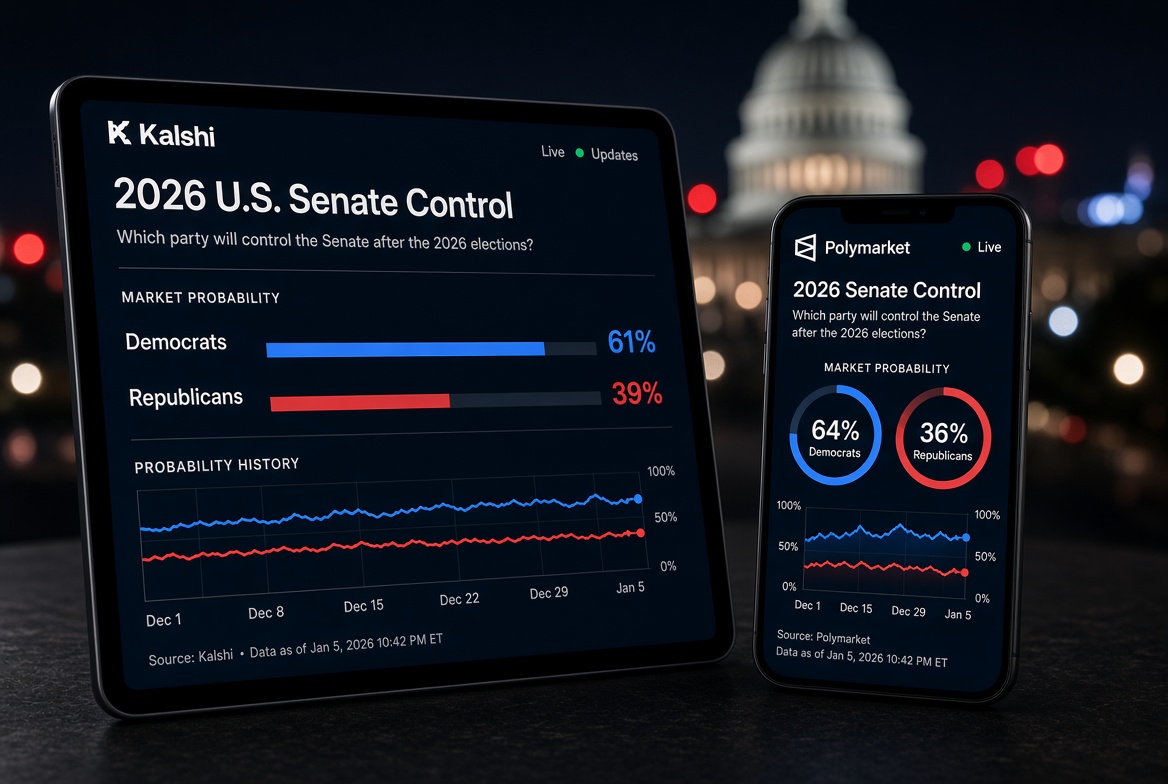
Kalshi and Polymarket have pushed the probability that California’s Proposition 40 passes on November 3 down to roughly 25–26%, treating the one-time 5% tax on billionaire net worth as a clear underdog even as some traditional polls still show modest support. Traders on both platforms are pricing failure more aggressively than early surveys suggested.
Proposition 40 would impose a one-time levy equal to 5% of the net worth of individuals worth at least $1 billion who resided in the state as of January 1, 2026. Bill proponents claim the revenue would fund state healthcare programs such as Medi-Cal, with smaller shares for education and food assistance.
Proponents have estimated potential collections near $100 billion, though some ultra-wealthy residents have already relocated, reducing those figures, and collecting such a tax is likely fraught with practical obstacles. Even a successful “yes” vote would face questions around valuation, residency, and constitutionality, contributing to the discount traders are applying relative to raw polling support.
Opposition spending has been heavy. Google co-founder Sergey Brin has directed more than $100 million against the measure and related counter-proposals, and opponents have raised more than $205 million in total. Governor Gavin Newsom and other prominent Democrats have publicly opposed the initiative, giving the “no” side political cover that traders appear to be weighing. While the bill appeals to progressive-leaning voters, the political figures themselves draw heavily from the donors that would be impacted by this one-time mega tax.
Markets Converge On Low Passage Probability
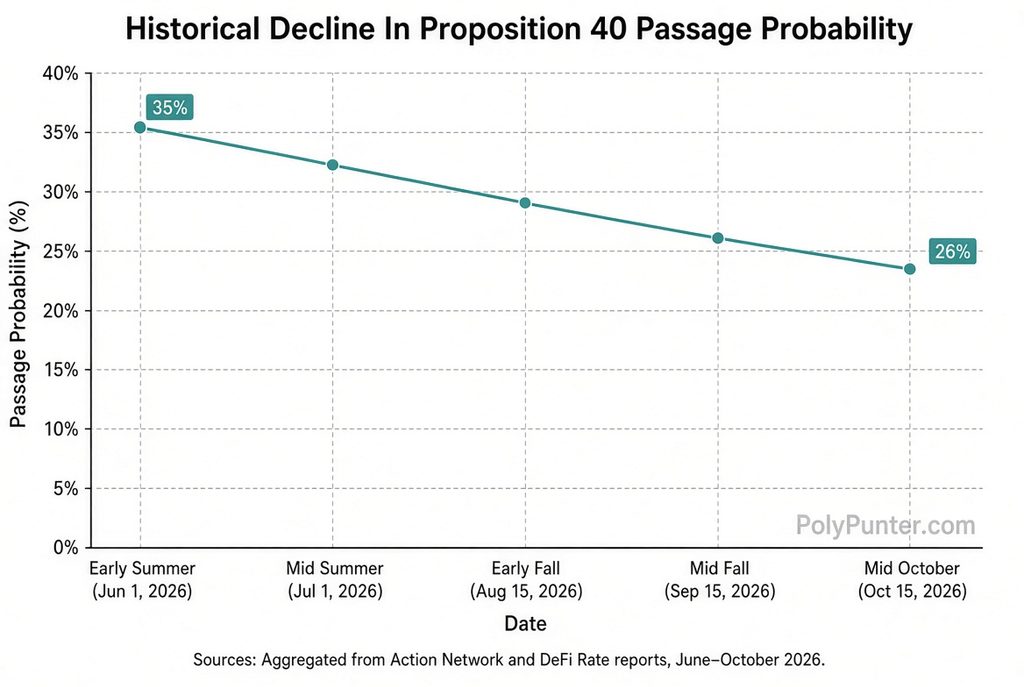
As of mid-October, Kalshi listed the “yes” side of Proposition 40 near 26 cents while Polymarket hovered around 25–30%. Both boards treat passage as unlikely, and the platforms have stayed directionally aligned even when prices differ by a few cents. That alignment suggests traders are responding to the same public information.
The decline has been gradual. Earlier summer readings sat closer to the mid-30% range on some contracts before settling in the mid-to-high 20s. Volume has been meaningful but not explosive compared with national races, yet the contracts remain among the more actively traded state ballot measures.
Related markets on whether the tax would take effect before 2027 or defeat opposing propositions have traded even lower in some cases. Traders appear to be pricing not only voter sentiment but also implementation risk and the chance that companion measures could limit the tax even if Proposition 40 clears a majority.
For active traders, the current pricing offers a clear consensus that the measure faces long odds. With weeks remaining, late shifts in polling or advertising could still move the contracts. The gap with traditional surveys remains one of the cycle’s more closely watched discrepancies.
Polling Versus Market Signals
An early September survey from the Public Policy Institute of California found that 52% of respondents said they would vote yes and 46% said no. Those polling results contrast noticeably with the roughly 25–26% probability priced into the market. The same poll showed majority support for measures that would constrain the tax’s reach.
Supporters point to the polling as evidence that a path still exists if turnout and messaging align. Opponents counter that heavy advertising, elite donor opposition, and the one-time structure make sustained majority support difficult.
The discrepancy is not unique. Prediction markets have diverged from early polls on state propositions when well-funded campaigns or legal questions enter the picture. Here, opposition resources and high-profile elected officials appear to weigh more heavily with traders than the September snapshot. Propositions in California tend to be viewed as uphill battles for passage, and voters unfamiliar with propositions at voting time often vote against them by default.
Whether the markets or the polls prove more accurate will be known only after November 3. In California, that will often be well after election day, as the state has a notoriously slow, extended vote-counting period.
What The Pricing Means Heading Into November
With the election less than a month away, the 25–26% range functions as a live, dynamic consensus forecast. Volume has been sufficient to move prices on news, and both platforms have shown responsiveness to campaign developments. Traders who believe the polls understate late opposition momentum can position accordingly. Political market traders have different views on how much polling data should weigh on their expected outcome probabilities.
The measure’s fate will also influence related contracts on overall ballot outcomes and potential legal follow-through. Platforms continue to list the primary passage market alongside narrower questions about timing and interaction with other propositions.
Proposition 40 has become one of the higher-profile state-level tests for how prediction markets price well-funded ballot fights. The final outcome will determine whether a polling question of “who do you want to win” proves more accurate than an event market that asks “who do you think will win” and requires you to stake money on your prediction.
References
- California’s billionaire tax might now be dead on arrival, according to Polymarket and Kalshi odds – Moneywise / Yahoo Finance
- California Wealth Tax Odds 2026 – Action Network
- California Propositions 2026 Odds – DeFi Rate
- What to know about California’s billionaire tax – CalMatters
- 2026 California Proposition 40 – Wikipedia