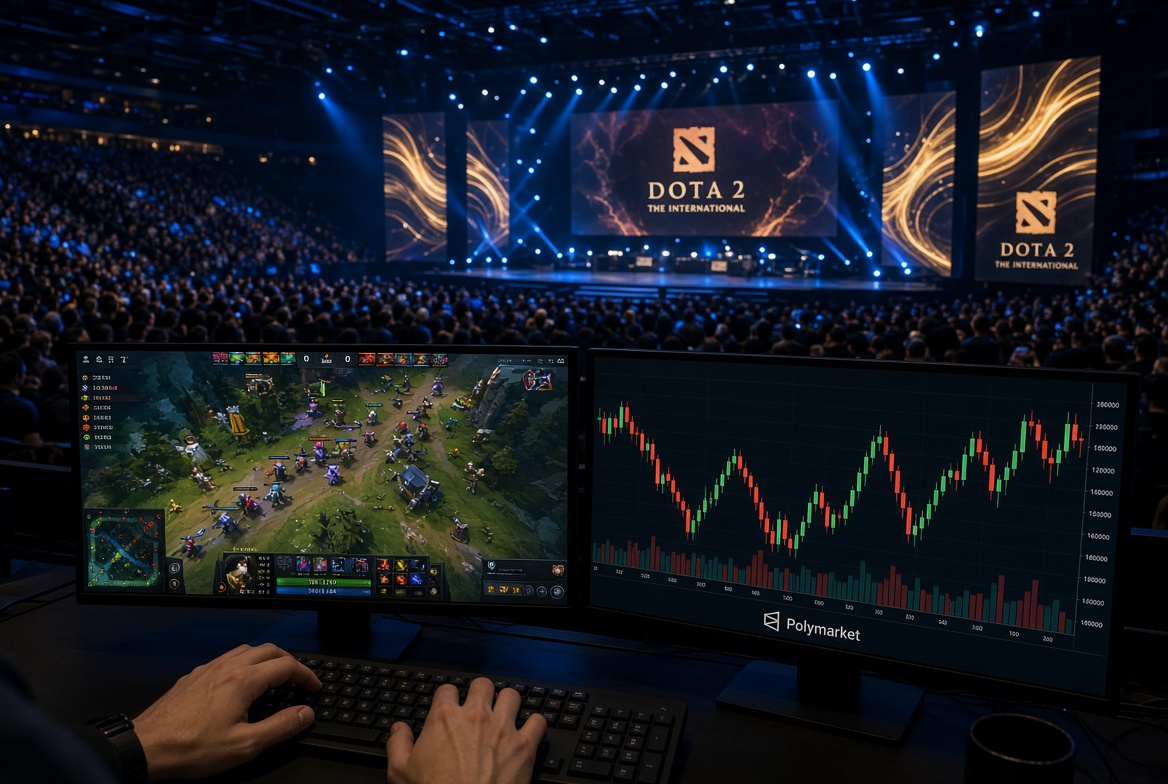
(Dota 2 is a 2013 multiplayer online battle arena (MOBA) video game by Valve, with over 400,000 active players.)
Team Spirit won Dota 2’s world championship 3-2 over Team Vision and shared a $3.32 million prize pool with the other 15 teams. Even contracts tied to those same series paid out $204.2 million, 61 times the official pot. The biggest winnings did not go to the roster lifting the Aegis trophy. They went to prediction market traders flipping live prices while matches were still open.
In a review of 21,936 Polymarket wallets, about 77% had results decided at settlement; that group finished $7,611,971 in the red. The other 5,004 wallets made money mainly by buying and selling before resolution, finishing $7,582,812 in the black.
Settlement Holders Lost While Short-Horizon Traders Printed
A Dota contract can sit until it resolves and pays $0 or $1, or a trader can flip it after a teamfight moves the price. On Polymarket, you can sort wallets by the path that actually drove profit or loss. The median contract winner made about $4.84. The median loser dropped about $23.15. Only 734 wallets made more than $1,000, while 906 lost more than $1,000.
One wallet, 0xaabec5…e9158, booked $406,692 across 17 trades in six Dota markets over 13 hours. It never posted resting prices. It only lifted offers already on the book. Another short-burst wallet made $156,149 in under 12 hours. Fast exits beat holding a “correct” team into settlement.
The worst losses went the other way. Each of the 10 largest drawdowns was resolved at settlement. One wallet deposited $693,522 across three markets, made 148 trades in nine hours, and lost the entire stack. Trading activity without an exit still collided with a binary result. Herein are the mechanics of event markets: it is a win or loss only if you hold until settlement.
A Handful of Wallets Supplied Almost All Tournament Deposits
The top 10% of Polymarket wallets supplied 97.8% of the $181.93 million deposited. The top 1%, about 220 wallets, accounted for 72.8%. Ten wallets placed 26.3%. Only 1,640 wallets put serious size to work, depositing $157.6 million, or 86.6% of the book. Typical wallets outside that group put in $19.98, and half of them still lost.
One account generated more than $21 million of volume, around 12% of Polymarket’s tournament total. When slicing the wallets into ten equal bands, only the largest band finished ahead. That group invested $177.9 million and ended with a profit of $473,415. Eight of the nine smaller bands lost money, and losses widened as deposits shrank.
Maker-versus-taker behavior flipped the usual script. Accounts that mostly posted standing offers lost $2.35 million. Accounts that mostly hit displayed prices made $838,149. Mixed wallets made $1.48 million on less volume than either group. Live Dota prices jump so fast that a resting offer can get lifted the instant a fight ends.
Polymarket Took 90% of the Flow and Most of the Fees
Traders moved about $182 million in response to match outcomes across both Polymarket and Kalshi. Polymarket handled roughly 90%. Kalshi processed a similar trade count, 586,845 versus 622,475, yet its average ticket was $31.04, compared with $263.78 on Polymarket. Size, not click count, decided the leaderboard. Kalshi also split many series into two yes/no books, which made its listing count look larger than the underlying matches.
Timing clustered on game days. Qualifiers drew $27.9 million across 111 series. The main event drew $152.7 million across 58 series. Peak day was August 21 at $27.45 million. Finals day ranked only third. On the two off days between groups and playoffs, volume collapsed by about 99%. Across match and qualifier books, 95.5% of dollars traded on the day of the match itself.
Polymarket collected $2.31 million in fees. Kalshi collected $450,054. Combined fees hit $2.76 million: almost twice the Dota champion’s share and 83% of the prize pool. The top 10 Polymarket wallets made $5.30 million together, more than all 16 esports teams in the tournament combined.
References
- Afik Rechler, Predictbook, “Who is the real winner of Dota 2’s world championship?”
- Predictbook, X post, September 3, 2026
- Tanya Chepkova, Finance Magnates, “On Polymarket, Being Right About Dota 2 Paid Less Than Trading the Odds”
- Adam Roarty, Esports Insider, “Dota 2’s biggest winners don’t play Dota 2 anymore, they trade it”
- KuCoin / Finbold, “Esports Prediction Markets Hit $204M During Dota 2 Championship”
- Valve / Dota 2 official news, The International 2026 championship recap
- Polymarket wallet profile 0xaabec5bfb0c7e2516900c4066ae58073d59e9158
- DotaCinema, “The International 2026, Fantasy and Predictions Dota 2”