Kalshi just keeps on rolling on with new business development and marketing partnerships with major professional sports organizations.
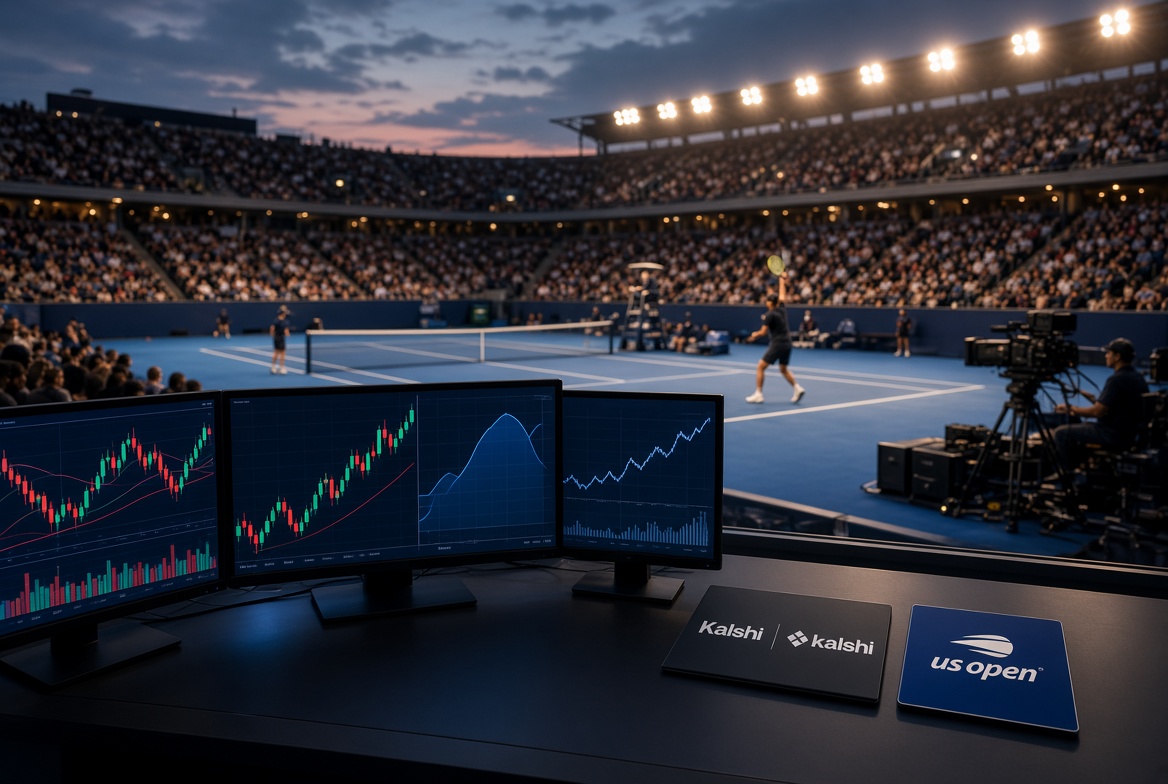
The US Open locked in a last-minute exclusive prediction market partnership with Kalshi as the main draw opened Sunday. The agreement takes effect immediately. Financial terms remain undisclosed, and the contract was not formally completed until after last week’s qualifying rounds ended.
The United States Tennis Association had spent recent weeks in talks with multiple platforms, mostly about match-integrity questions and potential deals for 2027 and later. New USTA chief executive Craig Tiley, who joined in February after more than a decade leading Tennis Australia, pushed the quick 2026 timing instead.
One clause is already standing out. The USTA is blocking other prediction market platforms from advertising inside the facility and on television, including across ESPN’s tournament coverage. Kalshi and ESPN declined to comment. The USTA did not immediately respond.
Hours earlier, Kalshi published a tournament preview that still said the company was “not affiliated with the U.S. Open or WTA.” That disclaimer landed on the same day the exclusive rights closed. Expect that to be updated ASAP.
Why the exclusive US Open prediction market deal closed so late
People familiar with the talks said the tournament did not originally plan a prediction market partner for this year’s event. Integrity concerns sat at the center of those meetings. Tiley’s arrival changed the calendar, and the exclusive Kalshi US Open partnership closed after qualifying rounds rather than waiting a full tennis offsesaon. Money talks rather loudly.
As of Sunday afternoon, Kalshi still did not appear on the tournament’s official partners list. No traditional sportsbooks appear there either. The gap between signed rights and public partner pages is common when deals close this late, but expect a series of more public facing announcements shortly.
Rival platforms to Kalshi now face a two-week advertising blackout on the season’s last Grand Slam. That lockout turns a sponsorship into a distribution wall. During a Grand Slam window, the wall matters because major tennis tournaments produce a dense daily slate of singles, doubles, and mixed doubles contracts.
Sabalenka priced at 23% as women’s singles volume builds
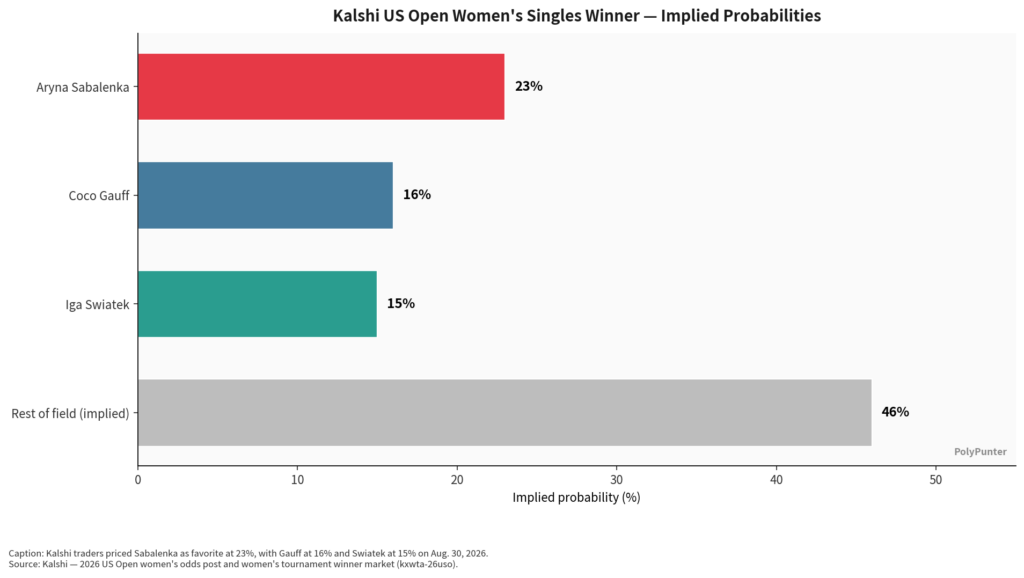
Kalshi’s preview, “2026 US Open women’s odds: Can anyone stop Sabalenka?,” listed two-time defending champion Aryna Sabalenka as the favorite at 23%. Coco Gauff sat at 16%, and Iga Świątek at 15%. Only those three names cleared 10% on the platform at the time of publication.
By early Sunday afternoon, roughly $1.7 million had already changed hands on the women’s singles winner market. That flow arrived before any exclusive signage or broadcast restrictions could be implemented.
Sabalenka is chasing a third straight title after early exits at Roland Garros and Wimbledon. Gauff won Cincinnati last week and remains the last woman to beat Sabalenka at this event, doing so in the 2023 final. Świątek won Toronto and reached the Cincinnati semifinals, giving traders two live alternatives near the top of the board.
First-round women’s contracts opened alongside the futures, with Jessica Pegula near 89% against Elena-Gabriela Ruse and Leylah Fernandez near 68% against Shuai Zhang. Those shorter boards give traders a way to trade session by session while the outright market stays open for two weeks.
Integrity language and what comes next
The ATP Tour does not operate the US Open, yet it has already spoken to federal regulators about sports-event contracts. In an April comment letter to the Commodity Futures Trading Commission, the tour expressed support for proposed rules and urged a ban on contracts tied to player injuries and officiating decisions.
Those recommendations sit behind any Grand Slam partnership, even when the USTA is the contracting party. Going live this year means those questions will be tested in public during a sold-out two week, highly publicized and watched tennis tournament.
Three practical items now sit over the next two weeks: when Kalshi appears on official partner materials, how tightly ESPN enforces the advertising restriction, and whether outright volume keeps climbing well past the $1.7 million already in the women’s winner market. Sabalenka’s 23% price leaves room for two-way trading if early-round results scramble the draw.
Rights holders elsewhere will read the contract as a pricing signal. If exclusive category control plus a broadcast lockout is available this late in the calendar, other professional spots properties may reopen talks they had parked until 2027.
References
- Front Office Sports, “US Open Signs Exclusive Deal With Kalshi”
- The Block, “Kalshi becomes exclusive prediction market partner of US Open: report”
- Kalshi, “2026 US Open women’s odds: Can anyone stop Sabalenka?”
- Kalshi, US Open women’s singles winner market
- USTA, Craig Tiley CEO appointment
- US Open official partners list
- ATP Tour comment letter to the CFTC
- Darren Rovell on X