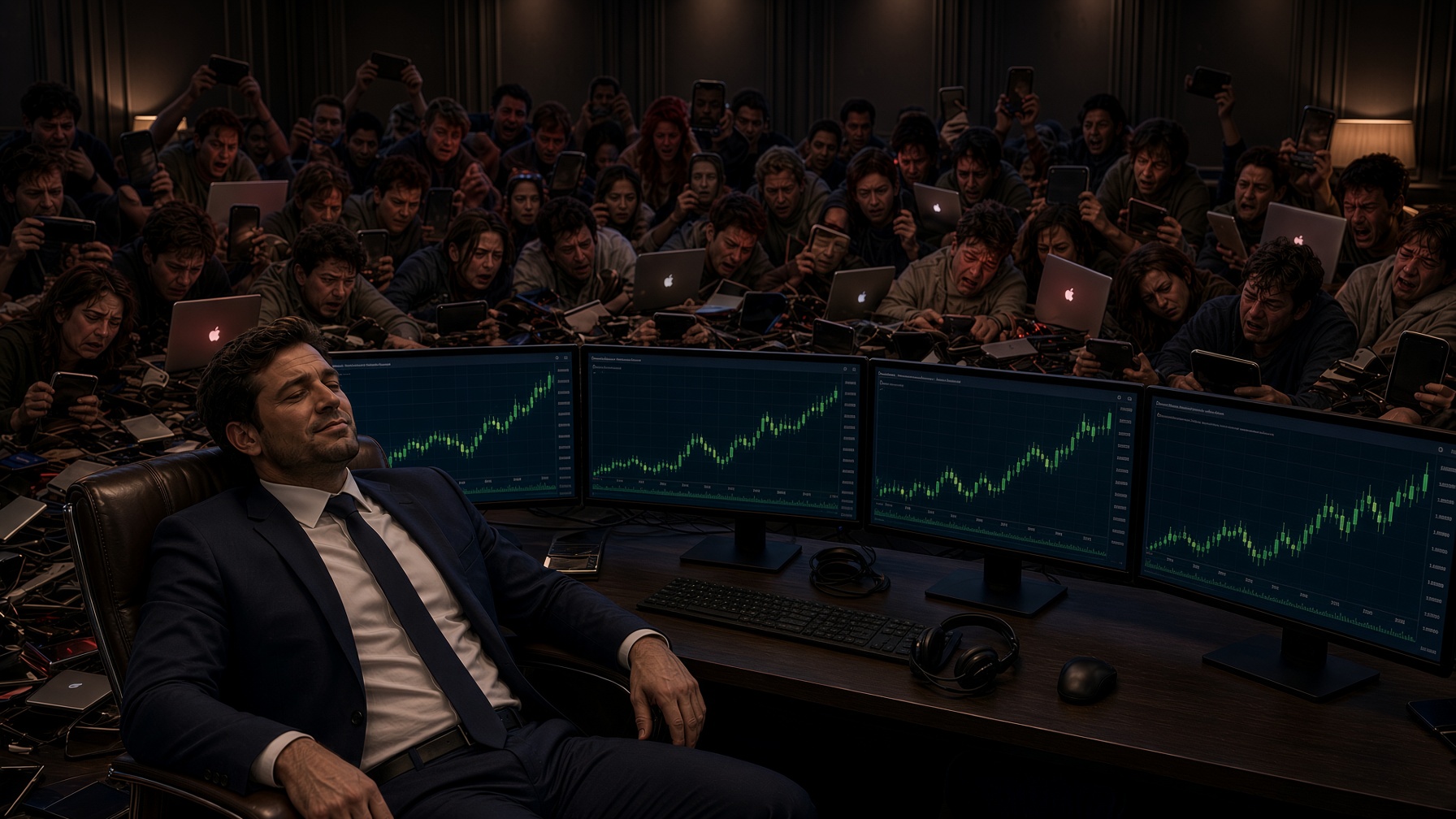

The cultural zeitgeist is swinging toward the view that commercially successful people are all cutting corners, connected insiders, or outright cheats. The average, hard-working, upright person stands no chance. This sensibility swings back and forth throughout American history, as we are a nation that struggles with nuance.
The current mindset that winners must be cheating also affects prediction markets. Not that illicit behavior doesn’t exist; it universally exists wherever money is to be had, but that there’s somehow a 1:1 correlation with cheats and prediction market winners. A closer examination of the relatively small percentage of traders who do succeed in forecast markets paints a very different picture.
Prediction markets exist to pull dispersed market knowledge into a single, public price. That job fails if every information advantage is treated as a scandal. Lawful research, faster reading of public data, and careful inference are not the same as stealing confidential files or breaking a position of trust. When platforms and regulators blur that line, they punish the behavior that makes event contracts useful: traders utilizing every possible legal edge.
The social product of these markets is informational. A contract price is a consensus probability estimate that is available to the public at no cost. Consequently, people who gather, test, and trade on better information, and iteratively validate and improve information sources, should be compensated when they are right. That incentive is the engine of information-seeking, and it is the feature critics often confuse with illegal insider trading.
The Core Distinction Between Research and Misappropriation
In U.S. law, illegal insider trading is not simply trading while knowing something others do not. It generally requires material nonpublic information plus a breach of a duty of trust or confidence owed to the source of that information. Counting cars in parking lots from Google satellite photos is not the same act as trading on unreleased earnings reports. Everybody is welcome to do the former. It’s only a matter of effort.
Prediction markets make the insider-trading line harder to see because the underlying subject is often reality itself rather than a single company’s stock. Additionally, prediction markets trade on unknown future events, whereas company earnings reports are fixed, proprietary data. A Fed rate-cut prediction contract, a weather-forecast threshold, or a policy-outcome deadline can be informed by public data, private investigation, or stolen secrets. Only the last category should trigger fraud-style enforcement.
Commodity Futures Trading Commission officials have said the agency will pursue cases involving tipping or trading on misbegotten information, not a pure parity-of-information regime. Derivatives markets have long allowed people to trade on lawfully obtained edges. Some of these edges may simply be more advanced research and trading tools, such as AI tools that come at a premium price. But these tools don’t reveal insider information; they merely produce cleaner forecasts by evaluating information sources and algorithms at speeds and levels of accuracy that may not be available to traders without them.
Think about the difference between a “street race” of two cars on a Saturday night versus a NASCAR race, with its well-defined regulations designed to make all vehicles equal and make the human element the difference. Event contracts should follow the same “street race” logic if their purpose is accurate prices rather than equal outcomes for every trader. Don’t punish people who build the better cars and win the races.
Platforms face a practical temptation: they can measure who is winning more easily than they can measure how knowledge was obtained. Winning alone is often a proof of cheating in gambling because it defies the odds edge held by the house. But markets are peer-to-peer trading. Somebody has to win, and somebody has to lose. Persistent skill, faster processing of public information releases, and cross-contract arbitrage can look mysterious to casual traders while remaining fully legitimate practices for savvy traders and their digital toolsets.
Why Financial Incentives Unlock Costly Information
Information is expensive. Reading primary documents, building models, tracking obscure data feeds, and staying awake for official releases all take time. Without a payoff, most people will not do that work. Prediction markets essentially pay for the time spent improving the public forecast. When a trader moves a mispriced contract toward a better estimate, the price becomes more useful to the entire marketplace.
Economist Robin Hanson has long argued that prediction markets are information institutions. Their job is to surface knowledge quickly. Incentivizing people who know more than the consensus current price is the point of the commercial market itself. Stock markets restrict certain insiders to protect corporate property rights. Prediction markets are designed to help private knowledge become public through trading.
This does not require celebrating private information leaks. It requires protecting the research channel. A journalist filing public records requests, a scientist reading trial protocols, or a trader reconstructing inflation prints from high-frequency series is doing socially useful work. The market should reward that effort when their estimation of future events improves market accuracy. That accuracy provides utility to the market and the public at large.
Informed flow is how prices discover facts. If platforms drive out people who invest in research, the remaining crowd is louder but less informed. Liquidity without information is entertainment. Information without liquidity is a potential idea never fulfilled. Healthy markets need both, with the personal research of as many dedicated and knowledgeable traders as possible sitting at the center.
Public Information Requires Work to Become a Price
A common objection says that all relevant facts are already public, so extra research adds little. That claim underestimates how slowly markets absorb even public signals. Not to mention assumes there are no more facts to mine. High-frequency studies of live event contracts show prices moving in the right direction after news arrives, yet not always completing the full adjustment on impact. Residual drift over subsequent minutes reveals attention limits, trading frictions, and market manipulators trying to game the system rather than add to it.
People who specialize in turning public releases into calibrated probabilities still create value. They read the footnote others skip. They notice a revision policy. They compare two official series that do not match. They build algorithms to test and formalize the weighting of their decision variables. They do so specifically in prediction markets for compensation, which need not always be financial, but that is the universal driver.
Field studies have identified traders whose orders have positive informational price impact. Those traders tend to realize profits consistent with informed activity rather than random noise. Operating a useful market does not require knowing in advance who holds superior information. It requires allowing those people to enter the market when they find a mispricing to capitalize on the imperfect consensus.
What the Evidence Shows About Skill and Abuse
Recent empirical work complicates the simplistic portrayal of a forecast market populated solely by thieves. One line of research argues that a small share of persistently skilled traders, who process public information faster and bet against common biases, accounts for much of the accuracy of prices. Recreational flow supplies volume and liquidity. The price-perfecting core is narrower.
Other papers document suspicious clusters of highly profitable wallets and warn that some of the profits appear to be the result of insider activity. Both findings can be true at once. And this is likely to be the case. A market can contain lawful research and unlawful misappropriation. Policy should go to extensive lengths to separate them rather than treat every outsized return as evidence of unfair trading.
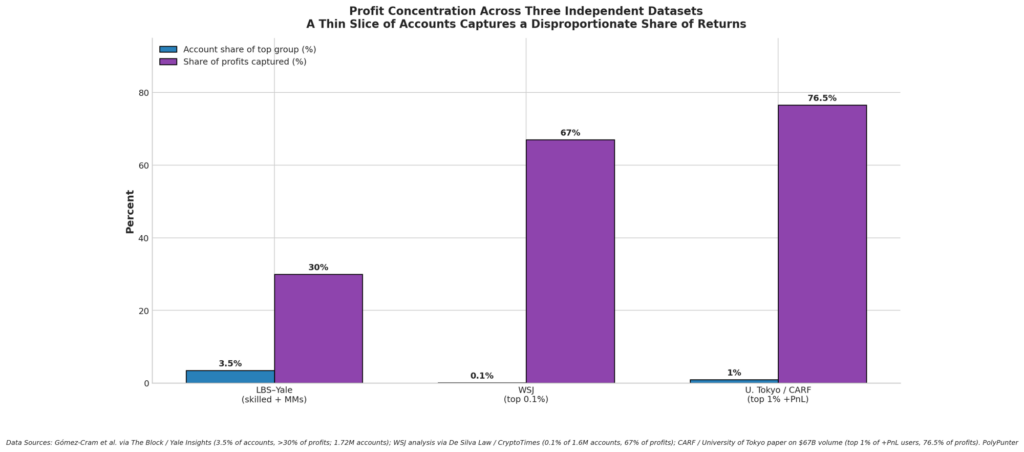
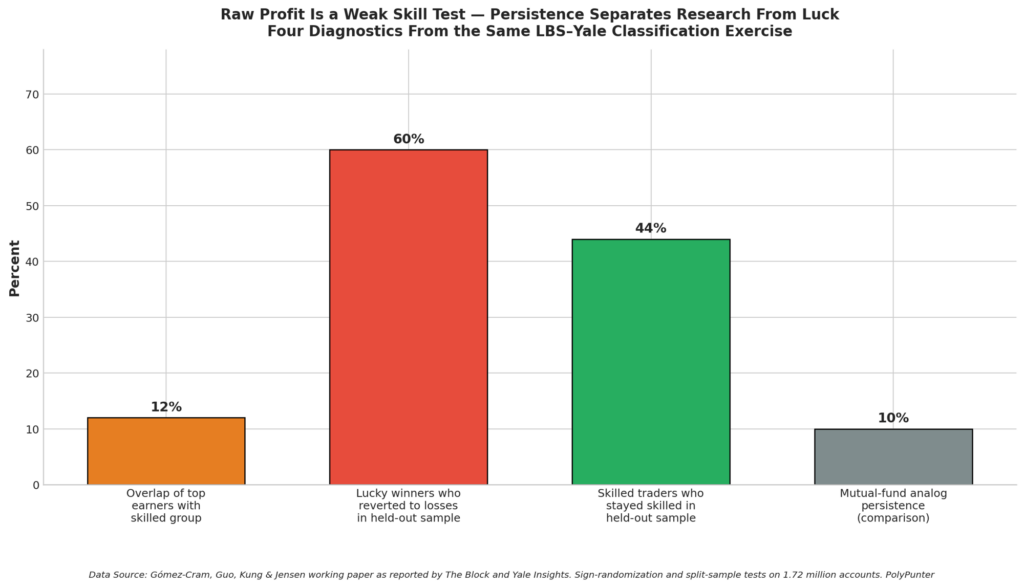
Screening tools that flag unusual size, timing, and win rates are useful tools for investigation funnels. But they are not verdicts. A high win rate in a selected sample of wallet-market pairs is a reason to look more closely at the potential for misdeeds. Many professional forecasters defy market odds simply because they are better at this than their competitors in the market. Again, this is not the same as individuals betting against the house and consistently outperforming the statistical edge the house holds. Winning in prediction markets doesn’t mean you have absolute answers; it merely means you have answers superior to those of the people you are trading with. The entire marketplace is a curved grading system.
Platforms have self-interest in drawing the insider-trading line clearly and distinctly. If a venue becomes known only as a place where stolen secrets are cashed in, public scrutiny heightens, and ordinary traders withdraw. If it becomes known as a place where careful research could lead to punishment rather than reward, the best information never arrives.
Target Rule Breaking and Deception, Not Unequal Knowledge
The CFTC has asserted that event contracts are derivatives and that insider trading principles may apply under the Commodity Exchange Act and Rule 180.1. Enforcement actions against people who used confidential employer data to trade related contracts illustrate the clean and obvious case. An employee who converts an unreleased ranking list or classified operational detail into a personal position is not doing research. That person is converting someone else’s confidential work product into a private payoff.
By contrast, a trader who uses industry experience, public filings, and independently gathered data to address a broader question is operating within the traditional derivatives model. A company employee who trades a wide climate or demand contract using only public adoption statistics is not the same as one who trades tomorrow’s unreleased earnings print. One is skill and work. The other is employing means distinctly unavailable to other competitors in the market, and legally outlawed.
Legal commentary has argued that prediction markets and securities markets should not automatically share the same priorities. In securities, protecting property rights in corporate information is central. In event contracts, the distinctive danger is often moral hazard: contracts that reward people for causing the outcome rather than forecasting it. Informed trading that improves the price is the product. Emphasis should lean toward a liberal interpretation of data sources. Event outcome rigging is the threat that warrants primary attention.
Optimal-enforcement models reach a related conclusion. Accuracy can be hump-shaped with respect to enforcement intensity. Too little policing drives the crowd away on market integrity concerns. Too much policing of market winners drives out the people who keep prices sharp. The right setting is nuanced, and should focus on specifically designated illicit activities.
How Platforms Can Protect Research While Policing Theft
Clear rules help more than generalized concern, and certainly more than panic. Platforms should publish and publicize prohibited conduct and ensure these rules are read and understood before a trader is approved to their platform. This would include trading on misappropriated employer data, classified material, or information obtained through deception. Conversely, platforms could reassure prospective traders that independent research, public data modeling, and lawful information edges are not only permitted but also means to improve the chances of successful trading outcomes.
Surveillance should focus on unusual profitability, new accounts making large trades in a single market upon entry, and screening of employment ties to the markets in question. Designated contract markets (DCMs) registered with the CFTC already carry formal surveillance obligations. On-chain venues can still require identity checks for large accounts. All platforms are obligated to flag problematic trades and cooperate with CFTC and related investigations. It is in their self-interest to do so to protect their brand reputation and avoid significant regulatory consequences.
Corporate and government ethics policies need to catch up as well. Companies already restrict employees from trading securities based on confidential information, though such restrictions must be rigorously enforced to counter the allure of financial motives. Those same policies should explicitly name event contracts, as many firms are now doing with their employees.
The Public Benefit, and Where the Critique Still Holds
Nothing in this call to promote and reward traders seeking edges in prediction markets should be seen as an attempt to deny or deflect documented cases of trading abuse. Suspicious pre-event spikes, clustered wallets, and trades by people with operational access have already produced investigations and serious civil and criminal charges. Those cases harm trust. They also supply the easiest media headlines and opportunities for public officials who don’t support event markets to call for serious reform, if not prohibitions.
Thin markets make the optics worse. A trader with an informed order can swing the market price dramatically with one highly confident trade, which can look like manipulation even when the trader is simply first with a correct read on probabilities. Deeper books greatly reduce that problem and make allegations of unfair trades still concerning but less pressing, as they tend to have minimal impact on pricing and on other traders’ outcomes in the market. Liquidity policy and market integrity concerns tend to be correlated.
Prediction markets should be judged first as forecasting infrastructure. Their consensus prices are valuable when they reflect more of the truth, sooner. That standard favors people who diligently hunt for facts and put those facts into smart trading positions. Platforms and regulatory bodies already contain the tools to uncover and punish market manipulators and lawbreakers. What has been missing is public messaging that defends the public utility of proper forecasting in staked trading markets open to anybody willing to put in the work and test their insights.
References
- Explainer: Insider Trading and Prediction Markets — NC State Poole College
- Prediction Markets Reward Insider Trading. That’s a Good Thing. — Fusion
- Why Prediction Markets and Securities Markets Require Different Regulatory Priorities — Oxford Law Blogs
- From Iran to Taylor Swift: Informed Trading in Prediction Markets — Harvard Law School Forum
- The Fine Line Between Inside Information and Market Manipulation — Prediction News
- Optimal regulation of insider trading in prediction markets — SSRN
- When Everyone Is an Insider: Prediction Markets and Insider Trading Law
- Joshua Mitts on Prediction Markets and Informed Trading — Columbia Law School
- Prediction Markets Invite Insider Trading—And That’s a Good Thing — Decrypt
- Why Prediction Markets Need Insider Trading — Forbes
- Thoughts on the Law of Insider Trading and Prediction Markets — Variant
- When Do Markets Fully Process Public Information? Evidence from Real-Time Prediction Markets
- Price formation in field prediction markets: The wisdom in the crowd
- Prediction Markets, Insider Trading and the CFTC’s New Enforcement Frontier
- CFTC Says Prediction Markets Are Derivatives and Insider Trading Laws Apply
- Inside Out: What Is and Isn’t Insider Trading in Prediction Markets — Better Markets
- Insider Trading Law Comes to Prediction Markets — Snell & Wilmer
- Insider Trading and Prediction Markets: What the Law Actually Says
- Wisdom of the Crowd or Wisdom of the Insider? — SSRN
- ForesightFlow: An Information Leakage Score Framework for Prediction Markets