A three-judge panel of the U.S. Court of Appeals for the Ninth Circuit on Friday denied requests by KalshiEX, Crypto.com, and Robinhood Derivatives for injunctive relief against the Nevada Gaming Control Board. The companies had argued that sports event contracts listed on federally designated contract markets qualify as swaps under the Commodity Exchange Act and therefore sit beyond state gaming statutes. The Ninth Circuit panel disagreed, holding that those contracts function as sports wagers and remain subject to state licensing and gambling enforcement authorities.
Writing for the court, Judge Ryan D. Nelson said Kalshi had not shown a likelihood that federal law preempts state gaming rules as applied to its sports event contracts. The district court, the panel concluded, did not abuse its discretion in dissolving an earlier preliminary injunction. Companion unpublished opinions reached the same result for appellants Crypto.com and Robinhood. Traders who used those platforms for sports outcomes now face continued geofencing and state-court enforcement while the companies seek further judicial review, with most legal experts seeing the outcome ultimately reaching SCOTUS for ultimate resolution.
What the Panel Held on Swaps and Sports Event Contracts
The Commodity Exchange Act, as amended by Dodd-Frank, gives the Commodity Futures Trading Commission exclusive jurisdiction over swaps. A swap, under 7 U.S.C. § 1a(47)(A)(ii), is an agreement that provides for a payment dependent on an event associated with a potential financial, economic, or commercial consequence. Kalshi argued that its sports-event contracts meet that definition because they trade on a CFTC-approved designated contract market (DCM) and settle based on game results.
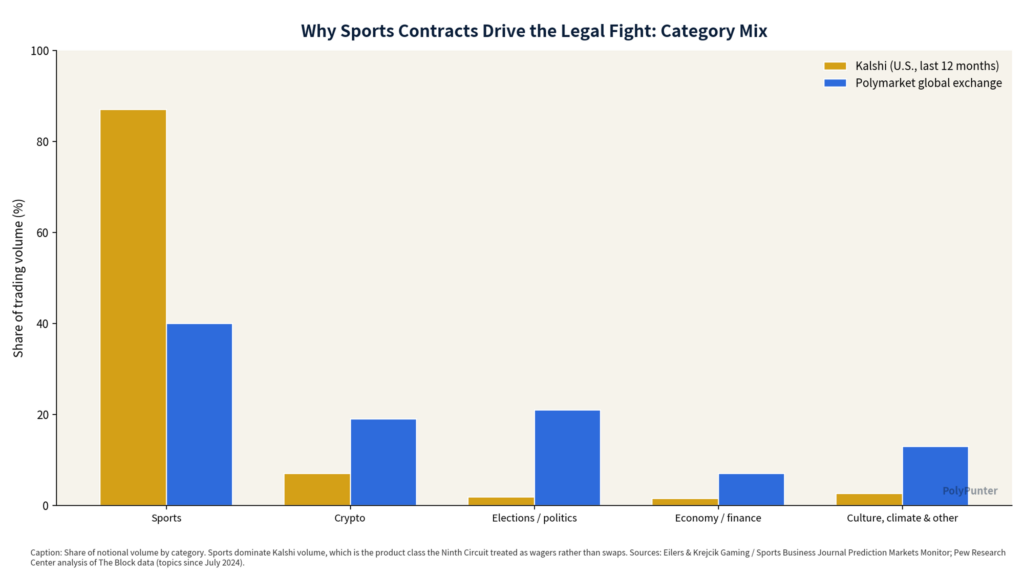
The panel rejected that reading. Sports event contracts were not swaps, the judges wrote, because they were plainly sports bets. Judge Nelson called it disingenuous for Kalshi to deny that a reasonable person would see the products as sports wagers. The opinion pointed to marketing that described the platform as the first app for legal sports betting in all 50 states and to contract structures resembling point spreads, props, and parlays. This was damning evidence in the eyes of the panel.
Express preemption did not save the companies. Section 2 of the CEA does preempt state regulation of swaps traded on a designated contract market. Yet the sports products failed the statutory swap definition, so that clause never attached. The Special Rule in 7 U.S.C. § 7a-2(c) and CFTC Regulation 40.11, which restrict gaming-related event contracts, further undercut the claim that Congress intended the commission to occupy this field.
The panel affirmed the order dissolving the injunction as to sports event contracts and remanded election contracts similarly so the district court can apply the same reasoning. Crypto.com and Robinhood received the same core holding. Both firms had already limited their sports contract offerings while appeals were pending.
How the Companies and State Officials Responded
Deputy communications director Alcinia Whiters of the Nevada Attorney General’s office called the result a major victory. Kalshi sought to sidestep gaming laws by labeling sports wagering products as federally regulated financial instruments, she said in a statement. Sports betting does not become something else simply because a company calls it an event contract.
Kalshi spokesperson Dani Lever stated that the company still believes that commission regulations, as written, do not prohibit sports event contracts and that the commission is working to clarify those rules. A Robinhood spokesperson said every eligible customer should have access to these markets through a registered futures commission merchant and that the firm plans to appeal.
A CFTC spokesperson argued that a derivative structured as a swap remains a swap regardless of the underlying subject, with statutory exceptions limited to onions and movie box-office receipts. The Ninth Circuit, that spokesperson said, invented a new and atextual exception. DraftKings and Flutter shares jumped more than 5% after the opinion circulated, as licensed sportsbook operators watched a rival channel face tighter state control.
The official opinion is posted as KalshiEX, LLC v. Assad, No. 25-7516, decided August 28, 2026. Judge Nelson wrote the opinion. Judges Bridget S. Bade and Kenneth K. Lee joined, and Judge Lee filed a concurrence.
Circuit Split and What Comes Next
The Third Circuit earlier this year held that Kalshi was likely to prevail on the theory that sports event contracts listed on a designated contract market are swaps under exclusive federal jurisdiction. Friday’s 3-0 result runs the other way. That disagreement is the classic basis for a petition for certiorari (a petition to be heard by the Supreme Court).
For traders, the immediate effect is continued restriction on sports event contracts while enforcement proceeds in state court. The Nevada Gaming Control Board’s enforcement chronology documents years of cease-and-desist letters, injunction fights, and temporary restraining orders. Oral argument in the consolidated appeals took place on April 16, 2026.
Election contracts remain on a separate track due to the remand. Sports products now carry an appellate holding that they lack the financial, economic, or commercial character required by the swap definition. Until a higher court speaks, traders should assume that sports-event contracts will be treated as gaming products within this territorial circuit.
References
- KalshiEX, LLC v. Assad, 9th Cir. No. 25-7516 (Aug. 28, 2026)
- CNBC coverage of the Ninth Circuit ruling
- The Block report and company statements
- Sportico on the injunction denial and market reaction
- Bloomberg Law on sports contracts and the swap definition
- Reuters via U.S. News
- Associated Press report
- Quartz summary of the holding
- CNN on the state-federal clash
- The Nevada Independent
- Covers industry analysis of the sports-contract holding
- Nevada Gaming Control Board actions timeline